קולות מעזה
Menu
From the field
Topics

Voices from Gaza

Residents of the Gaza Strip live in a humanitarian disaster zone. This entirely man-made disaster is a direct result of a policy employed by Israel, which, to this day, continues to dictate what daily life in Gaza looks like. This callous, unjustifiable policy sentences the nearly two million residents of the Gaza Strip to a life of abject poverty in near inhuman conditions no longer seen in the Western world. In testimonies collected by B'Tselem's field researchers, residents of the Gaza Strip describe their lives, the dreams they will not get to realize, the medical conditions they have no way of treating, the ongoing separation from family members and friends outside the Strip, and the unbearable suffering caused by their confinement to the Strip, with no hope for change. Read more >>
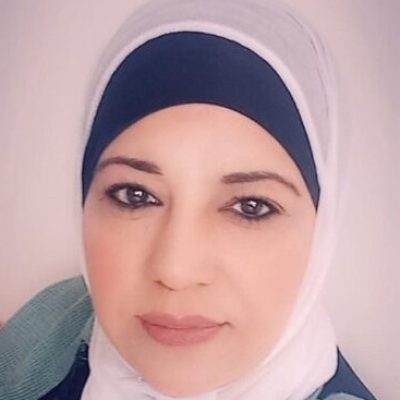
Huwaydah a-Darimli
Life in the camps is very hard. There is no privacy; women are constantly exposed to the gaze of strange men, which requires wearing overgarments and a hijab; long lines for water; the spread of skin diseases; dependence on soup kitchens; bullying and exploitation. Another pattern I see is women having to take on all the responsibility for the family. Some men lost their jobs and completely rely on their wives, and sometimes also make sexual demands without taking into account their wives’ wishes, mental state or the conditions in the shelters.
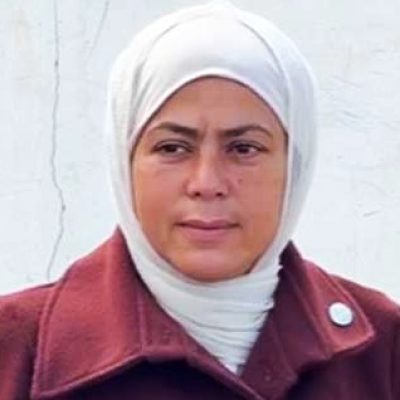
Almaza a-Sultan
[...] my daughters and I cut our hair, because there were no cleaning products or shampoo, and our hair was crawling with lice because of the filthy conditions we were living in. The few cleaning products and hygiene items that were available on the market were insanely expensive, and there was no way we could buy them. Sometimes my husband went to bombed houses to scavenge for food, hygiene items and cleaning products, and when he came back with some leftover piece of soap and we could shower properly, not wash ourselves a little with just water, we all felt as if we were born again.
Kifah al-Hasanat
My son Hamzah would go to get aid, although I forbade him to go there for fear for his life. But he insisted, telling me: “I’m dead anyway! We are hungry. We want to eat.” He would go at night to Netzarim, risking his life to bring us some flour and canned food, and I would sit in my prayer clothes and pray, imagining them coming to tell me that he had been killed. When he came back safely, I would smother him with hugs and kisses.
I suffer the most from the fire, which I spend so much time in front of, sometimes whole days. When my children want to bathe, I light a fire and heat water for them. When someone asks to eat something, I stay by the fire and cook for them, whether it’s morning, noon or night, all day long. During the day, my husband and sons go out to look for pieces of plastic or wood in the garbage dump, so I can light a fire. The skin on my face has grown darker because of the fire, and my hands have become wrinkled and the soot does not come off them.
Sabrin a-D’amah
This war has taken everything from me: my daughter, her children and her husband, my self-respect and my sense of self-worth, and my home. I’m homeless now, living on the street. I hate the word tent. I’m not used to this life, and I don’t know how we’ll be able to adapt to life in tents. I hope God helps us and life goes back to how it was before the war, that I return to my home and this tragedy finally ends.
Ikram Nasser
I gave birth to my son Samir in the eighth month of pregnancy, and I named him after his half-brother who was killed. During the pregnancy, I didn’t have enough food and there were no vitamins. I suffered from malnutrition and was almost a skeleton. I also suffered from a kidney problem. Samir was born weighing 800 grams, and they put him in an incubator. After the birth, I suffered from anemia. When I came back to the tent, we still had no food at all, and I ate only a few lettuce leaves. Fruit, milk and eggs were something I could only dream about. It was out of the question.
Everything is hard for us, and I’m young and can’t cope with all these difficulties alone. I’ve become irritable. I have no patience even for my children. Sometimes I wish I could have a big tent, with a private corner for my husband and me. I need privacy. I can’t even cry in front of my children, because then I’d fall apart. I try as hard as I can to appear strong for them and for my husband. I so much want to be alone, even for one day, to be just with myself in a distant place where I can scream at the top of my lungs and cry over this terrible life that has been forced on me.
My husband stood and tried to fix the tent with his bare hands, holding down the corners in an attempt to stop the water from coming in, but he was powerless against the force of the wind and rain. I saw his helplessness. I saw my little daughter shivering with cold, and I burst into tears, crying like I’d never cried in my life. All the pain and humiliation of the war, the displacement, the poverty, the fear, the exposure to the elements with no protection, all of it came together for me in that moment, when we were standing in the water, trying to protect ourselves from drowning inside a shelter made of cardboard and burlap that we called a “home.”
Tayyem al-Khawaja. Photo courtesy of the family
The winds were so strong that they tore down the tarps we put up. Suddenly, I heard Rawan screaming. We rushed over and saw her holding Tayyem. His body and face were blue. He wasn’t breathing and looked lifeless. I immediately took him to a-Shifaa Hospital. When I got there, the doctors checked him and said he was suffering from low blood sugar due to extreme cold […]
Muhammad Ghazi Nassar
While I was at the market, I heard people saying that a building in a-Sheikh Radwan had collapsed on its inhabitants. My heart sank, because I immediately felt it was our home. I went home and saw the roof had collapsed. Lina and Ghazi were trapped under the rubble. My wife and the other kids had escaped through another entrance. They were screaming and crying. [...] They had been trapped and apparently suffocated. When they were pulled out and I saw they were dead, I went into shock.
Hadil Hamdan. Photo courtesy of the family
I ran to pick up Hadil while my wife started lifting the other children and taking them out of the flooded tent. Her body was very cold and blue, and her lips had gone blue. Our other children were shivering from the cold and couldn’t walk. Their bodies were as cold as ice. [...] I held Hadil and tried to warm her and wake her up, but nothing helped. I hugged her and was terrified she would die from the cold. [...] the neighbors called an ambulance, but it was delayed. When it arrived about half an hour later, Hadil was already gone.
Rahaf Abu Jazar. Photo courtesy of the family
That night, it rained very heavily. We woke up at 3:30 A.M. and found the tent flooded. We checked on our children. Rahaf was completely wet. When my wife changed her clothes, she noticed that her body was very cold and her face looked different. Her lips had gone blue. I called an ambulance, but because of the heavy rain, it arrived only about an hour and a half later. My wife and I went with Rahaf to Nasser Hospital. She was already dying. The doctors tried to resuscitate her, but it didn’t help.
Hussein a-Zweidi
There were five interrogators, and they tightened my handcuffs so much that I lost feeling in my hands. They tied my legs to a chair in a “banana” position. All the soldiers in the room attacked me and beat me on my back, chest, legs and even my testicles. I thought my bladder would explode. I screamed and told them I had to pee. They ordered two guards to take me to the bathroom. When I got there, I was too shocked to pee. When I finally managed to, there was a lot of blood in my urine.
Mahmoud Abu Ful
They soldiers dragged me along the ground and put me in a narrow cell, like a coffin. One of them said to me: “We’re going to leave you in this coffin until you die, son of a bitch.” I was terrified and thought they were going to kill me. I stayed locked in that coffin for several days, completely isolated, without food and with almost no water. Every time I shouted and begged for water or food, the soldiers opened the door, beat me hard and shut it again. When I needed the bathroom, I called out to the soldiers, but they ignored me. I tried to hold it in, but in the end I was forced to wet myself. The soldiers opened the coffin from time to time just to see if I was still alive.
Jibril a-Safadi
I woke up and found myself lying in a large pool of blood. I was shocked. I looked at my feet and saw that they were bleeding. It was a horrific sight, and I started screaming and crying hysterically, hoping someone would come to help me. I was taken to the prison hospital. […] A doctor in uniform told me: “Listen, your life is in danger. You have to choose between having both your legs amputated and dying.” I started crying and screaming, hoping someone would hear my pain, my torment, my grief. They handed me a document and forced me to sign that I agree to have both legs amputated.
Muhammad Khader
The soldiers grabbed me, lifted me up by my arms and hung me in the “shabah” position, with chains, in the middle of the interrogation room. They brought a dildo and put it under my buttocks, and then began lowering the chain while holding me, until part of the dildo entered my anus. It was the worst pain I’d ever experienced. I started screaming and sobbing. That was the cruelest, harshest torture I went through during my entire detention in Israel.
The Metzada Unit attacked me and I was injured by a rubber bullet. I was sent to hospital for 15 days, and on the way there they beat me. They questioned me again about Hamas, about the hostages, and about booby-trapped houses. They threatened that if I didn’t give them information, they would arrest and rape my wife and my mother. I was badly beaten and humiliated almost every day. Sometimes they showed us a black body bag and said: “This is the only way you’ll leave this place,” and again demanded that we’d given them the locations of Hamas and of tunnels – things we had nothing to do with.
During the torture, one of the soldiers raped me. He shoved a wooden stick up my anus, left it there for about a minute, and pulled it out. Then he shoved it back in, even harder, and I screamed at the top of my lungs. After a minute, he pulled the stick out again, told me to open my mouth, pushed the stick into my mouth and forced me to lick it. I was flooded with feelings of injustice and humiliation.
At Sde Teiman, I went through the hardest days of my life. I’m still suffering from severe trauma. They held me naked, and soldiers set dogs on me that attacked me. They beat me on the penis, tied it with a plastic cord and caused swelling and bleeding. One detainee lost a testicle as a result of the torture. […] About 200 people, myself included, got scabies and scratched ourselves until we bled. When we asked for treatment, they told us: “You haven’t seen anything yet.” […] the doctor also beat us. There were also cases in which prisoners’ teeth were broken.
Haitham Salem
They tried to scare us and break our spirits all the time. Twice a week, they carried out suppression operations: they threw stun grenades into the cells, injured detainees, forced us to kneel with our hands on our heads, and swore at us. The soldiers made me a “shawish,” in charge of the other detainees, and ordered me to slap them. They told me, “If you don’t beat the detainees, we’ll beat you.” When I slapped the detainees, I apologized to them. The soldiers beat me and cursed me anyway. Those were the hardest days of my life. They showed no mercy or compassion towards any of us.
Muhammadal-Mishwakhi
The soldiers tied my hands behind my back and blindfolded me and several other detainees, and then they put us in a pit. Inside the pit, the soldiers beat us with their weapons and swore at us. We thought we were going to die in that pit. Then I heard jeeps moving. We were about 30 detainees, and they threw us into two military jeeps. That was when the torture began. During the whole drive, they beat us badly until we reached Karam Abu Salem (Kerem Shalom) Crossing. When we got there, we were surprised to see, in addition to the soldiers, Israelis in civilian clothes. They took us out of the jeeps and kicked us while they did so. They opened the zipper of our coveralls and threw us on the ground face down, with our bellies exposed, and then beat and cursed us.
Then they ordered me to take off my boxer shorts, and I was left completely naked in front of the female soldiers. They searched me very thoroughly using a scanning device. [...] They blindfolded me again, tied my hands and took me somewhere else; I didn’t understand where we were. There, they beat me with batons or sticks for a long time. Out of desperation, I tried to push the blows away and fight back at the soldier, but I couldn’t. Just then, they gave me a heavy blow and I felt one of my ribs break. From there they transferred me to another place, this time in an armored vehicle. I understood the place was called “al-Kalabat”: they threw me on the ground and dogs started stepping on me and attacking some of the other detainees.
Ahmad Abu Rukbah. Photo courtesy of family
Around 5:00 P.M., the three of us moved forward. There were many people, and trucks arrived with flour sacks. Each of us got one. On the way back, Bilal took a path alone and Ahmad and I walked together. The gunfire was heavy and direct. Suddenly Ahmad was hit and fell. I tried to save him. I took off my shirt and pressed it against the wound, but realized he’d died immediately. He was shot directly in the heart. His body was covered in blood.
My life is ruined. I’d rather die here than move south. Even if we could afford it, my wife couldn’t survive in a tent with no basic conditions and a newborn baby who is underweight. When we left home, we took nothing, only clothes. I knew it was the last time. I said goodbye to our house and our neighborhood. Being displaced feels like my soul has left my body. [...] We are now displaced, without hope, under bombardment and destruction. There is no safe place or humanitarian zone in the Gaza Strip. Every place is attacked.
Maysaa Sh‘alan
[...] Maryam was discharged from a two-day stay at the hospital. When we got home, she told her father she wanted to eat halawa. Muhammad smiled and told her, “Tomorrow I’ll look everywhere, and I won’t come back without halawa.” The next day, Monday, 18 August 2025, he went to the humanitarian aid distribution center in the Morag area of northern Rafah, hoping to find halawa in one of the aid packages. He left home at 1:00 P.M. Hours went by and he didn’t return. Around 5:00 P.M., his sister Ni‘mah, 35, from Khan Yunis, called and told me that Muhammad had been shot and taken to the hospital, where he died of his wounds.
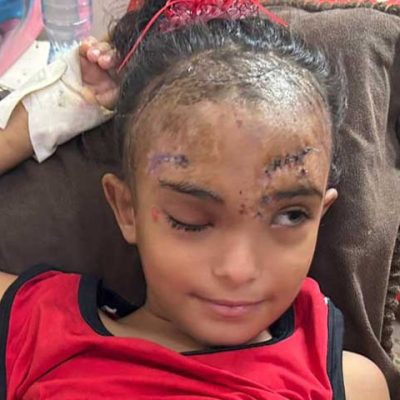
 Sila Husu
As we tried to escape, the school was bombed again, and Sila was hit in the head by shrapnel. Her head was covered in blood. I hugged her and screamed for help. My son Muhammad took off his shirt and tried to bandage Sila’s head to stop the bleeding. I shouted for an ambulance, but no one paid attention. […] Sila is still hospitalized […]. Her wounds are infected, and the hospital doesn’t have the antibiotics she needs. […] She needs more head surgeries to prevent fluid from leaking through her nose or eye socket. The doctors say her condition is serious and complicated, and that she needs treatment outside Gaza […].
Mahmoud and Bassam al-Jarjawi
I was in the schoolyard and my father, Bassam al-Jarjawi, 57, and my brothers ‘Omar and Mahmoud were in a tent in the yard. Suddenly, the military fired two missiles that struck the part of the yard with the tents, near the cafeteria. The yard was full of people at the time. […] I was injured in the leg by shrapnel and fell. I saw rubble and thick dust everywhere, and body parts and wounded people lying on the ground. […] [at the hospital] I identified the bodies of my father and my brother ‘Omar. It took several hours to identify my brother Mahmoud, as only parts of his body were found in the schoolyard.
Al-Mufti
On 21 December 2024, we ran out of drinking water. Because I was injured, I wasn’t able to go get water, Amneh (10) asked us to let her go. She went to fill water at the hospital, and on her way back, an Israeli missile hit her directly. When we found out, we screamed and cried. For three days we couldn’t bury her because it was too dangerous. After three days, we buried her under the ruins of a house […] I keep remembering my last conversation with Amneh. I can’t understand, can’t grasp how the military kills a child who was only going to get water.
Safaa al-Farmawi
On the way to the aid distribution center, Ghazal stuck her head out of the window to feel the wind and said to me, “Mom, I’m brave and strong.” She was proud of herself. When we arrived, there were thousands of people there, and every time the crowd moved forward, the Israeli military opened fire. We lay down next to a destroyed house by the roadside. When the shooting died down, someone shouted that the center was open and everyone started running toward it. As we ran, the soldiers opened fire again. I lost Ghazal and began shouting her name. I heard her answer, “Yes, Mom, I’m here,” but I couldn’t see her through the dense crowd. After that, I didn’t hear her again.
Sham Qdeih
Sham was born after nine years of trying to have another child, and her father and I were overjoyed at her arrival. She was born healthy, and her weight was normal. During the war, when she received vaccinations at clinics, we discovered she was not gaining weight. From the age of six months, she got steadily worse. She is now diagnosed with severe malnutrition. At her age, she should weigh 12 kilograms, but she weighs only 4.5.
Alaa Shhadeh. Photo courtesy of the witness
On my way back, I heard people saying the al-Mashtal area had been bombed, that there was a massacre in the tents there. I started running toward our tent, where my children were waiting for me. [...]I saw ambulances evacuating dead and wounded children. The sight was horrifying. All the tents were bombed and the area destroyed. [...] Suddenly, I heard Farah calling out to me from inside an ambulance. She said, “Mom, they bombed us, Sila was killed and Sanad is injured!”
‘Adel Madi
I saw [my brother ‘Adel] wasting away, his body becoming emaciated, his bones protruding. […] I was the one who cared for ‘Adel, and he was very attached to me. He slept next to me in the tent. At the end of his life, he could hardly speak because of his condition. But the night before he died, he called to me in a faint voice, as if he wanted to say goodbye. That night, I heard him groaning in pain, and I had no way to help him. I said to him: “Sleep, ya ‘Adel. I’m right here with you.”
Zeinab  Abu Halib
[…] Zeinab vomited brown-colored fluid, and her eyes looked tired. My husband and I decided to take her back to Nasser Hospital. I ran through the street with her in my arms […]. When we arrived, the doctors examined her and told us she had died before we got there. […] Every minute and every second, we remember our beautiful baby. […] Her siblings ask where Zeinab went, and that is the hardest question of all. Two days ago, the World Health Organization called us about arranging her treatment abroad, and my husband told them that Zeinab had died. Before she fell ill, Zeinab weighed 5 kilograms, and by the time she died, she weighed about two kilograms.
Hadi ‘Abed Rabu
We were trapped there for over half an hour under heavy fire from all directions. The whole time, I kept thinking, “God, just let me get home safely. I don’t want flour, I just want to get back to my family.” I think everyone trapped there with me, waiting for the second convoy, felt the same. It was a very tough half hour, maybe the hardest of my life. Next to me, a father and son and a woman of about 35 were killed. About 20 people were killed there, and many were injured.
Muhammad Abu ‘Aytah
[...] Israeli fighter jets bombed our house. In an instant, everything collapsed on us. We had some relatives displaced from the north and east of Gaza staying with us. Sixteen of them – my uncles and cousins – were killed and buried under the rubble. [...] I was in shock when I saw Hassan and Rima – they were lying on the ground screaming with their legs cut off. I fell to the ground and couldn’t get up. [...] We rushed them to al-Awda Hospital in Tal a-Za’tar. The place was extremely crowded, full of wounded people and without electricity, medications and surgical tools. [...] The operating rooms were flooded with blood. The doctors said there was nothing they could do except apply iodine and bandages.
Hani Ziyarah
At the hospital, they clean his wounds once a day in the operating room, under anesthesia. His pelvic area is at risk of infection all the time because it's so close to the rectum and urethra. He had another operation on his abdomen and now he has a stoma. He's in a very serious condition. He urgently needs treatment outside the Strip because the hospital can't give him proper care, because there's no medicine or painkillers.
Basel Kafinah
People take risks and go towards the entrance because whoever gets in first has a higher chance of getting the aid. Sometimes the army allows us to get close and then starts shooting. [...] One night, I went there and waited as usual. I started advancing together with other people because we thought it was allowed, and then everyone started running together. Suddenly, there was a barrage of heavy fire from tanks stationed a few hundred meters from us and from drones. I lay down on the ground behind a dirt embankment, crawled and got away. That night, more than 30 people were killed [...].  I’ve walked kilometers, crawled, run, pushed in among thousands of people, all while risking my life. And in the end, I come back with nothing.
Yamen a-Za’anin
 Those were the hardest moments of my life: The moment I found out Yamen was injured, the moment I found him lying in the morgue, and the moment that – only God knows how – I found the strength to call his mother and sisters to tell them he’d been killed. Yamen’s friends told me they’d gone together to the aid center, even though I forbade him from going. There was firing there from tanks, shells and machine guns, and people were killed and injured. Yamen tried to help one of the wounded, and was injured in the process. The bullet hit him in the waist and he was killed instantly. My son Yamen was shot dead only because he went to get aid, only because he wanted to bring his family flour, only because he tried to help someone who was wounded.
Sumayah Abu Qas
The army declared the opening of “American aid centers,” which were basically death traps. [...] [My son] Ousamah begged me to let him go there to get food, but I refused. I was afraid of losing him. In the end, I gave in to my daughters’ hunger. On the morning of 19 June 2025, Ousamah went [there] with my brother Ahmad and some other friends.  [...] At 11:00 P.M., my brother came back with Ousamah’s body. He was covered in blood and dirt. Ahmad told us an Israeli tank had fired a shell at them and hit Ousamah in the back, killing him and five others while they were opening boxes of aid. They all died on the spot. [...] He left behind a wife who was three months pregnant and five sisters. He died trying to bring us and his sisters bread.
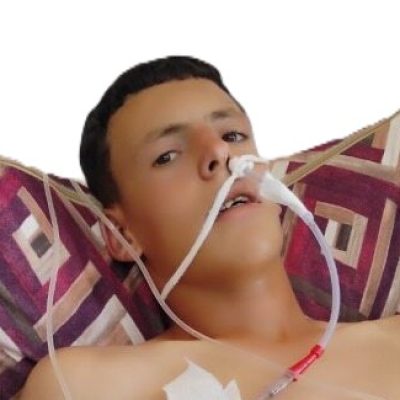
Hadi ‘Abd Rabu
I saw Israeli tanks and soldiers, and also Americans in uniform, armed with the same weapons as the Israelis, firing heavy gunfire at people like me who only wanted to obtain food. Many people were killed, most hit in the head or chest. I saw a woman standing just a few meters from me shot in the head. Her head simply exploded.
Shadi al-Kurd. Courtesy of the Witness
I go to the aide distribution sites almost everyday–sometimes to Netzarim, other times to Zikim, and others to a-Nabulsi. When I leave the apartment, I part from my wife and children as if for the last time. Going there is going to die. I might come back, I might not. There, I look death in the eyes. The army turned the aid distribution centers into death traps.
We waited for them to allow us into the center to get food. Suddenly, they started firing at us from the cranes the Israeli army stationed there. People started running in every direction to try and escape. My brother and I also ran, under the army’s fire. Then I was hit by five bullets [...]. When I woke up, I was on a bed in the Red Cross field hospital [...]. The doctors took the bullet out of my back because it was endangering me and damaging my intestine. They also operated on my leg and put in a platinum implant [...]. All I did was go to the aid center to get food for my children, and now I can’t even take care of myself – let alone get the treatment and medicine I need. I don’t know when I’ll be able to stand on my feet again. 
Rim Zidan
[…] my mother, my brother Ahmad, 12, and I went together. […] When we approached [the aid distribution site], the army suddenly opened massive fire. It was unbelievable. […] When the shooting stopped, we moved again towards the distribution site. I was in front, and behind me, my mother was holding Ahmad’s hand. Then the shooting resumed, and a bullet hit my mother in the head. I turned around and saw her lying on the ground. I thought she had fainted; I couldn’t imagine she’d been killed.
I heard from people that the aid trucks were going to pass through the a-Tahliyah area. I got dressed and ran out of the house to get there early. When I arrived, there were already huge crowds, but no trucks with flour. Just masses of people waiting for them. Suddenly, Israeli tanks started to fire at the people [...]. There were injuries and casualties. People went over to the wounded to try and help them, and then the army fired again. And again. The sight of the mutilated bodies was horrifying. Some were without hands and legs, others decapitated, some were shredded to bits. 
Hamzah Abu Skheleh. Photo courtesy of the witness
[...] a military drone fired at me and hit me in the right foot. I fell down and was evacuated in a mule cart. [...] I dragged from hospital to hospital with my entire family, in terrible conditions. Everywhere we went, the bombings and displacement continued. We lived in fear and hunger, without a steady supply of food or water and with no safe shelter. There were no doctors available anywhere, no medicine [...] the doctors at Al-Awda Hospital were forced to amputate [my leg] under difficult conditions to save my life.
‘Issa Madi
We walked about 3 kilometers with thousands of other displaced, hungry people [...] Suddenly, drones surrounded us and started shooting live fire. I was injured from a bullet that penetrated and exited my left hand. I turned around to look for my brother Firas and escape the shooting, and then a sniper shot me from about 300 meters away and hit me in the back, next to my spinal cord. [...] The situation was so bad that people stepped on dead bodies while running away. There were about 20 corpses next to me and dozens of wounded people. I was certain I’d die, too. 
Ziad a-Radi’
I ran inside to look for my wife and children among the ruins. I found my son Ziad sitting in one of the rooms on the ground floor, with rubble on top of him and around him. He was calling for his mother and siblings, and when he saw me, he started shouting, “Dad, I’m here.” He had burns all over his body. I picked him up and asked him if he knew where his mother was, and then I heard her calling me.
Ahmad al-Ghalban. Photo courtesy of al-Ghalban
I lay on the ground, bleeding. I looked at my legs and couldn’t believe what I saw. I told myself, “This is a dream.” My mother screamed and called for help. Five minutes later, a man arrived, and when he saw we were still alive, he put Muhammad [my twin brother] and me in a tuk-tuk and took us to the Indonesian Hospital, along with my uncle, my mother, and the others. On the way, Muhammad recited verses from the Quran and the Shahadatain prayers, but I didn’t realize he was taking his last breaths.
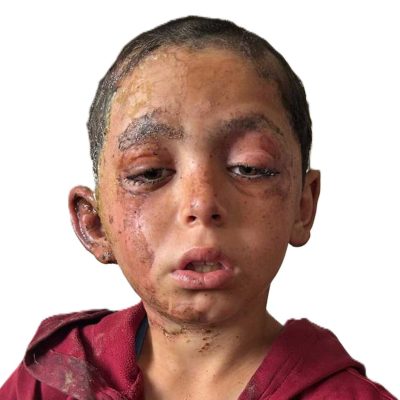
‘Azizah Qishtah. Photo courtesy of the witness
I picked up my husband and carried him on my back. His body was limp from the injury and very heavy. There was no one to help me, and I had to carry him on my own. I walked for a bit, rested, and then continued. He was still bleeding. We got to my uncle’s house, about 50 meters from ours. [...] Suddenly, I noticed his left hand was shaking badly. I asked if he wanted a massage, but then I saw he was dead. I checked again—I wasn’t mistaken. He died right there, in my arms.
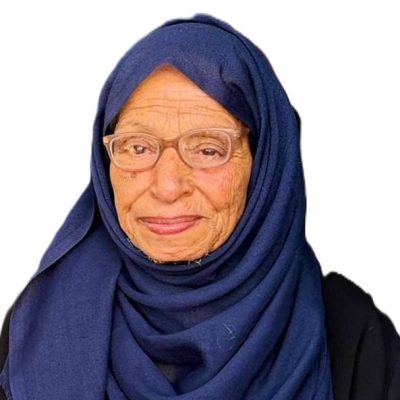
Suhad al-Jamali
While we were all sleeping, the house was bombed [...] Three family members were killed in the bombing [...] My son Muhammad was injured again and taken to al-Ma’amadani (al-Ahli) Hospital in Gaza City. [...] In the morning, my husband and I left early for al-Ma’amadani Hospital, and when I saw Muhammad’s left leg, it was black. The doctor told me they were going to amputate it because it was in very bad shape. There were dead bodies in front of our eyes, and I told myself, thank God Muhammad wasn’t killed.
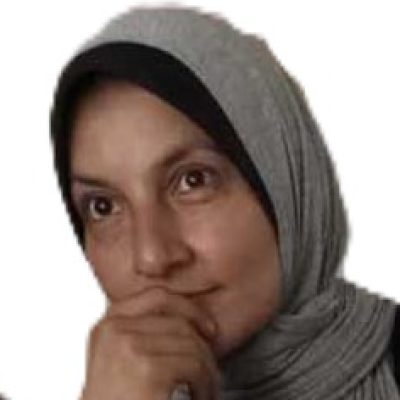
Khadijah al-‘Attar
On 18 March 2025, the war resumed, and the bombings began again. The crossings were closed, and food ran out. Prices rose even more and a sack of flour reached 1,500 shekels. […] Today, we’re surviving what the camp administration provides – half a kilo of flour every two days. […] After the fighting resumed, many soup kitchens stopped operating even though they had been people’s main source of food. Most of the people are starving. It’s been over a month since we last received cooked meals. We now go begging to get one meal a day for the children, especially for Najah.
Firyal Safi. Photo courtesy of the family
[...] the military sent a quadcopter into the house and used a loudspeaker to order us to raise our hands. The quadcopter filmed us. Then soldiers came in and forced us to strip. [...] The soldiers even used [my son] ‘Abdallah as a human shield—they forced him to accompany them as they searched the house and then to tie up the other men. Then they tied him up and arrested him too. [...] they ordered us—just the women, at gunpoint—to walk to southern Gaza along the coastline. [...] Along the way, we saw dozens of bodies—women, children, men—lying on the beach, with dogs feeding on them.
On 2 March 2025, the crossings were closed and food imports were banned. Goods gradually disappeared from the market, and now we can’t buy any food and there’s also no aid. [...] The war resumed on 18 March 2025 and we went back to a nightmare of killing, bombing, destruction and displacement. [...] For over six weeks, no food has entered the Gaza Strip. [...] Sometimes I find one or two pitas and that’s all we eat. We go to sleep hungry. We wake up hungry and terrified by bombings and the noise of aircraft.
Nuha Shehto-Faraj
The children were playing with my husband. My parents, my brother Hamzah and my cousin Muhammad were sitting in the living room, and I was in the kitchen, making coffee and pasta for the kids. Suddenly, there was a huge explosion. The blast cut off my hearing and threw me onto the floor. I thought the gas cylinder had exploded. Everything around me was burning. When I got up, I couldn’t find my children or anyone else in the family. Everything was in ruins. The house had been hit by three missiles from the air. [...] I was taken to a-Shifaa Hospital in an ambulance. I didn’t know the small body in the ambulance was my daughter Juri. I was only told at the hospital that everyone in the house was killed except ‘Ali and me.
‘Abdallah Shaqurah. Photo courtesy of the witness
In this brutal war, we’ve endured so much: killing, displacement, destruction, and hunger. But the hunger we’ve experienced in the past two months is on a different scale. The crossings are closed, and no goods are allowed into Gaza. This is another method of warfare the Israeli military uses against civilians in Gaza – starvation. My children beg me to get them meat or eggs, and I have to tell them there is none and I can’t. What crime have my children committed? Why must they starve?
I was nine months pregnant and weighed only 55 kg because I was eating just one meal a day — lentils, fava beans or falafel. When I went to the hospital to give birth, the doctors couldn’t believe I was pregnant. My baby girl was born weighing only 2 kg due to the lack of food.
Rajaa ‘Alian
We sat down to eat when we heard an explosion in the street. [...] my daughter, Elyaa (5), stood next to me. Suddenly, the house was bombed. Everything collapsed and there was smoke, dust and rubble everywhere. My mother and my sisters, Marah and Bisan, were killed. Elyaa and I were injured. [...] Elyaa had first and second-degree burns on her face and arms and wounds on her head that required stitches on her head. I had first-degree burns on my face and second-degree burns on my back and arms. The bodies of my mother and my sister Bisan couldn’t be recovered, and they’re still under the rubble. Marah’s body was retrieved with great difficulty, under fire.
‘Omar Abu Kweik. Photo courtesy of the family
‘Omar has been suffering badly since he was injured and lost his family. He’s always hiding, doesn’t like to be seen, and tries to hide his amputated arm and his face. […] His family was bombed before his eyes, even though they did nothing wrong. Everything that could have brought him happiness was taken from him. I try to help him remember his mother, his father and his sister. […] He says: “I don’t want to go back to Gaza. I want to stay here.” He’s terrified and doesn’t like to be reminded of what happened.
Razan Barbakh
Every day, Razan was taken to the operating room to clean her wounds and change her dressings, but she still developed sepsis [...] I cried over her, because I knew she was suffering terrible pain. Once she told me she was about to die, and that broke my heart [...] Painkillers didn’t help; her digestive system barely worked, and her blood oxygen level kept dropping [...] She wanted to say goodbye to her father and me, and she didn’t take her eyes off us until she drew her last breath and the machines went silent.
On 7 November 2024, in the morning, my son Hamudah and I were standing near the school gate, about to go out to look for food, when a drone fired a missile directly at us. We were both seriously wounded. We lay on the ground for two hours, and no ambulance could reach us because of the ongoing bombardment and the difficulty moving around the area. After two hours, by some miracle, we were evacuated on a tuk-tuk motorcycle to al-Ahli al-‘Arabi Hospital.
Malak a-Shurafa
Planes bombed our house while we were sleeping. My brother Ibrahim was killed in this bombing along with his wife, Sally Khader Subhi Yasin, their son Hamdi, 2, and their baby daughter Masah, 4 months old. Their bodies were torn to pieces and thrown onto the roofs of nearby houses. I was seriously injured all over my body, including my abdomen, and had several surgeries. My wife, all my daughters, my brother Mahmoud, and his family members were also injured [...] the doctors had to amputate my five-year-old daughter Malak’s leg because it was in really bad shape.
Right: Hanan and Misk a-Daqi. Photo courtesy of the family
I dread the moment Hanan and Misk will ask me about their legs. What will I tell them? When I go to buy shoes for my children, what will I do when Hanan and Misk ask why I don’t buy them any? If they say, “I want to play,” “I want to dance,” “I want to ride a bike,” what will I say to them? [...] How will they adapt to the new situation? They lost their mother, the love, compassion, and security she gave them, and they also lost their legs, their ability to move and play. Everything beautiful in their lives is gone. Their childhood was stolen. What did they do to deserve such devastation?
Two months before the war broke out, we renovated the house and bought new furniture for the living room and the children’s bedrooms, to celebrate Najat’s high school graduation and our son’s admission to university. I took out a bank loan to pay for the renovations. About a month ago, we heard from neighbors and acquaintances that our home was completely destroyed. When we found out, it was a black day for all of us. The children cried—they had so many memories and beloved things they left behind. I fell into depression. I felt like I was back to square one, that we have nothing.
Rasem Nabhan. Photo courtesy of the witness
On 28 December, the Israeli military bombed the school and two classrooms where people were staying were hit. I went into one of the classrooms and saw about eight dead bodies, body parts, injured people and a lot of blood. Suddenly, I heard crying and saw a little baby, just a few months old. I picked him up and left the classroom. I saw people running in panic and screaming. I didn’t know if his parents were killed or injured. I stood there waiting for someone to come to me, but everyone rushed out of the classroom and passed me by, and no one came up to me. The military ordered everyone at the school to evacuate and go to the southern part of the Gaza Strip immediately. My family and I left the school, taking the unknown baby with us. I decided to call him Hamudah
Some of 'Amer a-Sultan's family members who were killed in the bombing of his neighbor’s house. Photo courtesy of the witness
My mother said that the war was over and that she wanted me and my fiancée to get married already. She said she would hold the most beautiful wedding for me. The next day, the occupation shattered all of my dreams, and from happy wishes I went into deep mourning. On Sunday, 16 January 2025, the Israeli military bombed our house directly, and everyone inside was killed: my mother, my brother Tariq, his wife ‘Ula, their three children who survived the previous bombing – Muhammad, Rital and little Ahmad, my sister Shirin, 43, and her two children – ‘Alaa, 10, and Diaa, 8. I had been looking forward so much to going back to Jabalya and reuniting with them after a year apart, to celebrating with them. But the occupation killed that dream, too. It hit me so hard, and all I wanted was to die to escape the pain.
Aya Hasunah a-Susi
The children wanted to play next to their father and I let them [...] I heard them laughing and playing. My husband looked up at the sky, at the surveillance planes, and was worried about the level of noise they were making. Suddenly, I heard a huge blast [...] I immediately turned around to look at them, but all I saw was black smoke. I screamed, “My husband and kids!” and ran to them. I found my daughter Raghad covered in blood, lying on her back. I shouted, “Raghad!” Raghad!” I was shocked. Then I found my husband ‘Abdallah. His clothes were like black coal. Then I saw my son Hamzah. His head was covered in blood. [...] They were all dead.
The last suppression action I experienced was three days before my release. They ordered us to lie face down and brought in very big, frightening dogs the size of sheep. They ordered two detainees to go outside. One of them was a mental health professional. When they came back, they told us that outside, the soldiers had stripped them and made a large dog climb on them and stand on their chests. The Israeli military was especially interested in humiliating doctors and medical professionals from hospitals in the north.
My mother’s sister, who was next to me, died right before my eyes. I stayed trapped under the rubble for nearly an hour before they got me out and took me to a neighbor’s house. My father, who was hit by shrapnel all over his body and mostly in the pelvis, came with me. My brother Ahmad was removed from under the rubble before me, half an hour after the bombing. My mother, who got burns on her hand and had shrapnel wounds and bruises all over her body, went with him to the hospital, but she returned after half an hour and told me he had passed away. [...] That same day, they pulled the bodies of my maternal uncle, his wife, and my maternal aunts from under the rubble. They were buried shortly after, and I didn’t get a chance to say goodbye to them. In the evening, they also got my grandfather’s body out.
Malak, Mustafa and Suliman al-Masri. Photo courtesy of the family
I thought my husband and children were just injured, but when I arrived, I found out that my two sons, Suliman and Mustafa, had been killed and were already in the morgue. I was in shock and couldn’t face going to see them. When I asked about my husband and Malak, they told me they were both dead too and their bodies dismembered. My husband’s body stayed in the ambulance for two days, because the ambulance couldn’t reach the hospital until the army withdrew from the area.
The conditions at Ofer Prison were even harder than at Sde Teiman: insults, beatings, humiliation, degradation, kneeling for a long time with our hands over our heads. I felt like a slave. I was interrogated by a Shin Bet officer. On the way to the interrogation, the soldiers beat me brutally. The interrogator said his name was “Captain Hell.” It really was hell. He would say to us, “Welcome to hell.”
We’re freezing cold in the tent and we have no way to heat it, because there’s no electricity and we can’t afford to buy firewood—it's too expensive. We don’t have enough blankets and winter clothes, either. At night, packs of stray dogs wander between the tents, and my children are very scared. Life in the tent was bad enough in the summer. My wife had headaches the whole summer because of the heat, and we suffered from insects and rodents.
Jamalat Wadi at the IDP camp at al-Aqsa Hospital. Courtesy of the witness
During the ceasefire early on in the war, I came back from the market to the school we were staying at, and suddenly saw Muhammad at the school. He arrived through the Netzarim checkpoint. I started screaming loudly, hugged him, and kissed his injured leg. Muhammad held me close and cried. It was a huge surprise. I didn’t know if I would see him again [...] In early April, I lost contact with Muhammad [...] Later, someone told me that he’d been killed.
‘Aishah al-Qassas. Photo courtesy of the family
Just before I dozed off, Rana [my wife] nursed ‘Aishah and checked to see she was okay. The baby slept with us.  We woke up at 6:00 A.M. I picked ‘Aishah up and she was like a block of ice, cold and stiff and blue, and her eyes were open. I held her in utter shock. She wasn’t breathing.
‘Issam Saqer
Hadil [my wife] woke up early in the morning and went to the bathroom. When she came back to the tent, she checked on the children and found ‘Ali frozen. He wasn’t breathing, and his face was blue. She started screaming and calling me: “Wake up, look at ‘Ali. I found him frozen, with a blue face.” I started screaming and crying and said: ‘Dear God, don’t take him from me.’
[…] I saw bodies fly in the air in the school’s courtyard […] At first I froze in shock, I couldn’t move for a few minutes. When I recovered a bit, I tried to help the injured and clear rubble off the wounded […] People evacuated the injured and killed in private cars and donkey carts. From what I saw, most of the killed had head and abdominal injuries, and many of the wounded people were badly burned. I collected hundreds of body parts in that massacre. 
Ahmad a-Dalu
I threw myself into the fire and I managed to take ‘Abd a-Rahman, Rahaf, Farah, and my wife, who was sleeping next to her, out of the tent. I saw the fire burning Sha’ban’s body. He had been sleeping on a wooden chair right next to where the bomb fell. I saw his face melt from the flames, it was a horrific sight. In those moments I reached my peak of defeat and heartbreak. I said to him, “I’m sorry, my beloved son, but I can’t help you.”
Yaser Abu Rukbeh before the war. Photo courtesy of witness
The soldiers showed us a path to follow, but snipers were shooting indiscriminately there and my mother was hit in the leg. They also injured another woman and killed two of our neighbors. We carried my mother, and we all found shelter in a storage room that was still standing in a nearby house that was bombed. Bilal and I tore up our shirts and tried to dress her wound to stop the bleeding. Thirteen of us sat there in the storage room all night, listening to the bombings and shelling. Later, we stole into ruined homes nearby to look for food and blankets, but we couldn’t find anything in the rubble.
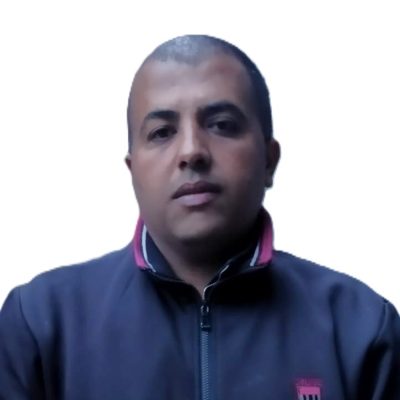
בסאם אל-עג'ורי, אביה של ספאא וילדיה זוהיר וופאא. התמונה באדיבות המשפחה
At the end of December 2023, my brother, Myasarah al-‘Ajouri (30) disappeared. We waited two days, and he still didn’t come. We waited two weeks, but Myasarah didn’t come back. After the army withdrew from the town and people returned, we went to look for him. We didn’t find him at his barbershop, and when we reached the house he rented, we found it had been bombed. We don’t know if he was there. We also searched in hospitals and reported him missing to the Red Cross but have been unable to get any information.
Ousamah al-Qreinawi, 9 months. Courtesy of Hanaa al-Qreinawi.
Losing my sister is unbearable, but I accept this fate from God. Ousamah is now nine months old. Amani always asked me to look after him and care for him, as if she knew in advance she was going to die. I don’t know what Ousamah did to deserve growing up without a mother and father. There’s no explanation for it. They were murdered in cold blood, and their son was orphaned. I’m heartbroken for him, and for my sister and her husband, who waited 16 years for a child, and when they finally had Ousamah – they were killed and left him forever.
On the right: Mu’in ‘Awad (10), next to his three brothers who were killed in the bombing: Ahmad (14), Hassan (15) and Mu’tasem (5). Photo courtesy of the family
My nephew Mu’in [10], the sole survivor from his family, cried hysterically when he said goodbye to his mother and siblings. He was shocked and couldn’t believe they were all gone and he was left alone. Mu’in is broken. He keeps asking about his mother and his siblings. He tells me, “My father left us. Then my mother and brothers left me. What did I stay alive for?” I have no words to comfort him.
When I managed to get out of the kitchen tent, I started screaming and looking for my sons. I saw bodies on the ground, and the schoolyard was covered in blood. I found [my son] Nazir safe and sound, but feared that [my eldest] ‘Abd a-Rahman had been killed because he was in the area that was bombed. […] I ran frantically to the road, managed to catch the ambulance evacuating him, and went with him to [the hospital]. There, the doctors decided to amputate ‘Abd a-Rahman’s left leg below the knee […].
My father and my brother Zeid, 18, were in a tent in the schoolyard waiting for lunch when the Israeli military suddenly bombed the school [...] We all rushed down to the yard and frantically searched for my father and Zeid among the dismembered bodies and the wounded [...] I found the body of Zeid, who had been wounded in the abdomen. When I saw him, I went hysterical and began screaming. I wandered around the yard barefoot, even though the ground was scorching from the bombing [...]. I saw my uncles, who were also displaced at the school, lifting my father, wrapped in a blanket, and I fainted.
I took my baby, grabbed my three other children, and we ran toward the school gate with the other IDPs. We all fled for our lives. The scene that day was apocalyptic. The school was a site of ruin, wreckage, stones, glass everywhere. On the way out, we stepped on bodies, some burned, and body parts, and on bleeding wounded whose limbs had been severed. There was blood and bodies everywhere.
Jihan’s children, Mu’in and ‘Imad, killed in a bombing on 16 November 2023. Photo courtesy of the family
On Thursday, 16 November 2023, we made dinner and sat down to eat. My son Mu’in was sleeping in the next room. When we finished eating, I went into the room where Mu’in was sleeping, along with my husband, our son ‘Imad, and my husband’s sister Ilham, 33. We didn’t hear any planes or bombs, but suddenly, the house came crashing down on us. [...] The next day, I was told ‘Imad had been killed. I sat next to Mu’in for four days while he was in intensive care. [...] I lost Mu’in on 20 November 2023. (Jihan Swelem-'Aweidah talked to B'Tselem in August 2024 about losing her little boys in a bombing. On 10 October, she was killed in another bombing).
Rajaa al-Harbiti
I grabbed my daughter’s hand, lifted her up, and begged the military not to run us over too, but the tank hit us, and we fell to the ground. I lifted my head and hand, and I was sure I was dying. I couldn’t hear Muhammad, but I saw Ahmad, his back covered in blood, and my husband, who was bleeding from every part of his body except his face. His left hand was severed. He said to me: ‘Raja’, my love, forgive me.’ I answered: ‘I forgive you, ya Akram.’
the sky was completely covered in clouds, dust and dirt. People started running in all directions. [...] We started rescuing injured people, as many as we could. Some lost hands, others legs. There were at least 100 of them. Some of the people we rescued died in our hands. When we entered the tents that were still standing, we saw they were full of bodies, mostly of women and children.
Nihayah Jaradeh
It was like Judgment Day: massive blasts, balls of fire and hell raining down on us, stones, trees and sand flying everywhere. The sound of the quadcopters shooting mixed with the screaming in the camp. There were dismembered bodies and bits of flesh everywhere, bodies of children, women, and men. I fled with my brothers and everyone around me, scared to death. I ran with my hands over my head, as if that would protect me if another missile landed [...]
It was as if the Angel of Death himself was flying the drone to make sure the quota of victims. It felt like a zombie movie. I saw severed arms next to me, stumbled over a severed leg, and I think I even saw the charred body of a man with half a face, meaning his head was split in two so he had one eye, one ear, half a nose and half a mouth left. But I’m not sure any more what I really saw in those moments of terror [...] Death was enveloping everything.
Fadi Baker several months after his release. Photo courtesy of the witness
They put cigarettes out in my mouth and on my body. They put clamps on my testicles that were attached to something heavy. It went on like that for a whole day. My testicles swelled up and my left ear bled. I was asked about Hamas leaders and people I didn’t know and hadn’t met. They asked me where I was on 7 October, and I said I was at home and had only gone out to get food for my wife. They beat me. Then they put me back in the freezing room with the loud disco music, and again left me there, naked, for two days.
Khalil Skeik
The whole way, they hit us hard with their guns, stomped all over our bodies and swore at us. They also used tasers to give us electric shocks all over our bodies. We got to a detention facility. I didn’t know where it was or what the place was called. When they took us off the truck, they dropped me face down on the ground. My jaw got injured and felt like it was broken, and some of my teeth fell out.
Mahmoud al-Bassiuni
We were handcuffed and blindfolded, and then, they put us in a big pit and left us there in the heat for about six hours. At first, we thought they were going to dump the sand on us and bury us alive, but they took us out of there and took us to a detention facility that I don’t know the name of. The trip there took about four hours, and the soldiers beat, humiliated and swore at us the whole way.
Diaa al-Kahlut
The interrogator repeatedly said to me “You’re Hamas,” “You’re a Hamas commander in the northern Gaza Strip,” and “We have information that you’re a Hamas supporter.” This time the interrogation included the “shabach” position: I was tied up while standing on tiptoes, with my arms stretched up and back. They left me in that position for two hours.
Safinaz a-Loh
I filmed people holding bleeding children in their arms, a guy carrying half the body of another guy, women running madly on the street with their heads uncovered, people falling on the ground because of the shooting and mayhem. I fell down, too, and two guys and a woman fell next to me. I saw children on the street without their families, and a child alone who was killed.
Nabil Kahil in hospital after his diagnosis. Photo courtesy of the family
The pediatric ward was full of patients – kids with cancer, hepatitis and many other illnesses. The hallways were crowded with sick and wounded people and the people staying with them. I have no words to describe what went on there. The whole time Nabil was treated in the hospitals in the Gaza Strip, he never got chemotherapy.
Dr. Adnan al-Bursh. Photo courtesy of the family
A doctor from al-’Awda Hospital called and told us the army had ordered all doctors over the age of 40 to go out to the hospital yard in their underwear. He said that Uncle ‘Adnan went down and was arrested. [...] All we knew was that Uncle ‘Adnan was in Ofer Prison and was being held under the Unlawful Combatants Law. Then, someone who was released from prison told us my uncle was not in the barracks [a nickname for the Sde Teiman facility] but in another detention facility. Then, before it was announced on the news, my father found out Uncle ‘Adnan had died in prison.
Dr. Khaled Hamudah and his daughter Razan before the war. Photo courtesy of the witness
They forced us to kneel in a prostration position, with our hands still cuffed and our eyes covered. We stayed like that for about two hours, and if a detainee dared move, even a bit, he was beaten. One of the soldiers asked me what I did for a living, and when I told him I was a surgeon in the Indonesian Hospital, he attacked me and kicked me really hard.
Muhammad and Hassan al-‘Ijleh
I was praying in the shack when a massive explosion shook everything. The shack collapsed, and I felt something hit my back. Salma’s leg was badly injured, and Ahmad was buried under the rubble. Neighbors rushed to pull us out
Shams Mhanna. Photo courtesy of the witness
One day, during the siege on the hospital, my uncle Amir and his children were sitting next to us. His son Karim, 3, was sitting on his lap when suddenly a bullet hit him in the head. He started bleeding, but there was no medical staff there. His mother held him. We bandaged his head with gauze, and then, even though it was dangerous outside, my uncle took him to the UNRWA al-Fakhura clinic. They told him Karim’s condition was very serious and he had to take him to al-Ma’amadani Hospital in Gaza. He didn’t manage to get him there, and at 6:00 P.M., Karim died.
Samia ‘Abd a-Latif ‘Abd a-Ghafur
My daughter Afnan said: “Father. Where’s father? He didn’t wake up!” I shone a flashlight on my husband and saw he’d been hit in the head by shrapnel and was dying. My daughter Shaimaa was also hit in the head, and was semi-conscious. My sister-in-law Iman, 45, was screaming, “My leg! My leg!” When I tried to help her, another tank shell was fired at us and killed my three daughters, Afnan, Duha and Shaimaa, my son Mahmoud, and my nephew, whose name was also Mahmoud, 19.
[the] soldiers ordered us on loudspeakers to go out to the street. They ordered the men to stand facing the wall and forced us to strip down to our underwear. There were almost 300 of us there, naked. They forced us to kneel and tied our hands and feet with zip ties. They kept us like that for four hours, cursing us and our mothers all the time. They beat us on our heads and other parts of our body with their guns, and kicked us in the face with their military boots. The kicking made me bleed.
Until the war, I lived with my husband and our nine children in the Tel a-Za’tar neighborhood in Jabalya Refugee Camp. But after October 7, the camp became a war zone. There were bombings and bodies everywhere. Families were bombed inside their homes, children, old people and women. UNRWA schools that were turned into IDP camps were also bombed. The Israeli army ordered us to move to places that were supposed to be safe and then bombed them. Here, in the northern Gaza Strip, nowhere is safe anymore.
Malak al-Hito. Photo courtesy of the family
On 16 November 2023, at around 2:00 A.M., I woke up to the sound of my husband shouting and calling for me. I heard him say that the station had been bombed. I was shocked because I hadn’t heard the explosion. All I could see around me was fire and dust. I could hear voices but couldn’t see anyone. I called out my children’s names. My husband started pulling our son Muhammad out to rescue him. I called for Malak. Then ambulances arrived. I couldn’t walk, so they carried me to an ambulance. While I was in the ambulance, the paramedics told me that my children were fine except for Malak. They told me she had been killed. I cried and screamed.
Sufian Abu Salah
When I got to the hospital, I heard them saying ‘Shiba in Tel Hashomer.’ A vascular doctor came and told me: “Your leg needs to be amputated. We need to consult an orthopedist.” The soldiers laughed and made fun of me: “Cut off his leg [...] When the orthopedist came and examined me, he told me: “You have to choose: Your leg or your life. It’s your choice.” It was the hardest decision I ever had to make.
I went into our tent and discovered everyone who was in it had been hurt or killed. My three sisters, Afnan, 16, Shaimaa, 15, Duha, 13, my brother Mahmoud, 16, and my cousin Mahmoud, 19, who tried to call an ambulance earlier - they were all killed. My uncle’s wife was hurt in the leg and her son, Ahmad, 15, was hurt in the right thigh. It was a horrifying scene. It was all I could do to hold it together and not break down there. I couldn’t take care of the wounded because I was afraid they’d shell us again. I had to just abandon them.
Alaa Rif’at al-Kurd and her son Karim. Photo courtesy of the witness
The doctors decided to amputate my leg. They said otherwise I would develop sepsis and could die. They also discovered my blood sugar was not balanced, which was probably why I was thirsty all the time. They operated on me again, and when I woke up, I didn’t have a leg. It was a terrible feeling, I can’t describe it. After the amputation, the nurses changed my bandages every day, without anesthesia because there were no anesthetics. I screamed in pain
 Amal Rif’at al-Kurd
My son Yusef had a curtain wrapped around his neck. He started choking, and I helped him get it off so he could breathe. Karim, Alaa's son, was next to me. His head was covered in blood and he was unconscious. I tried to wake him up. My phone was on me, so I called my mother-in-law and told her the house had been bombed and that we were under the rubble. I wasn’t injured, thank God. I called out to Bushra but didn’t hear her voice. I heard my son Yusef’s voice for a moment, and then I didn’t hear him anymore.
My face was blue and my whole body was swollen. I was in very bad pain and felt as if my right hand and leg were cut off. I was taken by ambulance to Abu Yusef a-Najar Hospital in Rafah, and all the way I called for my children and told them my children were under the rubble. When I got to the hospital, I found my brothers there and asked again and again about my children. Everyone told me the children were alive and would be rescued just as I was. Only later that day did they tell me that my husband, my children, my brothers-in-law Shadi and Ousamah, and Ousamah’s family, all were killed.
Yumana a-Rifi
Maram was killed about ten days after her baby and was buried without us being able to say goodbye to her. She got married about a year and a half before the war. She was a business management graduate, and she worked in the field. She was a vivacious person, with a sweet temper and a beautiful laugh. When Yumana was born, she was so happy.
Shaimaa Abu Jiab-Abu Foul
It was nighttime. They loaded us onto an armored personnel carrier (APC). They tied our feet, too, but didn’t cover our eyes. The zip ties hurt me a lot. They took us to a building with soldiers in it. I think it was still in Khan Yunis. They covered my eyes with a piece of cloth, and I heard them ordering the young men to strip down. Then they hit me with a rifle on my neck and head, and hit the young men, too – I heard them shouting in pain.
Wafaa al-Kurd ‘Issa
The hospital care was very limited, but thankfully, the birth was easy and I went home the same day. Taymaa was born small, weighing less than three kilos. I had nothing to eat after the birth, and I didn’t have enough milk to breastfeed her. I couldn’t find formula to supplement her diet. I was very afraid for her.
My husband was a vegetable vendor and once in a while he managed to sell some vegetables, and that's how we made a living. On 2 November 2023, my husband went out with his cousin Zaki a-Rifi and some others to try and sell vegetables so we could buy necessities, especially diapers for Maher. I tried to persuade him not to go because I was afraid, there were bombings around us all the time. But he insisted and said they were civilians that weren’t endangering anyone. Zaki came back after 20 minutes, badly injured in his hand, and said my husband was killed.
Rami Abu Ras
I also wondered why they arrested me. Why are they still holding me? What will happen to me here? When will they let me go? I thought about my difficult situation, especially the darkness I was drowning in under the blindfold without seeing anything, about the fierce cold and the strong wind. I was freezing all the time, and hungry and thirsty.
Nadiah al-Hilu
I was taken to an iron cage where I stayed with other female detainees for 11 days. My hands were in zip ties the whole time. We were given very little food. I barely even ate that so I wouldn’t have to go to the bathroom, which was far away and didn’t have a tap. If you were menstruating, you got one pad. In the bathroom, we helped each other. There was no shower, either. There were male and female soldiers around us all the time, and they wouldn’t let us sleep. They would turn on the light, turn on speakers, eat in front of us and swear at us.
Hadil a-Dahduh Zaza
I was put in a pit in the ground. When I was in it, with all the other detainees, the soldiers ordered me to take off my hijab. One of them told me: “I killed your husband and I want to bury you alive. Let the dogs eat you.” About half an hour later, they took us out of the pit and put us on a truck. There were men inside who were right up against me. At that point, I thought my husband had been killed. After I was released, I saw a photo they took of us in the truck. I’m in that photo.
Nabilah Miqdad
We were taken out of the cage and dragged to a bus, like animals. The bus started driving and the whole way, the female soldiers guarding us wouldn’t let us lift our heads. They swore at us, hit us on our hands and took pictures of us. After some time, the bus stopped. We were taken off it and each asked our name and photographed. A female soldier grabbed us by the head and ordered us to kiss the Israeli flag. Another female soldier bashed my head against the side of the bus.
Fatimah Baker
There are nine of us in the tent, without water, electricity, medications, and almost no food. Life here feels like a disaster. We’re living in the desert, in conditions unfit for human habitation. It’s hard to get potable water or even water for cleaning. There is no way to bathe, and we don’t do laundry either. We’re very cold because we have no warm clothes. There are insects everywhere here - mosquitoes and flies, and reptiles too. We’ve all lost a lot of weight and feel weak and exhausted all the time. We barely sleep at night.
Hala ‘Obeid
Relatives told me the Israeli military had invaded a-Zeitoun, where my husband was staying. They said he went to stay with his uncle Samir and that soldiers entered the house and arrested Samir, seven of his sons and my husband. Until yesterday, I hadn't heard any news from Shadi. Then, one of his cousins, Jawad, 17, who was arrested and released yesterday, called me. He told me that on the day of the arrest, the soldiers took all the men out of the house and ordered them to strip, and told all the women to go south. He told me that they tied the hands of all the men behind their backs, blindfolded them with bits of cloth, beat them, and poured cold water on them. Shadi was still injured, and Jawad said the soldiers beat him, too.
I lost my cousins and my neighbor, all of them my friends, just to get some flour and canned goods after months of starving. The hunger here is real and extreme, and we have no other way to get food. We go there and risk our lives because it's the only option, but when you go, you don't know if you'll come back. Now I don't know if I'm capable of going there again. On the other hand, when the flour runs out at home, I won't have any choice, despite the danger
Julia
I was on the balcony with my two grandchildren, Julia and Majd. The rest of the family were inside, getting ready for lunch. Suddenly, I felt my body flying through the air, and then I fell on the floor. Julia and Majd crashed to the floor, too, and there was dust and debris everywhere. There was a lot of smoke too, and I could smell fire. My shoulder felt dislocated, and I couldn’t move or get up on my feet. Then I started feeling like the building was collapsing underneath me, until the third floor became the first floor.
Sharif al-Kafarneh
We buried Yazan that day in the cemetery here in Rafah. Losing him is terrible. I look at the mattress he slept on until he was hospitalized, and all I can feel is grief and deep sorrow. I always tried to give Yazan everything he needed and take care of him, but the conditions here are so difficult now that I had nothing to give him any more. The deadly hunger here killed him.
Sami al-Hadad
Alma talks about her family non-stop, about her brothers and sister. She talks about how she saw her brother under the rubble. She keeps asking to go back there to look for her family members under the rubble. We told her there was nothing to go back to. I even took her to a place where you can see the northern Gaza Strip from far away, so she would see the destruction and understand that it’s impossible to go back there right now.
Ahamd Abu Foul. Photo courtesy of witnees
We took the rubble off the bodies by hand. We did all the work with our hands and with the help of some light equipment. In the end, we managed to get out the bodies of Muhammad, my wife Islam, my father, my two sisters and my aunt. I did it emotionlessly. I can’t feel anything anymore, and that made it possible for me to get them all out. After that, I buried them next to each other in al-Falujah cemetery in Jabalya R.C.
Ibrahim Hasunah
Since then, I've been alone in the world. I lost my family. I have no home and no future. I cry every day. I go to sleep alone and wake up lonely and lost. I came back from Turkey a month before the war started because of my family. My mother really wanted me to get married. We hoped the war would end and we’d go back to our lives, but they killed my mother, my father and everyone else in my family. They killed everyone. That's how I became an orphan, alone. My life is black now. I don't think I'll ever get over the trauma.
Hazem al-Madhun
I have no family left. We were just starting out as a family. We were happy together. On 13 October, we celebrated our first wedding anniversary. All I have left are our two wedding rings, which I’m keeping. I have no other mementos. All the photos and videos are gone. Our clothes, my wife’s and daughter’s belongings, all gone. My house in Gaza City was completely destroyed by the bombing. It was bombed just one day before I left the city. All my memories with my family are gone forever.
Shadi Fatayer
we heard a loud explosion and the roof of the building and its pillars collapsed on us. Everything was dark and full of dust. Hanan was still holding my hand when a block of concrete fell on her, and I couldn’t move. I screamed out to the children and only Ibrahim answered. He said, “Dad, I’m going to die.” I told him to recite the Shahadatain. I shouted for help, hoping someone would hear me and save my wife and children. I called out to Hanan, but she didn’t respond.
Khamis al-A’araj. Photo courtesy of the witness
I haven’t showered in ten days because there isn’t always water and when there is we save it to clean the toilets. A six-liter jug of water, which is not really drinkable, costs five shekels (~ USD 1.4). That’s a lot of money for us. My son Yusef, 17, walks about a kilometer to a place where you can fill up water and waits in line for hours just to fill two jugs for which you have to pay. We use one for drinking, even though it is not clean water, and the other for bathing. The children are still wearing the same clothes they wore when we left home and we don’t have enough water to wash them.
איבראהים אל-ר'נדור. התמונה באדיבות העד
Because of the hunger, my wife can barely nurse our nine-month-old son, Yamen, and baby formula is nowhere to be found either. A little while ago, we managed to buy a kilo of dates for NIS 40 (~ USD X), which has been helping us survive. We live off what we manage to get - a little rice, a little corn we ground, and also barley, which is meant for feeding farm animals. The price of barley has also gone crazy. Now even the barley ran out and people have started grinding bird and rabbit food. But there is not much of that either. There is no food for humans or for animals.
Amneh al-Masri
I miss our old life, before the war, without all the bombings and killings. We’re exhausted. We’re broken and have no strength left. In one of the bombings, I lost a lot of people form my family and my parents were spared by luck alone. Now, the military might invade Rafah and force us out again. I don't know where else we can run. We’ve been displaced four times. I don’t know what fate awaits us.
Ahmad Abu ‘Aydah. Photo by Olfat al-Kurd, B'Tselem, 30 Jan. 2024
I’ve started having diarrhea and vomiting, and my body has become weak. About a month ago, I started getting stomach aches and swelling, and tingling in different parts of my body. I started throwing up everything I ate, even the water I drank. After this went on for about two weeks, I went to the Kuwaiti hospital here in Rafah. They ran tests and diagnosed me with hepatitis. The doctor said it was due to lack of hygiene and told me to be more careful and also to eat healthy. He said there was no cure and it would go away on its own if I was careful.
מוחמד אבו מרסה במחנה העקורים ברפיח. צילום: מוחמד סבאח, בצלם, 25.1.24
They put me in a jeep again, with other detainees, and transferred us to a large structure that had a rough floor, like concrete, and a tin roof. The sides were open and it was very, very cold. There were a lot of detainees there. When we got there, they blindfolded us and ordered us to kneel down on our knees. I was held there for 35 days, and all that time we were not allowed to move or speak to each other. We ate and slept with our hands tied and our eyes covered.
Mahmoud Abu Qadus. Photo by Muhammad Sabah, B'Tselem, 23 January 2024
Every day, the soldiers ordered us to sit on our knees from 5:00 A.M. until the evening. We ate and drank with our hands tied in front of us. If we looked sideways, or even spoke to one another, they would punish us and make us stand with our hands raised for about three hours. On top of that, they didn’t let us go to the bathroom when we asked, and they didn’t always let us pray, either.
Rami Riyad Abu Dalfeh
The whole way, the children cried from hunger, thirst, and fear at the sight of the bodies in the streets. We walked to a military checkpoint south of a-Zeitun neighborhood, along with a lot of other people who were carrying white flags. When we got to the checkpoint, the soldiers swore at us over loudspeakers: “Go, animals.” We kept walking until the entrance to a-Nuseirat Refugee Camp. I suffered from severe pain in my legs the whole way, because I have a herniated disc and had surgery two months before the war.
They blindfolded me with a piece of cloth and handcuffed me in front with white zip ties.There were six of us girls. One of the girls was in pain. The soldiers asked me to translate what she was saying into English, and I translated that she thought she’d miscarried. One of the soldiers said, ‘Oh my God.’ A doctor came in and covered her with a blanket. She was told to put on shoes, so she wouldn’t be so cold. The soldiers told us to sleep, but it was too cold and we were lying handcuffed on rocks, so we weren’t really able to.
Sami ‘Awwadallah Baker
The shelling grew worse and I was worried about Adham [my son] and Diab [my nephew], so I went out looking for them. On the way, I was hit in the hand by a shot from an Israeli drone. I heard Adham and Diab shouting for help, but there was heavy shelling and I couldn’t reach them, even though they were about five meters away from me.
After the war started, my milk dwindled and I could barely nurse Alma anymore. I had to get formula and give her two bottles a day. At first she did okay on the formula, but then we couldn't get that brand anymore, and when we switched brands she didn’t respond well [...] She’s lost weight, she coughs a lot, and has diarrhea and vomits. Sometimes she runs a high fever.
Wisam al-Qau’d at the IDP camp in Khan Yunis. Photo: Olfat al-Kurd, B’Tselem, 5 Jan. 2024
A few days ago, I took Wisam to the doctor here in the camp. He prescribed eight rounds of inhalation, one a day. I took Wisam to the European Hospital east of Khan Yunis, and he got one round of inhalation. Then we came back to the IDP camp. I didn’t want to stay there because I was afraid the hospital would be bombed, so he didn’t get the rest of the treatment.
Farid ‘Amer. Photo by Olfat al-Kurd, B'Tselem, 1 January 2024.
They kept me lying on the ground in our garden for about half an hour. Then they took me like that, naked, to another house in the neighborhood, about 150 meters from my house. They took my photo and gave me a number (058793).
In the evening, they took me and about 15 other women they arrested to another place. They told us we were in an Israeli military detention facility. Every time I moved, I got hit on the head. Every time I heard soldiers’ voices, I was afraid I’d get hit again. They kept cocking their weapons to scare us. Every time I heard that, I recited the “shahadatein” because I was sure they were going to shoot me. Our hands were tied in zip ties the whole time.
Nihal a-Najar
All my dreams are gone. My sisters were killed, my home was bombed. The wedding dresses and my gold jewelry are under the rubble. The Israeli army left me with nothing. No hope for happiness. It took away every sweet thing in my life. Our lives are terrible now. I cry all the time over my sisters, over the situation, over the hopelessness of it all.
Alaa al-Kurd
On 17 November, we set out on foot at 7:30 A.M. and started walking. At 8:30, we reached the Netzarim checkpoint. The soldiers ordered us to raise our IDs in the air and walk slowly, without turning our heads left or right. There were crowds of people, so I tied my children’s hands to mine with a kaffiyeh so they wouldn’t get lost. The conduct at the checkpoint was degrading. The soldiers forced us to stand for hours, without moving or sitting down. Only at 1:30 P.M. did they allow us to move on and cross the electronic gate at the entrance to the checkpoint.
Ghadah Abu Tabikh
We could barely contact my mother and brother, who stayed behind in a-Shati, because the communication networks weren’t functioning. It was very, very stressful for me. I managed to get them on the phone just once, after dozens of attempts, and spoke with both of them. I heard bombings in the background. I asked them to leave the camp so they wouldn't be killed, but my mother said she couldn't walk and that “Our fate is in God's hands.” 
'Issam Da'ur with daughter Juri and son Fadel, who was killed when their home was bombed. Photo courtesy of the family
I’m a general practitioner at the Indonesian Hospital in the northern Gaza Strip. On Sunday morning, 15 Oct. 2023, an ambulance came to take me to the hospital because it was too dangerous to get there any other way. Before I left, I went into the room where the kids were sleeping and looked at them, without waking them. It was the last time I saw my nine-year-old son Fadel alive.
Three days ago, we decided to move to Salah al-Din School in a-Rimal. It was very crowded, so we just sat on the floor. We slept sitting up and stood in line for everything -– to go to the bathroom, fill up water, get food. On 10 Nov., the school came under fire so we moved to the YMCA building. With us here are about 200 other people. There are long lines to use the toilet and shower, and not enough food and water.
Now we’re at a-Shifaa Hospital. A few days ago, the Israeli military shelled the courtyard and people were killed and injured. Then they hit the hospital’s solar panels and the surgical ward. There was massive gunfire around the hospital, and people sheltering here were hit. After that, some of the people who were sheltering here left. The dead bodies stayed in the courtyard and it’s too dangerous to go get them in order to bury them.
Children here are getting sick because it’s impossible to maintain hygiene, and maybe because of the poor quality of the water we buy. A lot of people are suffering from stomach aches and diarrhea.
In the morning, in Rafah, I went from bakery to bakery until I found the shortest line. I stood there from 10:00 A.M. to 3:00 P.M. and managed to buy a bag of 30-40 small pitas. I came back exhausted after five hours of standing in line, terrified, hearing bombings all around.
We were given food and water for the first time after about three days. We stand in long lines every day to get two small pitas, half a tin of canned meat and some water for the day. The queues are rough and exhausting. I could barely get us blankets.
I sleep in the yard and my wife and daughters sleep in a room. Some have mattresses and others only blankets on the floor. There are a lot of people in the yard, because there isn’t enough space inside. If it becomes cold and rainy, I don't know where we’ll go.
There are about 40,000 people here now. There is no corner without someone in it. Some are in warehouses and others in tents put up in the yard. My family and I made a tent out of blankets, but the sides are open and there is no privacy.
Olfat al-Kurd
I’ve already lost more than 16 relatives in this war - uncles and cousins.  I’m in shock and can’t even cry. I feel emotionally disconnected. I try to put on a brave front for the family, but it’s very difficult. We have no idea how this will end and what will happen to us. These could be our final days.
Muhammad Sabah
I went back to the neighborhood the next day to check on our house. It was hard to reach because of the wreckage. The roads were cut off and the entrance to the building was blocked by rubble. I went into the apartment and found a lot of damage. I stood there for a moment and mourned the home we had, but I couldn't linger because I was afraid there would be another strike. I ran in to my neighbors, who were also there checking on their homes. They were all shocked and mourning their ruined apartments. We stood on the street, among the debris, and could smell the smoke from the bombs.