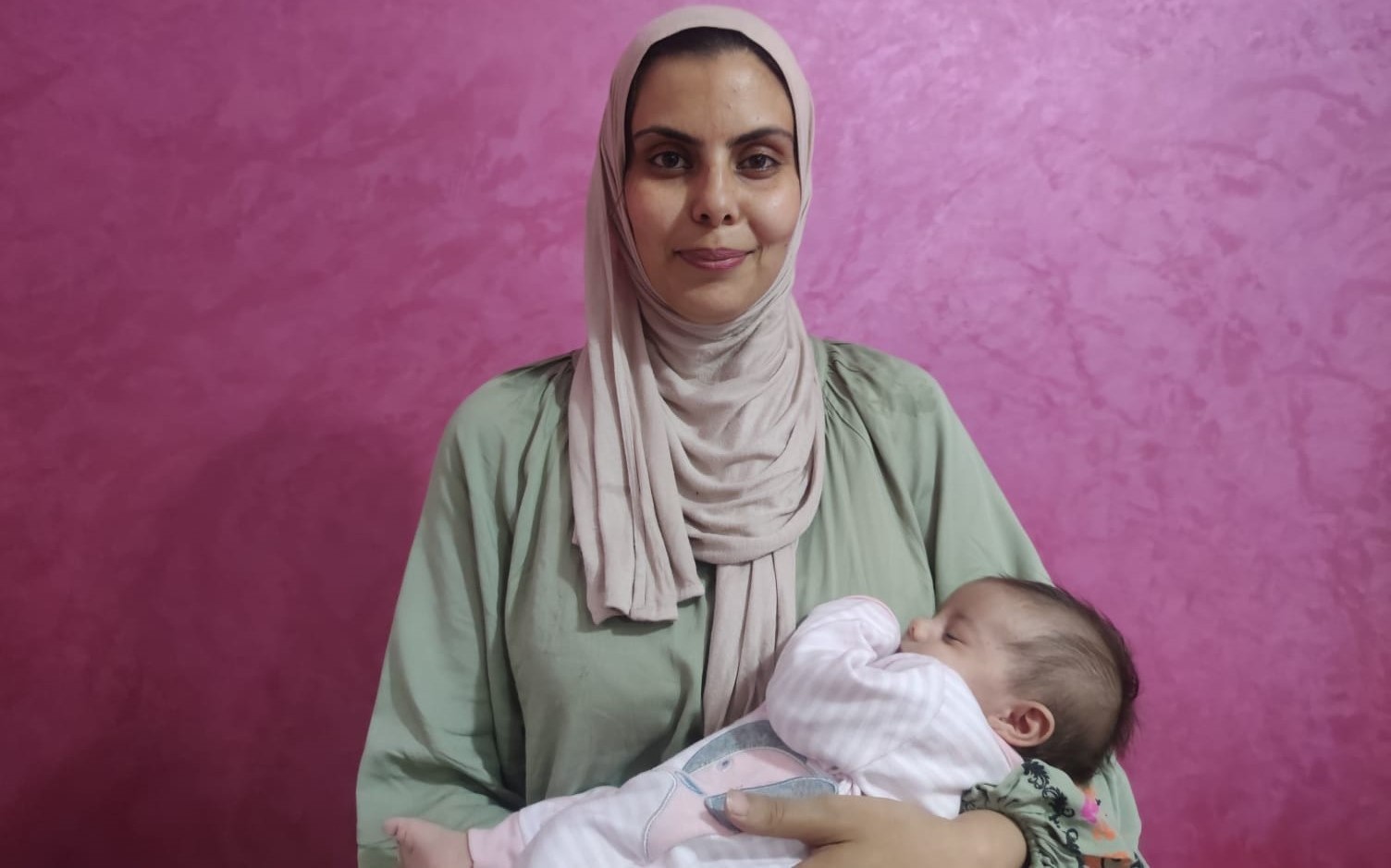
A 39-year-old mother of three from Jabalya Refugee Camp who gave birth during the war, Wafaa described losing her brother and father in the war and the difficult conditions in northern Gaza
I’m married to Saleh ‘Eid, 59, and have three children: Taymaa, a month and a half old, Tayyem, 2, and Rim, 10, my daughter from a previous marriage who lives with my ex-husband’s family. When the war started, my husband, Tayyem and I barely left the house. I was five months pregnant, and we stayed in northern Gaza because we had nowhere safe to go. On the first day of the war, my brother Safwat al-Kurd, 50, moved to our place along with his wife, Maysoun, 46, and their only daughter Habibah, 10, as well my father, Muhammad al-Kurd, 76.
In the first month of the war, there was already heavy artillery shelling and unbearable bombing in our area. The army scattered leaflets ordering us to leave the northern Gaza Strip because the area was dangerous.
We didn’t leave, even though the electricity was cut off in our area on the first day of the war. We got by with a rechargeable battery that we charged at the neighbors’ place, because they had a solar power system.
On 4 November 2023, we woke up in the middle of the night from a missile that exploded next to our house. Later, we understood the target was probably the mosque across from us, less than 10 meters away. All our windowpanes shattered, the doors collapsed and the room closest to the mosque was completely destroyed.
My father was injured by shrapnel in his left leg. He had diabetes, an enlarged prostate, a stomach ulcer and problems with his eyesight. Ambulances came and took my father and several other wounded people from the neighborhood to the Indonesian Hospital in the north of Gaza City. My brother Safwat rode with my father in the ambulance.
I moved with Tayyem and with Safwat’s wife and daughter to relatives of my husband who live nearby. When my father was discharged from the hospital, he went to his sister’s house in Jabalya Refugee Camp near the hospital, so he could go there for medical check-ups. Safwat went with his wife and daughter stay with his relatives of his wife, the Suliman family. That’s how we all dispersed.
Despite the bombing and shelling, Safwat and I visited my father and also accompanied him to appointments at the hospital. But on 19 November 2023, the house where Safwat was staying with his wife and daughter was bombed, and they were all killed. A lot of other people were killed in the bombing, 11 members of the Suliman family.
The news of Safwat’s death hit me like a lightning bolt. At first, I couldn’t believe it. I called them and tried to reach them, but they didn’t answer. I wanted to go there, but I couldn’t leave the house because there was heavy bombing and shelling. I felt very lonely. All my other brothers and sisters had already moved to southern Gaza, and only Safwat and my father and I stayed in the north. And now I’d lost Safwat. I told the family Safwat was killed, but I didn’t tell my father. He asked after him almost every day, and in the end I told him he’d gone to Egypt. Then he wondered how Safwat had left without saying goodbye to him. Every time, I came up with a different excuse.
We still haven’t managed to get the bodies of Safwat, Maysoun and Habibah out from under the rubble. I went to the Civil Defense (which is in charge of rescue, first aid, and firefighting in Gaza) and asked them to help us clear the rubble, but they don’t have any proper tools left or fuel for the diggers. My husband, my cousin, and I went there several times and tried to move the debris off them, but it was too hard. They’re still buried there.
In early December, I brought my father to the house we were staying at and told him about Safwat. He was shocked. He started crying, screaming, and calling for Safwat. On 8 December 2023, we moved to the house of other relatives the old Gaza Street because the bombing and shelling intensified where we were. My father joined us there. We stayed there for about three weeks, although there was heavy artillery shelling there, too.
That’s when we started to really feel the shortage of food. At that time, the army scattered leaflets ordering us to move to the western part of the city. We left under shelling and shooting. Entire families abandoned their homes. We had nowhere to go, so we stayed out on the street, without shelter, food or a toilet. I had to relieve myself out on the street.
Later, we found a building under construction and moved into it. It wasn’t fit for living in. The toilet wasn’t ready, and of course there was no water or electricity. The only food we had was rice. That’s all we ate. I was heavily pregnant, and very tired and exhausted. We tried to get more food, especially for Tayyem and my father. The lack of hygiene was awful. We couldn’t bathe, and Tayyem and I got lice. I had to shave his hair.
After two weeks, we heard the army had withdrawn from Jabalya so we went back there, to the house of Sabah, my husband’s sister. But then the bombing intensified there again, so we left and moved to a school that was turned into an IDP camp, because we thought it could be safer there.
My father’s health deteriorated, because of the poor nutrition and lack of medication for his diabetes and prostate problems. On 21 January 2024, my father passed away. It was the hardest day of my life. A black day. I was left completely alone, without my father and without my brother. There was no one to bury my father. We waited until a relative arrived, and he and my husband buried him near the building where my brother was killed. My goodbye was just taking one last look at my father, broken and in tears.
After the death of my father, the hunger got worse in Jabalya Refugee Camp and in all of northern Gaza. It was almost impossible to get hold of flour, and when it was available the price was outrageous. There was no fruit, vegetables, meat, eggs or grains. When they did reach the shops, the price was ten times higher. My husband Saleh and I went to sleep hungry every night.
In the last month of my pregnancy, we rented an apartment in Jabalya. I was exhausted and starving. We didn’t have enough food for Tayyem, either. We were all hungry. Every day I worried how I would give birth with the hospitals overwhelmed and unable to provide services, bombing day and night, and hunger growing worse by the day.
On 27 February 24, I gave birth to my daughter Taymaa at al-Awda Hospital in northern Gaza. Despite the labor pains and the bombing, I went to the hospital on foot. We left Tayyem with my in-laws and only my husband and I went to the hospital, along with a friend of mine. I took baby clothes from relatives, so I would have something to dress her in when we left the hospital. The hospital I gave birth in was destroyed, and so were the buildings around it. The hospital care was very limited, but thankfully, the birth was easy and I went home the same day.
Taymaa was born small, weighing less than three kilos. I had nothing to eat after the birth, and I didn’t have enough milk to breastfeed her. I couldn’t find formula to supplement her diet. I was very afraid for her. In northern Gaza there’s a shortage of baby formula and diapers. There wasn’t any clean water to prepare formula anyway, so breastfeeding was the only option.
Afterwards, I started buying food from the airdropped aid. People who manage to catch it sell some of it, at crazy prices. And it’s pretty bad food. Life was hellish. The bombing and shooting lasted all day long. We lit fires to cook food, bake bread and heat water. I was in a very bad state and couldn’t take the noise of the bombing and shooting anymore.
My husband is a German citizen, and it turned out that because there were no communications in northern Gaza, the German consulate in the West Bank, which tried to evacuate us, had trouble contacting us. About a month ago, after the communications were up again, they called and told us they wanted to evacuate us to Egypt and from there to Germany.
On 2 April 2024, they called and told us we had to travel to southern Gaza because they’d arranged for us to leave through Rafah. I was very afraid to pass through the military checkpoint on Rashid Street on the coastal road, because of the bombing and shooting at civilians on the street. But the embassy said we had to leave, and I decided to trust in God. We left the house and managed to cross the checkpoint and get to Rafah safely. We spent one night in the home of the family of my brother, who was killed a few years ago.
On 3 April, they arranged passage for the children and me. We went to Rafah Crossing and managed to cross into Egypt and travel to Cairo. Three days later, they also arranged for my husband’s passage, and he also made it to Cairo. Thank God, now we are together, doing well and safe.
But Gaza is not doing well. I left my daughter Rim behind. I haven’t seen or heard from her in six months. I only once managed to talk to her on the phone and hear she was okay. I left my heart and soul behind in Gaza. I don’t know if I’ll ever go back to Gaza City. It’s a ghost town now. Unfit for living. Everything there is in ruins – the houses, the streets, the schools, the hospitals, the markets. Gaza is now a pile of stones.
I left Gaza in tears, with a very heavy heart, over parting from our loved ones, our family, and friends. I long for the day the war will end and Gaza will go back to what it was. God willing, we will return to Gaza.
* Testimony given to B’Tselem field researcher Khaled al-’Azayzeh on 11 April 2024