A 21-year-old from the a-Sheikh Radwan neighborhood in Gaza City, Malak described difficulties feeding her baby, whose health is deteriorating
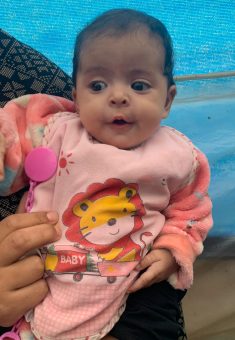
my husband, ‘Issam Dabash, 27, our son Bassam, 2, and our baby Alma, who was born on 29 September 2023, a week before the war, and is now three months old.
We had to leave home in the very first week of the war and moved straight here, to the IDP camp. We’re sharing a tent made of plastic sheeting and tarpaulin with my husband’s family, 27 people. Catastrophic conditions.
After the war started, my milk dwindled and I could barely nurse Alma anymore. I had to get formula and give her two bottles a day. At first she did okay on the formula, but then we couldn't get that brand anymore, and when we switched brands she didn’t respond well. We tried several brands and it didn’t help. It might have to do with the quality of the water, too. Her health has deteriorated. She’s lost weight, she coughs a lot, and has diarrhea and vomits. Sometimes she runs a high fever. At the Red Crescent clinic in Khan Yunis they gave her something to stop the vomiting, but it didn’t really help. The doctor recommended a different type of formula and I tried that too, but she kept throwing up.
After a few days, Alma started suffering from shortness of breath, and I took her to a-Nasser Hospital. The doctors said she was dehydrated and had a chest infection. They put her on inhalation and gave her fluids. ‘Issam looked for the first formula we gave her everywhere. He managed to get to Rafah somehow and looked there, too, but couldn’t find it. We’ve tried several kinds of formula, but her condition hasn’t improved and I have to give her what I have. Every box of formula costs about 35 shekels (~ USD 9.5), and it’s difficult for us to keep up with the cost. On top of that, there’s a diaper shortage. When you manage to find diapers, the prices are sky high, 120-150 shekels (~ USD 32-34) a package. Bassam is still wearing diapers, too, and it’s too expensive for us. We buy the cheapest kind we can find and sometimes use cloth diapers. But because there’s no way to maintain hygiene, it gives them rashes. Sometimes, we have to sell the food we get from UNRWA to buy formula and diapers.
Bassam isn’t really healthy, either. He has a bacterial infection in his digestive system because of the contaminated water and lack of sanitation. We have medicine for the children, but nothing helps.
Because there is no source of energy, we have to bake and cook over a fire, and the smoke causes breathing difficulties. We don’t even have baby clothes. Alma has grown and the clothes we brought are too small for her now. Someone gave us some clothes for her here, but it’s not enough. It’s very cold in the tent and she needs more warm clothes.
Lately, my blood pressure has gone up and I’ve started taking medicine to lower it. I don’t sleep and can’t relax. Alma cries all night, probably because of the stomach aches and phlegm that builds up in her chest. I stay up, holding her. Her condition makes me so sad. I’m stressed all the time, worrying about the kids and what will happen to all of us. I cry all the time, too.
* Testimony given to B’Tselem field researcher Olfat al-Kurd on 5 January 2024