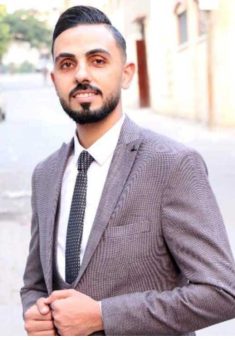
Yaser (31) and his wife, from Jabalya R.C., welcomed a baby during the war. He recounted a year of repeated displacement, hunger and caring for his injured mother
Exactly a year ago, on 7 October 2023, I was woken by the sound of missiles and didn’t understand what was happening. Since then, the army has been bombing every part of the Gaza Strip, dropped leaflets here in the north instructing us to go south, or calling us on the phone and demanding we evacuate. It’s psychological warfare in order to force us out of our homes and go to places we don’t know, which aren’t safe either, despite what the army says.
At the beginning of the war, about 40 of us in the family stayed here, in my parents’ five-story building in the Tel a-Za’atar neighborhood in the camp. I was here with my parents, Ahmed Abu Rukbeh, 75, and Amneh Abu Rukbeh, 72, my siblings and their families. On 13 October 2023, after homes right next door were bombed, we all moved to my brother Sayed’s house in another part of the camp. The next day, the army announced we had to leave there, too, so we moved to the Al Yemen Assaeed Hospital in the camp, which was still under construction but partially functioning. We stayed there one night and then went back to my parents’ home, even though it was dangerous.
Two days later, a lot of people in northern Gaza started heading south, and my brothers decided to go there too with their families. My parents refused to leave, so I stayed with them along with my wife, who was in the early stages of pregnancy. My brother Bilal, his wife, and their baby also stayed. There were seven of us in total, and we stayed on the ground floor of the building.
The bombings grew heavier and didn’t stop. It was indiscriminate fire, from the air, from tanks. When we felt we could no longer stay, we split up. My wife and Bilal’s wife went to their parents’ homes, and I went with Bilal and our parents to Bilal’s store in the camp center. It was a small shop, and the conditions there were very rough. Over time things got worse there, too, with more bombings and shooting. We eventually moved to a preschool in the area, where we stayed for three days until a ceasefire was declared.
During the week of the ceasefire, I went home with Bilal and our parents and we stayed there. But the very night the ceasefire ended, the Israeli army bombed and shelled the area very heavily. It was a terrible night, and in the morning we decided to leave again. When we tried to go outside there was sniper fire, and they fired at us, too. So we had to go back in and stay there.
We were trapped inside for about 14 days. There was a corpse lying outside our front door, with dogs feeding on it. The corpse decayed over time, and the nauseating stench filled our home.
During those two weeks, the army shelled our upper floor and several homes nearby. The shelling and the shooting from the quadcopters was relentless.
One night, after we were stuck inside with no electricity and very little food and water for about two weeks, the army ordered us and our neighbors to leave. The soldiers showed us a path to follow, but snipers were shooting indiscriminately there and my mother was hit in the leg. They also injured a woman from the a-Shamali family and killed two of our neighbors – an elderly man from the a-Talouli family who was in a wheelchair, and a young woman from the al-‘Ajrami family.
Bilal and I carried my mother, and we all found shelter in a storage room that was still standing in a nearby house that was bombed. Bilal and I tore up our shirts and tried to dress her wound to stop the bleeding. Thirteen of us sat there in the storage room all night, listening to the bombings and shelling. Later, we stole into ruined homes nearby to look for food and blankets, but we couldn’t find anything in the rubble.
When a friend called to check in on us, I asked him to bring a stretcher so we could carry my mother. He risked his life and came with a stretcher. We put my mother on it and took her to the UNRWA clinic in the camp, but they couldn’t treat her injury there, so they transferred her by ambulance to another clinic. Bilal went with her and I stayed with my father. Bilal told us over the phone that my mother had fractures below the knee, and that they’d stitched up her wound without anesthesia or even painkillers.
Then Bilal took her to a Red Crescent clinic in the eastern part of the camp, hoping she could get better treatment there. The doctors there said she needed a platinum implant. After Bilal and my mother were there for a week, we lost contact with them for a whole week. Then, Bilal sent me a message saying the Israeli army had invaded the Red Crescent clinic and was rounding up all the men there, so they were likely going to arrest him. He said my mother would be evacuated with the other women to an UNRWA school.
After that, we heard nothing from Bilal or my mother for 27 days, during which my father and I moved from one displaced persons’ camp to another. A friend eventually called and told me that Bilal and my mother were at al-Ahli Hospital in Gaza City. I tried to contact Bilal but couldn’t get through. The situation on the ground was very bad and I couldn’t reach them.
Then I got a call from another friend, telling me Bilal and my mother were now at al-Shifaa Hospital and that my mother had undergone surgery to amputate her leg below the knee. When my father and I heard that, we broke down.
A few days later, my father and I managed to reach a-Shifaa Hospital and met both of them there. Bilal told me the army had detained him at the Red Crescent clinic for 12 hours and ordered the women to evacuate. Other women had taken my mother and headed toward a displaced persons’ camp at a school, but along the way, they couldn’t carry her anymore so they left her on the street by one of the houses.
That night, after the army let Bilal go and left the clinic, Bilal and a few young men followed the same route as the women. On the way, they heard a woman calling for help. Bilal recognized my mother’s voice and started looking for her, even though military drones were hovering overhead.
He found her on a wheelchair, surrounded by dogs, screaming. He took her to a displaced persons’ camp at an UNRWA school and managed to find an ambulance, which took her from there to al-Ahli Hospital and later to a-Shifaa Hospital.
When the Israeli army invaded a-Shifaa Hospital, we brought my mother back to our home in the camp. Bilal and I were alone with my mother, caring for her and changing her bandages. There was extreme hunger in northern Gaza, and we only ate one meal a day. There was nothing to buy except flour, which was hard to find and very expensive. We bought a 25-kilo sack of flour for 1,700 shekels [~$450 USD]. We mostly ate mallow plants (khubeza) and lentils. There was no meat, vegetables or even canned food. Those days were very difficult.
In April, my wife gave birth to our daughter, Aylul. Throughout my wife’s pregnancy, I saw her very little because she stayed with her parents. She had a very difficult pregnancy because of the hunger and lack of vitamins. When Aylul was born, I went from clinic to clinic and hospital to hospital—those that were still functional—until I finally found a place to get her vaccinated.
In May, the army dropped leaflets from the air ordering us to evacuate and go towards western Gaza, and then it invaded the camp again. We feared for my mother’s safety and took her to my sister Mahasen, 41, who lives in western Gaza City.
We stayed there throughout the invasion of Jabalya RC, which lasted about 20 days. We heard the heavy bombing in Jabalya all the time, and worried about our neighbors and our home.
When the army withdrew from the camp, Bilal and I immediately went back to check the situation. I was shocked. We found total destruction: houses, roads, schools, hospitals, all in ruins. There was no basic infrastructure left in the camp. The streets were littered with bodies, and it was too much for a human mind to grasp. The streets were demolished. When I tried to walk, I found myself stepping on a decomposing body.
When we reached our house, we couldn’t believe our eyes. The upper floors were bombed and completely destroyed. The neighboring houses were destroyed, too.
Ten days later, bulldozers came to clear the streets and roads. Bilal and I repaired the ground floor so we could go back home. Then my parents came back, and so did my wife and Bilal’s wife with our babies.
The streets were piled high with garbage, and the stench from the trash and the corpses filled the camp, which was also plagued with mosquitoes and other insects. We couldn’t sleep.
We stayed at home from June to early October. The whole time, we heard bombings and saw bodies on the streets. We lived in fear and in unbearable conditions. There is still hunger. There are no vegetables, fruit or meat, and anything that is available is very expensive. We can only get hold of canned food.
My mother is still suffering from the wound and is dealing with her disability. She also has high blood pressure and diabetes, and we can barely find medication for her, which is also very expensive.
Two days ago, on 4 October 2024, at around 8:00 P.M., tanks began shelling the camp and quadcopters started shooting. That night there was no way to escape and it was very dangerous to go outside. We waited until dawn to decide what to do.
The next day, the army dropped leaflets announcing a military operation in Jabalya RC and ordering everyone to go south. We had no choice but to go back to my sister Mahasen’s house in western Gaza City. There was no transportation available, so we walked to the center of the camp, pushing my mother in a wheelchair. There, we found a vehicle that took my parents, Bilal and his family to Mahasen’s house, while my wife and I went with our baby to her parents’ house in the camp.
That night the bombing grew heavier, so the next morning, my wife and I traveled with the baby to Mahasen’s house, amidst tank shelling and gunfire. Now, we’re all here at Mahasen’s.
We are tense and afraid all the time. We’ve been living through this war for a year now. Our lives revolve around displacement, hunger and constantly searching for water, food and firewood. Every time we leave the house, we risk our lives. The gunfire and shelling are relentless. There is no stability, only fear and terror. A year of a new Nakba and of genocide.
* Testimony given over the phone to B’Tselem field researcher Olfat al-Kurd on 7 October 2024