A 45-year-old mother of nine, Sabrin described the repeated displacement, the loss of her daughter, who was killed along with her entire family, the difficulties providing for another daughter who needs dialysis, and the complete loss of privacy that comes with living in a tent:
Before the war, I lived in the town of Jabalya, in the family’s five-story building, and I had a beautiful, stable life. There was electricity, there was water. I had a large kitchen with all the appliances and cookware. I had a private room, and there were rooms for my sons and daughters.
My husband, Muntasser, 50, who works in the Civil Defense (emergency and rescue services), and I loved going out with our children to the beach, to gardens and the like, and I was happiest on the days when my entire family gathered, and we spent time together. We had nine children: Shaimaa, 28 (married), Hussein, 27 (married), Rumaysa, 26 (married and mother of two, who lived with us because her husband has been abroad for five years), Fidaa, 25 (married and mother of two), Ihab, 22, Qassem, 20, Salah, 19, Rawaa, 16, who suffers from kidney disease and needs dialysis three times a week, and Eileen, 13.
My family used to gather at my house, and I would make the tastiest dishes, cakes, ma’amoul and cookies. I took courses in confectionery, and I planned to open a private business specializing in pastries and cakes. We would all sit around one table. We were a family full of joie de vivre. We hosted relatives on special occasions and also on ordinary days, and I used to visit my parents often, who also lived in Jabalya, and I was happy to be near them.
7 October was a black day on which my life was turned upside down. At first, we tried to store food and water for fear of shortages, and then, because we were afraid of the bombings, we moved to my parents’ house, in the western part of Jabalya, farther from the border. We lived there for four months and then went home because it was very crowded there. Our life was already hard, exhausting and cruel. We had to fill water in containers all the time. My children used to walk a long distance to fill buckets of water and bring them home. They would complain a lot about pain in their arms and legs. Two of my sons, Qassem and Salah, suffered a hernia because of carrying water, and both had surgery during the war. My son Salah suffers from nerve pain in his hands for the same reason.
The water was of poor quality, and Rawaa, who suffers from kidney disease, needs clean water. I asked people in their homes and wandered the streets, asking who had clean water for my daughter, and I found none. Then I began boiling and filtering the water so that Rawaa could drink. We didn’t have gas for cooking anymore, so I collected garbage in order to light a fire, boil water and cook for the children.
After a while, the military ordered us to evacuate our home, and we moved to a school that had been converted into an IDP camp. We stayed there for three months, which were some of the worst of my life. The classrooms were packed with IDPs; there was a severe shortage of water; the bathrooms were unbearably filthy, and I felt disgust every time I used them. My daughters and I would stand for hours in line for the bathrooms. Fights kept breaking out among the IDPs waiting in line for water or for the bathrooms. The schoolyards were full of sewage, and the stench was unbearable. Mosquitoes and flies were swarming in numbers I’d never seen in my life. My children suffered badly from rashes all over their bodies, and even medicine did not help them. So we decided to leave the school, and I told myself that I’d never go back to that place again.
After that, we moved to a-Shati Refugee Camp and rented a house there, but we left it after a short time and moved to friends’ house because my husband didn’t have enough money to pay the rent. He’s still getting his salary, but it’s only 1,000 shekels (~ 320 USD) a month, and that wasn’t enough for our family’s needs given the sharp price hikes caused by the war.
That was when the extreme starvation started, and there was no flour either, and I had to grind animal feed to make bread, so we’d have something to eat. But I didn’t know what to make for Rawaa or how to deal with her condition at that time. I felt terrible when I had to give her bread made from animal feed.
My sons began going to the aid distribution point in Zikim. I would part from them in tears, and when they came back, I would kiss their feet, hug them and beg them not to go there again, because I had heard about young men whose heads were crushed by tanks and about trucks that ran over young men and killed them, and they would answer me, “Mother, we suffered from hunger and we want to store flour so that we don’t starve again”. The bombings around us intensified, and the situation got worse every day, but we didn’t know where to go. I didn’t want to move to the southern Gaza Strip and live in a tent.
On 12 September 2025, my daughter Fidaa’s family was wiped out. She was killed along with her husband, Hussam Jum’ah, 28, and their children, four-and-a-half-year-old Jud, and three-year-old Mustafa. When I received the tragic news about the death of my daughter, her husband and their children, I didn’t believe it. The family was simply erased from the population registry. They were in an IDP camp that had been set up in the Feisal School in Jabalya, but when the bombings intensified and the Israeli military began blowing up buildings with robots, they left and moved to friends’ house in a-Slatin neighborhood in Beit Lahiya, and that house was bombed.
A week after my daughter and her family were killed, we had to move to the town of a-Zawaida in the central Gaza Strip. We rented a 50-square-meter plot of land there for 300 shekels (~ 97 USD) a month. We stayed there for only one month. I felt very alien there, without my parents and siblings, without my neighbors. All the faces around me were unfamiliar.
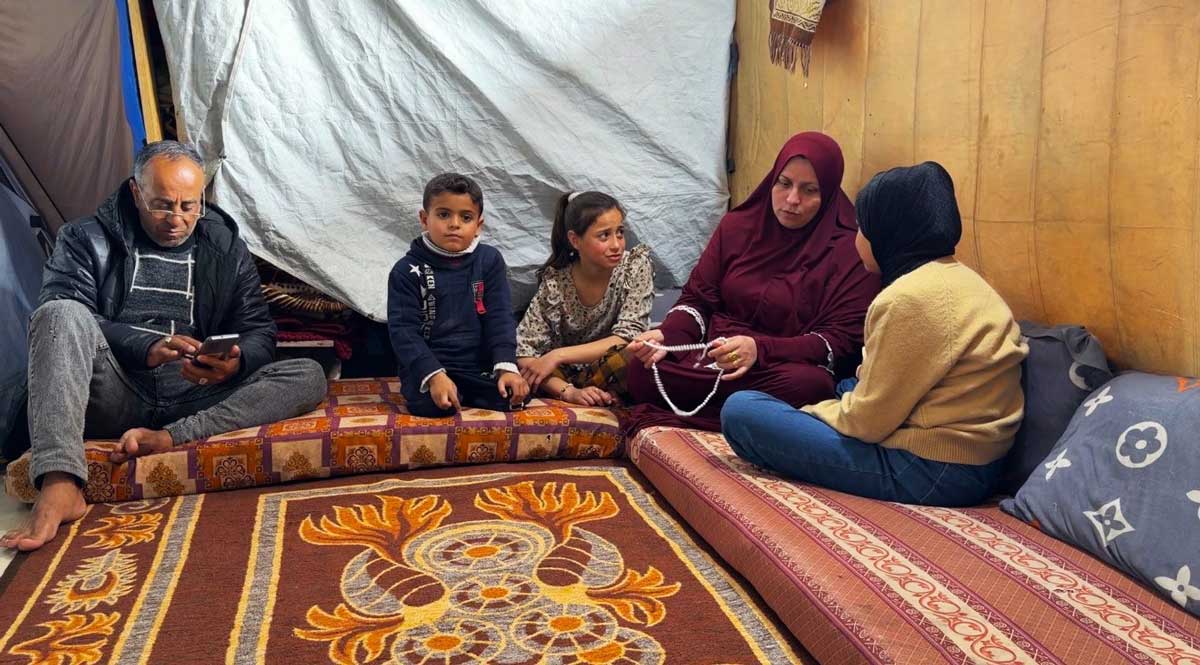
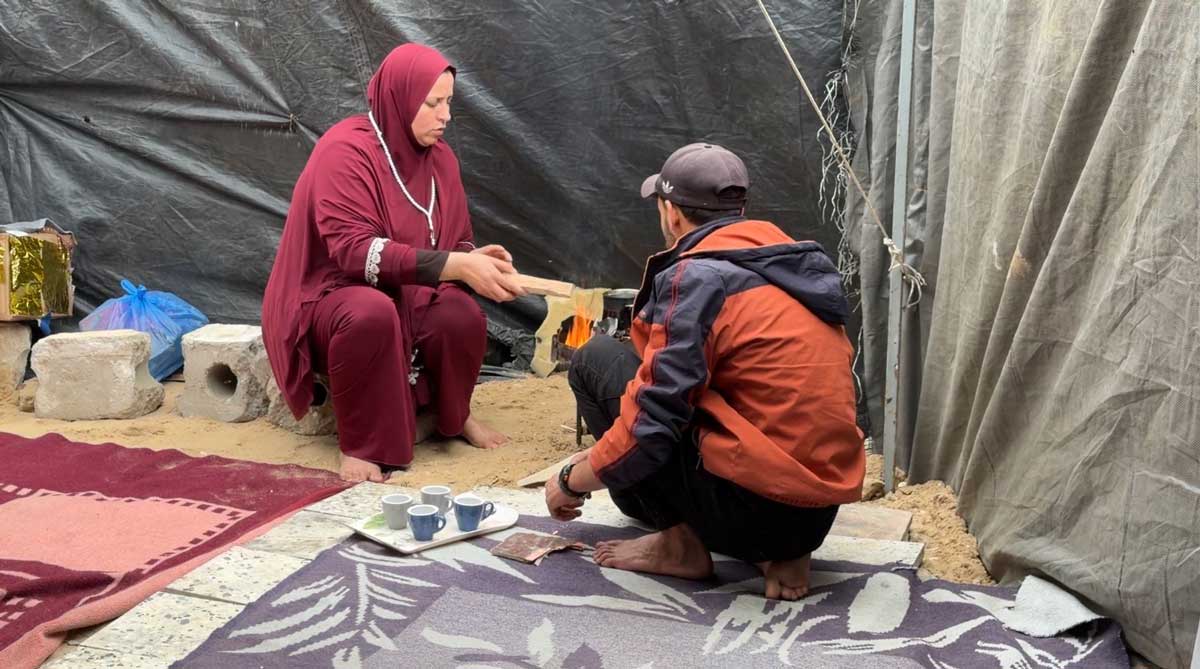
It was the first time I experienced living in a tent. Ten of us lived in the tent, and everyone’s whole lives, the women’s, men’s and children’s, happened in that uncomfortable tent. My husband and I had no private space, and even as a family, we had no privacy because all the tents were right next to each other. If I spoke to my husband about something, the next day, the woman in the next tent over would say to me, “You talked to your husband about such and such.” It felt like they were sitting with us inside the tent, with no separation, and that made me worried and anxious. I felt offended and humiliated to the depths of my soul. In addition, I had to help my husband with tasks usually done by men, because he couldn’t manage everything alone: going around looking for public kitchens, standing in line to fill water, buying clean water from tankers when they came at all, and buying bread at the bakery. When I was doing these tasks, I no longer felt that I was really a woman.
After that, I heard that in the city of Khan Yunis there was a plot of land where people could live for free and where there was water. I decided to move there with my family. The drivers asked for 1,000 shekels (~ 320 USD), so we borrowed the money and moved again. We lived there for about a month, too, again in a tent.
The bathrooms were shared with the neighbors, and I had to wait a long time in line, even though I suffer from intestinal problems and can’t hold it in for long. The hardship of living in these conditions caused problems between my husband and me. I would tell him that I couldn’t live like this in a tent or in IDP camps, that because of my intestinal problems I couldn’t stand in line for the bathrooms, and that I also needed a bidet. In addition, perhaps the worst difficulty I faced during the war was the shortage of sanitary pads. As a substitute for pads, I would cut up cloth for myself and for my daughters, because it was very hard to get pads, and even when they were available in the markets, they were too expensive for us.
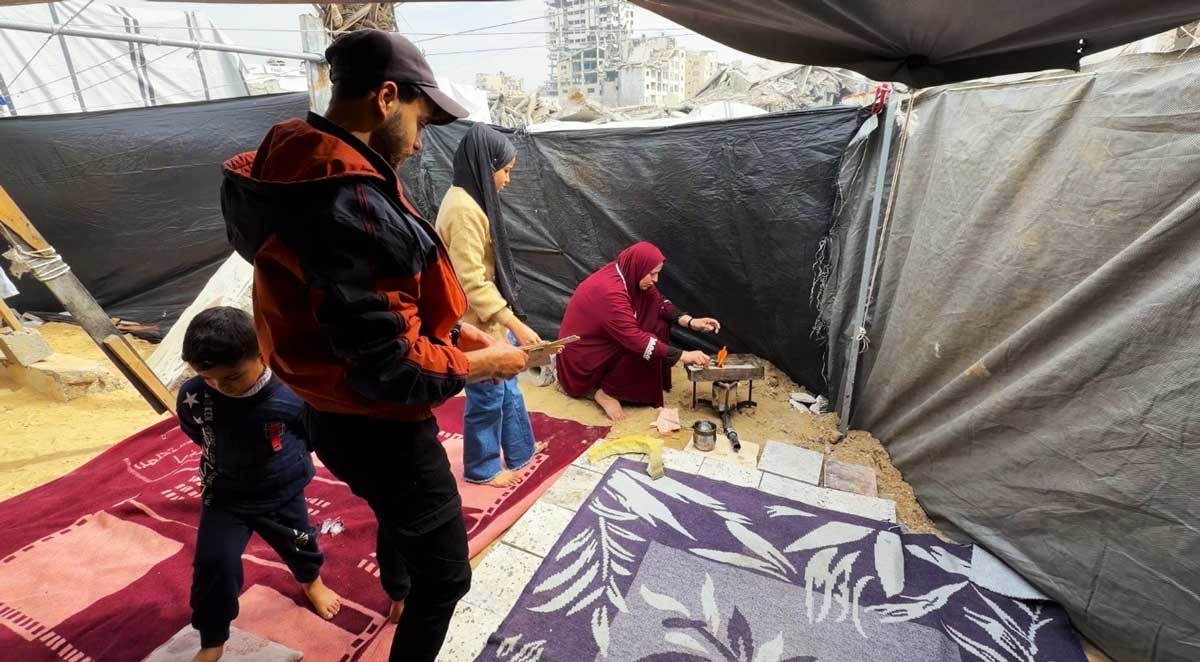
After the ceasefire was announced in October 2025, we returned to the northern Gaza Strip, together with my brothers-in-law and their families. The men went to see what condition our house was in, and they discovered, to our great sorrow, that the building had turned into a pile of rubble, all five floors. We looked for another place where we could put up a tent. Our tent was old and shabby, full of tears and unusable, so we bought a new tent for 1,700 shekels (~ 550 USD), and we put it up on a small plot of land whose owners are outside the Gaza Strip, in western Gaza City.
We still live here, ten people in a tent, and because there’s no privacy, my husband and I live like brother and sister and never get to be alone. My daughters and I stay in our prayer clothes (an outer garment commonly worn outside the home) all day, and it’s very burdensome. I also can’t change when my sons are around. In the war, women’s privacy, my privacy, was lost, and this has really taken a toll on my mental health. Sometimes, when my husband and I argue, I tell him, “I can’t take this life. It’s turned me into a mental patient. My whole life has been turned upside down. Look where I am now compared to where I was.”
At home, I had a room of my own, and my children also had rooms of their own. Today, we all live in a tent where mice and cats roam freely. Since moving to a tent, I’ve been staying up all night. I can’t sleep, so I spend the night praying, reciting verses from the Quran and thinking about what is happening to me, how I fell from a life of safety and stability in my home to the lowest point. Using the bathrooms still causes me great suffering, because the bathrooms are shared with my sisters-in-law and brothers-in-law and with other families in the IDP camp. I dream of having my own bathroom, but that is impossible because there’s no space available next to the tent.
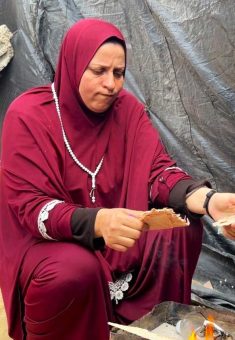
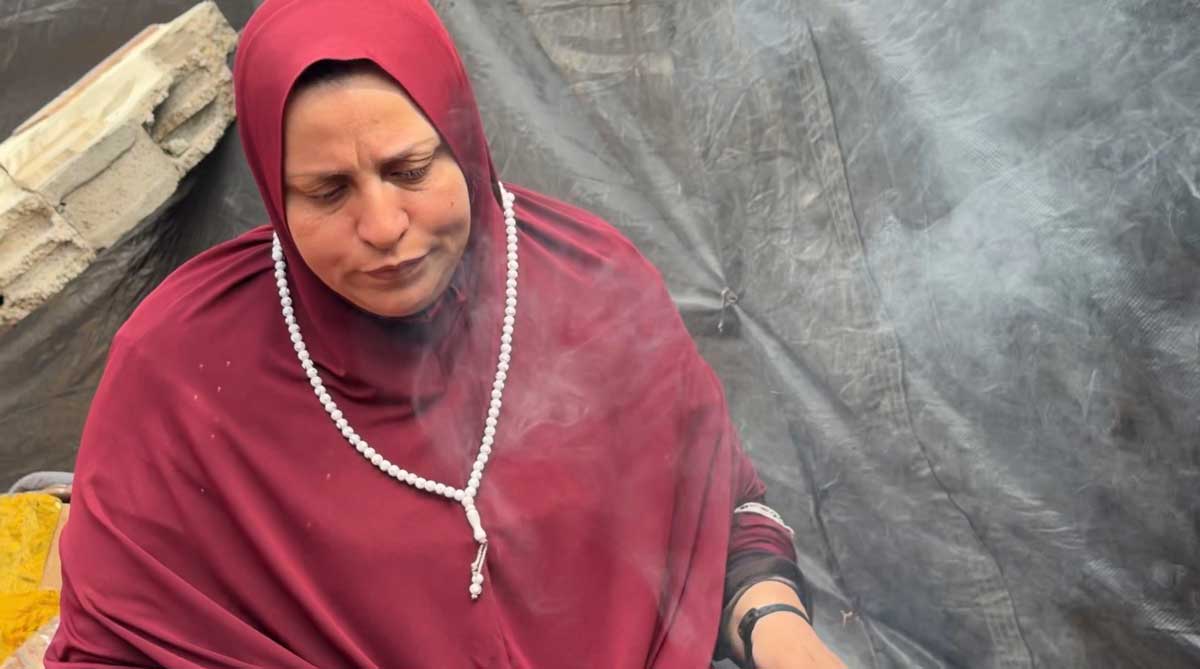
And I haven’t even spoken about our suffering in winter. The cruel cold is killing us. Rainwater seeps into the tent and floods our clothes and our food. I look at the tent sinking in water and don’t know what to do. I have no choice but to resign myself and say: “I’m like the other women here.” I spend the whole day in front of the fire, to heat water for my children’s showers, to cook, to bake in the clay oven. I wake up and get up immediately to look for wood and plastic and then light a fire. My children also spend the day looking for plastic and wood so that we can make a cup of tea.
Now the month of Ramadan is approaching. This is the first Ramadan since my daughter Fidaa and her family were killed. How will I get through Ramadan without her? How can it be that she won’t be with us around the table? May God have mercy on you, my daughter, and on your husband and your children. May God help me bear the pain of losing you.
In addition, being unable to provide for my daughter Rawaa’s needs causes me great suffering. The markets have everything now, vegetables, fruit, sweets, meat, but my husband is a simple clerk who receives his salary in tattered, torn banknotes that many sellers don’t want to accept, and I can’t buy what I want. Rawaa now has dialysis three times a week at a-Shifaa Hospital, and I can’t afford to buy her the food she asks for or always provide her with clean, safe drinking water, and this breaks my heart. We’re now waiting for a time when we can travel abroad so that Rawaa can have a kidney transplant, which I will donate to her. I hope we manage to travel, that the surgery succeeds, and that my daughter’s suffering comes to an end.
This war has taken everything from me: my daughter, her children and her husband, my self-respect and my sense of self-worth, and my home. I’m homeless now, living on the street. I hate the word tent. I’m not used to this life, and I don’t know how we’ll be able to adapt to life in tents. I hope God helps us and life goes back to how it was before the war, that I return to my home and this tragedy finally ends.
* Testimony given to B’Tselem field researcher, Olfat al-Kurd, on 30 January 2026
Read more: Clinging to what’s left of life: Palestinian women under genocide in Gaza, 8 March 2026