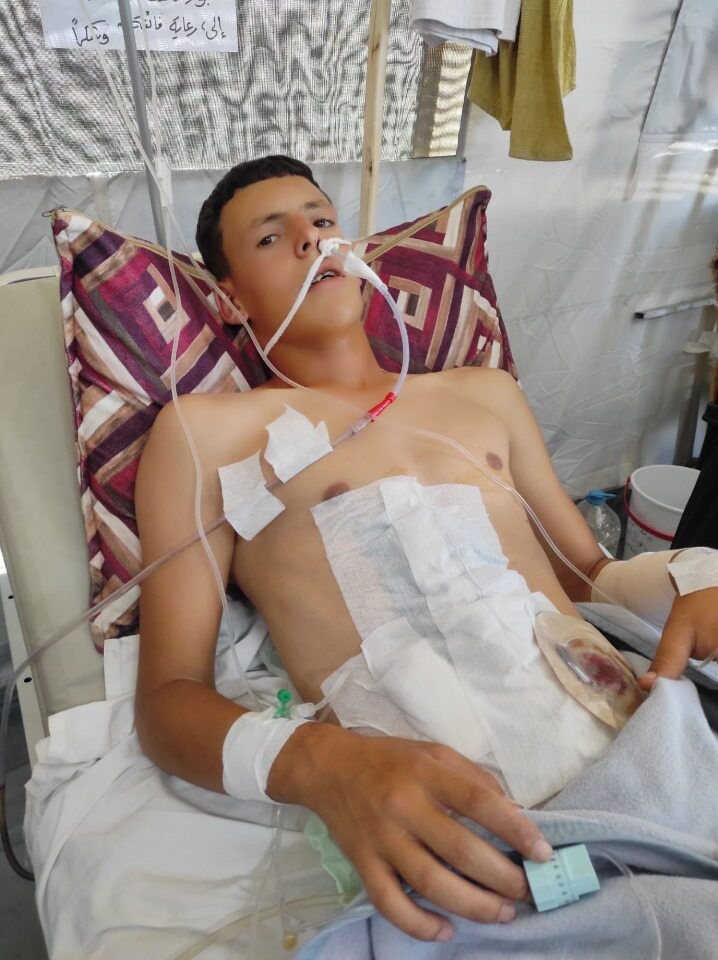
A 19-year-old resident of Rafah, ‘Issa described being severely injured by army fire near a GHD aid distribution site, and enduring displacement, hunger and harsh living conditions:
I live with my father, Iyad, 48, my mother, and three siblings: Firas, 22; ‘Amer, 16; and Shadi, 9. Up until the war, we lived in a five-story building in Rafah together with my uncles and cousins – there were 50 of us in total. Our lives before the war were simple and quiet. Even with all the difficulties, we had a home that provided us shelter, and neighbors we loved and who loved us back. My father hasn’t worked in many years because of his health. We didn’t have a source of income, and we lived off aid from different organizations. It wasn’t really enough for a six-person family.
When the war started in October 2023, the army bombed the whole Gaza Strip incessantly, including Rafah. It wasn’t quiet even for a second, not during the day and not at night. Also, the army immediately started expelling people from the north to Rafah. UNRWA schools became extremely crowded refugee centers. The whole time, we lived in our house and mostly subsisted off UNRWA aid. We tried to also sell canned foods and basic foods in stalls to buy basic necessities.
On 6 May 2025, the Israeli army announced they were going to attack Rafah and ordered all the residents to flee. Our lives turned into a real nightmare. The army bombed the city all the time, and missiles hit buildings that crumbled on their residents. When the bombs started falling near us, we had fled too, under fire. We only took some clothes and blankets with us.
We evacuated to an encampment in the al-Mawasi area of Khan Yunis, next to the British field hospital that was set up in the area where the Fish Fresh restaurant used to be. Life in the IDP camp is very difficult. There aren’t even the most basic living conditions. We share the bathrooms with many people, and to bake we have to make a bonfire. We don’t have mattresses and there’s barely any shelter from the sun and cold. For many months we slept on the ground and covered ourselves with the few blankets we managed to bring from home. We kept hoping the army would retreat from Rafah and we’d be able to go home, but that hope is now very distant.
Even during the ceasefire in January 2025, we couldn’t go home to Rafah and the bombings continued around us the whole time. Our hunger got worse after the army closed the border crossings and blocked the entry of aid on 2 March 2025. We don’t have any flour left, food has disappeared from the markets, and everything has become very expensive.
On 18 March 2025, the war resumed and the situation got even worse. We could no longer buy flour, vegetables, sugar, oil, rice, or salt. Even before the war, we barely got by, and during the war we’ve become destitute. The absolute poverty and helplessness are wearing us down, and the hunger gnaws at us and causes terrible suffering. Most of the time we can’t even get a loaf of bread. My brothers suffer a lot from hunger and complain constantly. At times we’ve had nothing to eat for two or three days, and only added salt to drinking water because it eased the feeling of hunger a little.
When the hunger became unbearable, people started going to the aid distribution sites that the army set up hoping to get some flour and food. We didn’t have a choice, even though we knew those places are death traps surrounded by snipers and drones.
On 1 June 2025, at 4:30 A.M., my brother Firas, two friends, and I started walking towards the aid site next to al-Alam Square in western Rafah. We walked about 3 kilometers with thousands of other displaced, hungry people, until we arrived at the al-Aqawah neighborhood, which is about 200-300 meters from the distribution site. Suddenly, drones surrounded us and started shooting live fire. I was injured from a bullet that penetrated and exited my left hand. I turned around to look for my brother Firas and escape the shooting, and then a sniper shot me from about 300 meters away and hit me in the back, next to my spinal cord. The bullet exited through my stomach. There were three snipers there, and they knew very well that we were hungry, unarmed civilians who were there just to get aid.
I fell down, bleeding heavily. I understood that I was critically wounded, and was sure I was going to die. I started reciting the shadatein. My brother tried to stop the bleeding, but he didn’t have anything to use. He looked for people to help him take me to the hospital, but everyone around us ran away. The situation was so bad that people stepped on dead bodies while running away. There were about 20 corpses next to me and dozens of wounded people. I was certain I’d die, too.
My brother started crying out for help, but no one dared get close. He carried me until he managed to find a donkey cart and put me on it, until the donkey was injured too, and then he carried me again, looking for help. I was still bleeding heavily. Only about half an hour later, a tuk-tuk showed up. My brother begged the driver, offering him 4,000 shekels [~1,180 USD] – money we don’t have – just to take me to the hospital. My brother was willing to sacrifice his life to save mine.
The tuk-tuk took me to the Red Cross field hospital next to the Fish Fresh restaurant, where dozens of wounded people had already turned up. Without the mercy of God and without my brother Firas, I wouldn’t be alive. When I got there, the doctors immediately took me into the operating room, stopped the heavy bleeding from my back, and took out part of my intestine that was injured. They saved my life.
I’ve already had three back surgeries. I have difficulty breathing because I have a nasogastric tube inserted through my nose, and the doctors said it will be a long time before I can walk again because the bullet hit only a few centimeters from my spine. I can’t sleep because of the pain.
I only went to the aid distribution center to try to get some food, and it almost cost me my life. We have nothing to eat. What happened to me and to others that day near the aid distribution site was not a one-time incident – it’s an ongoing crime against us. The war has taken away our home, our safety and our livelihood. I have no home, no food, and no hope of living with dignity. I just want this war to end and for us to be able to get food easily and with dignity.
* Testimony given to B’Tselem field researcher Muhammad Sabah on 5 June 2025