A 28-year-old mother of five from al-Bureij Refugee Camp, spoke about losing her husband when their house was bombed, and her nine-year-old son losing his leg in the bombing of the IDP shelter at the a-Razi school in a-Nuseirat Refugee Camp on 16 July 2024:
Until the war, I lived in al-Bureij Refugee Camp with my husband, Nael Nazir a-Nashash, 33, and our five children: ‘Abd a-Rahman, 9, Layan, 8, Nazir, 6, Dana, 4, and Bayan, 2. On 19 October 2023, there was very heavy bombing in the area where we lived, and we were terrified. We left our home quickly, without taking anything, not even the children’s papers or other documents. We moved to Abu ‘Areban School in a-Nuseirat Refugee Camp.
The next day, my husband, Nael went back to the house with two of his brothers, ‘Ata, 40, and Muhammad, 32, and his cousin Nazir, 20, to bring us mattresses, clothes, and other things. While they were there, the military bombed the house. It was completely destroyed and all of them were killed.
I stayed with the children in Abu ‘Areban School for about three months. Two families lived in one classroom, about 30 people in total—around 20 children and the rest women. My children and I slept on blankets on the floor and suffered greatly from the cold, because we had fled with no warm clothing, bedding, or blankets. Conditions in the school were harsh. The classrooms and toilets were filthy, and there was always a long line for the bathrooms. My children suffered from digestive problems and skin diseases.
When I heard that the military was about to invade a-Nuseirat R.C., we moved to Rafah. We lived there in a tent in the Tel a-Sultan area. The tent was small, barely enough room for two mattresses, and rainwater leaked inside. We suffered terribly from the cold and from insects, and had to use a bucket as a toilet because there were no facilities. We lived mostly on canned food, fava beans, tuna, luncheon meat. I cooked on a fire with wood, until my son Nazir burned his leg from the flames, and then I stopped cooking.
When the Israeli military began invading Rafah, I returned to a-Nuseirat R.C., this time to a-Razi School. It was extremely crowded.
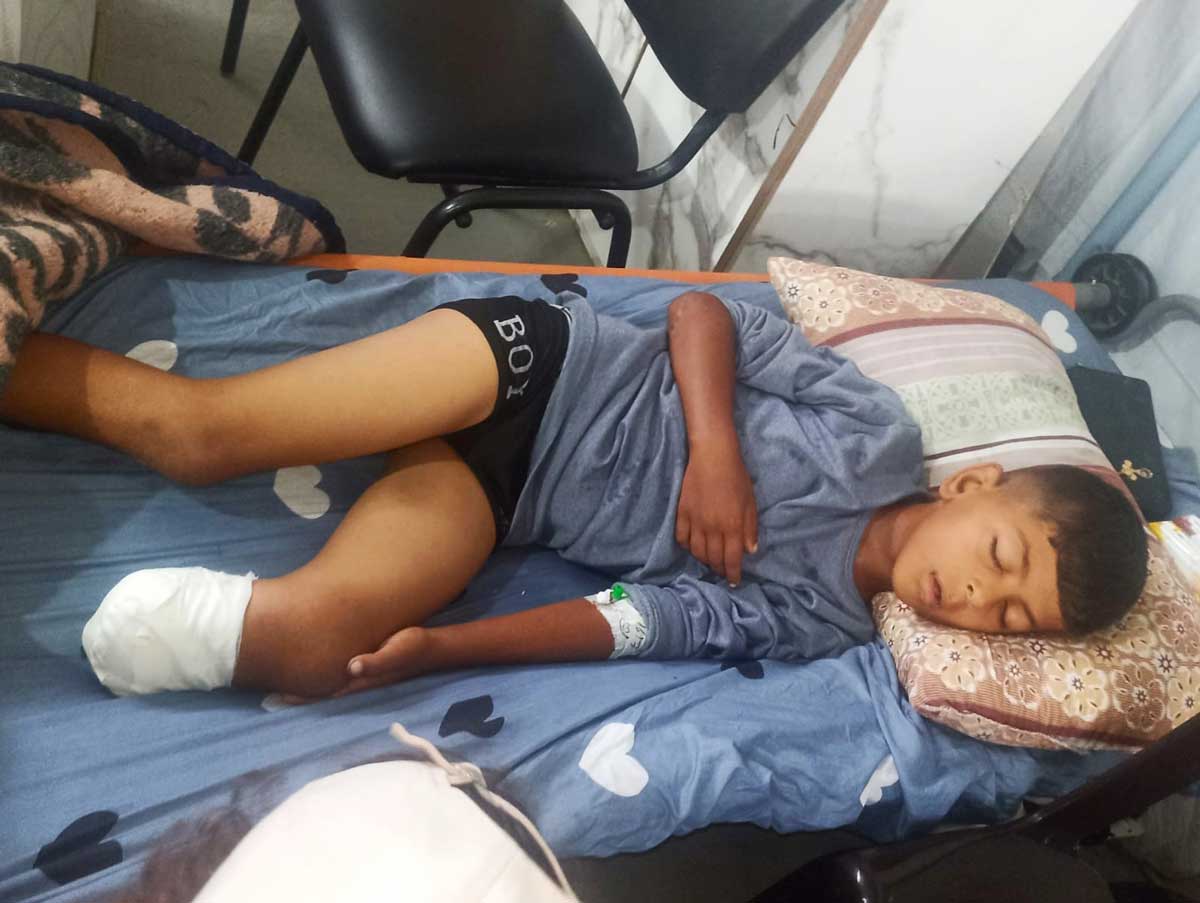
On Tuesday, 16 July 2024, at around 2:00 P.M., the military suddenly bombed the schoolyard. I was in the kitchen tent with my daughters when it happened, preparing lunch. During the bombing, I fell to the ground and clutched my three daughters to shield them from the debris falling on us. My son ‘Abd a-Rahman was in the yard. He worked at a small stall there to help support us after his father’s death. My son Nazir was playing outside the tent.
When I managed to get out of the kitchen tent, I started screaming and looking for my sons. I saw bodies on the ground, and the schoolyard was covered in blood. I found Nazir safe and sound, but feared that ‘Abd a-Rahman had been killed because he was in the area that was bombed. People told me he had been severely injured in the leg and had just been taken by ambulance to the hospital. I ran frantically to the road, managed to catch the ambulance evacuating him, and went with him to Shuhadaa al-Aqsa Hospital in Deir al-Balah. There, the doctors decided to amputate ‘Abd a-Rahman’s left leg below the knee, and he was taken into surgery.
I was in terrible distress, and when I saw ‘Abd a-Rahman for the first time with his leg amputated, I fainted. He was discharged from the hospital after ten days. We’re still living in the IDP shelter at a-Razi School, which was bombed, because we have nowhere else to go. There is no safe place anywhere in the Gaza Strip.
* Testimony given to B’Tselem field researcher Khaled al-‘Azayzeh on 20 August 2024