A 21-year-old student from Khan Yunis, speaks about being repeatedly displaced with his family following Israeli military orders until they were hurt in a shelling, in which he lost his father, a brother, three sisters and other relatives
Up until the war, I lived with my parents and six younger siblings in a-Sater al-Gharbi area in Khan Yunis.
On 2 December 2023, the army dropped flyers in the area, telling us to evacuate, and we did. That night, before sunset prayer, my family and I left our house. My uncles, whose houses were near ours, refused to leave because they had nowhere to go.
My family and I walked to my maternal grandfather ‘Abd a-Latif’s house. He’s in his eighties, and he lives south of Khan Yunis. Grandfather’s house had four floors, and there were about four families in each. We were on the ground floor with 25 other relatives. It was very crowded there, and there was a shortage of water, electricity and food. We only got running water once a week for about six hours. When the water came, we’d fill up pots and dishes, whatever we could. We went to Naser Hospital twice a day to charge batteries for lights.
On 4 December 23, we found out the Israeli military bombed my paternal grandfather Mahmoud ‘Abd a-Ghafur’s house, which was luckily empty. It was a three-story house in the al-Majaideh area in Khan Yunis.
On 7 December 2023, neighbors called and told us the army had bombed my uncles’ homes in a-Sater al-Gharbi area in Khan Yunis and more than 30 of our relatives were killed.
The next day, there were bombings around my grandfather’s house where we were staying, so we moved to my father’s uncle’s farm near the al-Qararah port. We cleaned up a hothouse and settled in it. It’s a two-dunam (1 dunam = 1,000 sq. meters) farm and each three families got an area in it to share.
We stayed on the farm for about four months, even though tanks shelled there almost every day, and shrapnel landed there. We lived there in fear and left only for essential things, like getting food. We mostly relied on the aid that was handed out to the IDPs.
It was very cold there too, and we had no mattresses or blankets. We had to leave everything behind when we left my grandfather’s house. So we put on several layers of clothing to keep warm.
Then, one Thursday, at the end of December or the beginning of January, I’m not sure, we heard bombings and shouting close to us at night. I went with my father and my cousin towards the voices and shouts. We walked about 100 meters, and suddenly, we saw a bombed structure in front of us. There was a wounded man there and his three daughters, who’d been killed. We got him out of there and came back the next morning and found his daughters’ body parts. They were from the Masalha family and had been displaced from the al-Qararah area.
On Saturday, 9 March 2024, we heard from neighbors that the Israeli army said it was going to invade the al-Mawasi area, west of al-Qararah. This time, we refused to evacuate. There were a lot of us, mostly women, children, elderly people and people with special needs, and there was nowhere left to go.
That night, we said the evening prayers and sat down together, like we did every night. And then, at night, missiles fired from an airplane hit close to the farm, and half an hour later, tanks started shelling the area. We went through a terrifying night. The children screamed. When dawn broke and things calmed down a little, we fell asleep. I woke up when it was still dark, from my sisters’ screams. I got up, turned on a flashlight, and saw my father, Munir, 49, and my sister Shaimaa, 14, both severely wounded in the head.
We were all in shock and stood there, looking at them, not knowing what to do. My cousin, Mahmoud ‘Abd a-Ghafur, 19, tried to call an ambulance, but no one answered.
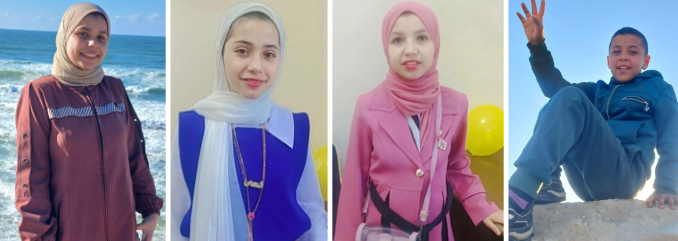
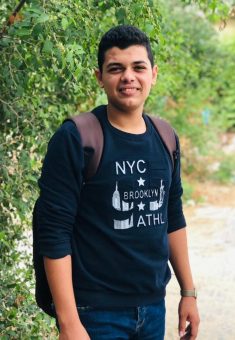
After about ten minutes, there was another explosion. I think it was a tank shell. I was outside the tent just then, with my uncle Samir, 46, my mother, my sister Alaa, 18, and my brother Muhammad, 10. Samir was hit by shrapnel in the chest and fell to the ground. I went into our tent and discovered everyone who was in it had been hurt or killed. My three sisters, Afnan, 16, Shaimaa, 15, Duha, 13, my brother Mahmoud, 16, and my cousin Mahmoud, 19, who tried to call an ambulance earlier - they were all killed. My uncle’s wife was hurt in the leg and her son, Ahmad, 15, was hurt in the right thigh. It was a horrifying scene. It was all I could do to hold it together and not break down there. I couldn’t take care of the wounded because I was afraid they’d shell us again. I had to just abandon them. I went out and took my mother, my brother Muhammad, my sister Alaa and my uncle’s sons, ‘Omar, 5, and ‘Abd a-Latif, 9, and we walked towards the sea, to our relatives’ tents.
When we reached them, I told them what happened and then we went back to the farm. Some of them rode a tuktuk. My cousin and I rode in a horse-drawn cart. When we got there, we started checking on the victims. We took the wounded and the bodies in the tuktuk and the cart to Shuhada al-Aqsa Hospital in Deir al-Balah. There were dead and wounded everywhere along the way.
At the hospital, they pronounced the death of my father, three sisters, Mahmoud my brother, Mahmoud my cousin, Sidqi, who was the head of our extended family, his daughter Najwa, 30, and two more relatives, Ilham Yunes ‘Abd a-Ghafur, 25, a mother of two young children, and Ahmad Sidqi ‘Abd a-Ghafur, 35, married and a father of five, who was severely wounded and died the next day.
More than 12 members of the family were wounded. Ten were treated and discharged that same day. Two were more badly wounded: My cousin, Khaled Samir, spent three days in intensive care and then got surgery. He was discharged after 10 days. My aunt Maqbulah, 72, who was injured and was also suffering from a pelvic fracture, was kept in the hospital for three days and then discharged too.
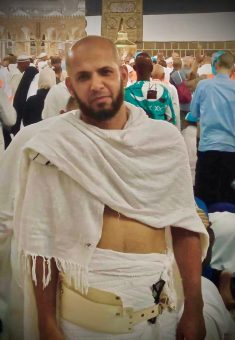
That night, I lost my father, three of my sisters, my brother and my cousin. My father was an imam and preacher in the mosque and worked for the waqf. My sister Duha was a seventh-grader, my sister Afnan was a tenth-grader, my sister Shaimaa was an eighth-grader, and my brother Mahmoud was a fourth-grader. My cousin Mahmoud Samir was a second-year university student.
On 18 April 2024, my mother, my sister Alaa, my brother Muhammad and I managed to get out of the Gaza Strip and go to Egypt, and now we’re here in Cairo.
* Testimony collected over the phone by B’Tselem field researcher Khaled al-’Azayzeh on 12 May 2024
Samia ‘Abd a-Latif ‘Abd a-Ghafur testimony, ‘Abd a-Rahman ‘Abd a-Ghafur mother