A 52-year-old father of seven describes extreme hunger in an IDP camp in northern Gaza where his family are sheltering since their home was hit in a bombing
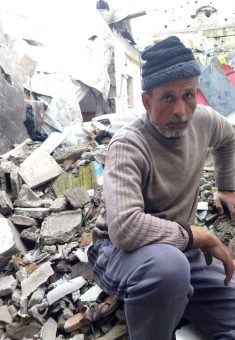
A 52-year-old father of seven describes extreme hunger in an IDP camp in northern Gaza where his family are sheltering since their home was hit in a bombing
My wife and I have four daughters and three sons. Up until the war, we lived in Jabalya Refugee Camp and I worked in Israel. At the beginning of the war, we didn’t leave our home. We heard the Israeli bombings non-stop and it was so frightening, we didn’t dare step outside. On TV, we saw people being killed in their homes and on the streets, and many people who were displaced from their homes and moved to other parts of the camp or to Gaza City and southern Gaza. We have no relatives or friends in the south, so we preferred to stay home. We also heard from people there was an Israeli military checkpoint on Salah a-Din Road, which leads to southern Gaza, and that there was shooting there all the time, too. It was very dangerous outside, and we lived in constant anxiety.
In early January 2024, our neighbor’s house was bombed and our house was damaged, too. Everything we had was burnt, and there was nothing left to take away. Everything was ruined. It was a single-story house that I built gradually and put my whole life into. We had to move to an IDP camp in a school in Jabalya. We slept in one of the classrooms, in terribly crowded conditions, literally on top of each other. Some days, I slept on a chair outside the classroom just to avoid the overcrowding. There were thousands of people there, all displaced from their homes like us. While we were there, diseases spread because of the lack of cleanliness and water.
We spent a month there, and then we moved to a different IDP camp, here in al-Falujah. There is no food or water here. In fact, there’s nothing here. You can’t get food in the market, either – no canned food, flour or rice. There isn’t even barley left. Sometimes, we manage to find khubeiza growing by the roadside or in fields and we pick it. If we manage to find some cardboard or wood to make a fire, we cook it in water and then eat it for a day or two and at least manage to sleep better at night. We used to eat khubeiza maybe once a year, and now it’s almost our only source of food. In the last four days, we didn’t sleep at all because we’re so hungry. We didn’t eat a single thing. We couldn’t get any food. All I do is look for food, all the time, and I can’t stop thinking about at night, either.
Everyone here in the camp is pale with hunger and can barely stand on their feet. Diseases like viral hepatitis have already broken out here. A lot of people are nauseous and dizzy with hunger all the time.
Add that to the incessant bombings and the fear of death all around here.
I haven’t showered in 10 days because there isn’t always water, and when there is we save it to clean the toilet. A six-liter jug of water that isn’t really fit to drink costs five shekels (~ USD 1.4). That’s a lot of money for us. My son Yusef, 17, walks about a kilometer to a place where you can fill up water, and waits in line for hours just to fill two jugs you have to pay for. We use one for drinking, even though the water isn’t clean, and the other for bathing. The children are still wearing the same clothes they had on we left home, and we don’t have enough water to wash them.
We can’t give our children anything. We can’t provide for their needs, and it feels terrible. This is our life now. Every morning, we wake up to another depressing day of looking for food.
*Testimony given by phone to B’Tselem field researcher Muhammad Sabah on 20 February 2024