A 49-year-old father of four from Beit Hanoun, a-Za’anin recounted the killing of his son by tank fire during the distribution of sacks of flour in the northern Gaza Strip on 17 June 2025:
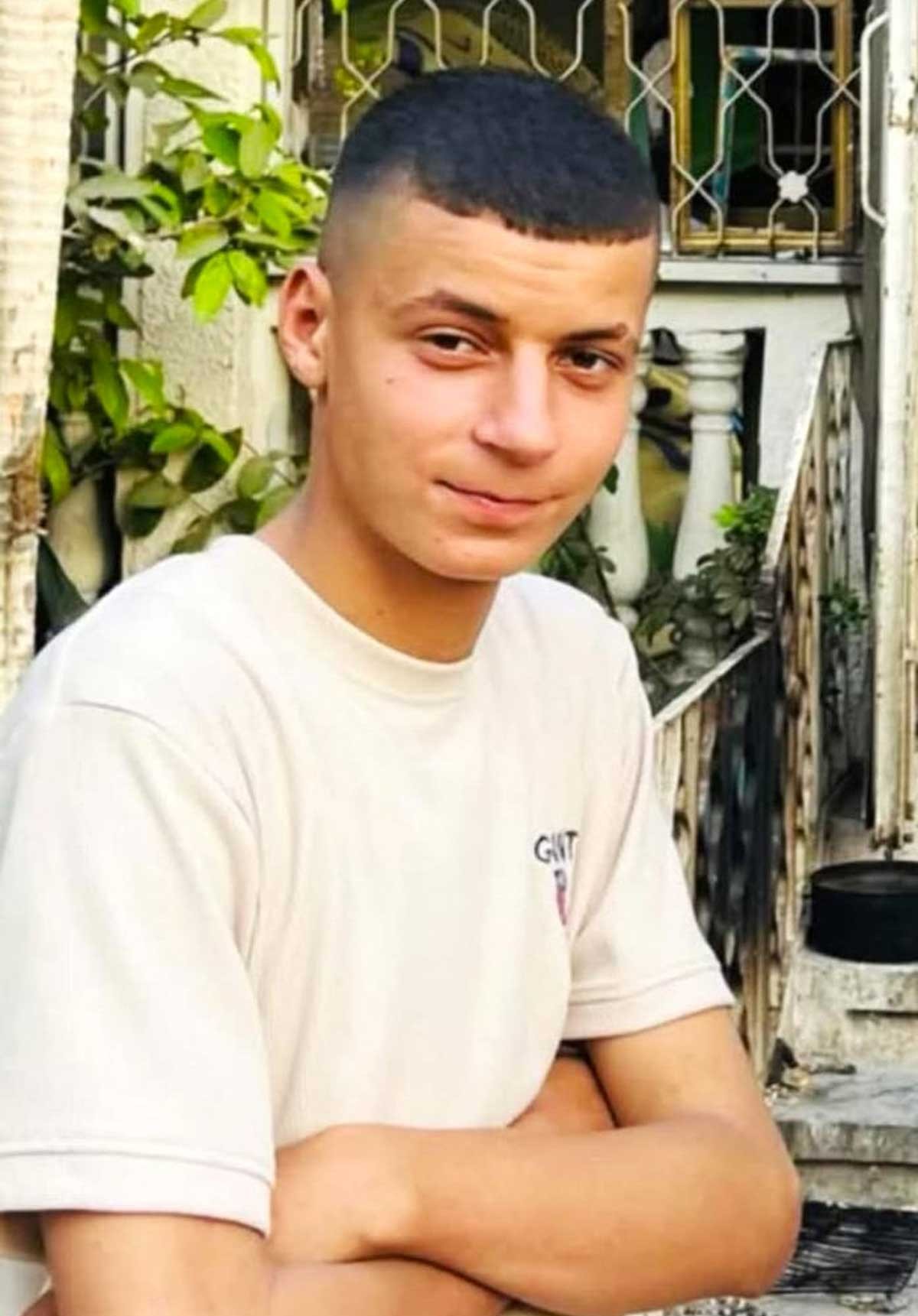
Up until the war I lived with my wife, Haniyeh ‘Othman, 48, and our four children – Dina, 22; Lana, 21; and twins Mustafa and Yamen, 19 – in the town of Beit Hanoun in the northern Gaza Strip, close to the border and to Erez Crossing. When the war started, my wife wasn’t with us. She had just left the Strip to accompany her sister while she received treatment for colon cancer.
Already on the first day of the war, the relentless shelling made us leave our home in the north immediately. In the beginning, my children and I moved to our relatives in the western part of Gaza City, and we stayed there for about 20 days. When the Israeli army attacked that place, too, we moved to a storage unit in Khan Yunis. After that, I rented an apartment in the town of al-Qararah in Khan Yunis District, and we lived there for about two months until the army ordered us to evacuate the area. This time, we went to the city of Rafah. On our first day there, we stayed on the street, and after that I rented an apartment where we lived until they invaded Rafah. Then we moved to the center of the Strip, to the city of Deir al-Balah, where I set up a tent. We lived there until the ceasefire was announced in January 2025.
The period of being displaced and moving from place to place was filled with suffering and pain. I felt a burning injustice. We are still suffering – fear, hunger, difficulty finding water. We also really feel my wife’s absence, and carrying this heavy burden alone is a torment. My wife is also really suffering from being so far away and fearing for us. She makes sure to stay in touch and check in all the time, but we all miss her so much.
During the ceasefire, we returned north and I went to Beit Hanoun to check on our house. There was nothing left, just rubble. I rented a small apartment in a-Sheikh Radwan neighborhood, in the western part of Gaza City, and that’s where we’re living now. When the ceasefire began, things got better and food was more available. But then Israel closed the crossings and the stores emptied again, and then the war resumed. The relentless noise of bombing and shelling, screams and ambulance sirens, became our daily routine again. Now, it’s truly starvation. You can’t buy 25-kilo sacks of flour any more. We buy a 1-kilo sack at insane prices, and share bits of bread between the whole family so everyone eats. Vegetables are very expensive and we buy one piece of each kind. We eat two meals a day, one at 3:00 P.M. and a lighter meal at night.
But even with the terrible conditions and the hunger that’s killing us, it never crossed my mind to go to the aid distribution centers that the Israeli army set up, and I don’t allow my children to go, either. Those places are death traps, on top of the chaos, the gangs and the thieves on the way.
On 17 June 2025, my son Yamen, who worked as a security guard at al-Awda Hospital in Jabalya, went out. I thought he was going to a-Rimal market to buy clothes to celebrate his sister Dina’s engagement, which was planned for the next day. After two hours I called to ask how he was doing, but someone else answered the phone and said that Yamen had been wounded near an aid distribution center in the area of a-Sudaniyah [Zikim] in the northern Gaza Strip, and taken to a-Shifaa Hospital.
His twin brother, Mustafa, and I quickly went to look for him at the hospital. With every step I felt like my soul was leaving my body. We looked for him among the wounded and didn’t find him. We went to al-Ma’amdani Hospital and he wasn’t there either. Then we went back to a-Shifaa, and there, we found him in the morgue. Those were the hardest moments of my life: the moment I found out Yamen was injured, the moment I found him lying in the morgue, and the moment that – only God knows how – I found the strength to call his mother and sisters to tell them he’d been killed.
Yamen’s friends told me they’d gone together to the aid center, even though I forbade him from going. There was firing there from tanks, shells and machine guns, and people were killed and injured. Yamen tried to help one of the wounded, and was injured in the process. The bullet hit him in the waist and he was killed instantly. My son Yamen was shot dead only because he went to get aid, only because he wanted to bring his family flour, only because he tried to help someone who was wounded.
The next morning we took Yamen from the hospital to our home and said goodbye to him in terrible pain – me, his brother and his sisters. My daughter Dina was in complete shock. Her joy around the engagement turned into grief. After the funeral, I set up a mourning tent.
Yamen was very loved. He was sensitive and social, generous and brave. His presence in our home was pleasant and comforting. Every corner of our house reminds me of him. Sometimes, we forget he’s gone and call him to come sit with us and eat. We suffer his loss every day, every moment, every place. Our whole family is struggling to cope together with the loss – my wife too, over the phone. We promised to support and help one another, to stay strong so that we can overcome this terrible loss. I pray to God for strength to bear the loss.
* Testimony given to B’Tselem field researcher Olfat al-Kurd on 29 June 2025