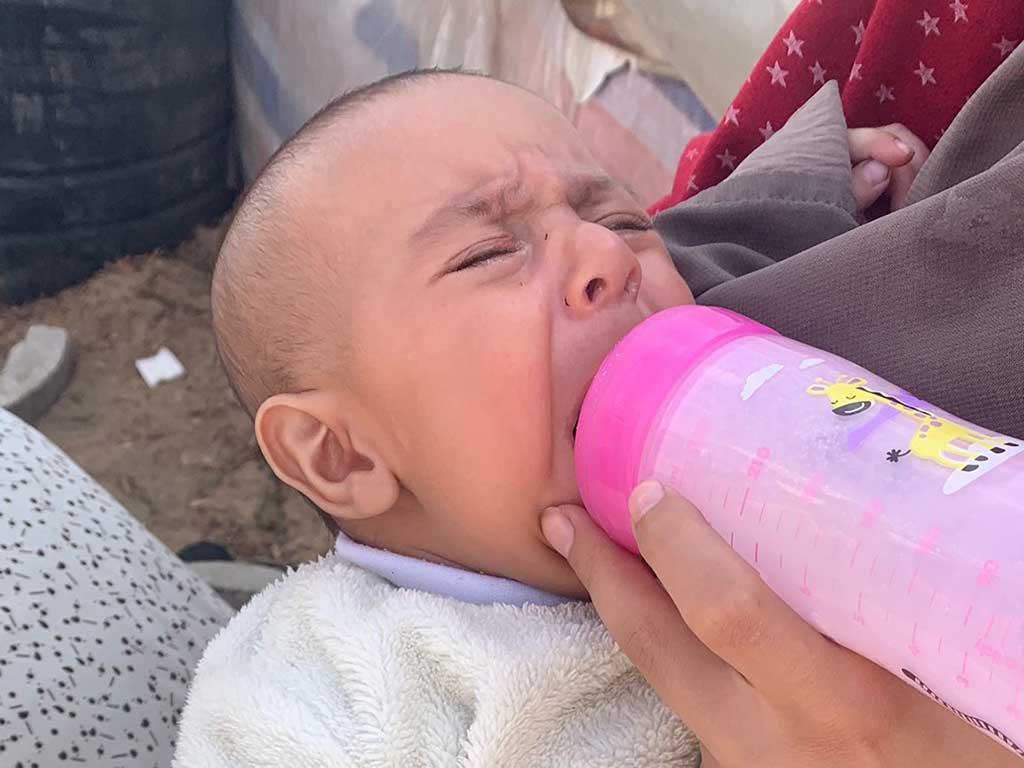
A 30-year-old mother of three from a-Shati Refugee Camp, Riwaa described giving birth to her son amid war and being unable to help her children who suffer from health issues:
Until the war, I lived in a-Shati R.C. in Gaza City with my husband, Muhammad al-Qau’d, 33, and our two older children, ‘Abd a-Rahman, 10, and Aylul, 7. ‘Abd a-Rahman has two congenital conditions: two holes in his heart and esophageal atresia.
On 9 October 2023, two days after the war broke out, I gave birth to our third son, Wisam, at the Assahaba maternity hospital. The hospital wasn’t functioning normally because of the bombings, and there was a shortage of doctors in the operating rooms. They kept the anesthetics for people who were injured in the bombings. I had to have a C-section without general anesthesia, and the pain was insane. I needed blood transfusions, but the hospital didn’t have any. Because they couldn’t find a donor, I didn’t get a transfusion. I heard fighter planes and bombs while I was giving birth.
Because there were too many patients and not enough doctors, I was discharged the day after the surgery. I was exhausted and my hemoglobin was very low. I couldn’t even walk. I waited for an hour at the entrance to the hospital with my husband and sister, until we found a car. Then we went to my family’s house on al-Jalaa Street in Gaza City, because it was safer and our children were already there. When we got there, there were about 40 people in the house – my aunts and uncles on my mother’s side who were sheltering there. Because of the bombings, everyone was afraid to go shopping, so there was barely any food and I mostly ate bread with jam and halva.
The stitches hurt a lot, but it took about 17 days for me to find a nurse to take them out. We stayed in my family’s house for about a month, without electricity or running water and with the communications down, while the area was constantly being bombed. Shrapnel from missiles penetrated the house. In the end, we realized we had to go south.
On 10 November, we left the house and headed towards the Netzarim checkpoint with my parents and my sisters, 11 people altogether. Wisam screamed and cried the whole way, because he was hungry. The soldiers at the checkpoint ordered us to stand without moving. I held Wisam in one arm and used the other to hold up my ID card. I was exhausted and still weak from the surgery, and also because my hemoglobin was still low. They kept us at the checkpoint from 10:00 A.M. to 4:00 P.M., and only then let us carry on.
We made it to my sister’s house in the area of Bani Suheila, near Khan Yunis. She’s abroad and the house was empty. We stayed there for a week and a half, but there was constant bombing there too, and the windows shattered on top of us. Then the military scattered flyers ordering to evacuate from there, too.
All that time, I had trouble getting Wisam infant formula. When I did get hold of some, it wasn’t always the same kind. Wisam had a hard time adjusting to the changes. He had terrible stomach aches and cried a lot at night. The cost of infant formula also made it very difficult for us – 30 to 40 shekels (~ USD 8-11) per container.
On 21 November, we moved to the IDP camp at the UNRWA training center in western Khan Yunis. My mother’s sister was already in a tent in the camp, and we spent the first night with her.
The next day, we got hold of a tent and we’ve been living in it for two months. The conditions are unbearable. It’s a very simple tent made of plastic sheeting and cloth tarps, and there are 11 of us sleeping on the sand huddled together. It’s very cold. There are no toilets, and you have to go to the public toilets and stand in line. This is how I’m live now, with two young children and a newborn baby. Wisam didn’t even get the vaccines a baby his age is supposed to get, because they’re not available here.
It’s very hard to get hold of formula or diapers here, too. At first I was given a donation of diapers, but we used them all. Even when you do find diapers, they’re very expensive – 120 shekels (~ USD 33) a pack instead of 20 (~ USD 5.5). We can’t afford it, so I’ve been using cloth for diapers for Wisam and he has a bad rash.
Wisam still has stomach aches, and I still haven’t found a formula that works well for him. We go out looking every day, but can’t find any. He cries day and night, from stomach pain, hunger, cold, diaper rash – it’s hard to tell. Because I’m weak, my mother and sisters take turns trying to calm him.
A few days ago, I took Wisam to the doctor here in the camp. He prescribed eight rounds of inhalation, one a day. I took Wisam to the European Hospital east of Khan Yunis, and he got one round of inhalation. Then we came back to the IDP camp. I didn’t want to stay there because I was afraid the hospital would be bombed, so he didn’t get the rest of the treatment.
‘Abd a-Rahman isn’t doing well, either. He vomits most of what he eats. Before the war, he had some tests done at a hospital in Gaza and he was supposed to get an endoscopy done in November. Obviously, that didn’t happen because of the war. Because of ‘Abd a-Rahman’s problems, I’m constantly worried that Wisam has an even more serious condition, but there’s no real way to check here.
Wisam has grown and all the clothes I had are too small for him, and not warm enough. ‘Abd a-Rahman and Aylul are also suffering from the cold and need warmer clothes. I went all the way to Deir al-Balah to look for clothes for everyone, but couldn’t find any.
* Testimony given to B’Tselem field researcher Olfat al-Kurd on 5 January 2024