A 35-year-old mother of four from a-Shati’ R.C., west of Gaza City, Rajaa recounted the night a tank ran over and killed her husband and two of her sons. She and her two other children were injured.
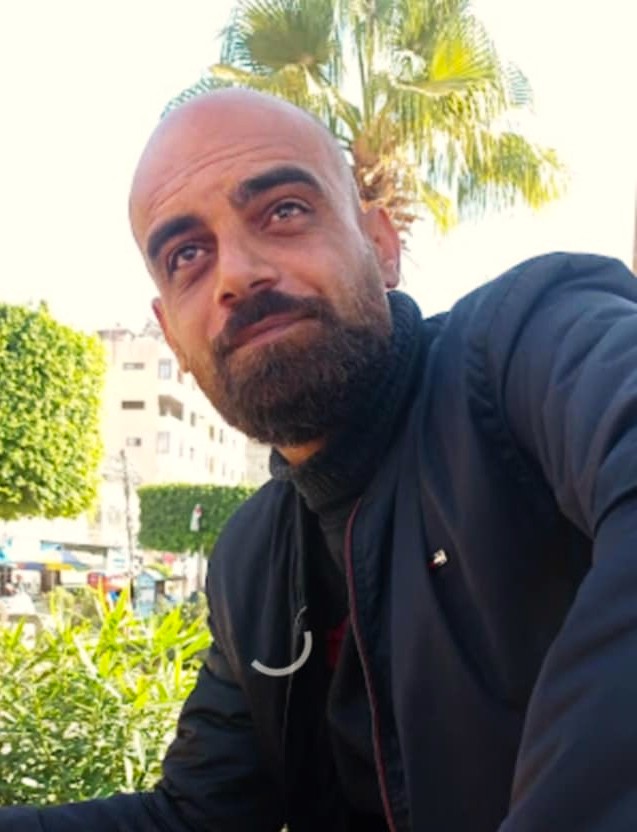
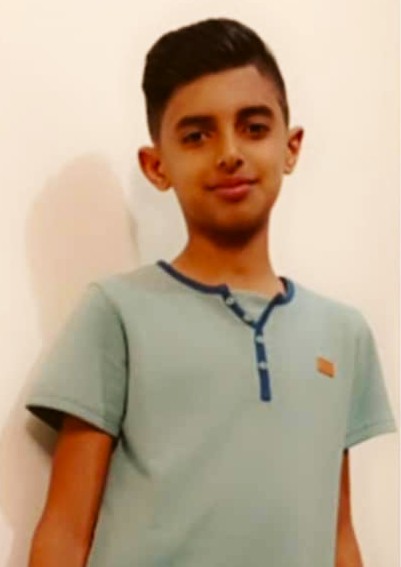
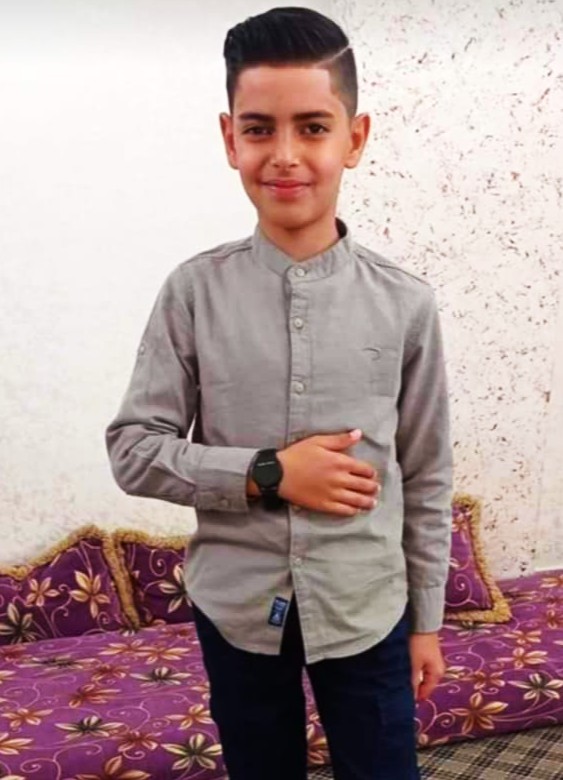
Before the war, I lived with my husband, Akram al-Harbiti, 39, and our four children – Muhammad (14), Ahmad (11), Ibrahim (6), and Sanaa (3), in a-Shati R.C. – in the northwest of Gaza City.
Three days after the war began, we moved to my brother-in-law’s house in a-Shati because there was heavy bombing near our home. We crowded into his small house with about 20 other displaced people. The next day, we decided to go to an UNRWA school in the a-Nasser neighborhood of Gaza City. We stayed there for ten days. Because of the overcrowding, lack of water, constant airstrikes, and little access to bathrooms, we decided to move again. My daughter, Sanaa, and I suffer from angina and I also have high blood pressure. The conditions were too hard to bear. We moved to my husband’s friend’s place in a-Shati, but the situation there was also very bad. Nearby houses were bombed, and there were rings of fire everywhere. We decided to go to my family’s house in Jabalya R.C. The bombings there were also intense. After a week, we returned to the school in a-Nasser. At some point, the army dropped leaflets ordering people to leave the area, and then they invaded western Gaza City and entered a-Rantisi Hospital. We stayed in the school for about two weeks, until Israeli tanks got close. Then we returned to Jabalia Camp, to my family’s house. After we left the school, the army laid siege to it and expelled everyone there. In Jabalya, the situation was terrible–there was shelling and airstrikes from every direction. I can’t put into words how much terror we felt.
On 18 November 2023, we decided to go south. We headed out from Jabalya R.C. toward the Netzarim checkpoint on foot. But before we got there, the army started shooting at everyone who was displaced, so we decided not to go on. We found a school nearby where other families were staying and spent the night there on 19 November. The next day, we continued south. On the way, near the checkpoint, we had to walk over corpses and body parts. We could hear children screaming everywhere. We saw the army stopping and arresting some young men who were trying to move from the north to the south. Eventually, we made it to the entrance of Nuseirat R.C., where we waited for a ride that took us to my aunt’s house–my mom’s sister–west of Khan Younis.
We stayed there for about two months, but then the house got too crowded with displaced people. So my husband, Akram, decided to put up a tent near the UNRWA college, and we moved into it.
On 25 January 2024, the Israeli army stormed the area with tanks and planes. They said it was now an active combat zone, fired in every direction, and told everyone to evacuate. We grabbed our bags and clothes, left the tent behind, and fled to al-Mawasi in Khan Younis. We spent three months there in a tent, under very tough conditions and terrible overcrowding. Even though the army had promised the area would be safe, there was gunfire and shelling every day.
On 24 April 2024, my husband decided we should move to Rafah. We went to an area near the border with Egypt (the Swedish Village). It was relatively quiet there–we could only hear the bombings from a distance–until the night of 6 June 2024, when there was a heavy bombardment of the houses near the Egyptian border by Israeli tanks and planes. My husband, the kids, and I were all terrified. We saw most of our neighbors leaving their tents, but we couldn’t go outside because the shooting was so intense. It was too dangerous.
My husband’s friend, Muhammad Qa’ud, 34, his wife Riwaa Miqdad, 31, and their children–‘Abd a-Rahman, 11, Aylul, 8, and Wissam, who was just seven months old–were living in the tent next to ours. They came into our tent and stayed with us. There were 11 of us in total, all lying on the ground inside the tent.
After some time, things calmed down a bit and my husband’s friend went back to his own tent. I made a meal for the kids, but they were too scared to eat. They told me they’d eat in the morning. My husband sat at the entrance of the tent with Muhammad, and eventually each of them returned to their own tent. We had hung a white flag at the entrance of our tent to show the army that we were civilians. I remember that during that night, we had to go to the bathroom in a basket inside the tent.
Some time after we went to sleep, the bombing got worse. At around 1:00 A.M., I heard a woman call out, “Muhammad,” and then she went quiet. She was probably killed by the heavy fire on the tents. I looked out through the small window in our tent and saw a yellow light. I told my husband that it was coming from bulldozers and that they probably demolished the houses near the camp. I was so scared that I was shaking, and he said to me, “Calm down, nothing will happen.”
During the night, my children were very scared. I asked my son Ahmad if he was afraid, and he said no, but I saw he was trembling with fear. I promised him we’d escape, and we prepared white flags for the road. At around 5:30 A.M., my neighbor Riwaa came by on her way to the bathroom, holding a white flag with her son ‘Abd a-Rahman. She relieved herself and went back to her tent. Just as she reached its entrance, the tanks opened fire in her direction. I heard her call out to her husband, “Muhammad, Muhammad,” and her children cry, “Dad! Dad!”
Then the army started firing toward our tent. My husband, Akram, was hit in the back and started bleeding. I heard my son Ahmad groaning in pain and realized I’d also been shot in my right foot. Suddenly, I saw a tank speeding towards us, crushing my neighbors’ tent – the Qa’ud family – on the way. My brother-in-law, ‘Abd al-Karim, 38, called us. I managed to answer and told him we’d been hit, that my husband was bleeding, and that the tank was coming straight towards us. My husband threw himself over our sons Muhammad, Ahmad and Ibrahim to protect them, while I grabbed my daughter Sanaa by the shoulder, picked her up, and fled the tent. We managed to get about a meter and a half away from my husband and sons before the tank ran over them before our eyes. I grabbed my daughter’s hand, lifted her up, and begged the military not to run us over too, but the tank hit us, and we fell to the ground. I lifted my head and hand, and I was sure I was dying. I couldn’t hear Muhammad, but I saw Ahmad, his back covered in blood, and my husband, who was bleeding from every part of his body except his face. His left hand was severed. He said to me: ‘Raja’, my love, forgive me.’ I answered: ‘I forgive you, ya Akram.’
I looked at my daughter Sanaa. She was barely responding. I told Akram she was dying, and he said to her, “My love, my daughter.” Suddenly, my son Ibrahim came out from behind his brothers and father–he was also covered in blood. I asked him if he was hurt, and he said no. I could see he was shaken by the sight of Akram, who was bleeding all over. I told him to come over and lie down behind me, because I heard the tank charging back toward us. I said, “Pretend you’re dead. The tank wants to run over us again.” The tank passed us and kept going toward the road. I looked over at Akram and saw him reciting the Shahada (“There is no God but Allah”). Ibrahim wanted to join his father in prayer, but I knew Akram was praying because he was dying.
A couple minutes later, I saw a woman walking by, holding a white flag, with children by her side. I begged her to take Ibrahim with her – he was the only one of us who hadn’t been injured – and bring him to al-Mawasi, where his grandfather’s tent was. She agreed and took him. Akram asked her to call an ambulance. She told him there were no ambulances, “only tanks.” In those final moments, he took his last breaths and died. I looked at Ahmad and Muhammad–they were dead too. I knew there was nothing I could do. I myself was injured. I saw that Sanaa had been shot in her right leg and realized she was about to lose consciousness. I started thinking about how to survive this, but the only thought I could hold onto was that I still had my ID card on me, and that if I were to die, at least my family would be able to identify me.
I tried to speak to Sanaa. I laid her on my back and started crawling forward. I crawled about 700 meters until I couldn’t move anymore. We were both bleeding, and I was in terrible pain in my back and left leg. I found a trash bin and stopped beside it. I saw that Sanaa’s mouth, nose, and eyes were full of sand. The sun was blazing, and flies clung to both of our wounds. She pulled on my prayer clothes, put them over her head, and asked me for water and if I could take her to the bathroom. I screamed out, hoping someone might hear us, but no one was around. I knew that if we moved too much, we might be shot because there could be snipers nearby. I lifted my head and saw a man. I called out, “Can anyone hear us?” I told him I was injured. He asked me to crawl toward him and said the whole area was dangerous. I told him a tank had hit me. He promised to help and told me to try crawling toward the sea. I tried, but I couldn’t. I tried using a rope to make a tourniquet to stop the bleeding from Sanaa’s leg. Then another woman passed us holding a white flag. She had children with her. I begged her to take Sanaa to a hospital. She said it would be difficult because the tanks were behind us, but she picked Sanaa up anyway and took her. After that, I heard a voice say, “The man is waiting for you, he wants to help–keep moving toward the sea.” I started crawling toward the asphalt, which was covered in stones. I tried to stop the bleeding in my leg with a rope. I kept crawling until I reached the fishermen’s shacks near the port. A drone was circling above me. I started waving at it, hoping it wouldn’t fire at me.
At some point, two young men arrived to help me. They placed me on a blanket and carried me about two kilometers. At that point, I lost consciousness, and then woke up in an ambulance. I asked the paramedic for painkillers because I was in so much pain, but they didn’t have any. Suddenly I saw a young man in front of me who said, “Sister, don’t be afraid.” I realized it was my brother Muhammad, 20. I asked him about Ibrahim and Sanaa, and he told me the Red Cross had brought them to him and said I’d been injured. At the end of the drive, we reached the Red Cross hospital west of Khan Younis. At first they thought they might have to amputate my leg, but in the end, thank God, they didn’t.
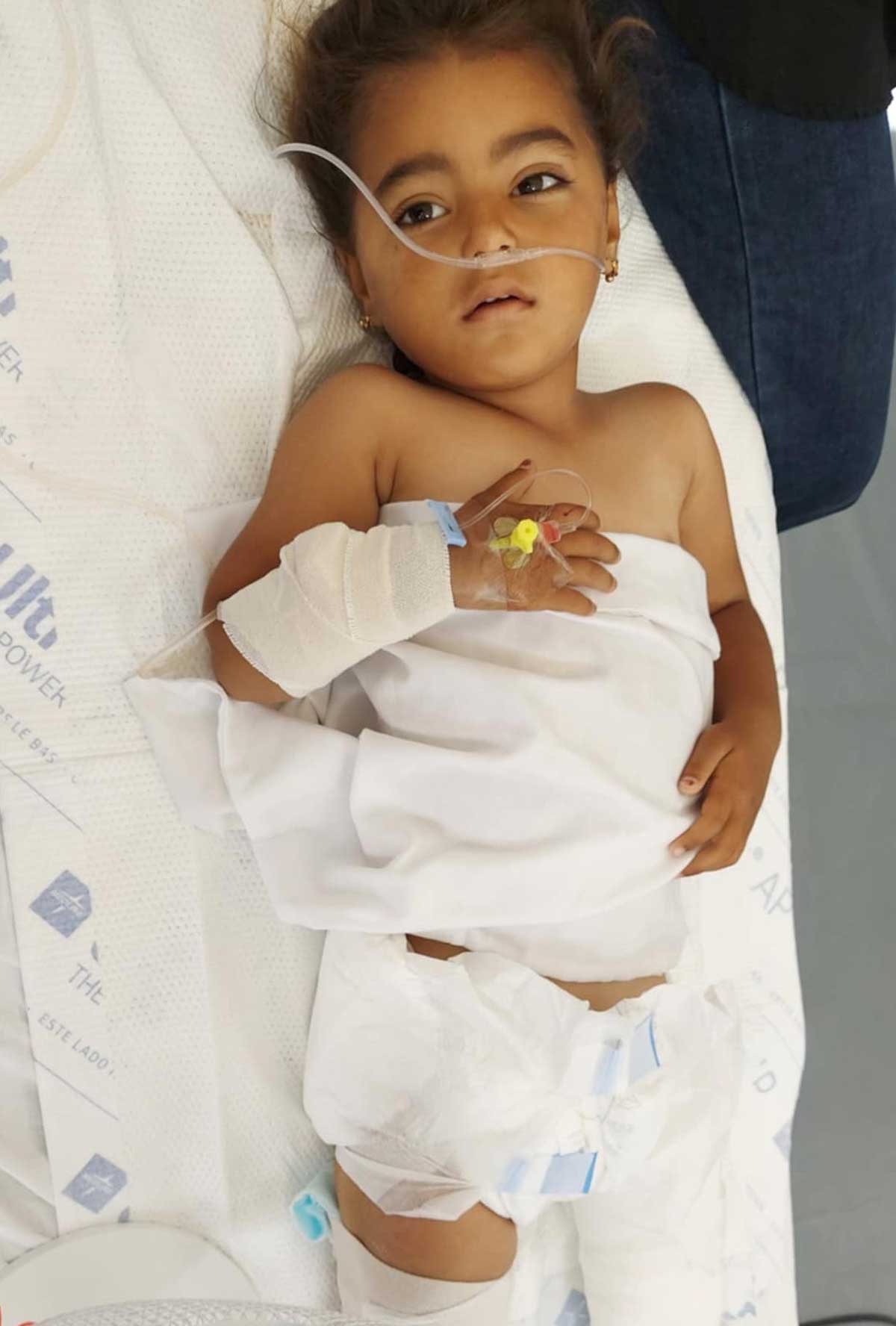
When I woke up from surgery, I asked about Sanaa again. They said she was also in the hospital–she’d been shot, both her legs were fractured and she was injured in her back. I had been shot in the foot, had four fractures, a crushed bone, torn tendons, and bruises on my back from being hit by the tank. The doctors removed the bullet, but I still have shrapnel in my foot, back, and shoulder. Sanaa and I were treated at the hospital for about a month. They operated on my leg five times, and I underwent a sixth surgery on my arm. Sanaa had four surgeries on her leg. She also has a sprain in her pelvis.
Currently, Ibrahim, Sanaa, and I are living in a tent with my family in Al-Mawasi. Sanaa has a hard time walking, and I use crutches. I still don’t know what happened to my husband and sons. I only know that no one has been able to reach them, even just to bury them. The Red Cross tried to get access to the area, but the Israeli army refused, and no ambulances were allowed in. Our neighbors, the Qa’ud family, were also run over by tanks, and I don’t know what happened to their bodies either.
I’m completely exhausted, both physically and emotionally. I still can’t wrap my head around the fact that tanks ran over my family right in front of my eyes. Ibrahim constantly recalls the moment the tank crushed his father and brothers. He keeps describing how Muhammad’s head was severed and how much Ahmad bled. He’s become aggressive–he hits other children, he screams a lot, has nightmares, and wets himself at night. Every time Sanaa hears a loud sound, she panics, covers her ears, and says, “tank.” She also has started wetting the bed at night. I feel like we’re living inside a horror movie. The doctors couldn’t believe we survived being crushed by a tank. I also didn’t think I’d make it.
We live in a tent and have nowhere safe to go. My family’s homes in northern Gaza were bombed too. We’ve been told that my brothers–Younes, 35, and Yousef, 38–have been held by the Israeli army in Nafha Prison (in southern Israel) since 20 November 2023, after they were detained at the Netzarim checkpoint on their way south.
These have been the hardest days of my life. Both Sanaa and I need implants in our legs, and I want us to leave Gaza to get treatment, but all the crossings are closed. I just hope the war ends, that this nightmare ends. We want to live safe lives, to have some kind of stability. But I know that even if the war ends, I have no home to return to. And I have no life without my husband and my sons.
* Testimony given to B’Tselem field researcher Olfat al-Kurd on 5 August 2024