A 45-year-old mother of six from Beit Lahiya, Sumayah recounted how her son was killed by a tank shell while getting food for his family from a GHF aid distribution site, and her family’s ordeal since the war began:
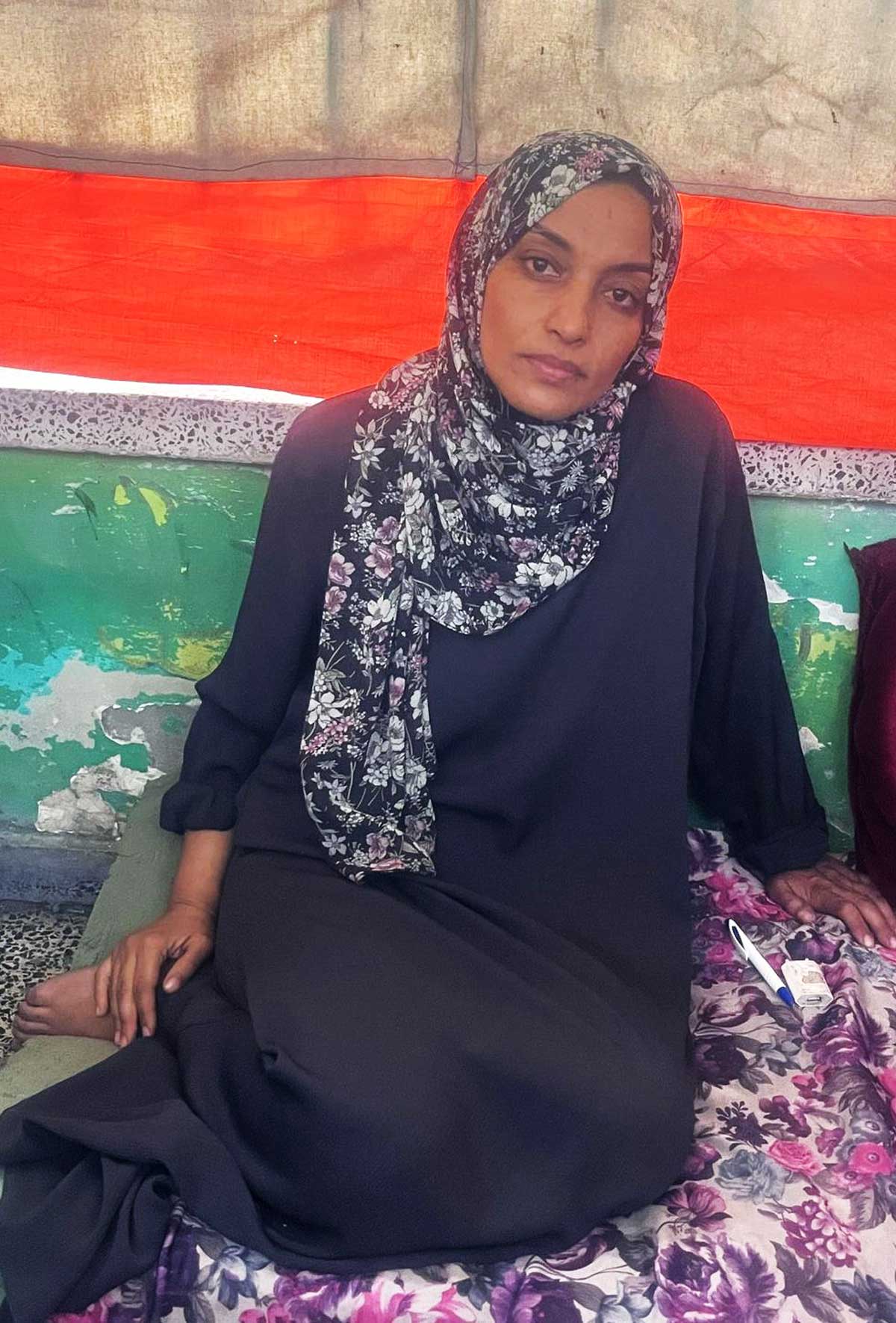
Up until the war I lived with my husband and our six children – Ousamah, 22; Rima, 13; Tala, 11; Rajaa, 9; Lina, 6; and Rafif, 4 – in an apartment we rented next to Kamal Adwan Hospital in Beit Lahiya. I was a nurse at the hospital. My eldest son, Ousamah, worked at a small ful and falafel restaurant and got married just four months before the start of the war. We managed and lived decent lives.
From the outset of the war, there were bombings everywhere – homes, mosques, schools and even hospitals. Through flyers and phone calls, the Israeli army told everyone to get out of the Beit Lahiya project where we lived. Despite the danger, we couldn’t leave our rented apartment because we had nowhere else to go. At the time I was still working as a nurse at Kamal Adwan Hospital and continued to go in for my shifts. I treated wounded people and even had to transfer mutilated and bloody bodies to the morgue.
On 17 November 2023, while I was at work, I was horrified to hear from my colleagues that the occupation army had bombed the area where we lived and surrounded it with a ring of fire. They said the target was the a-Shabrawi family’s home, and that more than 40 people had been killed – mostly women and children. Entire families were buried under the debris. Our whole neighborhood turned into a pile of rubble. It was sheer luck, by the grace of God, that we had moved a day earlier to my brother’s house nearby. So though our house was completely destroyed, my husband and children were saved.
After that massacre, my husband and I decided to flee with our children to the southern part of the Strip. We walked on foot through streets of death and active fire zones, without taking anything with us. We continued along Salah a-Din Road in a long line of displaced. Thousands of families were fleeing, with hungry children and new widows walking beside us. We all went through hell at the army checkpoints, where they conducted body searches, just to escape the bombings and the death that was all around us. Volleys of live shots followed us even on the road.
When we arrived at a-Nuseirat R.C., we paid someone to drive us to Rafah, in the southern part of the Strip. We thought Rafah would be safe, especially after the Israeli army declared it was, but the army lied. The army ordered us again and again to leave, each time to a different place that was supposed to be safe but wasn’t.
We got to the Tel a-Sultan neighborhood in western Rafah. There, in the middle of the street, we set up a tent we’d barely managed to obtain. We tried to get used to living in a tent, suffering hunger and cold. My husband looked for work to feed our children, but he didn’t find any. I still receive 1,000 NIS [~$300 USD] once every two months from the Ministry of Health in Gaza, but it’s not enough because prices have soared and there’s a severe lack of food.
Our miserable lives in that tent continued until 6 May 2024, when the occupation army threatened to invade Rafah and bomb it. We had to pack up everything we’d collected in our months there and flee again, this time to Deir al-Balah. We went to an IDP camp called a-Set Amirah in an area called the Abu Salim land. This is where our real nightmare began: hunger, poverty, diseases.
There was no clean water or food. The girls started to suffer from extreme hunger. Lina, 6, was so dehydrated and malnourished, she could hardly stand. Rima, 13, who was born disabled due to lack of oxygen at birth, also really suffered and her situation worsened. She has a motor disorder that gets worse with age.
My only son, Ousamah, had to walk the streets and the camps every day, under bombings, to look for work or a piece of bread for his sisters. Most days he returned empty-handed, with his face burned from the sun after hours of standing in line at the soup kitchen.
That was our situation until 19 January 2025, the day the ceasefire was announced. We thought the war was over. The army allowed us to return north after 15 months of killing and destruction. We couldn’t go back to our apartment because it was destroyed, and we didn’t find a place to shelter. In the end, we found refuge in the al-Buraq school, next to the Falastin Mosque on a-Naser street, which was bombed twice during the war. We cleared one of the rooms of debris, hung up cloths, and made it a temporary home. We lived off the simple aid we received from the school’s administration and from kind people.
Ousamah went back to work at the hummus restaurant so we could survive. hen, on 18 March 2025, the war resumed and was even crueller than before. The army closed all of the crossings and blocked the supply of food. Even flour disappeared. My girls begged Ousamah to go get flour.
At the beginning of May 2025, the army declared the opening of “American aid centers,” which were basically death traps. Whoever got close became a target. People went to get food and were returned to their families as corpses.
Ousamah begged me to let him go there to get food, but I refused. I was afraid of losing him. In the end, I gave in to my daughters’ hunger. On the morning of 19 June 2025, Ousamah went to the aid distribution center by al-Bureij R.C. in the Netzarim compound with my brother Ahmad and some other friends.
That whole day, I was scared and anxious. Then, at 11:00 P.M., my brother came back with Ousamah’s body. He was covered in blood and dirt. Ahmad told us an Israeli tank had fired a shell at them and hit Ousamah in the back, killing him and five others while they were opening boxes of aid. They all died on the spot.
My only son, who didn’t get to taste anything this world has to offer other than hunger and fear, returned to me dead. He left behind a wife who was three months pregnant and five sisters. He died trying to bring us and his sisters bread.
We’ve been through an indescribable tragedy. Hunger, displacement, death – a real Nakba. Ousamah was my pillar of strength. Since he was little, he always took responsibility for his sisters. I’ve been left with a broken heart, like all mothers who’ve lost their children.
Gaza has turned into one big cemetery. Since we lost Ousamah, our suffering has only worsened. We have no flour. No food. I’m begging for help. I just want my children to live in dignity, and for the war to end. We can’t take this anymore.
* Testimony given to B’Tselem field researcher Muhammad Sabah on 27 June 2025