A 50-year-old mother of six from the a-Twam area in northwest Gaza City, Nabilah spoke about the harsh living conditions and suffering in displacement camps and in a tent, about losing her son and grandchildren in a bombing, and about the particular difficulties women currently face in displacement sites in Gaza:
Before the war, I had a beautiful, simple life. I lived with my husband, Ibrahim, 59, our three children, Rudayna, 26, Rinad, 23, and Yusef, 13, and my husband’s two children from his previous marriage, Muhammad, 33, and Mai, 32. We lived in a three-story house in the a-Twam area in northwest Gaza City. I also have a married daughter, Rawan, 26, who is Rudayna’s twin, and a married son, Muhammad a-Sultan, 31, from my previous marriage, who was killed on 31 October 2023 together with his wife, Malak, 24, and their children, Rafiq, 4, and nine-month-old ‘Udai. They all lived near us. In the 2014 war, I also lost my son, ‘Udai a-Sultan, who was 21, also from my previous marriage.
Our home was simple but full of warmth and love. Friday was my favorite day, because on that day the whole family got together – my husband and I, the children, their wives and the grandchildren. We would spend the day laughing and smiling, a day full of cheerful commotion and joy. We also had beautiful daily routines, like when I woke up and prayed the dawn prayer with my sons, and then they went out, some to work, some to university and some to school. In their absence, the house felt cold, and I would busy myself with making lunch for them with a lot of love, waiting for them to come back home. When they arrived, the house filled with warmth again.
On 7 October, that cursed, unforgettable day, I woke up to pray the dawn prayer. I went to the kitchen to make coffee for my husband and me, made a sandwich for my son Yusef to take with him to school and walked him to the front door, where we waited together for the school bus. After he left, we started hearing many explosions and rocket launches, which made me stressed, and I told my husband to call the bus driver and ask him to bring Yusuf back home. Ten minutes later, Yusef came back, and I thanked God that he had returned safely.
When I sat down to follow the news, I was shocked to find out what was happening. My husband and I understood how serious the situation was, and he decided that we would leave the house immediately, without waiting even a moment, because our home is in an area the occupying army defined as a combat zone.
We left the house, leaving behind all our beautiful moments and memories. My husband, our five children and I went to a displacement camp in the a-Sheikh Radwan neighborhood. We stayed there only seven days, which were very hard. The situation was dangerous, with bombings everywhere, and we decided to move to the south of the Strip. We didn’t know yet that death and fear would chase us wherever we went.
On 15 October 2023, we left the northern Gaza Strip and moved south, to Khan Yunis, where we found shelter in Sina‘at al-Wakaleh (an UNRWA Gaza training center). When I saw the place, I was stunned. There were masses of IDPs there, and the overcrowding was terrible. We found a room in one of the buildings and all of us, my husband and our five children, lived in it together. We stayed there for about three and a half months.
The living conditions there were very harsh. We survived on aid that came from charity organizations. The toilets were shared, and we had to wait in line for a long time. It was humiliating, because all the IDPs knew you were waiting to relieve yourself. I used to go to the toilets with my husband or one of my sons, and I didn’t let my daughters go alone either. I was afraid for them because of the other IDPs there, because they were all strangers, and who knows what could happen if one of us went there alone.
The yards of the UNRWA training center were full of tents that were right on top of each other, and the corridors in all the buildings were packed with IDPs. There was not an ounce of privacy. If you spoke with a family member, everyone could hear your conversation. Everything there was dirty, full of garbage, and every day, fights would break out between the IDPs, in the line for water, in the line for the toilets and so on. I washed our clothes by hand and hung them in the room we lived in.
My son Muhammad and his family stayed in the north of the Strip, and I called him often to see how they were. On 31 October 2023, I woke up in the morning with a strong sense of worry and called him at 5:00 A.M. His voice sounded distant, as if the distance between us was greater than ever. I didn’t know this would be our last conversation. About four hours later, around 9:00 A.M., we got the bitter news that my son Muhammad, his wife Malak, and their children Rafiq, 4, and baby ‘Udai had all been killed.
Time stood still. I didn’t cry right away, as if my soul needed time to grasp what had happened. How can it be that the voice I heard in the morning becomes a memory from the past when it is not even noon yet! Since that day, mornings are no longer mornings, and distances can no longer be measured. My heart carries their names and their memory, instead of carrying the hope of seeing them again.
When the Israeli military invaded western Khan Yunis, we left all our belongings behind, went out under fire and shelling and moved farther south, to Rafah. We walked a lot until we reached, after an exhausting day, my husband’s sister’s house, where she hosted us for four days. After that, we found shelter in a displacement camp. We lived in one of the classrooms, and every day we stood in line at a Takiya [a charity kitchen] to get food, and if we didn’t find one, we’d go without food or eat very little.
We were in a very bad situation. There was no privacy, and we had to stand in line for the bathrooms for hours. I would go down to the schoolyard at night and try to have my husband or one of my sons go with me. They also accompanied my daughters, for fear they would be exposed to exploitation or harassment or the like. I waited in line for the toilets in the dark, and when I was inside, I was constantly afraid someone would knock on the door and ask me to hurry up. The situation made me terribly uncomfortable. Sometimes, during the wait, it was already too late, you felt you couldn’t wait any longer, but there were still people ahead of you in line, and you had to wait and hold it in. The most humiliating thing for me was to walk with my daughters in the schoolyard, which was full of young men, carrying a bottle of water in my hand to use inside the bathrooms because they had no water. We even showered in that same bathroom, and sometimes in the classroom.
On top of everything else, from the first displacement to Khan Yunis, my daughters and I had to cope with a severe shortage of sanitary pads. Even when they were available on the market, they were rare and sold at outrageous prices; a small pack of pads cost 25 to 30 shekels. The only solution was to use pieces of cloth or small articles of clothing that we cut up and folded like pads, a very difficult and disgusting situation.
When Rafah was invaded in early May, we were displaced again to Khan Yunis, again to a school that had been turned into a displacement camp. We faced the same hardships we had suffered in the previous displacement camps. Those were exhausting, draining days for me and my family. There was no privacy; we had to spend all day getting the fire going and stand for hours by the flames because of the shortage of cooking gas. My daughters and I hand-washed the clothes. My husband and my sons would go out to look for firewood, drinking water and ways to meet other needs, and sometimes they walked long distances.
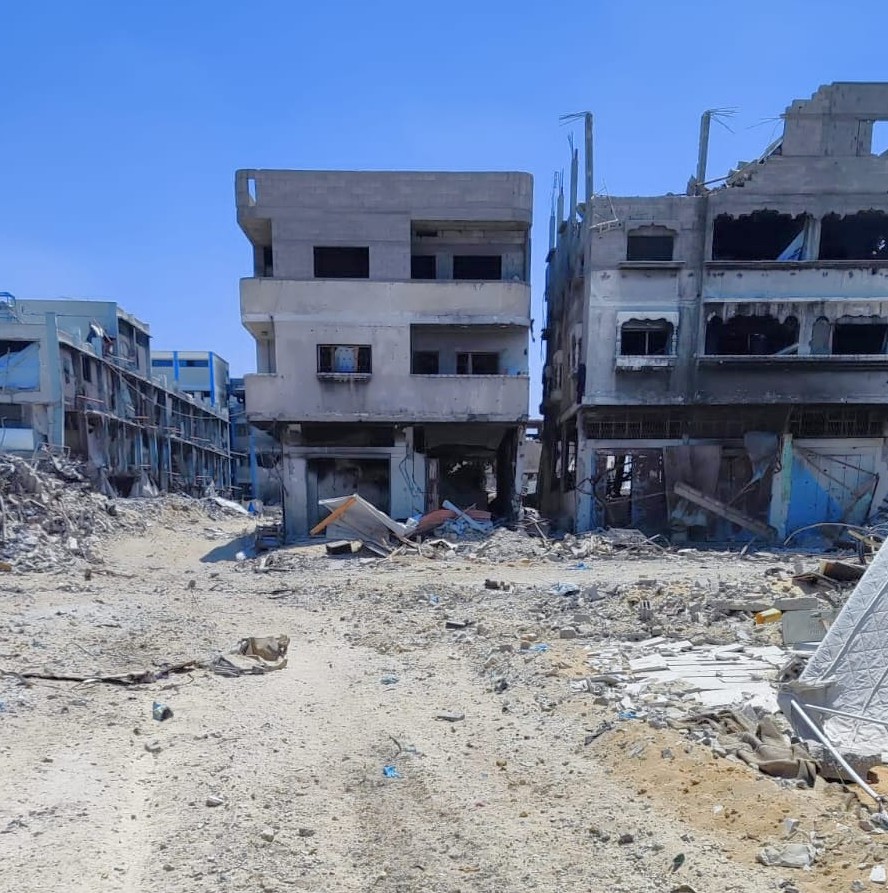
During the ceasefire in January 2025, we went back to the northern Gaza Strip. When we reached our home, all we found was a pile of rubble. We put up a tent next to it, made of tarpaulin and plastic sheets, and seven of us lived in it for three months. My husband and my sons improvised a primitive pit toilet, wrapped around with plastic sheets and tarpaulin. We all went through very hard days. We lived like IDPs even after going back home.
When the ceasefire was violated, we were displaced again, to western Gaza City. The time we spent there was the worst in our lives. I truly longed for death to rescue me from this life. We put up a tent in the port area. The place was filthy and disgusting, but we had no choice. Getting water was very difficult. We ate one meal a day, lentil stew, and sometimes not even that. There was no bread at all.
I swear to you by God, there were days when we had nothing to eat. My husband and my sons would go into the sea and collect shellfish, like small black balls, and then we would light a fire, and I’d use them to make soup for my children. Sometimes we ate them like nuts. Their taste was unbearable, but we ate them because there was nothing else.
After that, we went through very frightening days as the army drew closer and the dangers increased. We didn’t have the money to go south again, and moved into an abandoned building nearby that was safer from gunfire and stray bullets. One night, the danger became so real that we started reciting the Shahadatayn [the declaration of faith recited before death]. We saw death right in front of us. Rockets fell very close to us, and we heard the sound of tank tracks. It was terrifying. I didn’t believe we would survive that night. We were truly saved by a miracle, because that same night a ceasefire agreement was reached, thank God.
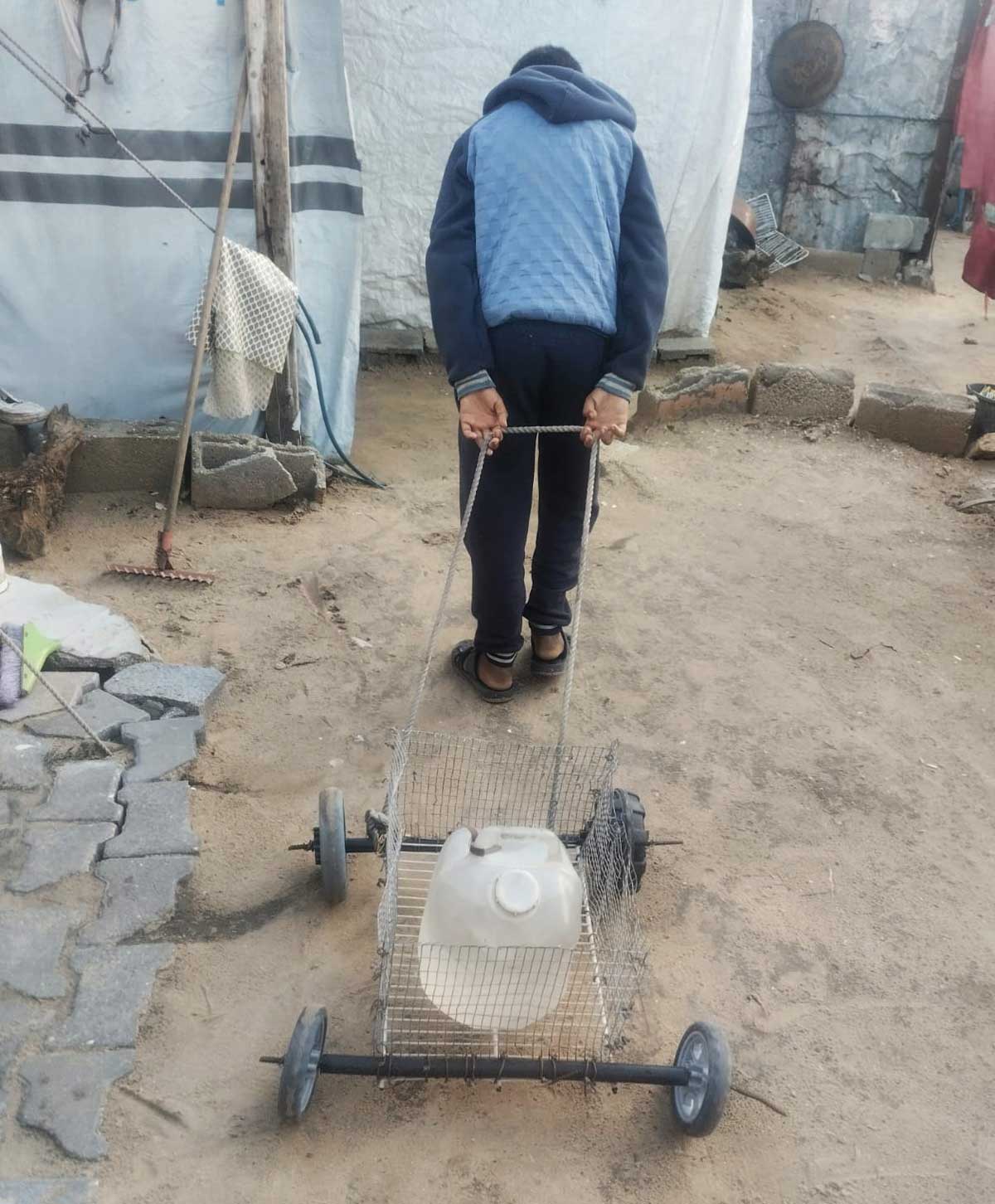
Three days after the ceasefire was announced, we went back to our destroyed home in the a-Tawam area and again put up a tent next to it. We’re close to an area that has been defined as “yellow,” and we constantly hear gunfire and bombings, but we have nowhere else to live. We also suffer from a severe shortage of water. Water trucks come once every three or four days, and the water we get is not enough for drinking and certainly not for anything else. Sometimes we have no water for several days.
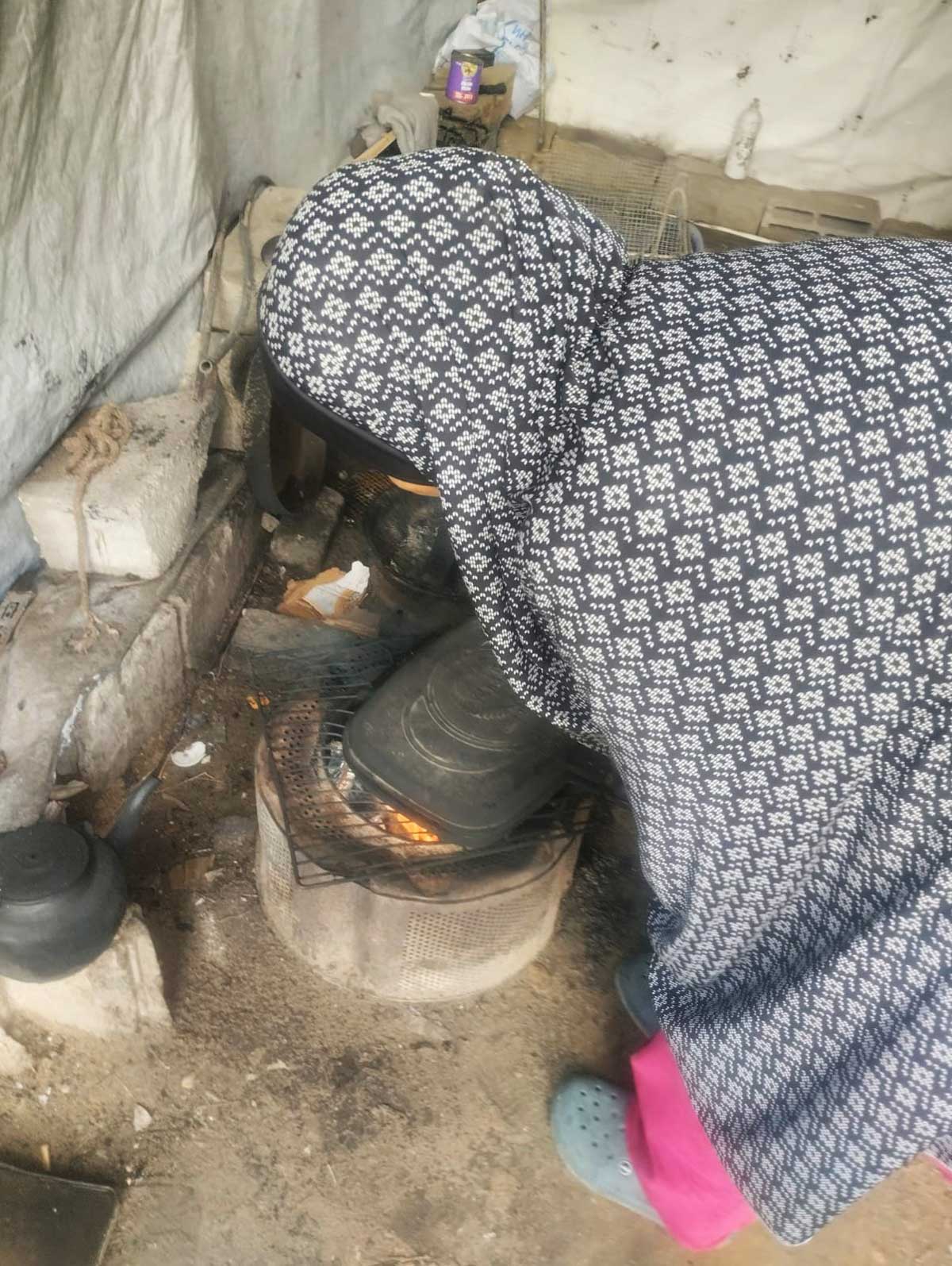
I suffer the most from the fire, which I spend so much time in front of, sometimes whole days. When my children want to bathe, I light a fire and heat water for them. When someone asks to eat something, I stay by the fire and cook for them, whether it’s morning, noon or night, all day long. During the day, my husband and sons go out to look for pieces of plastic or wood in the garbage dump, so I can light a fire.
The skin on my face has grown darker because of the fire, and my hands have become wrinkled and the soot does not come off them. My clothes and body smell of smoke, and it bothers me. For a time, we suffered from a shortage of cleaning supplies, and I had to wash clothes and dishes with toothpaste. My hands hurt because I have been doing laundry by hand for two years now. It hurts so much that I have trouble falling asleep.
My daughters and I spend all day in our prayer clothes and hijab, which you usually wear when you leave the house. If we rest during the day, we keep them on. We have no choice but to stay in a hijab all day because we do most of the “housework” outside the tent, cooking, laundry and so on. It’s the same when standing in line at the Takiya, and when we fill water. We’re dressed like this all day.
Our tent is very small and barely holds the seven people living in it. We all suffer from a lack of privacy. We have been in this situation for so long, and there is no solution. My husband and I have difficulties because we have no private space of our own. Our children hear everything that happens between us, and that embarrasses me very much. I feel abandoned and broken.
Now, the most troubling problem is the winter weather. Our tent has flooded more than once. The cold takes mercy on no one, and we have no heating. All night long, I try to find spots in the tent that have not yet gotten wet, so that my children have a dry place to sleep, while my body literally shakes from the cold. The tents don’t protect us from rain and cold. We’re coping with these problems with almost no means and no help.
I miss my son Muhammad. I miss the Fridays when the whole family gathered, and Muhammad’s laughter. Muhammad was my support in this life. I miss my home, my private room, and the privacy I used to enjoy. At home, each of us had our own room, and now we are all crammed under a sheet we stretched around us, and we all use a primitive toilet with a sheet of fabric stretched around it. We’ve become homeless, vagrants who live on the street.
My life has been destroyed and turned into an ongoing tragedy. My soul is tired. My heart aches. I weep for myself, for the hell I have fallen into. I wish this were only a nightmare, and that soon I would wake up, get up to make coffee for myself and my husband, make a sandwich for my son Yusef, and then each of us would go about our day, to work or to university, and I would start cooking lunch for them with lots of love.
* Testimony given to B’Tselem field researcher Olfat al-Kurd on 1 February 2026
Read more: Clinging to what’s left of life: Palestinian women under genocide in Gaza, 8 March 2026