A 45-year-old father of seven from Rafah, Muhammad described displacement, his arrest, and the torture, hunger and harsh conditions he suffered during the roughly six months he was held at Sde Teiman:
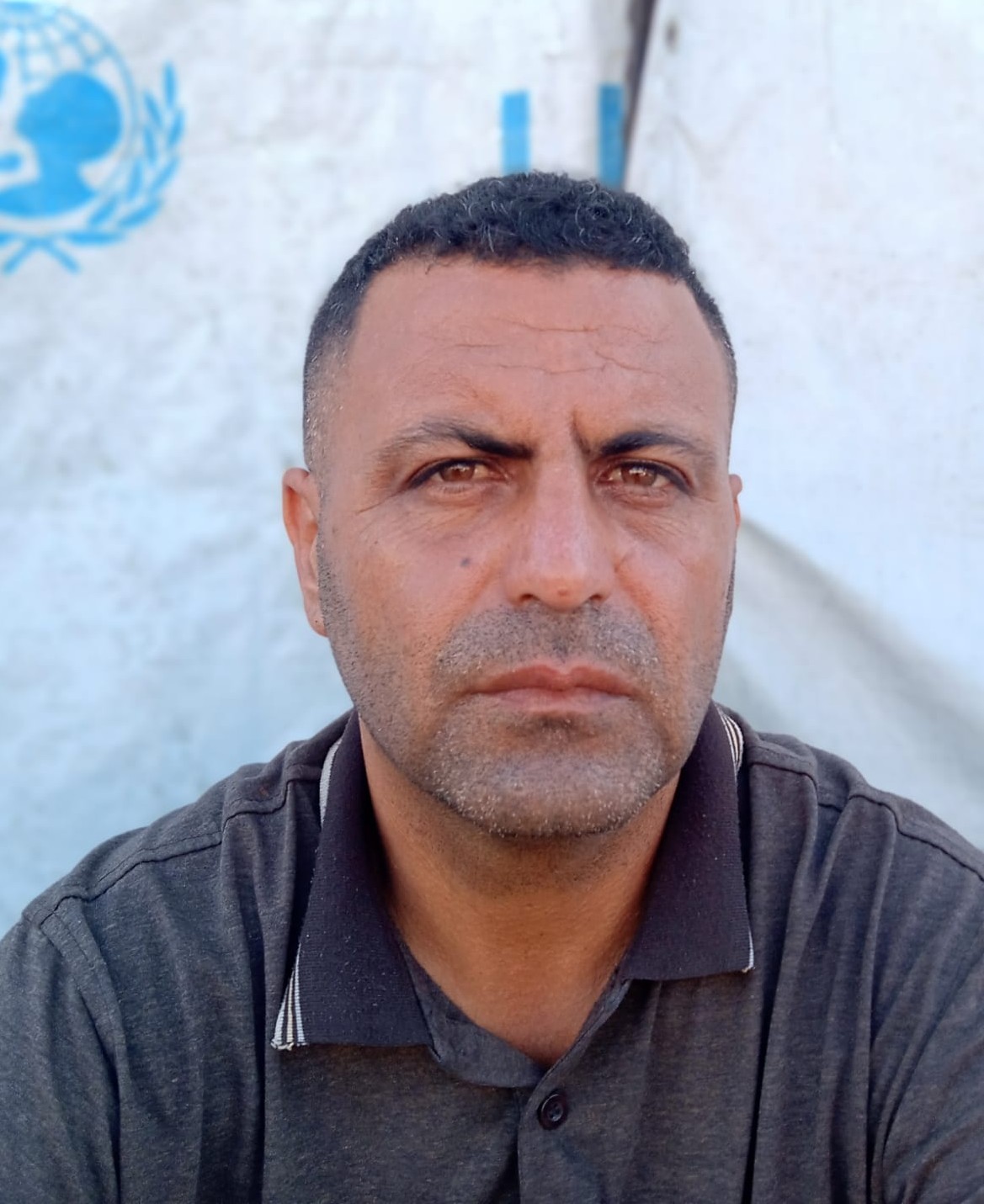
Before the war, I had an administrative job in the Palestinian Authority and lived in the Saudi neighborhood in a-Shaburah Refugee Camp in Rafah with my wife and our seven children: Hala, 18, Saleh, 15, Lana, 13, the triplets Yasser ‘Arafat, Amin and Ibrahim, 11, and Muhammad, 2.
My family and I have endured every kind of suffering since the war started: hunger, thirst constant fear of bombings. In May 2024, after the ground invasion of Rafah, we were forced to leave our home, and the ordeal of displacement began. We took only essential items and went to live in a tent in the al-Mawasi area in Khan Yunis. The situation there was difficult all the time: there was constant bombing, and we lived in fear every minute. Every day, I stood in long lines to get us water, and day after day, I searched for food to meet at least our basic needs.
We lived like that until 30 January 2025, when we heard that people were starting to go back to the Saudi neighborhood in Rafah. We were exhausted from living in a tent in the IDP camp and, even though we knew it would be dangerous, we decided to go back to Rafah, hoping the situation would be slightly better. We moved to the Tal a-Sultan neighborhood. As soon as we arrived, we heard bombings, quadcopters circling above the houses and incessant gunfire.
On 23 March 2025, the military surrounded the Tal a-Sultan neighborhood and dropped leaflets ordering us to leave for the Saudi neighborhood to its west. But then the Israeli military opened fire at a group of IDPs who were ahead of us. Two young men were killed, and other people were injured. This incident sparked great fear and created chaos among the IDPs. We were terrified that if we obeyed the Israeli leaflets, we’d get shot too. We didn’t know where to go or where to turn, and there was no one to guide us. There were no Red Cross workers and no other organization there. We kept walking until we reached the Taybah Mosque. We were exhausted and tired, especially the women and children. We rested a bit and then decided to continue towards the UNRWA shacks and tents in the northern part of the Saudi neighborhood. On the way, we came across tanks and Israeli soldiers, and we stopped. After 15 minutes, the soldiers ordered the women and children to stand separately from the men, and then told them to continue alone to the al-Mawasi area in Khan Yunis. They kept us men there.
Then we were ordered to go into a screening device with a camera installed on it, and we had to look at it. Five young men went in before me. Some of them were arrested, and some were released. When I went in, the officer ordered me to keep walking towards the soldiers. They took my ID card, checked my name and ordered me to sit on the ground. I heard the soldiers telling other men, in Arabic, “Yalla, go!”
I stayed there, and one of the soldiers ordered me to undress, put my clothes and belongings into a black bag he gave me, and told me to put on a white coverall. It was very cold. The soldiers tied my hands behind my back and blindfolded me and several other detainees, and then they put us in a pit. Inside the pit, the soldiers beat us with their weapons and swore at us. We thought we were going to die in that pit.
Then I heard jeeps moving. We were about 30 detainees, and they threw us into two military jeeps. That was when the torture began. During the whole drive, they beat us badly until we reached Karam Abu Salem (Kerem Shalom) Crossing. When we got there, we were surprised to see, in addition to the soldiers, Israelis in civilian clothes. They took us out of the jeeps and kicked us while they did so. They opened the zipper of our coveralls and threw us on the ground face down, with our bellies exposed, and then beat and cursed us. We stayed like that for about two hours, in the cold.
They put us back in the jeeps, which drove us to a place whose name I don’t know. There, we changed out of the white coveralls. We were told the transport unit would drive us from there. They put us on a bus that was in very poor condition, without seats and not fit for transporting people. We were beaten on our heads with sticks the whole way. At some point, I briefly blacked out. I came to when they hit me on the shoulder. They also constantly swore at us and cursed our mothers, wives and daughters. One of the soldiers sang something I didn’t understand and forced us to sing it after him. We had no choice but to try to repeat what he was singing.
The bus finally stopped at a prison, and they made us get off. I didn’t know which prison it was, but later I found out it was Sde Teiman. We saw a doctor who was supposed to examine us, but instead he swore at us and used inhuman expressions that humiliated us. It’s hard for me to even repeat them.
Then they forced us to take off the coveralls we were wearing and gave us gray tracksuits instead. From the moment we put on those tracksuits, another stage in our ordeal of torture began.
It was around 2:00 A.M. and they took us to the cells. The soldiers untied our hands and gave us a bit of food: a piece of bread and a piece of cheese, because it was Ramadan.
I hoped we’d be able to sleep enough hours and rest from the beatings. But at 4:00 A.M., they woke us up and told us roll call would be at 4:30 A.M. every morning and that we would only be allowed to go to sleep at midnight. We were completely exhausted and could barely breathe from all the blows we had taken.
At 7:00 A.M., they tied our hands again and took us to the Shin Bet (ISA) interrogation room. I didn’t know why I’d been arrested. When my interrogation began, an officer who introduced himself as “Abu ‘Ali” came in. He told us: “You’re here as prisoners of war, you dogs.”
He told me we had killed his wife and children. I asked him how and why, and he answered: “All of Gaza is dead. We won’t leave a single one of you.” I told him I was a clerk at the Palestinian Authority and had no connection to any factions. His response was: “You’re all terrorists. Hamas and Fatah. We will bury you. No Red Cross and no aid organizations, no one will ask about you. You’re not known anywhere.”
While we were there, we wanted to die. We were severely tortured. The treatment we got from the male and female soldiers was very bad. They swore at us using obscene language. They hardly allowed us to shower, and when they did, it was only for two minutes. We didn’t change out of those tracksuits for more than two months. Our clothes got so filthy, and we had to wash them and put them back on while still wet, even in the cold of winter. We had to wear the same tracksuits because there were no other clothes to change into.
Members of the special unit would raid the cells, claiming they were conducting searches. They would throw in stun grenades, shout and swear at us and our families, and beat us. They beat us badly. Because of the beatings I took, my hearing was damaged, and I have tinnitus and ringing in my ears.
They forced us to kneel with our hands up in the air for hours. Sitting in that position for so long caused unbearable pain and numbness in our legs. Afterwards, they would drag us out of the room on the ground, again on the pretext of carrying out a search, humiliating and beating us again, sometimes also in sensitive areas. Another way the soldiers humiliated and terrorized us was by pressing hard on our kidneys with a stick, which caused us terrible pain.
When a prisoner complained about the pain and asked for a painkiller, the soldiers answered: “Drink some water,” and that was it. That’s how we spent the days of detention at Sde Teiman. Daily beatings and humiliation, and very little food, in very poor condition including tuna, preserved eggs, boiled potatoes, pasta, apples and sliced bread.
Throughout our entire time there, we hardly saw any sunlight. We were shut in rooms or in shacks all day and were allowed out for only 10 minutes a day. I slept on a hard, dirty mattress and had only two thin blankets to cover myself. Because of the harsh conditions, many prisoners, myself included, got a fungal infection.
We used the same dirty, foul-smelling mattresses and blankets the entire time. The smell was unbearable. The room was also dirty and smelly. We went through very harsh days and months: mistreatment, beatings, humiliation, psychological torture, lack of sleep and constant lack of rest.
In the last month of our detention, we were given medication for the fungus, our food portions were increased, and the treatment we received improved a bit. We didn’t know what caused that change.
On the last day in the detention facility, we were brought food and a female soldier ordered us to eat, pray and go to the bathroom quickly. We followed her orders. Afterwards, she ordered us to lie face down and then to get up, and then they started filming us. While they filmed, they asked each of us for our names and the names of our parents.
That night, 10 October 2025, at around 11:00 P.M., we heard dogs barking and guessed they were transferring prisoners from the prison. Members of an Israel Prison Service unit arrived and transferred us while beating, humiliating and torturing us, with the ties on our hands tightened as much as possible. We drove for about two and a half hours to another prison, we didn’t know which. We arrived there at 4:00 A.M., and as soon as we got off the bus, dogs attacked us. Then we were led from place to place, until we realized we were in the Negev Prison (Ketziot). We were there for two days, and then Shin Bet agents told us we would be released that evening.
A Red Cross representative from Nablus came and told us: “The ceasefire has come into effect and you’re in the first group to be released from prison.” They took our fingerprints. It was only then that we understood we were really going to be released. We were overjoyed. We couldn’t believe it was really happening. We bowed down to God in thanks and cried with joy.
On Monday, 13 October 2025, at around 4:00 A.M., we were ordered to get ready to leave immediately. They tied our hands and put us on a bus. During the bus ride, IPS people beat and abused us. It went on like that the whole drive, until we reached the Karam Abu Salem (Kerem Shalom) Crossing at midday. There, they untied our hands and we started walking, until we met the Red Cross representatives. Only then did we feel safe and understand we really were out of prison.
I was arrested and released without being charged with anything, and the days I spent in Sde Teiman were the hardest days of my life.
I was very happy to see my wife, my children and my family. They were all alive, but in very bad shape. They were gaunt, and their faces were pale. There was massive destruction in the Gaza Strip. I was shocked to discover how many people, including friends and neighbors, had been killed in the war.
Despite everything, I thanked God that I came out of prison alive, without severe injuries or a disability. But I can’t forget the torture, terror, humiliation and pain I went through, and the injuries to my body and my ear. Now, I suffer from poor memory, lack of focus, insomnia and constant exhaustion, and my mental state is very bad because of the harsh experiences I went through in prison.
* Testimony given to B’Tselem field researcher Muhammad Sabah on 26 October 2025