A 34-year-old father of seven from al-Juneinah neighborhood in Rafah, Ahmad spoke about losing his eight-month-old daughter Rahaf, who died of cold exposure during a stormy night in an IDP camp in al-Mawasi, Khan Yunis, on 11 December 2025:
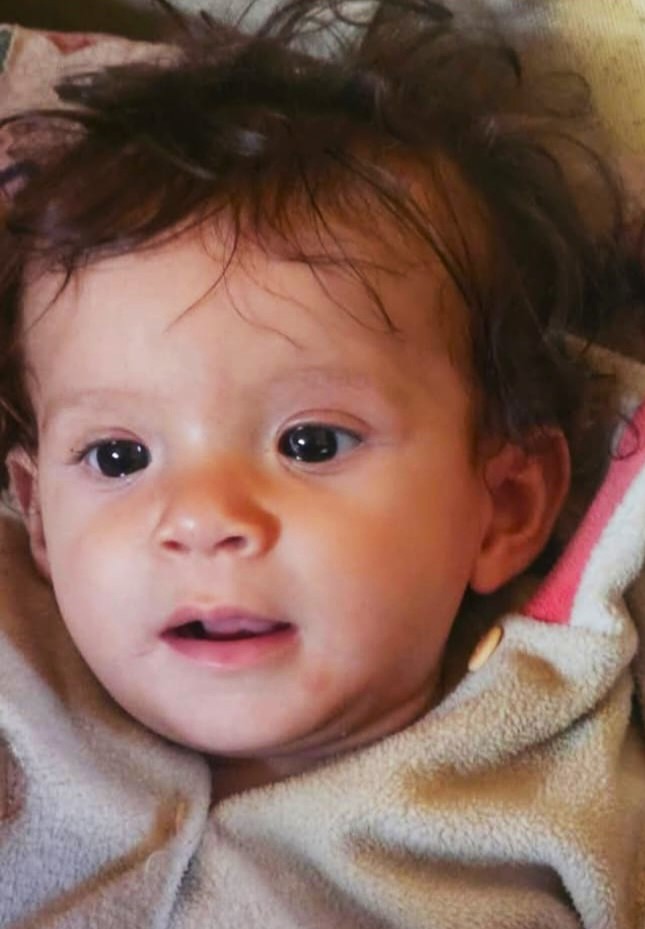
First, I want to share with you the pain I feel after losing my baby daughter, Rahaf. On top of that pain, there is sadness and fear because my wife and I don’t know what will become of our children and us. We’ve been forced to move from place to place, and now I’m worried about them because of the cold. I don’t know where to begin my story. Should I talk about what we’ve been through since the beginning of the war? About our displacement and escape? Or about losing my daughter?
My wife Hajar, 32, and I had six children: ‘Alaa, 12, Alaa, 11, Muhammad, 9, Amneh, 7, Rital, 5, and Sham, 3. Until the war, we lived in al- Juneinah neighborhood in Rafah. From the first day of the war, I felt it was going to be brutal, with no distinction between civilians and fighters, and without sparing children, women or the elderly. So I decided to shelter in the IDP camps set up in UNRWA schools in Rafah. My family and I left our home at the very beginning of the war, because of heavy bombings near us. We took only a few clothes and personal belongings with us, and lived in very difficult conditions because Rafah took in more than 1.5 million displaced people. It was hard to find food and drinking water, and no place was truly safe.
After we left home, we couldn’t go back for more clothes and belongings because it’s close to the border with Israel. Then, in March 2024, we learned that our house had been bombed. Life as displaced people was continuous suffering, but things got even worse in May 2024, when the military invaded Rafah. That was the cursed day when my wife, our children and I had to leave Rafah for Khan Yunis. I said goodbye to Rafah, my beloved city, with a heavy heart. By then, we had almost nothing and left the city empty-handed.
The day we left was very hard. The trip cost us a lot of money, and in Khan Yunis we couldn’t find a tent to live in. I put my trust in God and we moved to al-Mawasi, Khan Yunis. Then we moved again to the city of Khan Yunis, and finally ended up in the al-Qadiseyah displaced persons’ camp in al-Mawasi, Khan Yunis, which is extremely overcrowded. We are still there now. The camp was set up in a low-lying area, and when it rains heavily, the tents are flooded with water and the sand it carries.
Two months after we left Rafah, my wife became pregnant with our daughter Rahaf. She had a difficult pregnancy, in conditions of severe hunger we suffered from the whole war. She didn’t get proper nutrition for a pregnant woman, because I struggled to get food in general, and especially fruit, meat, etc. She was denied the most basic rights of a pregnant woman, to eat food like eggs or drink milk to strengthen her bones and make up for the nutrients her body was giving to the fetus. So both she and the fetus weren’t properly nourished. The food shortage was so severe that she became malnourished during the pregnancy, and continued to suffer from malnutrition after she gave birth.
When my wife’s contractions started, at midnight on 8 April 2025, we walked to the hospital because there was no transportation. Our baby girl was born on 9 April 2025. She was very small and delicate and didn’t know what fate awaited her, so I decided to name her Rahaf, which means “gentle, delicate.” When Rahaf was born, we were relieved when the doctors told us she was healthy.
After we went back to the tent, the exhausting race to find infant formula began. It was sold at very high prices. Hajar was malnourished and couldn’t breastfeed. Sometimes, kind people gave me formula as charity, but most of the time I struggled to get it and Rahaf went hungry. My wife and I were afraid she would become malnourished and need hospitalization, or, God forbid, would die like many babies who died during the war from malnutrition and hunger.
Despite the hunger and harsh conditions in the tent, we raised Rahaf with great love and spoiled her. When she started babbling, our joy knew no bounds.
When a ceasefire was announced in January 2025, I felt relief. I was happy we had survived the war without losing anyone from my family. But I was worried that winter was coming while we were still living in a worn-out tent that couldn’t protect us from the cold and rain. I tried to prepare the tent for winter. I piled sand around it to stop water from getting in when it rained. But I knew that because we were in a low area, there was still a big risk the tent would flood. I kept praying it wouldn’t happen.
We don’t have enough money to buy a new tent or tarps, and to buy clothes and blankets for the children. When people reported on social media that a storm was coming, I tried somehow to reinforce the tent to prepare for the wave of cold and rain. The storm arrived on 11 December 2025. We stayed in the tent because there was nowhere else to go. We covered our children with blankets, especially Rahaf, who was eight months old. After my wife fed her, we all went to sleep.
That night, it rained very heavily. We woke up at 3:30 A.M. and found the tent flooded. We checked on our children. Rahaf was completely wet. When my wife changed her clothes, she noticed that her body was very cold and her face looked different. Her lips had gone blue. I called an ambulance but because of the heavy rain, it arrived only about an hour and a half later. My wife and I went with Rahaf to Nasser Hospital. She was already dying. The doctors tried to resuscitate her, but it didn’t help.
My wife and I were in shock. We cried and hugged Rahaf’s cold body. We couldn’t believe our baby was dead because of the extreme cold and the flooding in our tent that night. The doctors took her, wrapped her in a shroud and prepared her for burial. Those were the hardest moments we went through in the entire war.
Later, we went to bury our little baby, Rahaf. After we buried her, my wife and I returned to our dark tent, which was filled with grief and loss. That was the end of the short life of Rahaf, my heart and my soul. A story of suffering that even mountains couldn’t bear.
Rahaf was just an innocent, tiny, delicate baby. We lost her because her small body couldn’t survive the extreme cold. We’re going through unbearable days. My wife, our children and I are mourning Rahaf’s death, and still can’t believe she’s gone. All our hearts are filled with sorrow, and our small tent is filled with grief. Our youngest daughter, Sham, keeps looking at Rahaf’s pictures and saying, “Rahaf is dead.” My wife is doing very badly. She cries all day, hugs our children and says, “I don’t want to lose any more. I can’t bear more grief.”
We’re still here in the tent, in very harsh conditions. It’s a hard winter and we are suffering from the heavy rain and extreme cold. The tent doesn’t protect us from anything.
Rahaf is not the first baby to die of cold in the Gaza Strip. As long as the international community remains silent and does nothing about what is happening here, more babies and children will fall victim to the extreme cold. Today we lost Rahaf. Who knows who we will lose tomorrow. We hope Rahaf is in a better place and pray that God will help us bear the pain of losing her.
* Testimony given to B’Tselem field researcher Olfat al-Kurd on 14 December 2025