A 33-year-old mother of four from Jabalya RC, Alaa spoke about her home that was destroyed by the military, the killing of her eight-year-old daughter in an airstrike on a displaced persons’ camp in northern Gaza, her 14-year-old daughter’s serious injury, the hunger, and the deadly risk at aid distribution points:
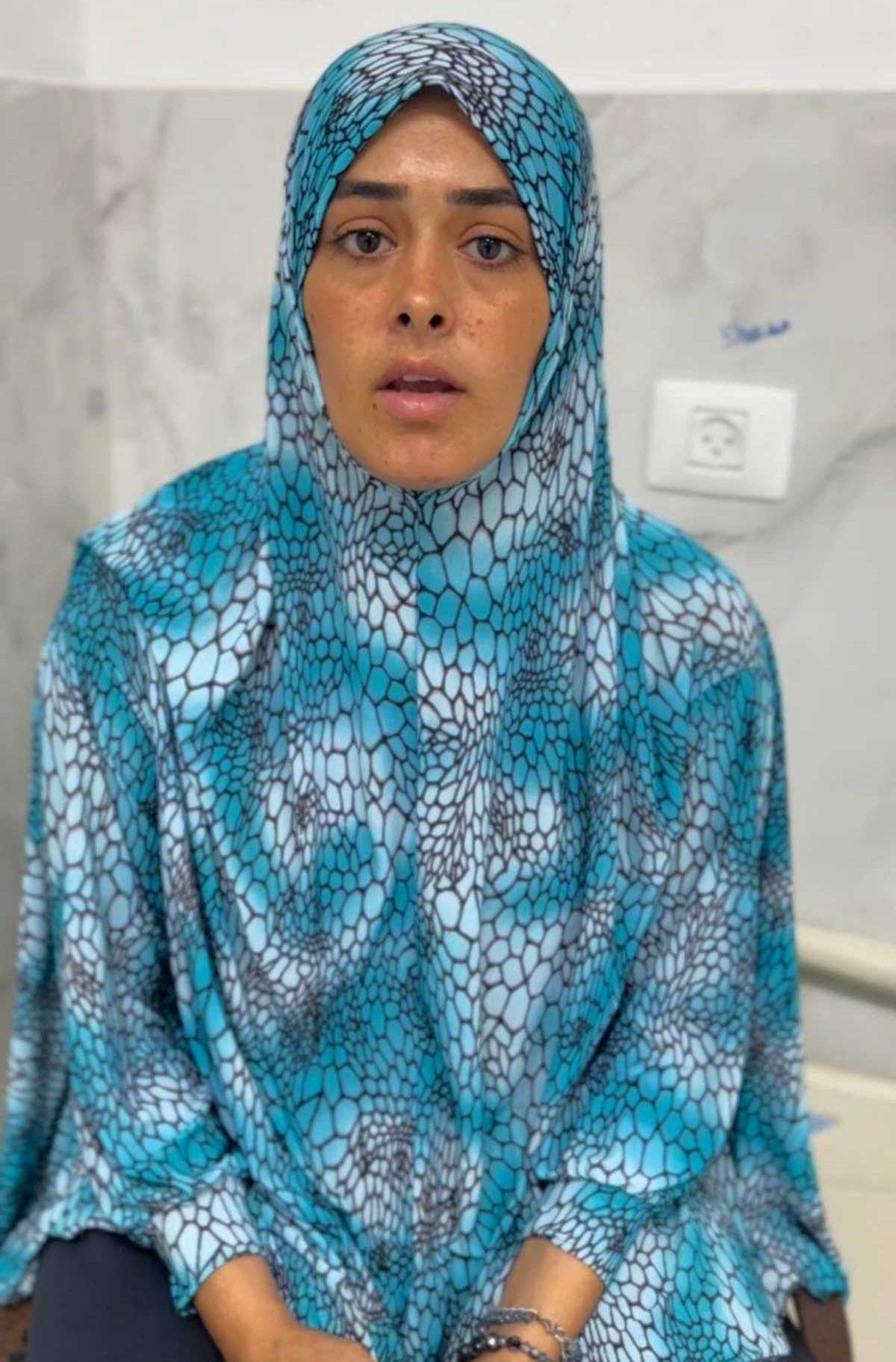
Until the war began, I lived with my husband, Mahmoud Shhadeh, and our four children, Farah, 14, Ilin, 13, Sila, 8, and Sanad, 6, in a seven-story building on al-Hojah Street in Jabalya Refugee Camp, behind the Safi concrete factory. My husband’s relatives lived in the other apartments in the building.
Mahmoud worked odd jobs, and we were hard up. After 16 years under Israeli blockade, life in Gaza was unbearable. Two and a half months before the war began, my husband went abroad to look for work and find a way to support us. He went to find new hope, leaving me and the children behind. We waited for him every day, every moment. If I had known what was coming, the killing and destruction, I would never have let him go without us.
At the very start of the war, the Israeli military bombed and shelled our neighborhood. After ten days, the army created a “ring of fire” and bombed homes with people inside. Hundreds of people were killed and wounded, including women and children. I had never seen anything like it. We had to get out.
I was forced to escape with the children, without my husband beside me. We left with his relatives and went west. We settled in the Hamamah School on the first street of a-Sheikh Radwan neighborhood. We stayed there, waiting to see what would happen, but things got worse with more bombing and the number of dead kept rising.
After about a month, we started getting threatening phone calls from Israeli intelligence officers who ordered us to move south. They bombed a-Radwan Mosque opposite the school, as well as three houses next to it. We left Hamamah School and went to the Falastin School in a-Rimal neighborhood, hoping it would be safer there. But after a week, we were forced to leave again after more threatening calls from the military and orders to go south.
We went south through Salah a-Din Street. We passed through Israeli checkpoints and reached Rafah, where we settled in the western part of the city, in the al-‘Alam area. We set up a tent and looked for a way to survive among hundreds of thousands of displaced people crammed into what we called “death tents.” In winter we suffered from the cold, and in summer from the heat. We never imagined we would have to leave our homes, where we lived with dignity, and move to torn tents that offered no protection.
We stayed like that until 6 May 2024, when the military again issued warnings, threatening to invade Rafah and ordered the residents and displaced people to leave immediately. We knew an invasion of Rafah, like the previous invasions of cities, would bring destruction and death. We were displaced again. I took the children and whatever clothes and things we could carry and went back to the center of the Gaza Strip. This time, we set up a tent in the a-Sawarhah area of a-Nuseirat Refugee Camp.
We survived thanks to soup kitchens operating in the area we moved to. Every day I sent my two older daughters, Farah and Ilin, to stand in line for hours, where they had to endure harassment and pushing, just to bring back a plate of lentils, rice or beans. I had no source of income and no other options.
On 20 January 2025, when a ceasefire was declared, we walked back north because the military banned vehicles. I hoped we could get back to our lives, with a roof over our heads and not a flimsy tent with no safety or life, and with food available. But when we reached Jabalya RC, it was a wasteland. I swear I didn’t see a single house standing. It looked like an earthquake had hit. Everything was destroyed: there were no homes, schools, mosques, infrastructure or water. Our home was gone. We set up a tent next to the tents my husband’s family put up beside the ruins of our house, and tried our best to adapt to this harsh new reality.
I had to send the children again to soup kitchens to ease our hunger, and we survived on that and on a little aid from UNRWA.
But it wasn’t long before the war suddenly flared up again, on 18 March 2025. Fighter jets started bombing the Strip again, and the military closed all the crossings and went back to its policy of deliberate starvation. Not a crumb of flour was allowed in. There was no food, no water, no medicine. The hunger began to gnaw at us. The children were dehydrated and malnourished. On top of that, on 19 May 2025, the military again distributed evacuation orders in our area in Jabalya RC and began shelling and bombing it. I fled with my children under shelling and bombing, and this time we were displaced to a tent in the al-Mashtal area of a-Shati Refugee Camp.
There, the hunger reached its peak. Children died of starvation and thirst. My children cried day and night, looking for a crumb of food or a sip of water inside the tent. I went begging for food, pleading with neighbors for a piece of bread to quiet their hunger. Then Israel began allowing shipments of flour into Gaza via aid trucks. The amounts were deliberately limited and sporadic, and it looked like they were meant to force desperate crowds to gather and then be attacked. The trucks entered through two points: a-Saifa (Zikim) in the northernmost part of the Strip, and the Nabulsi roundabout on the coastal road (a-Rashid), near the Sheikh ‘Ajlin Mosque.
I had no choice but to go to those places to get flour to bake bread for my children and ease their hunger. I started going with Farah and Ilin to the aid distribution points in Zikim and at the Nabulsi roundabout. Sometimes we went together, and sometimes we split up. I saw huge crowds, hundreds of men, women and children, all risking their lives for a single sack of flour. Everyone was hungry and just wanted to eat.
I swear I went to Zikim and Nabulsi more than 15 times. Each time there were stampedes, bombings, drone fire and more. Every day people were killed, men and women looking for food. Each time Farah came back, she told me people were killed beside her and that she herself was nearly injured or killed.
Those aid distribution points were death traps. They were also meant to humiliate us, when we were willing to do anything for a sack of flour to keep us alive. Sometimes I came back with a sack, and other times I couldn’t even reach the trucks through the crowds.
On 21 July 2025, several women from our area and I prepared to go to Zikim after we heard that flour trucks were on their way. I left the children alone in the tent and entrusted them to God. Each time I left, I knew there was a real chance I wouldn’t return, given the horrors I had seen before.
Shortly after midnight, on 22 July 2025, we reached the al-‘Amudi area in northern Gaza. Thousands of starving people were gathered there, and then they started firing at us. I don’t know what it was, missiles or shells, but I swear I saw bodies flying through the air. People started running, and I fled too. I realized the military intended to massacre us and that I wouldn’t get any flour. I began walking home empty-handed. I just wanted to reach my children alive.
On my way back, around 1:30 A.M., I heard people saying the al-Mashtal area had been bombed, that there was a massacre in the tents there. I started running toward our tent, where my children were waiting for me. I ran nonstop until I reached the tents. I saw ambulances evacuating dead and wounded children. The sight was horrifying. All the tents were bombed and the area destroyed. I couldn’t find our tent.
Suddenly, I heard Farah calling out to me from inside an ambulance. She said, “Mom, they bombed us, Sila was killed and Sanad is injured!” I started screaming and crying. I looked for Sila and found her lying on the ground with her head bleeding. I picked her up and begged the rescue teams to save her. We were taken to a-Shifaa Hospital, where the doctor tried to resuscitate her, but a piece of shrapnel had penetrated her head. At 2:00 A.M., they declared her dead.
Sanad was lightly injured. But Farah was wounded by shrapnel all over her body, especially in her right leg. Another piece lodged in her head, and later the doctors told me it was just one millimeter from her brain. She lay on the floor of the hospital from 2:00 A.M. until 4:00 P.M., because there were no available beds. The hospital was overwhelmed with the huge number of people wounded in the massacre near the aid trucks and in the bombing of our camp, where 13 to 15 people were killed, about 10 of them children.
What did all the people who were killed do wrong? What did my daughter Sila do, who died starving while her mother went to bring her a piece of bread?
I am still at the hospital with Ilin and Sanad, by Farah’s bed. Her condition is critical because of the shrapnel in her head, and there is no treatment available for her. The doctors said surgery would be extremely dangerous because of the fragment’s location, and she needs specialized surgeons and operating rooms with imaging equipment –none of which exist in Gaza now. The military has destroyed or shut down most hospitals. There are no medicines, barely any first aid, and not enough beds.
What I’ve been through in this war of extermination is beyond human endurance. We’ve suffered hunger unlike anything I’ve ever known, bombardments, killing, and destruction no one could bear.
The children and I are still suffering from malnutrition and dehydration and are in bad shape. We stilly rely on soup kitchens. There is no light at the end of tunnel to indicate that this insane war, which has worn us to the bone, will end. I lost one daughter, another is badly injured and I can’t even provide for my children’s basic needs. I’m doing everything I can now to get Farah medical treatment outside Gaza, because of the dangerous condition she’s in.
* Testimony given to B’Tselem field researcher Muhammad Sabah on 10 August 2025