A 35-year-old mother of three from Deir al-Balah, Shifa described caring for her young nieces who had their legs amputated after a bombing that killed their mother and seriously injured their father
Until the war, I lived with my husband and our three children, ‘Omar, 11, Isma’il, 9, and Sham, 2, in Jabalya Refugee Camp in the northern Gaza Strip. Now we live with my parents in Deir al-Balah, in the southern part of the Strip.
We left our home at the very start of the war and moved in with my parents, as we did done in previous wars, because I am very afraid of the bombings. My parents’ house is small, and about twelve of us are crowding in here.
Until a week ago, my brother Muhammad, 26, lived with his wife Shaimaa, 25, and their two daughters, Hanan, 3, and Misk, nine months, on the second floor of a two-story building about 500 meters from my parents’ house. My cousin Bilal a-Daqi, 26, lives on the first floor of that building with his wife Wisam, 25, and their two daughters, Jihan, 3, and Linda, 18 months.
Muhammad, his wife, and their daughters would come to my parents’ house almost every day. They’d bring us supplies and spend most of the day with us before returning home.
On 3 September 2024, around 3:30–4:00 P.M., I was at home when suddenly there was massive noise and a missile landed near the house. I rushed to the window and saw smoke and flames. My brother Yusef ran outside right away to see what was hit, and my son ‘Omar went with him.
I then called my brother Muhammad and his wife Shaimaa, but they didn’t pick up, and then I called my cousin Bilal, who did pick up and told me he wasn’t at home. Just then, ‘Omar came back crying and screaming, saying the missiles fell on Muhammad’s house.
My mother started crying and screaming. I tried to calm her down, telling her that the bombing was far away and couldn’t have possibly hit them. But a few minutes later, they said on the news that the a-Daqi family home had been bombed, a woman and her daughter had been killed, and people were wounded.
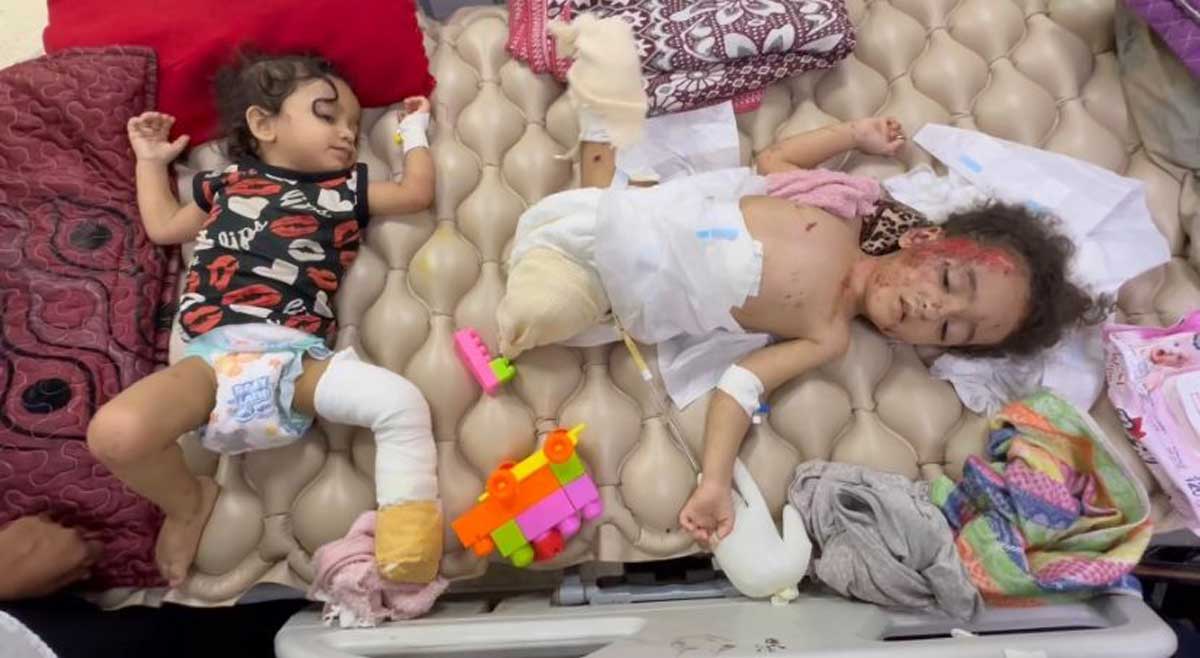
In the meantime, Bilal managed to go home and get his wife and daughters, who were unharmed. He brought them to us. They were barefoot. Wisam, Bilal’s wife, whispered to me that Shaimaa had been killed. A few minutes later, we got confirmation that Shaimaa had been killed and found out that their two daughters, Hanan and Misk, had been wounded and taken to Shuhadaa al-Aqsa Hospital. We were told that Shaimaa’s body was torn to pieces.
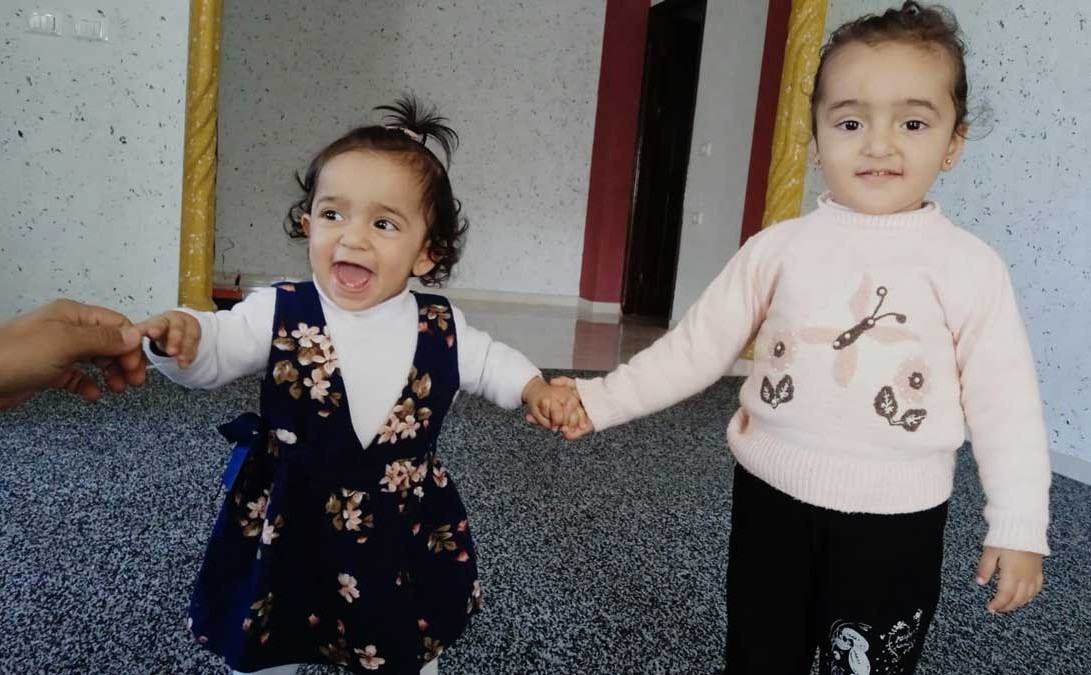
I stayed at home with my mother and father, while my sister Hikmat went to the hospital. She updated me from there that Muhammad was seriously wounded and was in the ICU, and that the doctors had amputated both of Hanan’s legs. She also had injuries to her intestines and colon, burns on her face, and shrapnel in her hands. Misk’s left foot was amputated, and she had shrapnel all over her body. Hikmat said Shaimaa’s dismembered body had been brought to the hospital and was already buried.
I didn’t even have the chance to say goodbye to Shaimaa, nor did her husband or daughters. Her parents, my sister Hikmat, and my brother Yusef said their farewells before the burial. Those were very difficult moments.
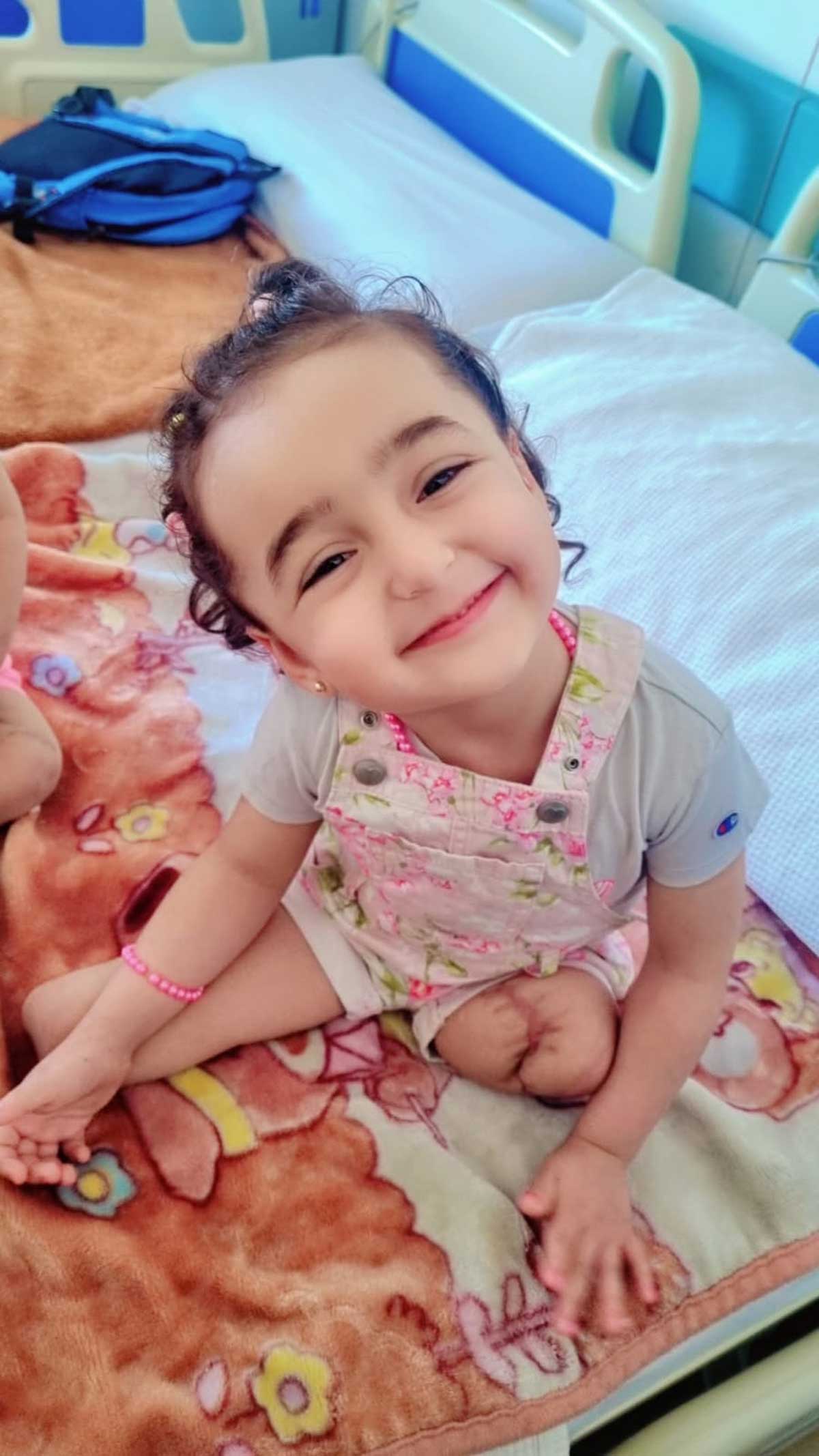
After my nieces came out of surgery, I went to the hospital to see them. My sister Hikmat went home to be with our parents. Now I’m taking care of my nieces. I stay with them at the hospital all day. Hanan’s condition is very serious. She has a fever, cries day and night, complains of pain, and asks for her mother. She’s not allowed to eat right now, and she’s only allowed to drink a little water. Misk, whose foot was amputated, eats very little. These little girls have lost their mother, but I haven’t told them that their mother was killed yet. They don’t yet understand what death is. They don’t know she’ll never come back. I tell them their mother will come later.
My brother Muhammad is in critical condition. I can’t visit him because he’s in the ICU and no one is allowed in. I only see him through the window. He’s had several surgeries and will need more. They keep taking him back into the operating room to clean his wounds and remove shrapnel. Once, he looked at me and nodded his head, and I felt he was in shock. I couldn’t bear to see him like that.
Muhammad loved his wife, Shaimaa, very much. They were a small family living a normal life, but they didn’t have time to experience a lot of joy. In a matter of moments, he lost his wife for no reason, was seriously wounded, and his two daughters were injured and their legs were amputated. Sometimes, my little girl Sham comes with me to the hospital. I see how she’s amazed and puzzled when she looks at Hanan and Misk. She looks at their legs and says, “What, Misk too? What happened to them?”
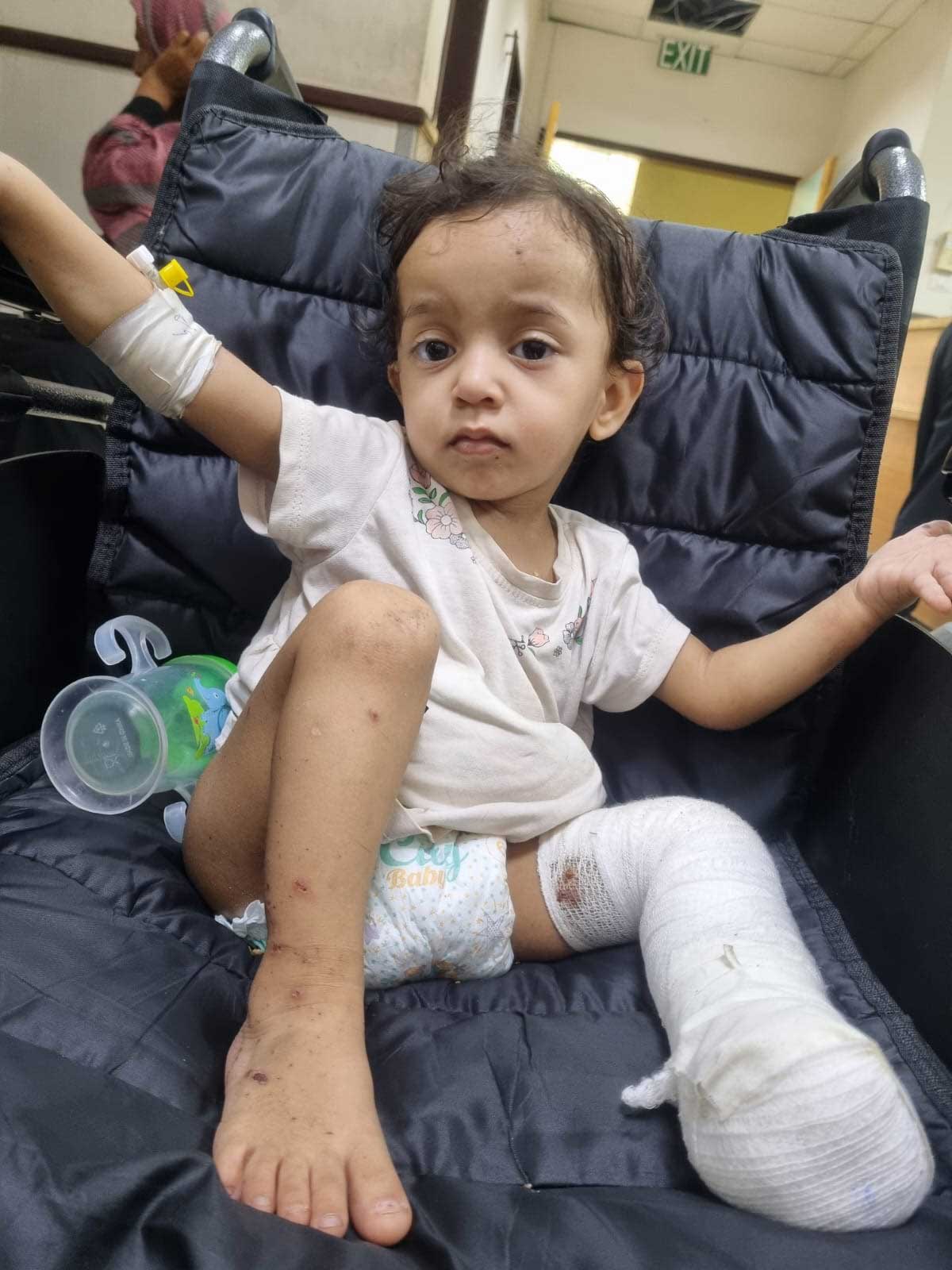
I look at them and my heart aches. How will they go on like this, without legs, without a mother? I dread the moment Hanan and Misk will ask me about their legs. What will I tell them? When I go to buy shoes for my children, what will I do when Hanan and Misk ask why I don’t buy them any? If they say, “I want to play,” “I want to dance,” “I want to ride a bike,” what will I say to them?
They always played at their grandparents’ house. But when they are discharged from the hospital and go back there, they won’t be able to play like they used to. How will they adapt to the new situation? They lost their mother, the love, compassion, and security she gave them, and they also lost their legs, their ability to move and play. Everything beautiful in their lives is gone. Their childhood was stolen. What did they do to deserve such devastation?
Now I’m responsible for their care, but I’m not their mother. I very much hope I can make up for all this loss, but I’m also aware that nothing can replace a mother’s embrace. What will I do when the war ends? Will I leave them with their father and go back to our home in the north? How can I leave them? After losing their mother, they need me.
This was a small family that harmed no one, and their world was destroyed. They were bombed in cold blood.
Hanan and Misk need further treatment outside Gaza and to have prosthetics fitted, but all the crossings in and out of Gaza are closed now. There’s no medicine or medical supplies. For them, prosthetics would be a small comfort. They’ll never make up for the legs they lost, but they could help them, at least a bit.
I’m in a terrible mental state. I can’t stop worrying about my family. I’m scared of losing a child. Every time I hear planes, I’m terrified at the thought of losing another loved one.
Our lives now are an ongoing tragedy, like the lives of everyone who’s been displaced from their home in northern Gaza, lost family members or have relatives who were wounded. I live in constant fear, terror, and stress because of the bombings, and I know very well nowhere in Gaza is safe. For the Israeli planes, all the residents of the Gaza Strip, no matter where they live, who they are, or how old they are, are targets. To the army, everyone here is the same and there’s no difference.
We’re struggling financially. Sometimes we get food aid. The prices of vegetables and fruits are high, and I can’t provide for my children’s needs. This creates a feeling of helplessness that’s very hard for me to bear.
I’m also very afraid that we won’t be able to return to our homes. We live in uncertainty, not knowing what will happen to us or what our fate will be. We have no future.
I call the whole world: end this bloodshed! Stop the annihilation in Gaza! Where is the international community, and why is it not protecting us? Children are being murdered here in cold blood in front of the whole world, and no one lifts a finger! The whole world is taking part in the war against us!
* Testimony given to B’Tselem field researcher Olfat al-Kurd on 10 September 2024
In a follow up testimony given to B’Tselem field researcher Olfat al-Kurd in March 2025, Shifa a-Daqi said:
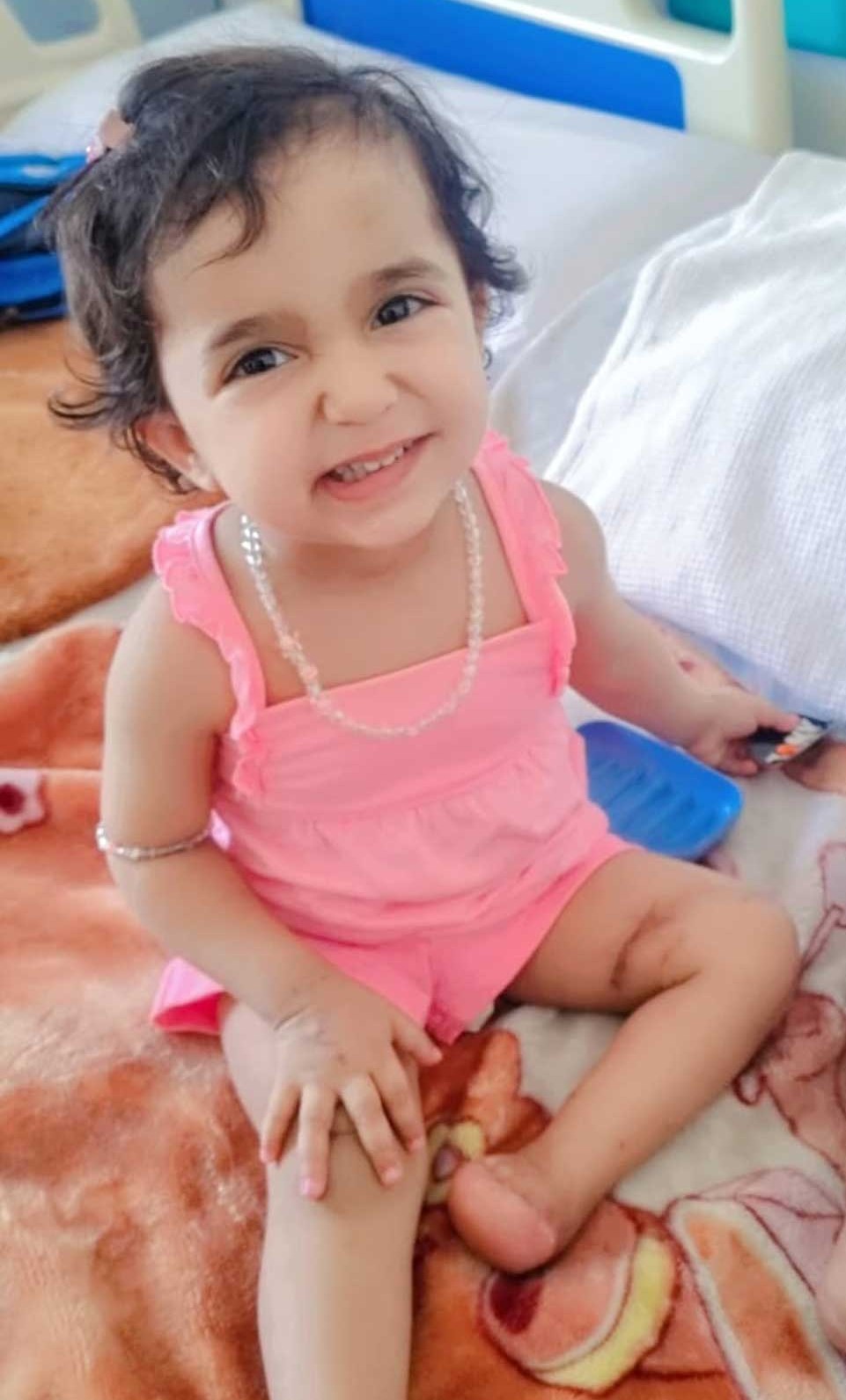
Hanan and Misk were discharged from Shuhadaa al-Aqsa Hospital on 21 January 2025. They had physiotherapy at a rehabilitation center in the Strip, after which we received referrals for both of them for treatment abroad. Several international institutions and organizations that saw our posts on social media about their condition contacted us, but they said that only one family member could accompany them, and I didn’t want to go without my children.
Then, someone from a Canadian organization contacted me and said they wanted to arrange treatment for Hanan and Misk and that they could arrange for my children to live with a family in Canada for a year so I could be with them in the hospital. We started making arrangements for the trip, but after some time, the organization called again and said we would have to go to Egypt first and continue the process from there.
At first, I refused to go to Egypt because I was afraid we would get stuck there and not be able to continue to Canada. But the World Health Organization called us and said they had arranged for me, Hanan, Misk, and my children ‘Omar, Isma’il, and Sham to travel to Egypt on 15 February 2025, so I decided to go after all. We’ve been in Egypt for about a month now. The girls are in the hospital, but there is no treatment for them here in Egypt. They can get prosthetics, but there’s no follow-up care. Right now, they’re only getting vitamins and physiotherapy. But they will need prosthetics and ongoing care and follow-up as their bodies develop, and they can’t get that in Egypt.
We’re all here in the hospital. Misk and Hanan are patients, and we sleep here next to them, inside the hospital. I’m still waiting for a better treatment solution and for arrangements for me and the children. But in the meantime, I gather it’s difficult to get entry visas to other countries for treatment because they’re all afraid of immigration from Gaza. We may not be able to get visas.