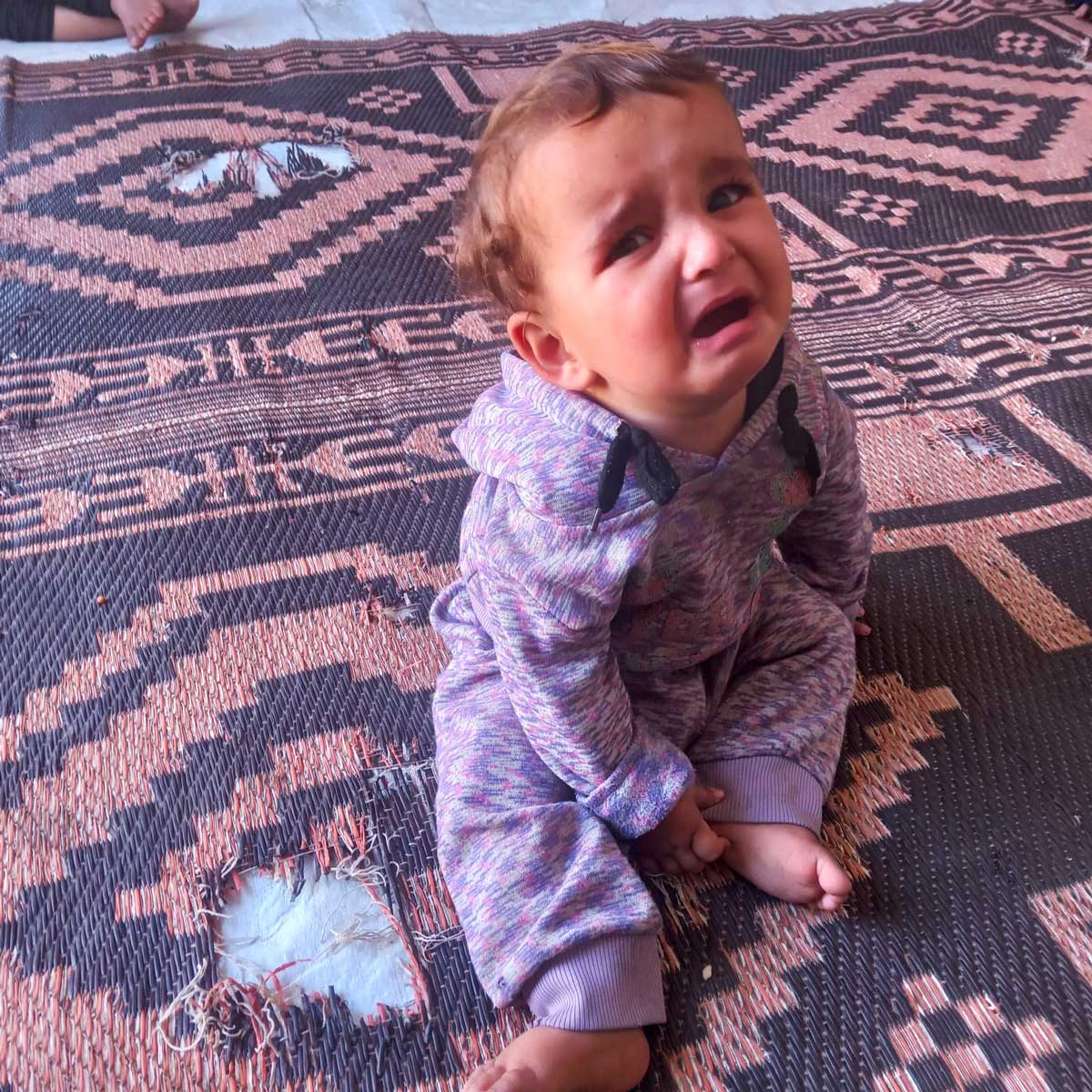
A 29-year-old mother of four from the town of Jabalya, Khadijah described how her displaced family has been suffering from harsh living conditions and hunger, stunting her toddler’s growth due to severe malnutrition:
When the war in Gaza began on Saturday, 7 October 2023, we woke up to the sound of rockets and didn’t know what was happening. The situation escalated quickly and planes began bombing every part of the Strip constantly. The bombed homes without warning, mosques during prayer, and schools. I was six months pregnant with my daughter Najah, who is now a year and a half old. I lived with my husband, Mahmoud al-‘Attar, 29, and our three children, Maryam, 11, Amirah, 8, and ‘Issam, 5, in the town of Jabalya north of Gaza City. With lived in a 250-square-meter building we shared with my husband’s brothers.
From the first day of the war, residents of areas near the fence in the north and east started leaving for fear of being hit. Israel created a “ring of fire” – massive bombing of residential areas with dozens of missiles fired at the same time from fighter jets. It felt like a huge earthquake: houses collapsed and the whole area turned to rubble. Whoever was inside the homes was killed, and the others experienced terrible fear. Doors and windows were blown away by the blasts. Children, women and elderly people screamed. We felt like we were in hell. I’d never felt such fear.
We stayed home despite the constant shelling and the indiscriminate artillery fire that hit houses nearby. Every day, drones dropped leaflets ordering us to leave Jabalya and go south, but we refused because we had nowhere to go. After 40 days, we started to feel death closing in. The sound of tanks grew louder and the shelling got closer.
On 17 November 2023, at around 8:00 P.M., the military entered our neighborhood. We remained trapped in our homes under nonstop shelling and gunfire until 7:00 A.M. the next day. When the shooting eased, we escaped with hundreds of others. We didn’t take anything with us, not even a change of clothes. My husband and I ran through the streets with our children, under indiscriminate fire from every direction. We heard women and children screaming and saw dozens of bodies lying on the ground and in carts. People were running in panic, looking for someone to take the wounded people to hospitals.
We left the neighborhood on foot without knowing where we were headed. My husband decided we should go south, in the hope we’d find safety there. We walked with thousands of displaced people of all ages along Salah a-Din Street to al-Kuwaiti Square, and from there to the Netzarim checkpoint the Israeli military put up. We waited there from 7:00 A.M. to 5:00 P.M., until we were finally allowed to cross south.
We continued on foot all the way to Rafah. We didn’t have a single shekel. We didn’t eat anything that whole day. When we got there, we were sunburnt and exhausted from hunger and thirst. As we entered the city, I collapsed from sheer fatigue and my nose started bleeding. Eventually, my husband found a place for us in a small classroom at al-Quds School, near al-‘Awdah Square. We shared that classroom with 12 other families. It was terribly overcrowded. I slept on the floor with the children, on a single blanket with no mattress. I suffered from cold, back pain, exhaustion and extreme hunger. I was weak and begged my husband to find something to eat because I was afraid for the baby in my womb. My husband slept in the schoolyard because there was no room inside. We began eating from the “Takiya” (soup kitchen) at the school – lentils and peas, and sometimes canned noodles.
The situation in Rafah was very bad. Hundreds of thousands of people poured in, looking for shelter, and the city was completely packed within two days. Prices skyrocketed – a sack of flour cost between 700 and 1,400 shekels (~180 to 370 USD). We couldn’t buy anything. My husband looked for work and barely found anything, to buy us food and get me vitamins for the pregnancy.
On 5 December 2023, I was eight months pregnant and started feeling severe pain in my stomach and back. At first, I thought it was from the cold and from sleeping on the floor, but when I reached the Emirati Maternity Hospital in Tal a-Sultan, the doctors said I was suffering from severe malnutrition and needed to an emergency C-section to save my life and the baby’s.
I had the surgery, and that’s how Najah was born. She was born severely malnourished and in critical condition. They moved her to the NICU, where she spent three days between life and death. When she stabilized, I brought her back to al-Quds School, and neighbors gave me a mattress and a blanket.
We stayed at the school until 6 May 2024. After the military threatened to invade the city and the bombing got closer, we had to leave again. We walked to the area of Morag, between Rafah and Khan Yunis, near a-Safwah School, and put up a tent out of cloth. We had no money and received no help from anyone. My husband went begging. For the first two weeks, we survived on the money he collected from begging or on food scraps he found in the trash. It was like living in hell, without money, food or shelter.
We stayed in Khan Yunis for three months, suffering from hunger, humiliation, and lack of water and access to toilets. In late July 2024, tanks approached the area and began shelling, so we fled again, under fire. This time we went to Deir al-Balah in the central Strip. We slept on the coastal road, in a tent with about 30 other people.
In the meantime, I noticed that Najah wasn’t growing. She was suffering from severe malnutrition and dehydration. I took her to the American Maternity Hospital in a-Zawaidah, where the doctors said she was in critical condition because she had gone so long without food and vitamins. I started bringing her there for regular follow-ups, and she was fed intravenously four times a week.
Almost every day, we sent Maryam to the soup kitchen to get food for lunch and supper. Usually, she came back with lentils or rice. Sometimes we went two or three days without food because the soup kitchens weren’t operating. We divided Najah’s nutritional supplements among us. Sometimes, my husband and I gave up our meals so the children could eat.
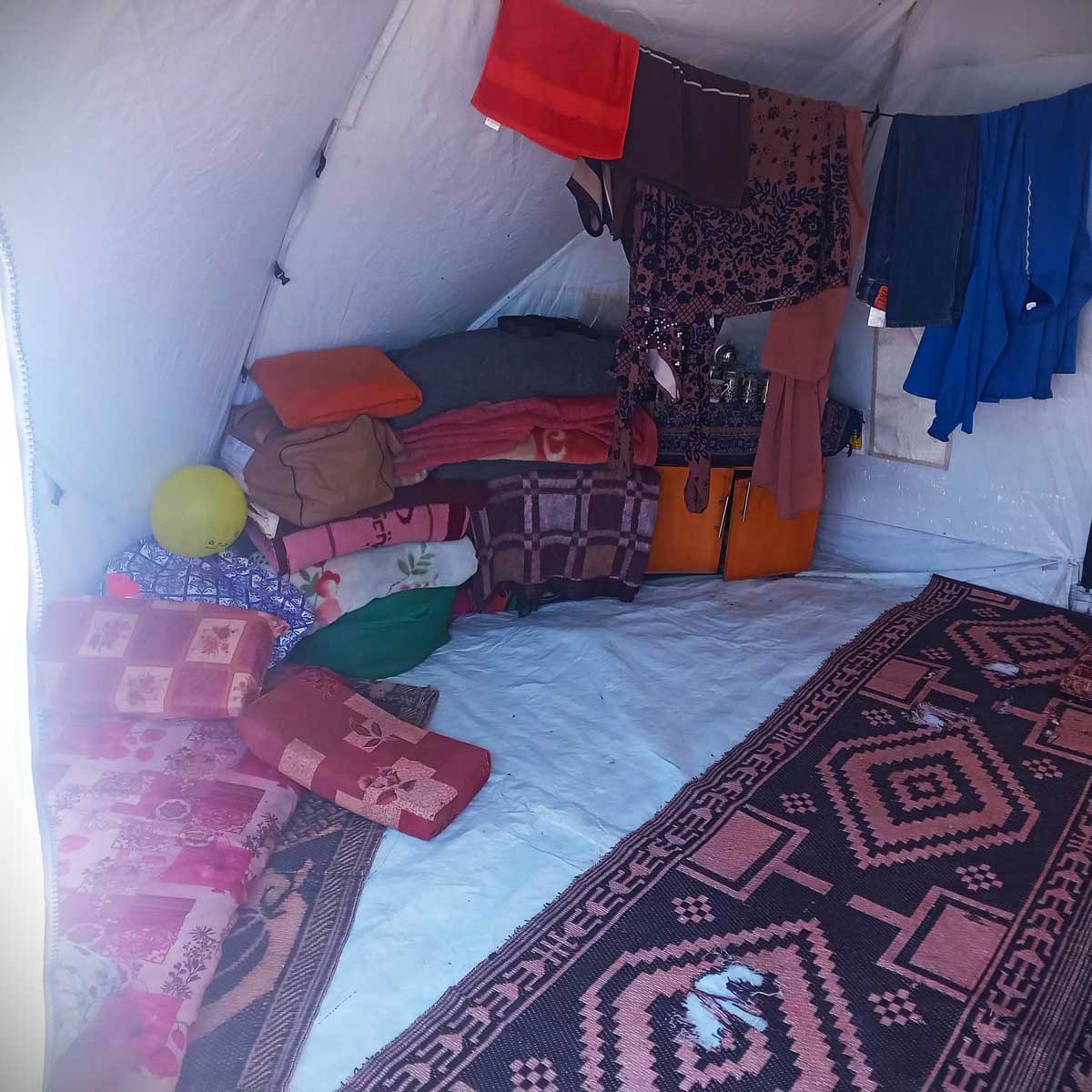
We continued like that until the ceasefire was declared on 19 January 2025. We stayed in the south for another week, and then walked back to Gaza City because vehicles were still banned from entering. When we reached Jabalya, we found our home destroyed. We moved into a displacement camp on Halawah Street in Jabalya, along with about 1,200 other families who had lost their homes.
The calm didn’t last. On 18 March 2025, the war resumed, and the bombings began again. The crossings were closed, and food supplies ran out. Prices rose even more and a sack of flour reached 1,500 shekels. There was nothing we could buy.
Today, we are living off what the camp administration provides – half a kilo of flour every two days. I knead dough and bake pita bread over an open fire, because there’s been no cooking gas for more than three months. I burned my right hand on the fire and now have third-degree burns that haven’t been treated, which makes it very difficult to function.
After the fighting resumed, many soup kitchens stopped operating even though they had been people’s main food source. Most of the people are starving. It’s been over a month since we last received cooked meals. We now go begging to get one meal a day for the children, especially for Najah.
We sit helplessly in our tent, hoping that God will end this war that has taken everything from us: our home, food, peace. I don’t know how we’re getting through the days without food. A few days ago, we got four kilos of a baking mix made of wheat flour, lentil flour, ground pasta, and a bit of yeast. I baked bread from it, but it came out very hard. Still, we eat it just to ease the hunger that’s been gnawing at us for months. We’re just waiting for this war to end.
* Testimony given to B’Tselem field researcher Muhammad Sabah on 18 May 2025