A 29-year-old mother of one from Beit Lahiya, spoke about the family’s displacement, life under siege, the airstrike that wounded her and her five-year-old daughter and killed her mother and two sisters, and another strike that killed her eldest sister along with other relatives:

Before the war, I lived in Beit Lahiya with my five-year-old daughter, Elyaa. My husband, Nader ‘Alian, 31, works outside the Gaza Strip, in the United Arab Emirates. My parents, Muhammad, 63, and Nabilah, 54, lived in the apartment next to ours with my sisters Bisan, 31, who has special needs, and Marah, 26. Two of my brothers live abroad, one in Belgium and one in Turkey. My father is married to another woman, and they have five children together.
At the beginning of the war, my sister Khulud, 35, her husband Ayman a-Z’anin, 41, and their daughters Rita, 12, Rozit, 9, Aylul, 2, and baby Elyaa, joined us.
After the war began, because of the heavy bombardments, we moved to my uncle’s house. He lives abroad. His family had already been displaced to the south. The house was only a few streets away from our house. In early December 2023, the military laid siege to the area. Twelve of us were trapped inside the house for twelve days. We appealed to international organizations for help on social media, but tanks and bulldozers surrounded the house and shelled everything around it. We barely moved, only to use the bathroom. We had no food or water. One day, I saw a huge bulldozer through the window. I was so terrified that I froze and couldn’t move. I stayed in shock for two days.
After the military withdrew, I returned home with Elyaa, my parents, Bisan and Marah. Our house was almost completely destroyed, and we lived there in very harsh conditions. Khulud, Ayman and the girls stayed in my uncle’s house. On 23 October 2024, my father went to fetch water from my uncle’s house. The military, which had raided the area, arrested him and Ayman. They were released a few days later and joined Khulud and the girls, who by then had moved to western Gaza City. Later, my father joined his second wife and their children in the south.
I stayed in our house with Elyaa, my mother, Marah and Bisan. We planned to move south but couldn’t do it alone, so we waited for an opportunity to join people evacuating from the schools in northern Gaza that had turned into IDP camps. We didn’t go to the schools ourselves because Bisan wouldn’t have been able to handle the bathroom conditions there. One day, the military bombed our neighborhood again, and we fled back to my uncle’s house.
On 30 November 2024, around 4:00 P.M., we sat down to eat when we heard an explosion in the street. My mother said, “Pray that we make it out alive.” Marah walked around the house praying, while my mother and Bisan stayed at the table. Elyaa stood next to me. Suddenly, the house was bombed. Everything collapsed and there was smoke, dust and rubble everywhere. My mother, Marah and Bisan were killed. Elyaa and I were injured.
There was no one to evacuate us to the hospital. My cousin, Shaimaa ‘Alian, who lived nearby, took us to a school in Beit Lahiya. From there, we were evacuated in a wheelchair to a field clinic where I had worked as a paramedic at the start of the war. They treated us there. Elyaa had first- and second-degree burns on her face and arms and wounds on her head that required stitches on her head. I had first-degree burns on my face and second-degree burns on my back and arms.
The bodies of my mother and my sister Bisan couldn’t be recovered and they’re still under the rubble. Marah’s body was retrieved with great difficulty, under fire. We buried her near the school.
On 4 December 2024, the military ordered us to evacuate the school, and shortly afterward, before we managed to leave, it bombed the area. Many displaced people were injured, and everyone who was there was forced to flee, including us. I was exhausted and wounded, and I don’t know how I managed to stay on my feet. As we walked west from the northern part of the city, I spoke on the phone with my sister Khulud, who was still in the western part of the city with her husband and daughters. We walked for a long time, injured and wearing the torn clothes we had received from IDPs at the school. I felt so depressed and heartbroken because my mother and sister were still under the rubble. I cried the whole way. Elyaa had bandages on her face and arms, and I was still suffering from the burns on my face, back, and arms. I am still receiving treatment for them.
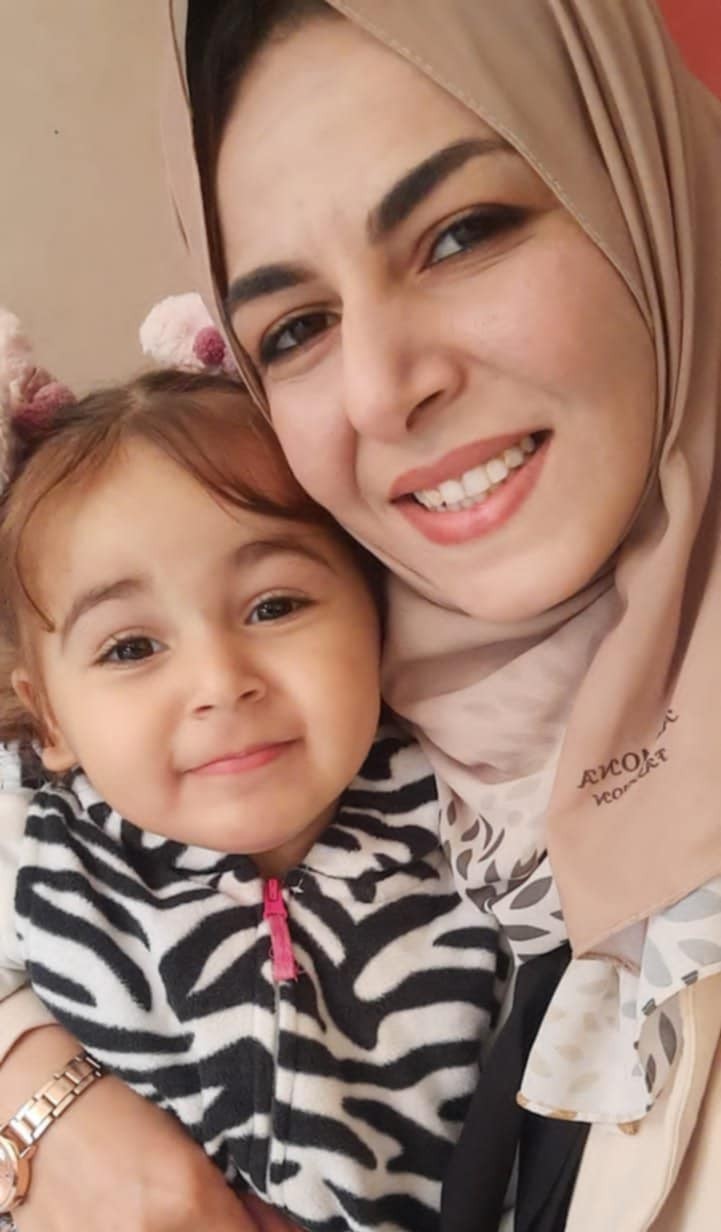
When I finally reached the house where my sister Khulud was staying, I was in very bad shape. When we met, Khulud hugged me and Elyaa, and we fell to the floor. We cried and held each other for half an hour. Everyone in the house cried because of the longing and because Khulud and I were the only ones left of our sisters. We comforted one another and shared our pain. After that, we never left each other’s side. Khulud, who is older than me, was nearly all that was left of my family after we lost our mother and sisters.
On the first day of the ceasefire, in January 2025, we walked back to Beit Lahiya in the morning to look for the bodies of our mother and Bisan under the rubble. When I reached the destroyed house, I broke down. I screamed, “Maaamaa!” Everyone in the street heard me. It was the first time I had seen the house since the airstrike, and I couldn’t believe what my eyes were seeing. It hurt so much when I found the torn pieces of the clothes I was wearing that day hanging from a post inside the house, ripped off me during the explosion. I realized I was looking at the stones that had fallen on my sister Marah, and her blood was still there. That day, I felt death.
Khulud and I started searching for our mother’s body in tears. It hurt to see the place where she was sitting at the kitchen table. I found the spot, but where was my mother? Where was Bisan? They must still be buried under the rubble, because a two-story house with all its furniture and belongings had collapsed on top of them. There is no heavy equipment here now to remove them. We tried to dig with hand tools and even managed to bring in a small bulldozer, but we couldn’t find their bodies or any remains of them.
In Beit Lahiya, we discovered that it wasn’t just our house that was destroyed, but almost all the houses belonging to our family. We were in shock at what we saw. There was almost nothing left. My father and his second family came back from the south about a week after the ceasefire began. We were all back in Beit Lahiya again. The two-story house of my brother Majd, who lives in Turkey, was still standing. We fixed it up, and Elyaa and I lived on the first floor with Khulud, her husband Ayman, and their daughters. There were two families on the second floor: my aunt Ilham Rajab, 59, her husband and their five children, and my uncle Khaled ‘Alian and his family, also seven people in all, altogether, 14 of us lived in that house.
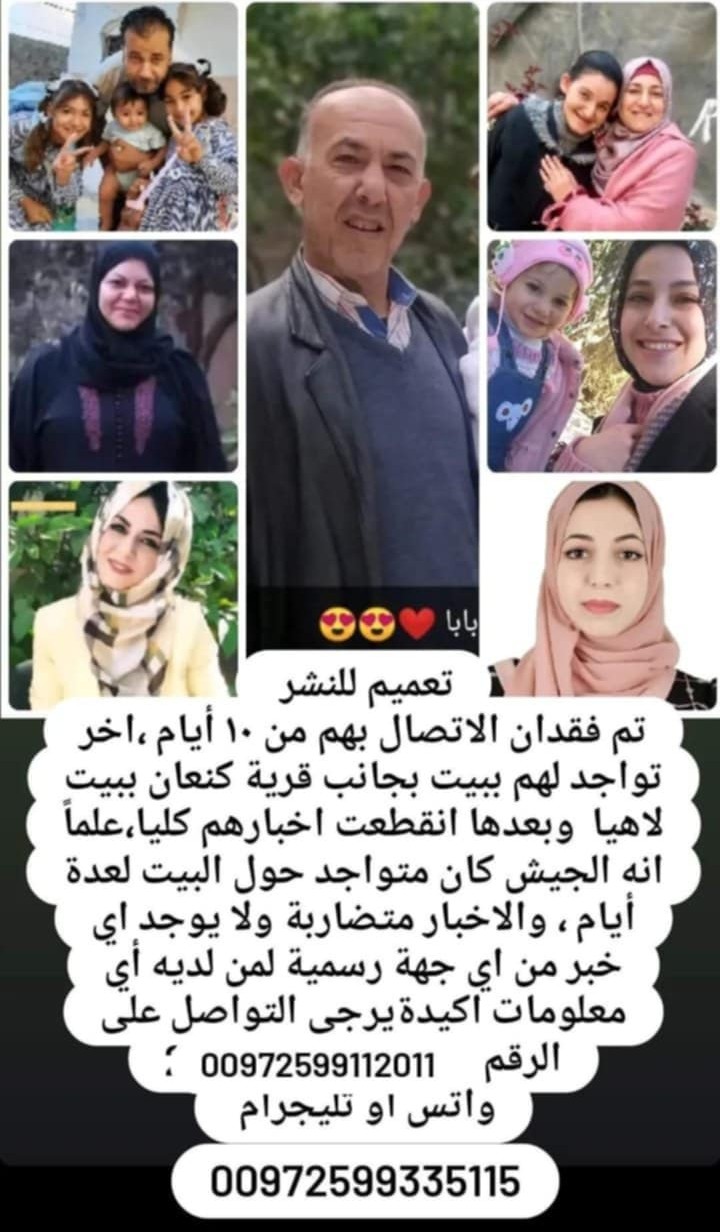
My father, his wife, and their children stayed in their own house. He set up a room, kitchen, and bathroom and invited me to live with them, but I refused. I wanted to stay with Khulud.
On 24 March 2025, during Ramadan, after we ate the iftar meal and prayed the afternoon prayer, Khulud and her husband went to Al-Awda Hospital to send some documents because there was electricity and internet there. When they returned, we both stood in the kitchen. I was making sandwiches and Khulud was making tea. All the girls were asleep in the room. I was standing by the window when suddenly I saw red fire inside the house, right in front of my face. I fell to the floor and stones began to fall on me. The lights went out and everything went dark. I started reciting the Shahadatayn [the Islamic declaration of faith, recited before death], but then I realized I could move. I got up and ran to the girls’ room. I found them crying, scratched and wounded, the room full of rubble and debris. I pulled them out of the house.
Khulud’s husband, his head covered in blood, asked me where she was. I told him she had been right next to me and must be fine. He said, “No, Khulud is here,” and pointed to a pile of stones. I was in shock. What did he mean “here?” She’d been right beside me, and I was fine. How could she be under the rubble? Civil Defense crews and medics arrived and started calling her name, but she didn’t answer. They began clearing the debris. I couldn’t understand what was happening. I couldn’t believe it. I was sure they wouldn’t find anything because she had been right next to me, and she was for sure fine. I stayed beside them, stunned, until they saw a lock of her hair, and then I fainted.
I woke up at the Indonesian Hospital to the terrible disaster. Khulud had been killed. I lost her too. That news hit me even harder than the deaths of my mother and my two other sisters, because she was the only one I had left. That day, Khulud was killed along with my aunt Ilham Rajab, 59, her granddaughter Tasnim, a year and a half, and my uncle’s wife, Manal Rajab, 45.
The rest of the family members who had been in the house were relatively lightly injured. My father came to us right after the bombing and wept over Khulud as he said goodbye to her at the hospital. I returned to my grandfather’s house in Beit Lahiya with Elyaa, Ayman, and his daughters. The next morning, we buried Khulud and the others who were killed. It was unbearably painful for all of us.
I’ve been living at my grandfather’s house with Elyaa since then. Ayman and the girls are renting a house in western Gaza City. I visit them from time to time, or they come to see us. Every time I see them, my heart burns. We sit together and cry. They are deeply attached to me. Little Aylul tells me on the phone, “Please tell me where my mother went.” My heart is broken. I’m the only aunt they have left. I still can’t process what happened.
I want to go to my husband Nader in the UAE. I want to escape every street here, every memory. I feel dead inside because of these memories. But if I leave, my nieces will have no one left. Today, I stood in the yard of my parents’ destroyed house and remembered our gatherings, the sounds of life, our laughter, my sisters and I, and how my mother used to bring us sunflower seeds and popcorn. I started shaking and crying. I went back to bed and fell asleep from pain and grief. Elyaa tells me, “Life isn’t beautiful without my grandmother and my aunts. I wish they knew I’m old enough for kindergarten.” I want to escape it all, all the memories and everything I’ve lived through.
* Testimony given to B’Tselem field researcher Olfat al-Kurd on 12 April 2025