On the Agenda
Filter updates:

Israeli military digs deep trenches to prevent access to communities of Masafer Yatta
For over a month the military has been curtailing the movement of the Palestinians living in Masafer Yatta (Greater Yatta) in the South Hebron Hills by putting in place physical obstacles. Local residents occasionally managed to forge side paths to get through, and each time the soldiers restored the obstacle either the same day or the next. This morning, 26 December 2017 2017, at around 10:00 A.M., soldiers arrived in the area with bulldozers. They re-blocked paths the Palestinian residents forged between Masafer Yatta and the community of Sh’ab al-Botum. This time the soldiers also piled up mounds of boulders and dug a ditch – two meters deep, by three meters wide – to keep vehicles from getting though. In addition, the troops also dug another ditch along a road which had not previously been blocked, and which runs between the communities of Khallet a-a-Dabe’ and Khribet al-Fakhit.
Dead end: Unemployment among college and university graduates in Gaza
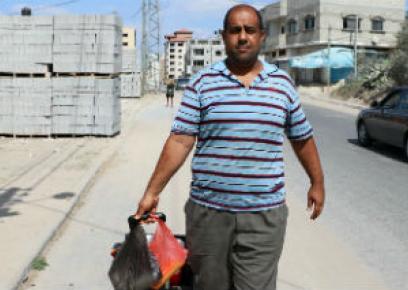
June 2017 marked a decade since Israel imposed a blockade on Gaza, ruining the Gazan economy and drastically lowering the quality of life there. The unemployment rate there is currently one of the highest in the world, at 46.6%. Women and young adults are even worse off. Four residents related to B’Tselem field researchers how they pursued higher education in the hopes of improving their financial position, but since graduating have remained unemployed, with little hope for change.
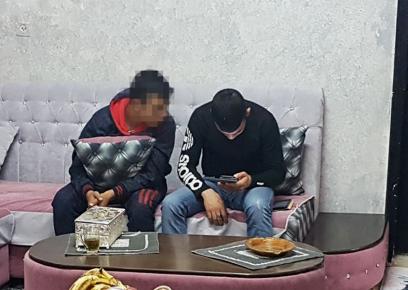
H.R. (on the left) at home with a friend. Photo by Amit Gilutz, B'Tselem, 24 Dec. 2017
East Jerusalem: Israeli Border Police officer pepper- sprays Palestinian, 15, at close range for no reason, others arrest the father
On 20 Nov. 2017, Israeli Border Police harassed Palestinian teens in Batan al-Hawa. An officer pepper-sprayed one of them, 15, in the face from very close range, for no reason. When his father tried to complain, the police arrested him for “threatening a police officer”. He was taken to a police station, interrogated and released on bail. This is not unusual conduct. Police brutality and false arrests are nothing new in Batan al-Hawa, a neighborhood where the largest expulsion in East Jerusalem in recent years is currently underway.

Yazan a-Rajabi after a Border Police officer sprayed pepper spray in his face. Still from video
Israeli police assault and arrest two Palestinian teens, fire sponge rounds and throw stun grenades in East Jerusalem neighborhood
On 7 Nov. 2017, Israeli police writing traffic tickets in Batan al-Hawa, Silwan, detained a Palestinian, 15, cycling by. When their demand to see his ID card went unmet, as he is too young to have one, an officer assaulted him and pinned him to the ground. A cousin who tried to intervene was pepper-sprayed. Both teens were arrested and the younger fined for riding without a helmet. This incident exemplifies deliberate harassment in a neighborhood under settler takeover, and the default use of arrest against Palestinian teens in East Jerusalem.

A.D. and W.D. awaiting their friend at the entrance to the Jerusalem Magistrates Court. Photo: 'Amer 'Aruri, B'Tselem, 7 November 2017
Hundreds of Israeli police raid al-‘Esawiyah in East Jerusalem, arresting 51 Palestinians incl. 26 teens
On the night of 22 Oct. 2017, Israeli police raided homes in al-‘Esawiyah in East Jerusalem and arrested 51 Palestinians, including 26 teens. Some of the minors, held in custody for a day or two, reported being beaten and forced to kneel for hours without food or drink. They were interrogated without a parent present and made to sign statements in Hebrew. Some did not see a lawyer. This conduct is part of a policy allowing systemic abuse of the human rights of hundreds of Palestinian minors a year, for decades, under a thin veneer of legality.

Still from video filmed by B'Tselem volunteer Jamal Abu S’ifan.
Hebron: Israeli soldier injures Palestinian, 16, in the head during settler march
On 11 Nov. 2017, settlers held a procession in Hebron’s Old City and the military shut down streets and shops along their way. The settlers tore down Palestinian flags hanging on closed shop doors, to which several Palestinian onlookers responded in protest. A soldier hit one of them, a 16-year-old, on the head with a rifle butt. This violence is part of daily life under occupation. It is not limited to beatings, but also takes the form of extreme restrictions imposed on Palestinians in the city to accommodate settlers.
Israeli soldier fires without cause at Palestinian car passing by post, killing the driver and injuring his sister
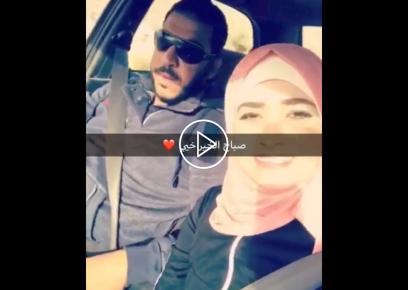
On 31 Oct. 2017, a soldier fired at a passing car in the West Bank, injuring driver Muhammad Musa and his sister, Latifah. Israeli personnel did not offer first aid, stopped treatment by Palestinian paramedics and carelessly transferred the driver to an ambulance that took him to an Israeli hospital, where he died. B’Tselem’s investigation found that the shooting was unjustified. MPIU is reportedly investigating, but experience shows this will likely end in nothing. Musa is the 36th casualty of Israeli security forces in the West Bank in 2017.
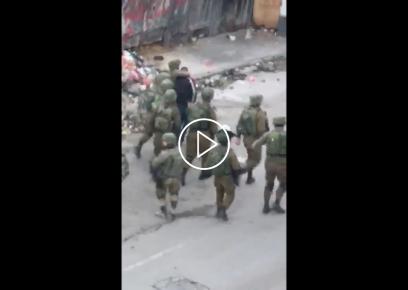
Still from video.
Video: Israeli soldiers beat Palestinian in Hebron
Video footage which reached B’Tselem shows a large group of soldiers violently dragging a Palestinian youth. A Hebron resident began recording the incident after hearing the youth crying out in pain. The violent incident took place on Friday, 8 Dec. 2017, on Wadi al-Tufah Street in the city of Hebron. Demonstrations were held that day across the Occupied Territories, including in Hebron, to protest U.S. President Trump’s recognition of Jerusalem as Israel’s capital. Very recently, when closing the investigation against the spokesperson of Israeli NGO Breaking the Silence, senior State Attorney officials tried to create the false impression that acts of violence by soldiers against Palestinians are an anomaly which always prompts an investigation.
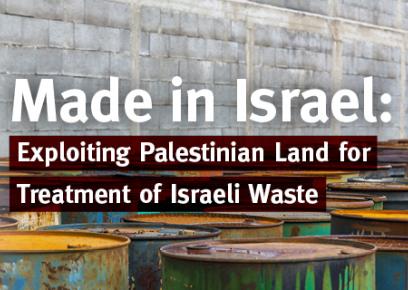
New report: Made in Israel: Exploiting Palestinian Land for Treatment of Israeli Waste
A new B’Tselem report, Made in Israel, reveals how Israel exploits the West Bank to treat waste – including hazardous waste – generated in Israel. In so doing, Israel abuses its power as an occupying power. It exposes the Palestinian residents – who are excluded from the decision-making process – to environmental and health hazards. This reality is simply one more facet of the exploitative policy Israel has practiced consistently for fifty years now, using Palestinian space and people to further its own interests, as if the West Bank were its sovereign territory.
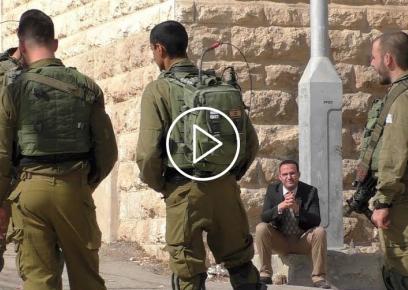
Occupation routine in Hebron: Soldiers harass teachers and children at school
In October and November 2017, B'Tselem documented four instances in which Israeli soldiers harassed Palestinian students and teachers crossing through a gate installed between their school and the road leading to the settlement of Kiryat Arba. These restrictions compound the constant harassment of Palestinian residents by security forces and settlers in Hebron. This intolerable reality has driven many Palestinians out of central Hebron and caused a economic collapse of the city center – effectively a form of silent transfer.
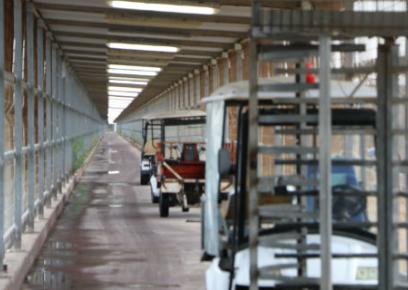
Untreated – Israel denies critically-ill patients from exiting Gaza for medical treatment
Faten Ahmad, 26, from Gaza, died of cancer in August. As the treatment she needed was unavailable in Gaza, she asked to receive it in East Jerusalem. Only one of her nine applications for a permit to leave Gaza was accepted. Every year, thousands apply to receive critical medical treatment in Israel or the West Bank. Last year, about half were not answered or were refused. Responsibility for conditions in Gaza, including the level of healthcare there, lies with Israel. Approving these requests is not an act of grace but a legal and moral duty.

Israel’s regime of apartheid and occupation is inextricably bound up in human rights violations. B’Tselem strives to end this regime, as that is the only way forward to a future in which human rights, democracy, liberty and equality are ensured to all people, both Palestinian and Israeli, living between the Jordan River and the Mediterranean Sea.
Since the Hamas attack on 7 October 2023, Israel has acted in a coordinated and deliberate manner to destroy Palestinian society in the Gaza Strip, committing genocide against its residents. In light of Israel’s actions in Gaza, the public statements made by Israeli decision-makers, and the international community’s failure to take effective action, there is a serious risk that the Israeli regime will expand the genocide to other areas under its control—first and foremost, the West Bank.
B’Tselem calls on the Israeli public and the international community to use every tool available under international law to bring an immediate end to Israel’s genocide against the Palestinian people.