|
More of our work in recent months:
- For 100 days, Maher al-Akhras from the West Bank village of Silat a-Dhahr has been on hunger strike to protest his administrative detention — one of the most extreme measures Israel employs against Palestinians. He is now on the verge of death. Israel refuses to release him and agrees, at most, to pledge not to extend his detention order after it expires in late November, unless new information is received. Al-Akhras refuses to end the strike on these conditions and has announced he will stop only if he is released. Israel’s Supreme Court has chosen not to order the state to release him, relying on legal constructs to rule that his condition does not justify release. The responsibility for what happens next lies with those who can prevent the prisoner’s further deterioration and even death. They can still choose to do so.
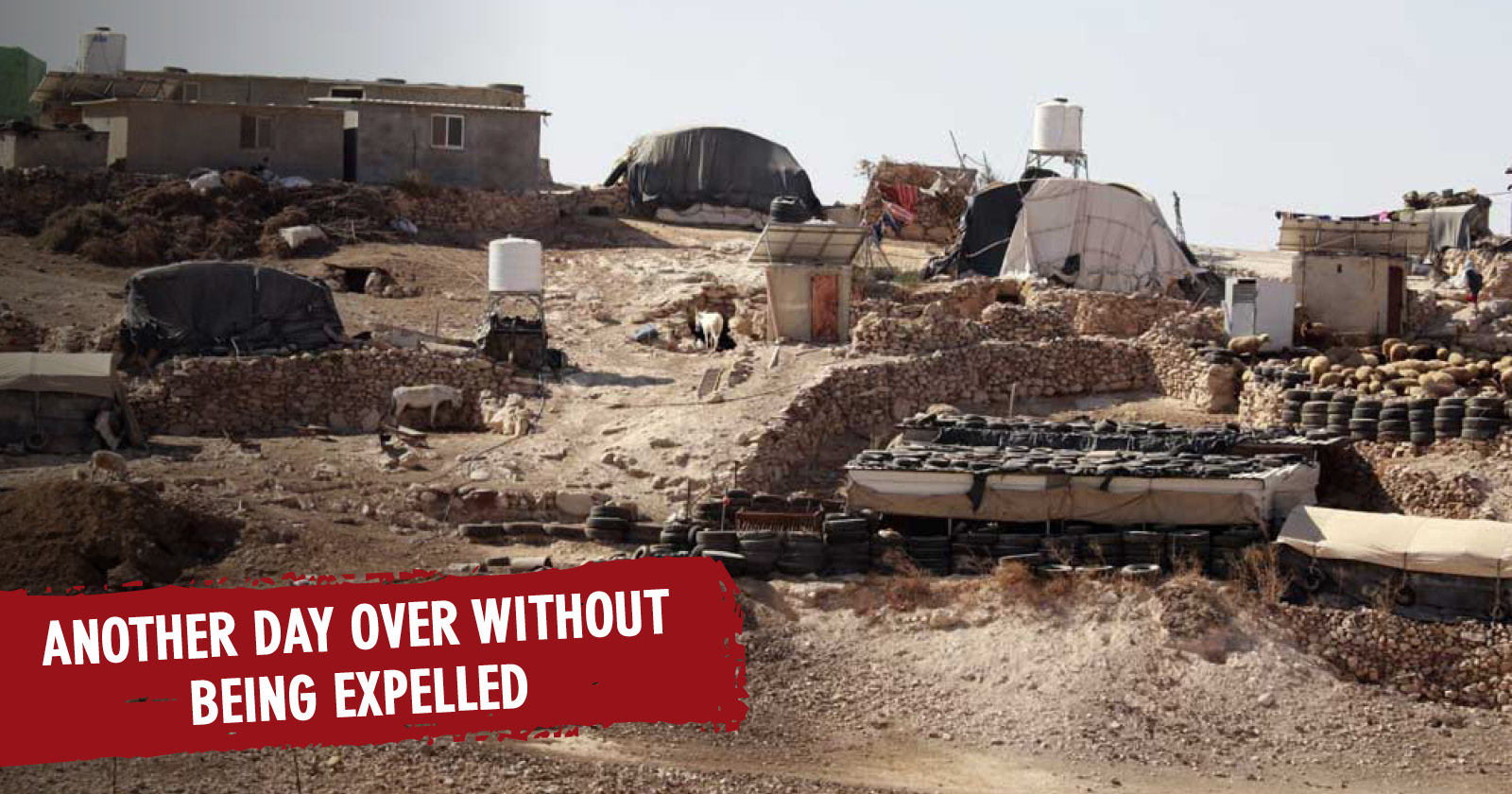
- Four days into the school year, the Civil Administration confiscated the tin plates that served as the roof of an elementary school in Ras al-Tin, a community lying east of Ramallah. The forces also took away 30 chairs and 12 desks, forcing pupils to sit on the ground to study in the scorching sun. The school, whose construction was completed, is in danger of demolition. This is no exception: in recent months, we have documented demolition after demolition of homes in Palestinian communities, including those facing expulsion, as well as residents demolishing their own homes in East Jerusalem, demolition of stores and public structures, and confiscation of equipment. These actions have left entire families homeless or robbed of an income, all as part of an Israeli policy to take over more land and drive Palestinians out of their homes.
- ‘Abd a-Rahman Jabarah, 22, lost his left eye and is in danger of losing sight in the other. The injury occurred in August, when Jabarah was sitting in a car and a Border Police officer fired at his head through the windshield. Why? Apparently, because the officers mistook him for a “wanted person”. Israel’s whitewashing mechanism, this time in the form of a DIP investigation, is already hard at work justifying Jabarah’s lifechanging injury.
- The mind boggles: Israeli soldiers planted IEDs within the territory of Kafr Qadum, where activists have been holding weekly protests for years against the closure of the main entrance to the village. The soldiers covered the explosives with stones and fabric. A group of women and children strolling in the area found the suspicious objects and alerted other locals. By sheer luck, no one was hurt. In response to questions by Ha’aretz reporters Hagar Shezaf and Yaniv Kubovich, the IDF Spokesperson unabashedly stated that soldiers had planted the explosives “in an uninhabited, open area where violent disturbances of the peace have been taking place regularly for several years”, in order to “create deterrence”. Even in an area where military retaliation is routine, planting IEDs is an exceptional step that conveys utter disregard for Palestinians’ lives.
- Throughout August and September 2020, B’Tselem received many reports of severe violence by settlers against Palestinians, including violent incursions into villages, harassment of residents at their doorstep or in pastureland, bodily harm and damage to property. Many victims remained traumatized and anxious, and had to pay thousands of shekels to repair the damage caused by the settlers. This unbridled violence in the West Bank has been fully backed by the state for years.
- On Thursday, 9 July 2020, 34-year-old Ibrahim Abu Ya’qub was fatally shot by Israeli soldiers while strolling with his friends in the village of Kifl Hares. According to the military, the soldiers fired at Palestinians who had hurled a Molotov cocktail at an army post near the entrance to the village. B’Tselem’s investigation found that the soldiers opened fire indiscriminately while pursuing two teens, injuring one of them and killing passerby Abu Ya’qub. In doing so, they showed utter indifference to the predictably fatal outcome of opening fire inside a civilian community.
- The Abu Hashhsash family suffer military night raids on their homes in al-Fawwar Refugee Camp, accompanied by severe physical violence and extensive harm to members. Last month, dozens of soldiers invaded the family’s home again, breaking one son’s nose, beating another son and taking him into custody on a stretcher. Violently beating Palestinians who do not pose any risk to soldiers or resist arrest has long been integral to the routine of the occupation.
- The Gaza Strip is on the brink of collapse due to the blockade and the scarcity imposed by Israel. We recently spoke again to the families of fishermen dealing with this collective punishment, which includes limiting the fishing range, opening fire at fishermen, confiscating boats and severely damaging their families’ livelihoods. In August 2020, after militants continued to launch explosive-laden balloons from Gaza into Israel, Israel limited the fishing range in southern Gaza even further and even banned fishing entirely for several days. The B’Tselem field researcher Olfat al-Kurd about
- In an Israeli attack on Gaza in 14 August 2020, the military fired two “warning missiles” at a compound belonging to the Hussein family in al-Bureij Refugee Camp. These relatively small missiles are allegedly fired to warn civilians of an impending strike and give them time to get away. The use of “warning missiles” demonstrates how unreasonable it is to expect civilians to grasp within minutes, in the dead of night, amid panic and confusion, what they must do to in order to save their families, including young children, while forced to leave their property behind knowing that destruction awaits. Four of the houses in the compound were damaged and two children injured in the attack: Rafif Hussein (3) was hit in the head and leg and Baraa Hussein (11) in the head, and both required hospitalization. The damage to the homes included shattered windows, cracked walls and destroyed belongings. B’Tselem reiterates that Israel’s policy of airstrikes in Gaza, which has caused thousands of casualties, has a black flag flying over it. It is unlawful and immoral.
- On 20 October 2020, we sent a letter along with 16 other human rights and civil society organizations in Israel to Minister of Foreign Affairs Gabi Ashkenazi. This followed an unprecedented decision by the ministry to stop issuing visas for foreign nationals employed by the United Nations Office of the High Commissioner for Human Rights (OHCHR). As Israel fully controls entry into the Occupied Territories, OHCHR staff need these visas from it. In the letter, we demanded the ministry revoke the decision and renew the issuance of visas to enable OHCHR’s routine operations.
B'Tselem in the media:
Hunger-striking Palestinian close to death, family says, Oliver Holmes, The Guardian
Israel refuses to release Palestinian 'on verge of death' after almost 80 day hunger strike, Gemma Fox, Independent
Palestine's olive harvest marred by rising Israeli settler violence, Alessandra Bajec, The New Arab
Number of Palestinians made homeless by Israeli demolitions hits four-year high despite pandemic, Independent
Israel's Cynical Exploitation of Palestinian Dead Bodies, Hagai El-Ad, B’Tselem Executive Director, Haaretz
Israeli NGOs demand government allow UN rights monitors, Joe Dyke, The Middle East
EU calls on Israel not to demolish Palestinian herding villages, Tovah Lazaroff, The Jerusalem Post
The dehumanization is the point, Sarit Michaeli, +972 Magazine
Israeli Soldiers Placed Explosives in West Bank Village for ‘Deterrence’, Hagar Shezaf & Yaniv Kubovich, Haaretz
Israeli soldier’s plea deal in fatal shooting faces scrutiny, Josef Federman, Associated Press/The Washington Post
When a Palestinian life is worth 3 months menial labor, Amit Gilutz, B'Tselem Spokesperson, Ynetnews.com
|