On the Agenda
Filter updates:

Palestinian children from Shu'fat refugee camp walk towards an Israeli checkpoint on their way to schools in other parts of East Jerusalem
Netanyahu’s Transfer Initiative: Nothing New, Just a Step Up
B’Tselem Executive Director El-Ad in an op-ed in +972 Magazine: Netanyahu recently proposed that Israel revoke the residency status of tens of thousands of Palestinians in East Jerusalem who live beyond the Separation Barrier. This appalling idea will merely continue what is already in motion: years of ‘quiet transfer’ and a decade of isolating the Palestinian neighborhoods east of the Separation Barrier

Protest near DCO Checkpoint, Ramallah area, 23 Oct. 2015. Photo by Oren Ziv, Activestills.org
High percentage of live fire injuries at protests in Ramallah area; concern - disproportionate and unlawful gunfire
Since early Oct. the number of Palestinians shot by Israeli security forces at protests has risen sharply: five Palestinians were killed and hundreds injured in the West Bank (excluding East Jerusalem). A particularly high proportion of casualties in the Ramallah area were hit by live gunfire. In addition, military orders restricting gunfire to the lower extremities notwithstanding, many individual were hit in the upper body by rubber-coated metal bullets. All this suggests that security forces are responding with excessive force to protests and clashes.

B’Tselem’s response to memo for new NGO legislation
Minister of Justice Shaked redefines cynicism when she cites “transparency” to camouflage her objective: defaming organizations critical of the Occupation and opposed to government policy. Even without this bill, B’Tselem gratefully makes public a list of its contributors. B’Tselem will carry on undaunted, exposing reality in the West Bank and the Gaza Strip. If the minister of justice and the PM are so concerned over foreign intervention in Israeli politics, they ought to waive the millions the Likud and Jewish Home received for their primary elections from foreign business tycoons, constituting the overwhelming bulk of contributions.
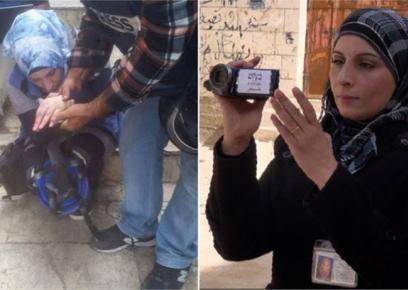
Manal al-Ja’abri at work, and after being hit in the hand by a rubber-coated metal bullet.
B'Tselem's Hebron researcher injured by rubber-coated metal bullet fired by security forces
On 27 Oct. B’Tselem’s Hebron researcher Manal al-Ja'bri was injured documenting a protest. A rubber-coated metal bullet fired by Israeli security forces fractured a finger in her left hand. She was filming clashes between security forces and Palestinian youth near the Bab a-Zawiya Checkpoint, Hebron. Al-Ja'bri, in a blue B’Tselem vest, was standing with a group of journalists across the street and at a distance from the Palestinian stone throwers. There was no apparent reason for security forces to fire at her or at other journalists there.

Ruins of home of Shaker Ja’abis, his wife and their four children, destroyed in the demolition of his brother’s home, one flight up. Photo by ‘Amer ‘Aruri, B’Tselem, 6 October 2015.
An Organized Barbarity Called 'Demolishing Terrorists’ Homes'
B’Tselem Executive Director El-Ad in an op-ed in Israeli daily Haaretz: The political and legal systems have been thrown into turmoil by Supreme Court Justice Vogelman scheduling an emergency hearing on demolition of the homes of the families of Palestinian perpetrators of attacks. Yet all party to this round of legal-administrative brutality can breathe easy: demolitions were sanctioned, are sanctioned, will be sanctioned by the court. Then, a family – which no one claims is guilty of any wrongdoing – will find its home reduced to a pile of rubble, or poured full of concrete.

Still from video.
Video: Young Palestinian man violently arrested, held wrongfully for 5 days because Israeli Police didn't bother to check his alibi
On 6 Oct. 2015, soldiers assaulted Palestinian Ansar 'Asi, 25, while he was standing at the entrance to a storage room at his workplace in al-Bireh watching clashes between soldiers and Palestinian youths. The soldiers violently beat 'Asi and arrested him. The incident was captured on his employer's security cameras. 'Asi was injured and taken to Hadassah 'Ein Kerem hospital in Jerusalem. He was held in detention for two days before being interrogated. Police interrogators told him that soldiers had identified him as a stone thrower, refused to listen to his denial of the allegations, and made no attempt to check his version despite the existence of the footage. Only following a military court hearing did the police view the footage. Even then, 'Asi was held for another two days due to the weekend sabbatical.
Ruins of Hassan family home south of a-Zeitun neighborhood, Gaza City. Photo by Khaled al-'Azayzeh, B'Tselem, 13 Oct. '15.
Military bombs Hassan family home in Gaza, killing pregnant woman and toddler
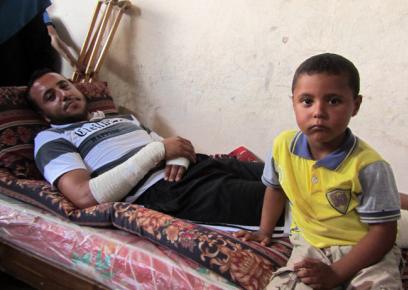
On 11 Oct. 2015, the military bombed the Hassan family home in Gaza, destroying it and killing mother Nur, 25, who was at an advanced stage of pregnancy, and daughter Rahaf, 3. Muhammad, 5, and father Yihya, 25, were lightly injured. B’Tselem’s investigation refuted claims that the bombing targeted “weapon production sites” or that the house collapsed due to a strike on a nearby training camp. The case exemplifies the illegality of Israel’s policy of airstrikes in Gaza, which has killed hundreds of Palestinian civilians in recent years.

Click to view full map.
Strict movement restrictions in East Jerusalem are prohibited collective punishment of Palestinians
Since 14 Oct. 2015, security forces have implemented the closure policy approved by the Israeli cabinet. Thirty-five checkpoints and concrete roadblocks have been placed at entrances to villages and neighborhoods in East Jerusalem and on internal roads, severely disrupting the lives of some 300,000 Palestinian residents. This constitutes the prohibited collective punishment of a population that lives under occupation and suffers ongoing violation of its rights. The vast majority of this population is not involved in attacks against Israelis.

Still from video: Palestinians and settlers throw stones at each other, while soldiers standing near the settlers fire tear-gas canisters at the Palestinians. Filmed by Ayat al-Ja’bri at 12:57 P.M. on 9 Oct. 2015.
Footage from Hebron: Israeli military enables 5-day settler attack
B’Tselem documented a five-day (6-10 Oct. 2015) campaign of violence by settlers against Palestinians in Hebron. Settlers repeatedly threw stones and bottles at Palestinian homes near the Kiryat Arba settlement fence, while Israeli security forces looked on. Settler violence intensified after two attacks by Palestinians in Hebron: a settler sustained serious injuries and a Border Police officer was slightly injured; one perpetrator fled, the other was shot to death. In another incident, a confrontation developed with settlers and Palestinians throwing stones at each other. Soldiers stood by the former and fired tear-gas at the latter. This glimpse of daily life in Hebron is an extreme example of the imbalance of power throughout the West Bank, in which Israeli forces back settler violence targeting Palestinians.

Fadi Alun
Footage raises grave concern that Fadi ‘Alun and Basel Sidr were shot while no longer posing danger
In 13 incidents over the past two weeks, Palestinians were shot to death for stabbing or attempting to stab Israelis , or when suspected of doing so. In two of these cases, video footage published by the media raises grave concern that the security forces shot to kill even when it was clear that the Palestinians no longer posed a threat and could be apprehended in other ways. The wave of stabbing attacks against Israelis is shocking, and security forces must protect the public by apprehending Palestinians suspected of such actions. Security forces have the authority to use the minimal amount of force necessary to achieve that end, according to the circumstances, but law enforcement officers cannot act as both judges and executioners.

A-Ras al-Ahmar residents wait to be allowed to return home. Photo by ‘Aref Daraghmeh, B’Tselem, 12 October 2015
Dozens of Palestinians in Jordan Valley forced to vacate homes for hours of military exercises
On 12-13 Oct. 2015, the military forced ten Palestinian families from Kh. a-Ras al-Ahmar to vacate their homes for three hours each day so troops could train nearby. Pursuant to orders served on 8 Oct., the families were made to leave the area with their flocks for the duration of the training. These repeated short-term displacements cause unreasonable disruption to the lives of communities in the Jordan Valley. In some cases, residents have no alternative accommodation and must wait it out in the open, trying to find shelter, food and water in the harsh weather.

Human Rights Organizations in Israel: Politicians’ calls to police and soldiers to shoot rather than arrest endorse the killing of Palestinians
Since the beginning of the current wave of violence, there has been a worrying trend to use firearms to kill Palestinians who have attacked Israelis or are suspected of such attacks. Politicians and senior police officers have not only failed to act to calm the public climate of incitement, but on the contrary have openly called for the extrajudicial killing of suspects. No-one disputes the serious nature of the events, nor the need to protect the public. However, it seems that too often, instead of acting in a manner consistent with the nature of each incident, police officers and soldiers are quick to shoot to kill. The political and public support for such actions endorses the killing Palestinians in the Territories and in Israel.
Israel’s regime of apartheid and occupation is inextricably bound up in human rights violations. B’Tselem strives to end this regime, as that is the only way forward to a future in which human rights, democracy, liberty and equality are ensured to all people, both Palestinian and Israeli, living between the Jordan River and the Mediterranean Sea.
Since the Hamas attack on 7 October 2023, Israel has acted in a coordinated and deliberate manner to destroy Palestinian society in the Gaza Strip, committing genocide against its residents. In light of Israel’s actions in Gaza, the public statements made by Israeli decision-makers, and the international community’s failure to take effective action, there is a serious risk that the Israeli regime will expand the genocide to other areas under its control—first and foremost, the West Bank.
B’Tselem calls on the Israeli public and the international community to use every tool available under international law to bring an immediate end to Israel’s genocide against the Palestinian people.