Ethnic cleansing of Palestinian communities and lone families in the West Bank (59 communities as of 16 Mar 2026)
Demolitions and confiscations in communities facing expulsion
Thousands of people – residents of dozens of Palestinian communities located throughout Area C, the West Bank – face imminent expulsion by Israeli authorities on a variety of pretexts. The live blog will pool the regular updates we get from B’Tselem field researchers regarding the communities and any attempts by authorities to expel them. Click on the number of a community cluster and then on the tent icon marked on the map for further information about communities facing the risk of expulsion.
The information in the blog reflects the latest state affairs known to us and is updated as we receive new data from the field. For more on the communities facing expulsion, click here.
The information in the blog reflects the latest state affairs known to us and is updated as we receive new data from the field. For more on the communities facing expulsion, click here.
6 Apr 2025
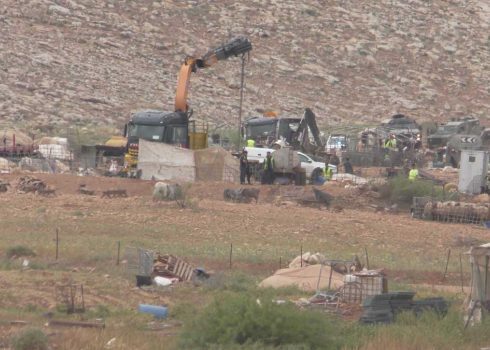
Civil Administration dismantles and confiscates homes of 4 families, leaving 35 people, 15 of them minors, without shelter
On Sunday, 6 April 2025, at around 9:00 A.M., Civil Administration personnel arrived with a bulldozer and trucks, escorted by soldiers and members of the Jordan Valley Settlement Council, to the area of Ras al-Ahmar in the Jordan Valley. The forces dismantled and confiscated eight residential tents, leaving four families – a total of 35 people, 15 of them minors – without shelter. The families had relocated to the area after settler violence drove them out of their homes in Khirbet Samrah about 20 days earlier. The forces also demolished a livestock enclosure and confiscated eight livestock pens, three water tanks, two generators, two solar panels, and two carts used for carrying goods.
7 Feb 2017

A child near the ruins of his home in Khirbet a-Ras al-Ahmar. Photo by 'Aref Daraghmeh, B’Tselem, 7 February 2017.
Israeli Civil Administration demolishes Palestinian home and 9 other structures in Jordan Valley
This morning, Civil Administration (CA) personnel arrived at the community of a-Ras al-Ahmar in the Jordan Valley. They demolished eight structures - including two residential tents - belonging to one of the families in the community. The family of seven, including five minors, was left without a roof over their heads. The CA also demolished six livestock pens that belonged to the family. The community of a-Ras al-Ahmar suffers constant harassment at the hands of the Israeli authorities. In September 2016, the CA demolished 27 structures in the community, ten of them dwellings. Over the course of 2016, community members were temporarily displaced on ten different occasions to make way for training held by the military nearby. Israeli authorities also demolished a livestock pen and two agricultural storehouse in the village of Kardalah.
30 Jan 2017

The demolition in Jabal al-Baba community, 26 January 2017. Photo by Hussam Abed, B’Tselem
Civil Administration demolishes homes of three families in Jabal al-Baba community
On Thursday 26 January 2017. Large Civil Administration and Border Police forces arrived at the community of Jabal al-Baba, located near al-'Eizariyah, northeast of Jerusalem. The forces destroyed tents that were the homes of three families, and two livestock pens, leaving 17 people, including 9 minors, homeless. The forces did not allow the families to remove all of their belongings from the tents and pens before the demolition, resulting in extensive property damage. The Jabal al-Baba community numbers 350, about half of them minors, and it is located in an area designated by Israeli authorities as Area E1, where an expansion that would connect the settlement of Maaleh Adumim to Jerusalem is planned. In 2016, the Civil Administration demolished structures in the community on two different occasions.
23 Jan 2017

Children from the community of Khirbet 'Ein Karzaliyah near the contens of the homes destroyed by the Civil Administration. Photo: 'Aref Daraghmeh, B'Tselem. 23 January 2017.
As they do every winter, Civil Administration forces demolish homes in Khirbet ‘Ein Karzaliyah today
This morning, Monday, 23 January 2017, Civil Administration forces arrived at the small shepherding community of Khirbet ‘Ein Karzaliyah, living some 5 km southwest of the Palestinian village al-Jiftlik, in the Jordan Valley. The community is home to three families. The forces demolished tents used as living quarters by two of them, leaving 13 people, including six minors, without a roof over their heads. The forces also destroyed two livestock pens and razed part of the access road leading to the isolated community. In February 2016, the authorities demolished three tents in the community, and destroyed its access road. Over the course of 2015, the Civil Administration destroyed homes in the community on two different occasions, lastly in March, when they also razed the access road. The Civil Administration demolished structures in the community in 2014 as well. In 1972, the military declared the area where Khirbet ‘Ein Karzaliyah is located a closed military zone (No. 904), claiming it needed it as a training zone.
5 Jan 2017
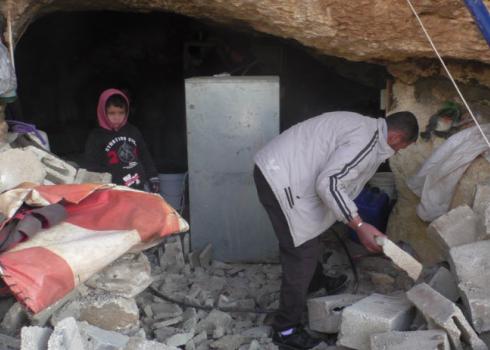
Members of the Hanani family among the ruins of the entrance to their cave, demolished this week in Khirbet Tana. Photo by Salma a-Deb’i, B’Tselem, 3 Jan. ‘17
2017 brings no relief: Israel continues largescale home demolitions in Palestinian communities
On Monday, 2 January 2017, Civil Administration forces came to two communities located north of the Ma’ale Adumim settlement, Wadi Esneisel and Bir al-Maskub. In the former, they demolished the homes of six families, numbering 48 people, including 34 minors, and a livestock pen. Some of these families had already lost their homes in August 2015, when the authorities demolished seven homes in the community. In Bir al-Maskub, the authorities demolished the homes of four families numbering 30 people, including 18 minors. Some of these families had lost their homes in a previous demolition in April 2016. The next day, on Tuesday, 3 January, Civil Administration forces came to the community of Khirbet Tana, located close to Beit Furik, and demolished structures that belong to 14 families, including six homes. The demolitions left 29 people, 15 of them minors, homeless. The forces also demolished 16 livestock pens. In 2016, the Israeli authorities demolished a total of 79 structures in the community on four separate occasions.
20 Dec 2016

A shepherdess and armored personnel carriers in the pastureland of Jordan Valley residents. Photo by Keren Manor, Activestills, 8 Dec. 2016
Sept.-Dec. 2016: Military temporarily displaces Palestinians in Jordan Valley 19 times, citing training nearby
Since Sept. some 220 Palestinians (incl. about 100 minors) have been forced to leave their homes in the Jordan Valley on multiple occasions to make way for military training. Families from Ibziq, Khirbet Humsah and Khirbet a-Ras al-Ahmar have had to spend hours on end, or even all night, far from home and exposed to the elements. The frequency of these displacements completely disrupts residents’ lives and jeopardizes the very existence of these communities. As an occupying power, Israel cannot use the land for routine military purposes, harm the livelihood of protected persons on this pretext, or attempt to expel the residents.
20 Nov 2016

Civil Administration officials arrive at the community of Ibziq to deliver temporary evacuation order. Photo by ‘Aref Daraghmeh, B’Tselem, 15 Nov. 2016
Military forces some 80 residents of Ibziq, half of them minors, to spend two nights away from home because of military training
Today, 20 Nov. 2016, Civil Administration officials handed evacuation orders to 14 families in Ibziq, north of Tubas. The families, 78 people, including 42 minors are to evacuate from Monday early afternoon to Tuesday morning, and for the same time Tuesday to Wednesday. They will have to spend two nights outside, away from home. The military has been training extensively throughout the Jordan Valley in recent weeks, turning out scores of residents in Palestinian communities in these areas, which Israel defines as firing zones.
13 Nov 2016

Target-practice image placed by soldiers in residential area of an al-Fajam area community, near ‘Aqraba. Photo by ‘Aref Daraghmeh, B’Tselem, 17 Oct. 2016
Military Resumes Maneuvers in Residential Areas and Grazing Land of Palestinian Communities: Two Communities Displaced and Another Ravaged
In recent weeks, the military has held several maneuvers in residential areas or grazing land belonging to Palestinian communities. Israel claims that the areas are “firing zones,” despite the fact that these communities have lived and worked on the land for many years. The repeated displacement threatens the ability of residents to continue living in the communities. As an occupying power, Israel may not use land for general military purposes, and certainly must not displace the residents or damage their livelihood on these grounds.
9 Nov 2016
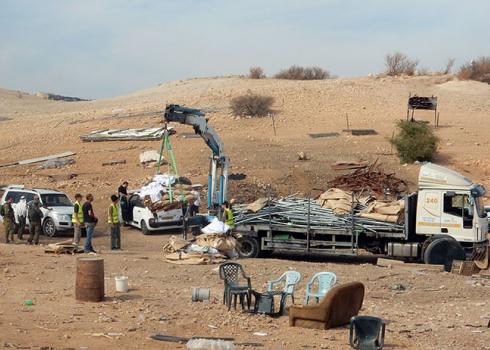
The confiscation in Khirbet Tall al-Himma this week. Photo by ‘Aref Daraghmeh, B’Tselem, 7 Nov. 2016
Civil Administration continues harassment and attempted displacement of residents of Tall al-Himma, Jordan Valley
On Thurs. Nov. 11, Civil Administration forces arrived at the community of Khirbet Tall al-Himma, located in the northern Jordan Valley, south of ‘Ein al-Beida. The forces dismantled six tents and confiscated them together with two tents that had not been pitched yet. Three of the tents had been used as dwellings by members of the community, and the rest were used as livestock pens. These structures were donated to the community this week by a humanitarian aid agency, after the Civil Administration demolished these families’ homes on 27 September 2016, leaving 25 people, 10 of them minors, homeless.
31 Oct 2016

Demolition of dwellings, Khirbet a-Deir, the Jordan Valley, 30 October 2016. Still from video filmed by 'Aref Daraghmeh, B'Tselem.
Civil Administration demolishes homes of 14 people, confiscated tractors and other equipment in Palestinian communities
Three communities targeted today as part of Israel’s confiscation and demolition campaign. Jordan Valley: In Kh. a-Deir, forces demolished the homes of 14 people, 4 are minors. In a-Ras al-Ahmar, forces confiscated tractors used for hauling water and feed for livestock. In Wadi al-Qatif, in the Ma'ale Adumim area, forces confiscated water tanks and portable toilets. In the campaign, launched in 2016 in a bid to expel Palestinian communities, Israel has so far demolished 255 homes, and left 1,076 people homeless, including 557 minors.
9 Oct 2016

The demolitions in a-Ras al-Ahmar in the Jordan Valley. Photo: 'Aref Daraghmeh, B'Tselem, 9 Oct. 2016.
Israel demolishes 18 Palestinian homes northeast of Jerusalem and in northern Jordan Valley
On 9 Oct. 2016, Israeli authorities demolished a total of 18 homes in the communities of al-Kurshan, near the Ma’ale Adumim settlement, and a-Ras al-Ahmar, in the Jordan Valley, leaving 52 people – including 23 minors – homeless. In the latter, they also demolished 17 livestock pens. In the massive demolition campaign it has waged since the beginning of 2016, Israel has thus far demolished 252 Palestinian homes in the West Bank, leaving 1,062 people, including 553 minors, homeless.
29 Sep 2016
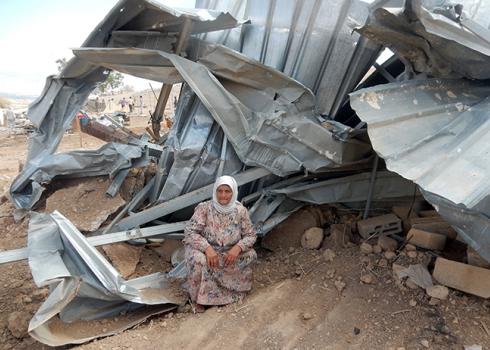
Zahrah Mahmoud Ayub,68, from Khirbet al-Himma, next to fresh ruins in the community. Photo by ‘Aref Daraghmeh, B’Tselem, 27 Sept. 2016
Israeli demolitions in West Bank leave 56 Palestinians homeless
On 27 Sept. 2016, Israel demolished 22 structures, half of them homes, in five West Bank communities: in the northern Jordan Valley, near Ma’ale Adumim, the South Hebron Hills, and East Jerusalem. This left 56 Palestinians, including 30 minors, homeless. The authorities also demolished water cisterns, livestock pens, and part of a school. This is part of a massive demolition campaign to pressure Palestinians to leave Area C that has, since the beginning of 2016, left 1,010 people homeless, including 530 minors.
1 Sep 2016

A resident of Badiw a-Mu’arrajat whose home was demolished. Photo: 'Aref Daraghmeh, B'Tselem, 1 Sept. 2016
Israeli Authorities Confiscate Caravans in Jordan Valley, Leaving 14 People Homeless
Yesterday (Wednesday, 31 August 2016), military and Civil Administration forces arrived in the afternoon in the community of Badiw a-Mu’arrajat to the northwest of Jericho. The forces dismantled and confiscated three residential caravans, a shack used for raising livestock, and mobile toilet facilities. All the structures were donated to the families by a humanitarian aid organization after the Israeli authorities demolished their homes on 4 August 2016. The destruction left 14 people homeless, including three minors. Fatima Malihat, whose home was demolished, stated in her testimony to B'Tselem: “They don’t want us to stay here. They are fighting to stop us making a living. Where should we go? They have demolished our home several times and they chase us wherever we go. Our life has become bitter and dark and we haven’t had a single good day. We are afraid even to put up a tent because they will just destroy it. Where should we go? We don’t have anywhere to go. Wherever we go to, they expel us.”
Israel’s regime of apartheid and occupation is inextricably bound up in human rights violations. B’Tselem strives to end this regime, as that is the only way forward to a future in which human rights, democracy, liberty and equality are ensured to all people, both Palestinian and Israeli, living between the Jordan River and the Mediterranean Sea.
Since the Hamas attack on 7 October 2023, Israel has acted in a coordinated and deliberate manner to destroy Palestinian society in the Gaza Strip, committing genocide against its residents. In light of Israel’s actions in Gaza, the public statements made by Israeli decision-makers, and the international community’s failure to take effective action, there is a serious risk that the Israeli regime will expand the genocide to other areas under its control—first and foremost, the West Bank.
B’Tselem calls on the Israeli public and the international community to use every tool available under international law to bring an immediate end to Israel’s genocide against the Palestinian people.