On the Agenda
Filter updates:

Roadblock on al-Madares Street. Photo by Hussam ‘Abed, B’Tselem, 9 Jan. 2017
Collective punishment in Jabal al-Mukabber: Jerusalem Municipality served some 40 demolition orders
On Sunday 8 Jan. 2017 Fadi al-Qunbar, 28, of Jabal al-Mukabber, carried out a ramming attack at the Armon Hanatziv Promenade in Jerusalem, killing 4 soldiers and injuring 13. Israeli authorities have since adopted punitive measures against his extended family and other locals. Collective punishment and administrative measures against Palestinian neighborhoods in East Jerusalem are an acknowledged Jerusalem Municipality policy and the mayor boasts of it. While the policy is overt, this does nothing to detract from its being wrongful and involving widespread persecution by the authorities of thousands of Jerusalem residents.

Muhammad Burqan. From “The Boy from H2” by Helen Yanovsky
B’Tselem-produced documentary to premiere at the Berlin International Film Festival
A short documentary by Helen Yanovsky, “The Boy from H2” - created in collaboration with B’Tselem’s field researchers and Camera Project volunteers in Hebron, and produced by B’Tselem’s video department - will premiere at the 67th Berlinale as part of the Berlinale Shorts competition. The documentary follows 12-year-old Muhammad Burqan, who lives in Area H2 of Hebron, a section of the city under full Israeli control.

Members of the Hanani family among the ruins of the entrance to their cave, demolished this week in Khirbet Tana. Photo by Salma a-Deb’i, B’Tselem, 3 Jan. 2017
2017 brings no relief: Israel continues largescale home demolitions in Palestinian communities
On 2 Jan. 2017, Civil Administration forces demolished ten homes and a livestock pen in Wadi Esneisel and Bir al-Maskub, north of the Ma’ale Adumim settlement, leaving 78 people homeless, including 52 minors. The next day, the forces continued, demolishing six homes and 16 livestock pens in the community of Khirbet Tana, located close to Beit Furik in the Nablus district, leaving 29 people homeless, including 15 minors. This followed the demolition of 79 structures in the community in 2016.

Soldiers capture 7-year-old Muhammad Shteiwi. Video stills by Abdallah Qadumi, B'Tselem, 23 Dec. 2016
7-year-old caught in soldier stakeout at Kafr Qadum protest
On 23 Dec. 2016, masked soldiers captured Palestinian boy Muhammad Shteiwi, 7, during the weekly protest at Kafr Qadum. They detained him for some 10 minutes, while firing at protestors. The incident, captured on video by B’Tselem volunteer Abdallah Qadumi, is yet another example of the inevitable daily injustices resulting from the occupation.

Border Police entering a Palestinian home in Silwan. Photo by Activestills, 30 Sept. 2014
Settlers’ presence in Batan al-Hawa results in local minors being arrested and detained by security forces
The neighborhood of Batan al-Hawa, East Jerusalem, is the site of the vastest dispossession effort being planned in the city. The neighborhood’s children and teenagers are hardest hit by the friction with settlers, police and security guards. Testimonies gathered by B’Tselem paint a grim picture of minors being held or detained, often with security forces employing violence and acting in a demeaning manner.

Palestinian protesters flee Israeli gunfire during protest near the Gaza Strip perimeter fence east of Gaza City. Photo by Mohammed Salem, Reuters, 20 Nov. 2015
Once again: Israeli military unlawfully shoots and kills Gazan protester and no-one will be held to account
On 18 Nov. 2016, at the weekly protest at the Gaza perimeter fence, soldiers shot and killed Muhammad Abu Sa’ed, 25, of a-Nuseirat R.C., from a distance of 15 meters. B’Tselem’s inquiry shows that he was probably shot by way of revenge for having just thrown a clod of earth that hit a soldier. At no time were the soldiers in any real danger from any of the protesters, including Abu Sa’ed and another protester who was hit by their gunfire. B’Tselem will not refer the matter to the military enforcement system, having concluded that it serves only as a whitewash mechanism that does not strive to uncover the truth or ensure justice.
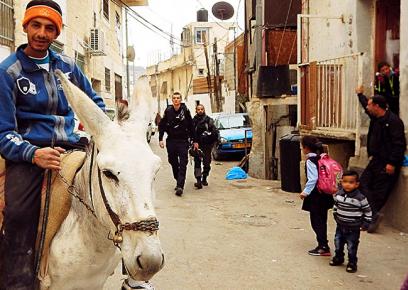
Residents and police in the neighborhood of Batan al-Hawa. Photo by Hussam ‘Abed, B’Tselem, 29 Nov. 2016
B’Tselem survey maps “Judaization” of the neighborhood of Batan al-Hawa, East Jerusalem
B’Tselem mapped the processes underway in Batan al-Hawa, which is facing the most extensive dispossession in East Jerusalem in recent years. Israeli authorities have already transferred 9 of its roughly 50 parcels to the Ateret Cohanim association, and settlers have moved in to 5. Eviction claims are pending against 81 Palestinian families who have lived in the neighborhood for decades. Residents are also subjected to other types of pressure. Settler presence brings with it the police, the Border Police and private security guards; they regularly use violence against local residents, including live fire and crowd control measures, threats, arresting minors and disrupting the fabric of life.

A shepherdess and armored personnel carriers in the pastureland of Jordan Valley residents. Photo by Keren Manor, Activestills, 8 Dec. 2016
Sept.-Dec. 2016: Military temporarily displaces Palestinians in Jordan Valley 19 times, citing training nearby
Since Sept. some 220 Palestinians (incl. about 100 minors) have been forced to leave their homes in the Jordan Valley on multiple occasions to make way for military training. Families from Ibziq, Khirbet Humsah and Khirbet a-Ras al-Ahmar have had to spend hours on end, or even all night, far from home and exposed to the elements. The frequency of these displacements completely disrupts residents’ lives and jeopardizes the very existence of these communities. As an occupying power, Israel cannot use the land for routine military purposes, harm the livelihood of protected persons on this pretext, or attempt to expel the residents.

Sitll from video filmed by Warud Da’na, 17
Hebron settlers hold mass Sabbath dinner; Israeli military takes over nearby Palestinian homes to secure the celebration
On 24-25 Nov. 2016, the military took over two Palestinian homes in Hebron, using the families’ belongings, bathrooms, kitchens, and in one home also a bedroom. For fear of the soldiers, some of the children went to stay with relatives. According to the IDF Spokesperson, this was ordered by the area commander as part of preparations for a mass settler celebration to be held nearby. The military’s conduct again illustrates what routine life looks like in central Hebron, with occupation authorities subjugating the lives of Palestinians to the whims of settlers.

Settlers’ shuttle van blocking alley. Photo by Jadallah a-Rajabi, Batan al-Hawa
Settlers in Beit Yehonatan, Batan al-Hawa, block road several times a day with police backing, disrupting lives of local Palestinians
The Batan al-Hawa neighborhood in East Jerusalem is densely built; its streets are narrow alleys, often only 2-3 meters wide. Local Palestinians told B’Tselem that they have found it hard to maintain a normal routine ever since settlers moved in in 2004. A shuttle service used by settlers and security guards blocks the street several times a day, for 15 minutes to an hour at a time, even though settlers have use of an adjacent parking they seized. The conduct of the settlers and private security guards, backed by official Israeli security personnel, makes it difficult for residents to get to work and school on time, and for businesses to get supplies.

Residents and police in the neighborhood of Batan al-Hawa. Photo by Hussam ‘Abed, B’Tselem, 29 Nov. 2016
Batan al-Hawa neighborhood, Silwan: The next target for "Judaization" of E. J’alem
Batan al-Hawa, Silwan, is the setting for the largest expulsion in recent years in E. J’alem. Supported by Israeli authorities, the Ateret Cohanim assoc., that already has 6 buildings in the neighborhood, plans to evict 81 Palestinian families. On top of facing discrimination in funding and services throughout E. J’alem, Batan al-Hawa residents must also fight for the right to live in their homes, due to efforts by the authorities and settler associations to cement Jewish presence in and around Jerusalem’s Old City. There are already 2,800 settlers living in these Palestinian neighborhoods, leading to increased presence of official and private security forces, who also use violence against local residents, and disrupt life in an area that is home to 100,000 Palestinians.

Erez Crossing. Photo by Amir Cohen, Reuters, 5 Oct. 2014
One quarter of Gazan requests for cancer treatment in Israel or the West Bank denied or ignored (WHO figures)
According to WHO figures for Jan.-Oct. 2016, cancer patients filed 7,267 applications for entry permits; 2,042 applications have either been denied or have yet to be answered. Israel retains significant control over Gaza, so that the development of Gaza health services or even obtaining treatment outside Gaza still depend on Israel. Yet Israel both imposes restrictions that hinder development of the local system and limits the number of patients it allows to exit Gaza for treatment in Israel or the West Bank. Although many patients cannot obtain satisfactory treatment in Gaza, Israel severely limits the number of entry permits it issues, a number it has further reduced since Operation Protective Edge.
Israel’s regime of apartheid and occupation is inextricably bound up in human rights violations. B’Tselem strives to end this regime, as that is the only way forward to a future in which human rights, democracy, liberty and equality are ensured to all people, both Palestinian and Israeli, living between the Jordan River and the Mediterranean Sea.
Since the Hamas attack on 7 October 2023, Israel has acted in a coordinated and deliberate manner to destroy Palestinian society in the Gaza Strip, committing genocide against its residents. In light of Israel’s actions in Gaza, the public statements made by Israeli decision-makers, and the international community’s failure to take effective action, there is a serious risk that the Israeli regime will expand the genocide to other areas under its control—first and foremost, the West Bank.
B’Tselem calls on the Israeli public and the international community to use every tool available under international law to bring an immediate end to Israel’s genocide against the Palestinian people.