On the Agenda
Filter updates:

Still from video.
Military sprays herbicides along Gaza border, destroying crops in 200 hectares
Since 2000, Israel has maintained a “buffer zone” along the Gaza border, within Gaza, restricting Palestinians’ access to their farmland and killing or injuring hundreds of civilians who posed no danger. Since 2014, the military has also sprayed herbicides to maintain the “buffer zone”, damaging land it authorizes owners to cultivate. In January, spraying without prior notice caused farmers serious damage. If Israel believes a “sterile” is crucial to its security, it must establish the zone in its own territory.

New Report: Getting Off Scot-Free: Israel’s Refusal to Compensate Palestinians for Damages Caused by Its Security Forces
Over the past twenty years, Israel has taken measures to guarantee a nearly blanket exemption from its obligation under international law to pay compensation to Palestinians harmed by its security forces. In a new report released today (Wed., 8 March), B’Tselem traces the development of this practice and illustrates how it has led to a major drop in the number of claims for damages Palestinians filed in recent years. Israel’s policy reflects how little value it places on the lives, bodies and property of Palestinians living under its control.
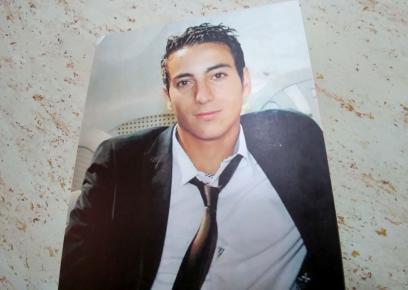
Qusai al-‘Amur. Photo courtesy of the family
Unjustified gunfire by Border Police officer during protest in Tuqu’: 17-year-old fatally shot with 0.22-inch caliber bullets
On 16 January 2017, a Border Police officer fatally shot Qusai Hassan Muhammad al-‘Amur, 17, of Tuqu’ in Bethlehem District, firing four 0.22-inch caliber bullets at him. B’Tselem’s inquiry found that the gunfire came after clashes between youths and the security forces had died down, and the security forces were in no danger. Six Palestinians (including al-‘Amur) have been killed and hundreds injured over the past two years by the military’s use of 0.22 inch caliber bullets as a crowd control measure. Video footage published in the media shows soldiers brutally dragging the injured al-‘Amur along the ground, indicating their profound disregard for his life.
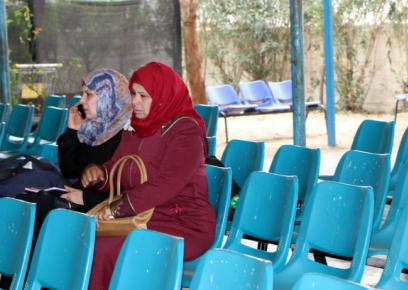
Women wait on Palestinian side of Erez Checkpoint to be allowed into Israel. Photo by Muhammad Sabah, B'Tselem, 28 Feb. 2017
Heartbreaking: Israel’s cruel policy of keeping families apart
Israel has restricted Palestinian movement between the West Bank and Gaza since the 1990s, more severely so since blockading Gaza in 2007. Visits are permitted only to immediate family under narrow criteria deemed “humanitarian”; even then, only some 25% of requests are approved. Israel has shirked responsibility for the extreme implications of its decade-long blockade on Gazans. It must respect the right of all West Bank and Gaza residents to family life and freedom of movement between the two areas, which are a single territorial unit.
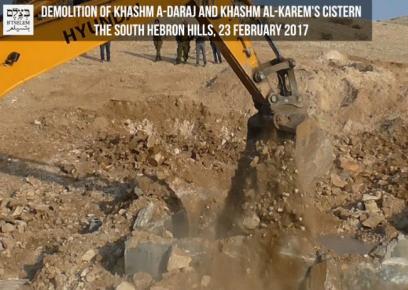
A Civil Administration bulldozer demolishing a water cistern in the community of Khashm a-Daraj-Khashm al-Karem in the South Hebron Hills on 27 Feb. 2017. Still from video.
Israel demolishes infrastructure, leaving Palestinian farmers without water for domestic and agricultural needs
In Jan. and Feb. 2017 Israeli authorities demolished water supply infrastructure in two West Bank areas. In the southern West Bank: 8 cisterns used by farmers and shepherds. In the Jordan Valley: authorities twice demolished a pipe supplying water to three small farming and shepherding communities. Since occupying the West Bank 50 years ago, Israel has controlled most of its water resources and ignored the severe shortages suffered by local Palestinian communities. It promotes only infrastructure that serves settlers, and demolishes facilities developed by Palestinians in Area C, in order to force them out of the area.
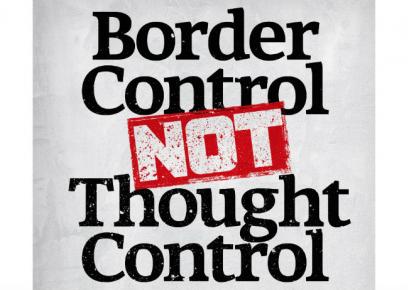
Human rights groups working in Israel: Border control not thought control
We, human rights organizations from Israel, consider Israel’s refusal to allow Omar Shakir of Human Rights Watch (HRW) to enter the country a cause of grave concern. Israel seeks to portray itself as a card-carrying member of the club of democratic countries. A state that defines itself as democratic cannot turn its border control into a thought police. Such measures will not deter us from continuing to report human rights violations in the territories controlled by Israel. Attempts to silence the messenger will not suppress our message.
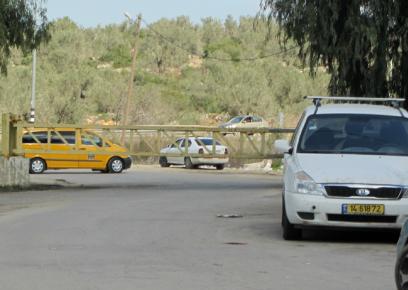
Taxi waiting for passengers outside the closed gate at the main entrance to ‘Azzun. Photo by Abdulkarim Sadi, B’Tselem, 2 Feb. 2017
Israeli military collectively punishes residents of ‘Azzun for 2½ weeks for actions by individuals
For 2.5 weeks, beginning in late Jan. 2017, the military blocked all vehicular access to and from the Palestinian village of ‘Azzun, as collective punishment for incidents of stone throwing, Molotov-cocktail hurling, and live fire at a major road nearby. The justifications given by the military are unfounded: blocking all traffic is not a relevant security measure - it is designed to pressure residents into taking action within the community to stop these incidents - nor is it an exception to the military’s longstanding policy and actions in the West Bank.
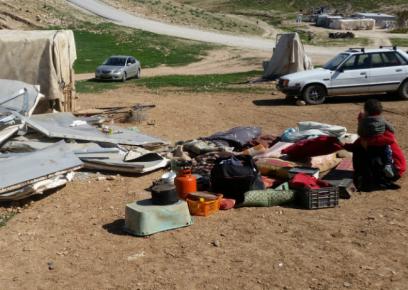
Local resident near the ruins of the trailer home the Civil Administration demolished. Photo by Hussam ‘Abed, B’Tselem, 20 Feb. 2017
CA demolishes elderly woman’s donated trailer home near Khan al-Ahmar, water pipe in Jordan Valley
This morning, 20 Feb. 2017, the Civil Administration demolished the home of an elderly woman – a trailer donated by a humanitarian aid organization – in the Palestinian community of al-Mehtiwish, which lies near Khan al-Ahmar on land Israel earmarked for expanding the Maale Adumim settlement. The CA also demolished a water pipe in the Jordan Valley which residents of Khirbet al-Hadidiyah and Khirbet Humsah had laid with the help of humanitarian organization, as Israel refuses to hook up these communities to the water grid. The pipe had been restored by residents after being demolished by the CA on 10 Jan. 2017.

Yara ‘Ashur, a medical student in Gaza, studies by the light of a battery-powered lamp. Photo by Khaled al-‘Azayzeh, B’Tselem, 23 Jan. 2017
Winter 2017: Living without electricity just an hour and a half away from Tel Aviv
Gazans have suffered severe power shortages ever since Israel bombed Gaza’s power plant in 2006. Since then, Israel has prevented restoration of the plant and impeded infrastructure repairs and upgrades. As a result, supply is rotated, with residents getting power only 4-8 hours at a time. In 2017, and especially in the cold of mid-winter, it is hard to imagine that in Gaza - not many miles away from Tel Aviv - families must lead their lives without a regular power supply. In accounts given to B’Tselem’s field researchers, local women described the hardships the situation entails.
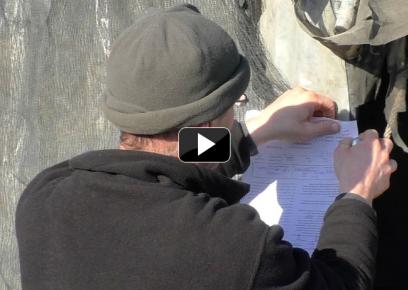
Civil Administration worker posting a stop-work order on a Khan al-Ahmar structure. Still from footage by B’Tselem field researcher Hussam ‘Abed, 19 Feb. 2017
Israeli CA serves stop-work orders for all Khan al-Ahmar bldgs., incl. school
Yesterday, 19 February 2017, large numbers of Civil Administration personnel and police arrived at the Khan al-Ahmar community, which is located near the settlement of Maale Adumim. They served 39 stop-work orders (a preamble step preceding demolition orders) , which apply to all of the community’s buildings, including its school. The school was built in 2009 and also serves children from other nearby communities. Khan al-Ahmar is situated in an area Israel earmarked for the future expansion of Maale Adumim. In 2016, Israeli authorities demolished 12 dwellings in the community, rendering 60 people homeless, including 35 minors.

New interactive documentary by B’Tselem offers virtual tour behind the invisible walls of occupation
Today, 13 February 2017, B’Tselem released a new interactive documentary entitled “The Invisible Walls of Occupation”. Viewers are invited on a virtual tour of the Palestinian village of Burqah, a rural suburb of the city of Ramallah that has become cut off from its urban center through various restrictions imposed by Israel. The documentary has Burqah residents leading viewers on a virtual tour of their village. The project depicts the story of the village and illustrates various aspects of Palestinians’ daily life under occupation. The project was co-produced by B’Tselem and Canadian digital studio Folklore, and is based on a B’Tselem report by the same name.

Shafiqa Jum’ah, 80, who was shoved by a soldier, fell and lost consciousness. Photo by Abdulkarim Sadi, B’Tselem, 10 Jan. 2017
Israeli soldiers raid homes in Kafr Qadum to deter protests against blocking road to the village
In Jan. B’Tselem documented two nighttime incidents of soldiers entering homes in Kafr Qadum, a village west of Nablus: They threatened residents and warned them not to attend the weekly village protests which have been held since 2011 when the road linking the village to Nablus was transferred to the exclusive use of settlers. B’Tselem found that the soldiers acted violently and aggressively, threatened children, and shoved an elderly woman. Such threats violate the right of expression, protest, and demonstration. They are unlawful and must be halted immediately.
Israel’s regime of apartheid and occupation is inextricably bound up in human rights violations. B’Tselem strives to end this regime, as that is the only way forward to a future in which human rights, democracy, liberty and equality are ensured to all people, both Palestinian and Israeli, living between the Jordan River and the Mediterranean Sea.
Since the Hamas attack on 7 October 2023, Israel has acted in a coordinated and deliberate manner to destroy Palestinian society in the Gaza Strip, committing genocide against its residents. In light of Israel’s actions in Gaza, the public statements made by Israeli decision-makers, and the international community’s failure to take effective action, there is a serious risk that the Israeli regime will expand the genocide to other areas under its control—first and foremost, the West Bank.
B’Tselem calls on the Israeli public and the international community to use every tool available under international law to bring an immediate end to Israel’s genocide against the Palestinian people.