During the Huwarah pogrom, Israeli settlers caused an estimated five-million NIS worth of damage to Palestinian businesses, which the military exacerbated with a punitive order to close businesses for five days
During the Huwarah pogrom, Israeli settlers caused an estimated five-million NIS worth of damage to Palestinian businesses, which the military exacerbated with a punitive order to close businesses for five days
On Sunday, 26 February 2023, at around midday, Palestinian militants shot and killed Israeli brothers Hallel and Yagel Yaniv, who lived in the settlement of Har Bracha, while the two were waiting in a traffic jam on a road that runs through the town of Huwarah. That afternoon, hundreds of settlers, escorted by soldiers, invaded several neighborhoods in the town of Huwarah as well as the villages of Za’tara, Burin and ‘Asira al-Qibliyah, and carried out a pogrom.
Settlers burned down a quarry, a carpentry shop, a carwash and an electrical equipment and lighting store, and torched five other warehouses, a used car lot and a scrap yard, burning a total of 140 cars. The total damage settlers caused to businesses in Huwarah is estimated at 5 million NIS (NIS 1 = USD 0.27). That day, the military ordered 350 Palestinian shops and businesses to close and remain closed for five days, exacerbating the damage.
B’Tselem field researchers Abdulkarim Sadi and Salma a-Deb’i collected testimonies about attacks on businesses during the pogrom:
Israeli settlers threw stones at a recreational facility and its owner’s apartment on the second floor and set fire to a house under construction and two vehicles. Soldiers fired tear gas canisters and threw stun grenades at the owner and members of his family
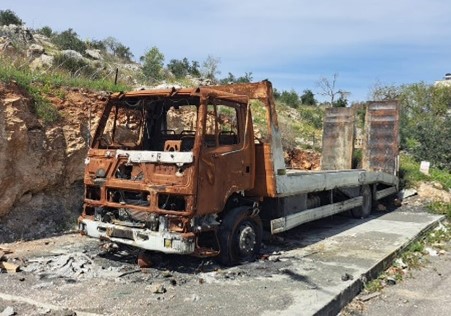
At around 2:30 P.M., soon after a Palestinian gunman shot and killed the Yaniv brothers, dozens of settlers, followed by about 15 soldiers, arrived at a building that houses Country Park Huwarah, a recreational facility, on its first floor and in its yard. The facility’s owner lives on the second floor of the building, and he was in the yard with family members when the settlers arrived. The settlers threw stones and sharp objects at them, smashed two water tanks on the roof of the house and dumped an unidentified substance into the swimming pool from a drone. They also burned a truck and a car parked in the lot in front of the house, set fire to another house owned by the same family, located about 500 meters away and still under construction, destroying 14 bales of artificial grass kept on the ground floor. When the family members tried to repel the settlers by throwing stones at them, the soldiers fired tear gas canisters and stun grenades at them.
The vehicles torched by the settlers. Photo by Abdulkarim Sadi, B’Tselem, 7 March 2023
About two months earlier, on 17 December 2022, B’Tselem documented a previous settler attack on the property and its parking lot, which resulted in damage estimated at NIS 40,000.
In his testimony, ‘Abdallah ‘Odeh, a 50-year-old father of 13 who owns the recreational facility, said:
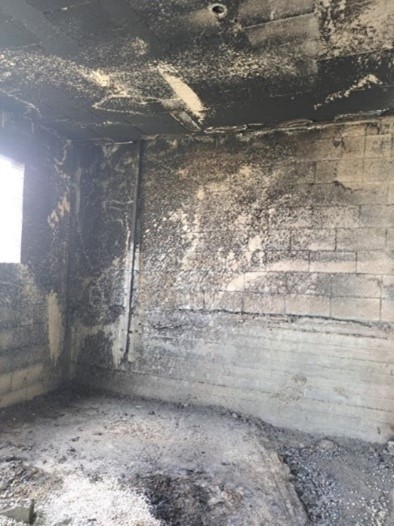
The ground floor of the house under construction. Photo by Abdulkarim Sadi, B’Tselem, 7 March 2023
At around 2:30 P.M., I was in the yard of the recreational facility with my wife and five of our children, when dozens of settlers arrived from the direction of the settlement of Yitzhar, which is up the hill, no more than 600 to 700 meters from us. We closed the main gate right away. The settlers started throwing stones and sharp objects at us, and we threw stones back to protect ourselves. I called the Huwarah municipality and some local residents for help.
Within a short time, about 15 soldiers came. At first, I thought they had come to protect us, but they started throwing stun grenades and firing tear gas canisters at us. One of the soldiers shouted at us in Hebrew as we were trying to defend ourselves, saying the settlers were Jewish, so we weren’t allowed to throw stones at them.
The settlers kept attacking us, flying a drone over the park, which dumped a red substance into the swimming pool. They also set fire to a tow truck and a car that were parked in the parking lot. The stones and sharp objects they threw punched holes in two plastic water tanks on the roof of the building, and the water leaked out of them. The settlers also set fire to a house I am building 500 meters away from the park, damaged the ceiling on the ground floor and 14 bales of artificial grass two meters wide and 50 meters long each that were kept there.
The attack lasted over two hours, and that whole time, my family and I were trapped in the park, trying to defend ourselves.
Israeli settlers torch a car lot, burning four cars and other equipment
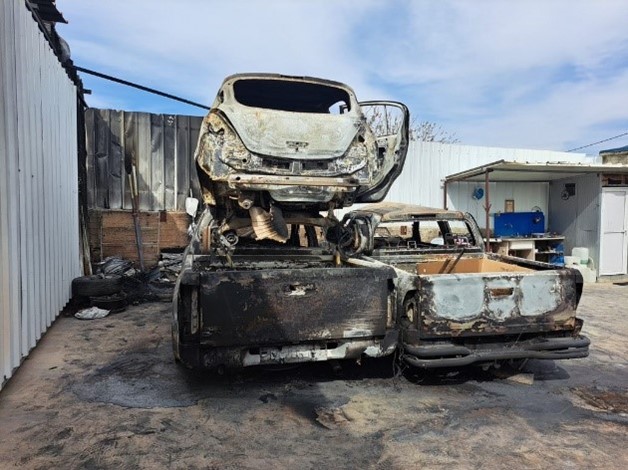
At around 8:00 P.M., masked settlers went to a used car lot owned by two residents of the village of Yatma, burned four cars and 40 tires and damaged water pipes, a steam cleaner and a car vacuum.
Three of the cars burned by the settlers. Photo: Abdulkarim Sadi, B'Tselem, 7 Mar. 2023.
In his testimony, Mu’in Najjar, a 41-year-old father of four who owns the lot, said:
On Sunday, 26 February 2023, we closed the lot early because we were afraid of retaliatory actions by settlers.
At around 8:00 P.M., we saw on social media that many settlers were burning houses and facilities in Huwarah near Route 60 and that the army had closed the checkpoints and was not letting Palestinians through. Just then, someone from Huwarah called me and said he saw settlers going into our lot, despite the locked iron gate. The settlers must have jumped over it. When I arrived, I saw they had set fire to four cars, which were completely burnt. The lot is located about 100 meters from Huwarah Junction, where there’s a soldier observation point that is always staffed in the afternoon.
I was scared to go to the lot that night and didn’t go until the next day. I was shocked when I saw the burnt cars. They’d also burned 40 tires. The sides of the lot were covered in soot, and the fire also destroyed water pipes, a steam cleaner, a car vacuum and other equipment.
Israeli settlers torched a scrap yard, burning about 110 cars, and attacked a house with stones. Soldiers fired tear gas canisters at residents trying to defend the house
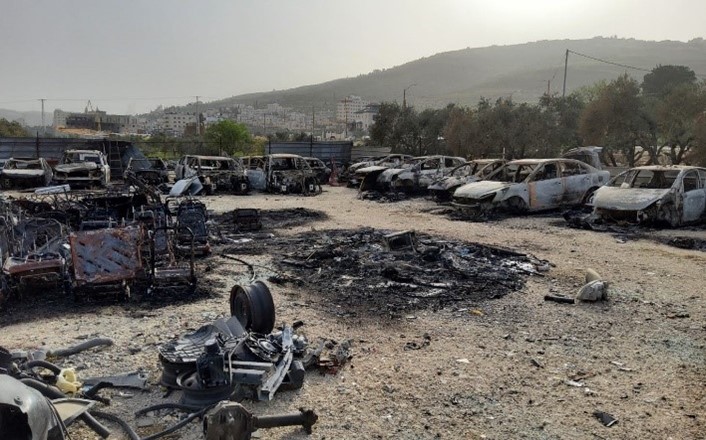
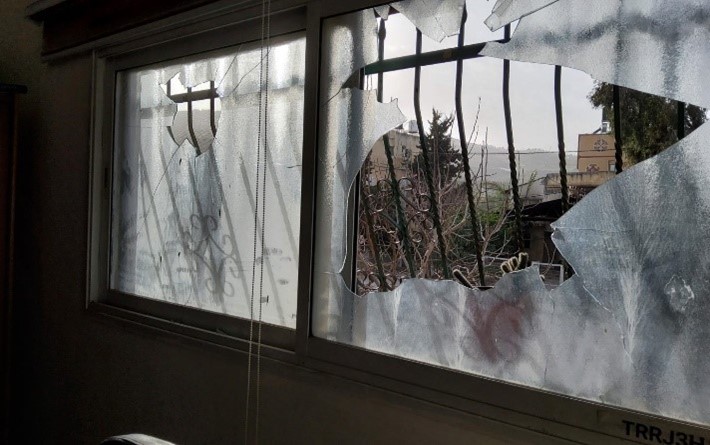
Around 8:00 P.M., several masked settlers arrived at a scrap yard owned by ‘Ayed Muhareb (50) from Huwarah. The settlers smashed the lot’s security cameras and started a fire near an electrical panel. The panel caught on fire that then spread, burning all the cars in the yard and edging closer to the home of ‘Ayed’s brother, ‘Issam Muhareb (74), next to the yard. The settlers attacked the house with stones, breaking the glass in two of its windows. Soldiers who arrived later, while the settlers were still in the area, fired tear gas canisters at the house. Two family members suffered from tear gas and smoke inhalation.
The burnt cars in ‘Ayed Muhareb's scrap yard . Photo by Salma a-Dib'i, B'Tselem, 5 March 2023
‘Ayed Muhareb, a father of six, said in his testimony:
Around 2:30 P.M., I was at work in Ramallah, and I heard a Palestinian had shot and killed two settlers in Huwarah. I called my son Qassam (14) immediately and asked him to close up the business. I set off to town right away. The roads leading to Nablus and Huwarah were closed, so I had to take a detour on the Hamra road. It took me about four hours to get to Nablus. I followed the news about the situation in Huwarah the whole way and checked the yard’s security cameras.
Around 8:00 P.M., I saw on the cameras many settler cars arriving, stopping near the entrance to the yard and then driving again. Then, I saw one car that stopped near the entrance to the yard for a few minutes and then drove away, and at the same time, I saw about eight masked settlers throwing stones at the lot. The settlers managed to break four security cameras, and I kept watching what was happening on the other cameras that were not damaged. I saw that some settlers had broken and knocked down the back gate of the yard and started a fire near the electrical panel. Then the power went out, and I couldn’t see anymore. I didn’t know what to do.
Windows smashed by settlers in the family home. Photo by Salma a-Dib'i, B'Tselem, 5 March 2023
I called my brother ‘Issam’s house, which is next to the yard. The situation there was catastrophic. I heard them shouting and screaming for help. I gathered from them that the settlers were attacking their house with stones and that they had set fire to the cars in the yard. Ruqayah (65), ‘Issam’s wife, and Fidaa (35), my nephew’s wife, were hurt from inhaling the smoke that engulfed the house and the tear gas fired by the soldiers, who were around the neighborhood escorting the settlers.
I didn’t manage to get to the yard until the next day. It was like a disaster zone. The yard was burnt. There were about 110 cars that had burned down completely, as well as car doors and other parts. Everything was burnt. I estimate the damage at about NIS 600,000. There was nothing left. The settlers didn’t stop there. They posted a photo of me holding a weapon from some Palestinian Authority event in the 1990s on “The Jewish Voice” website and said I was a “released terrorist,” claiming I was in prison in the first intifada. They mentioned my son’s name too. They don’t want us living in the area at all. They want to kick us out. I am very afraid for my life and my son’s life. What are we guilty of besides being born here?
On top of all this, the army closed Huwarah, and we couldn’t open our business for about five days.
Israeli settlers burn 26 cars in a repair shop. Soldiers fire tear gas canisters at Palestinian residents
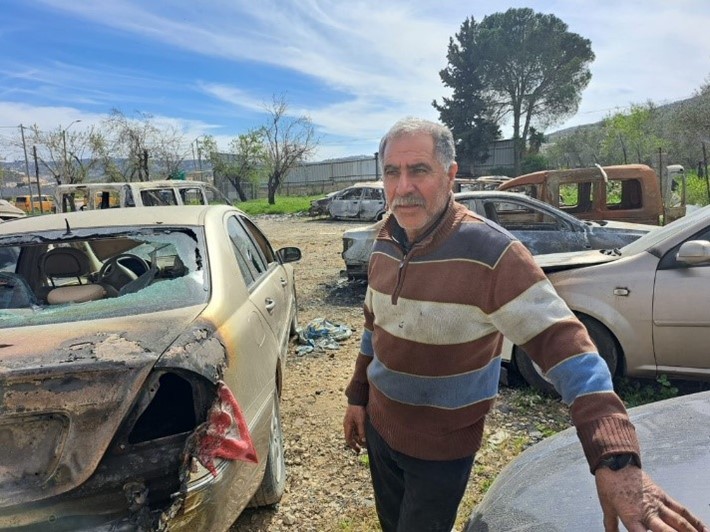
At around 8:30 P.M., settlers arrived at 61-year-old Hassan ‘Odeh’s car repair shop, destroyed the gate and torched 26 cars, some of which were parked in the parking lot and the rest next to the shop. The settlers blocked the path of a fire truck that arrived on the scene, and soldiers who escorted them fired tear gas canisters at the residents who came out to defend their property.
Hassan ‘Odeh standing among the cars burned by the settlers. Photo by Abdulkarim Sadi, B’Tselem, 7 March 2023
In his testimony, Hassan’ Odeh, a 61-year-old father of seven, said:
On 26 February 2023, in the afternoon, after I heard that two settlers had been killed in the center of Huwarah, I closed up early at the a-Shamal Car Repair Shop that I run with my sons, located about 150 meters from Huwarah Junction, because I was afraid of acts of revenge. After I closed up, I went upstairs to my house, which is on the floor above the shop.
At around 8:00 P.M., we started hearing a commotion on the main road (Route 60) that goes through the center of Huwarah. From the window, we saw a lot of settlers and soldiers on the main street and fire rising out of the businesses along it and around our house. Around 8:30 P.M., we saw a large group of settlers, some of them armed with handguns and rifles, advancing in our direction, escorted by Israeli soldiers and military vehicles. The settlers started throwing stones at our house, and some of them broke through the mesh fence that surrounds the land next to the garage, where I park customers’ cars and cars that are used for parts. They torched four cars belonging to Israeli customers, burning them, and four other cars belonging to Palestinian customers, as well as 15 cars used for parts. The settlers also set up burning tires that they had brought with them in front of the entrance to the shop, and the fire burned the gate and three cars that were parked in front of the shop. I watched it from inside the house. The firefighters couldn’t make it over because the settlers blocked their way.
We couldn’t protect our property because we were afraid of the settlers and the soldiers who escorted them. The military did nothing to protect us, and while the settlers set cars on fire, the soldiers fired tear gas canisters at our house. I estimate my customers and I suffered hundreds of thousands of shekels in damage in the settlers’ terrorist attack.
Israeli settlers set fire to an electrical equipment and lighting store, causing other damage as well
At around 9:00 P.M., settlers arrived at the Sha’ban electrical equipment and lighting store in Huwarah. They broke two windows in the storage room, poured a flammable substance that damaged rolls of electrical cable and other merchandise, started a fire next to a tire store, which burned it down and destroyed three security cameras. It wasn’t until around 10:00 P.M. that the fire department arrived and put out the fire.
In his testimony, the store’s owner Sab’ Sha’ban, a 31-year-old father of one from Nablus, said:
On Sunday, 26 February 2023, after the killing of two settlers in Huwarah, business owners on the street, myself included, closed up early to avoid acts of vengeance by settlers who spread throughout Huwarah along with soldiers.
At around 9:00 P.M., I was at home in Nablus, and I heard that settlers had started attacking and damaging businesses and facilities. I watched my business’ cameras on the phone. I was very worried because I had merchandise there worth millions of shekels.
I saw on the cameras many settlers who started a fire in a car lot near my business. I called the Huwarah municipality and the Civil Defense in Burin, too, hoping they could make it. I also called friends for help. In the meantime, I saw settlers break two windows in the front of my storage rooms, pour in flammable material and set the store on fire with burning tires. It wasn’t until around 10:00 P.M. that the fire department arrived and put out the fire.
The soldiers didn’t let us open our businesses for five days, but two days after the attack, I was able to get to the store and check the damage. Because of the fire, which lasted more than an hour, all the merchandise and the ceilings were covered in soot, on the upper two floors too. Some of the merchandise was completely destroyed, and we won’t be able to sell it.
I was shocked when I saw all the charred merchandise. A week has now passed, and about 18 employees in our three branches in the Nablus area are constantly busy trying to clean the merchandise and return it to good condition, but some of it was completely destroyed. The settlers also destroyed three security cameras. The damage was massive, and we are still unable to assess it.
The military punished Huwarah business owners with a forced shutdown, causing severe losses
The military punished Huwarah business owners with a forced shutdown, causing severe losses Iyad ‘Odeh, a 48-year-old father of five, who works at the al-Wajbah a- Sari'ah restaurant, spoke about the financial damage sustained by the restaurant and its staff after having to shut down for five days:
Our restaurant is located near ‘Einabus Square, on Huwarah’s main street. Shortly after a Palestinian shot at a car with settlers, killing them, soldiers spread out along the road, and the area felt like a military base. We closed the restaurant and went home.
I thought I’d be back at work the next day, but it didn’t work out that way. In the evening, I saw on social media that the military had ordered business owners on Huwarah Road to shut down for three days, and then the order was extended by two days. During those five days, we didn’t open the restaurant at all, which caused huge losses. A lot of the food we left spoiled, like the meat on the shawarma stick, salads, hummus and falafel and lots of meat that was in the fridge and is now past its expiry date.
On 4 March 2023, we went back to the restaurant and started cleaning and throwing away everything that went bad. It smelled. I went to the market, bought fresh vegetables and prepared new food, and then we opened the restaurant only at around 10:00 A.M.
We are a staff of 17, supporting 17 families. We get paid by the day, so if we don’t work, we don’t get paid. A worker makes NIS 100 to 150 a day. For five days, I didn’t make a single shekel. I have a family and a lot of expenses, and all the other staff also have obligations. We were all hurt by the shutdown, even though we were guilty of nothing.
Muhammad Aqtash, a 37-year-old father of three from Beita, owns an industrial equipment business. On 13 March 2023, he spoke about the losses he suffered after having to shut down for five days:
I own a business in the southern part of Huwarah’s main road, where I sell industrial equipment for metalwork. We have three employees. After the settlers were shot, I asked the staff to bring the merchandise displayed outside into the store. Within half an hour, soldiers spread out along the street and ordered business owners to close up shop. We had to close and go home.
I thought we would only be closed for one day, but that night, I saw on social media that the army ordered a three-day closure. Customers called me from all the cities and districts, wanting to order merchandise, and I apologized because I had no way of supplying it to them.
After three days, we thought it was over, but the next morning, at around 7:30 A.M., when one of the workers arrived to open up, soldiers told him that we were not allowed to open and ordered him to go home. I arrived after about half an hour. There were four soldiers in the street. I tried to open the business, but they ordered me in Hebrew to close it and go away. I asked them for how long, but they didn’t answer and only said that I should close the business and leave. I tried to change their mind, but it didn’t help. When I saw that all the businesses in the area were closed, I realized it applied to everyone. That day, I found out the shutdown had been extended by two days.
We opened the business on Saturday, but there was no work because everyone was afraid to come to Huwarah, and all the customers had found other alternatives. There were lots of soldiers on the street throughout the week, and our sales dropped sharply because it put people off coming, and so did the fear of settler attacks. We missed out on orders in the order of NIS 80,000 to 70,000 from Nablus, Jenin and Tulkarm. Even when there are no sales, we have operational expenses of NIS 1,700 to 1,500 per day.
Israel’s regime of apartheid and occupation is inextricably bound up in human rights violations. B’Tselem strives to end this regime, as that is the only way forward to a future in which human rights, democracy, liberty and equality are ensured to all people, both Palestinian and Israeli, living between the Jordan River and the Mediterranean Sea.
Since the Hamas attack on 7 October 2023, Israel has acted in a coordinated and deliberate manner to destroy Palestinian society in the Gaza Strip, committing genocide against its residents. In light of Israel’s actions in Gaza, the public statements made by Israeli decision-makers, and the international community’s failure to take effective action, there is a serious risk that the Israeli regime will expand the genocide to other areas under its control—first and foremost, the West Bank.
B’Tselem calls on the Israeli public and the international community to use every tool available under international law to bring an immediate end to Israel’s genocide against the Palestinian people.