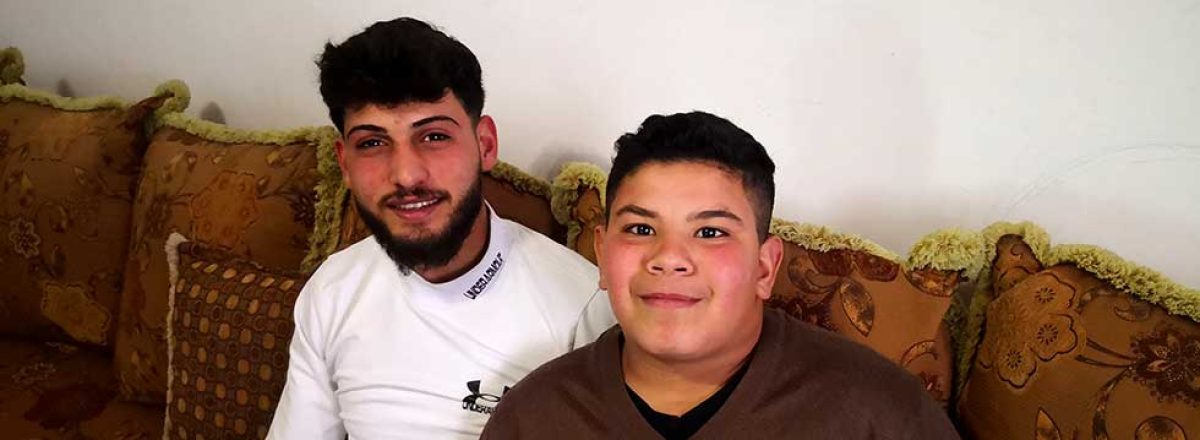
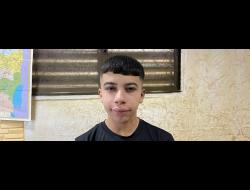
On Monday, 28 March 2022, at around 7:00 P.M., a group of about eight Palestinian teens from the village of Ras Karkar, in Ramallah District, used lasers to provoke soldiers and Special Police Unit officers who were at the entrance to the village. The teens fled into the village and the forces chased them in a vehicle, capturing Ragheb Samhan (13), who has an intellectual disability. They assaulted him, tied his hands with pieces of cloth, blindfolded him and took him away on his own, without informing anyone. After about two hours, the officers brought Ragheb back to the entrance to the village and released him there, handcuffed and blindfolded.
About half an hour later, some 15 soldiers and police officers arrived at Samhan’s house, where several family members and village residents had gathered to greet him. They arrested two of his relatives, Muhmmad Samhan (19) and Nader Nofal (18). They blindfolded the two young men, tied their hands behind their backs and drove them to a nearby military camp, interrogating them along the way. The forces held Samhan and Nofal in the vehicle for about two hours before transferring them to a trailer, where soldiers beat and kicked them and swore at them. After about five hours, at around 3:00 A.M., the two were released at the entrance to their village. They were summoned for an ISA interrogation a week later, after which they were released without charges.
This was yet another routine incident in the life of a Palestinian family in the West Bank. Soldiers and police officers arrested a teen with an intellectual disability without even bothering to inform his parents. They held and interrogated him in an unknown place for two hours, without an adult acting on his behalf, and then arrested two members of his family, holding them for about five hours and abusing them. This is the unbearable ease with which Israel runs the lives of millions of people, almost never holding anyone accountable
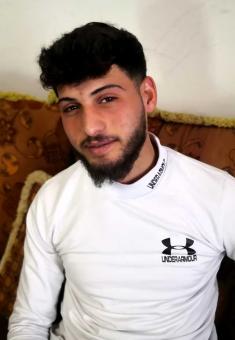
In a testimony he gave B'Tselem field researcher Iyad Hadad, Muhammad Samhan (19), a resident of Ras Karkar, described how both he and his nephew Ragheb Samhan were arrested:
Muhammad Samhan. Photo by Iyad Hadad, B'Tselem, 30 March 2022
On Monday, 28 March 2022, at around 7:00 P.M., I was at home near the a-Sadiq mosque in the village center. I looked out the window and saw two patrol vehicles enter the village – a regular military jeep and a white GMC, which I recognized as a Special Police Unit (SPU) vehicle. It looked like they were chasing children who’d been aiming laser beams at them at the entrance to the village, along Route 463, and run back into the village. I think there were about seven or eight children there. The vehicles stopped outside our house, and soldiers and police officers got out and chased the children among the houses.
A few moments later, I heard a kid shout, "It wasn't me, it wasn't me!" Two officers led him towards the jeeps. They hit and kicked him and then tied his hands in front of his body and covered his eyes with a piece of cloth. The boy kept shouting. I didn’t recognize him. The officers didn't wait around. They immediately put him in the SPU car and both vehicles left the village. I went outside to find out who they'd arrested and was told it was Ragheb, my sister's son. He's 13 and has a mild intellectual disability. I immediately went over to my sister's house. I asked her husband, Tawfiq Samhan (35), where Ragheb was and he said he’d gone to get water from the grocery store. I told him it looked like the military had arrested Ragheb. We went out to search for him together.
We got into my car and headed towards the Ni'lin Checkpoint to find out where they’d taken Ragheb. On the way, at the entrance to Ras Karkar, we saw a military patrol vehicle. We asked the soldiers where Ragheb was and explained that he’s a child with special needs. The officer said, "We arrested him because he pointed a green laser beam at us and threw stones." He demanded to see our IDs and a photo of Ragheb. We showed him the IDs but didn't have a photo, so I drove back and got one. We showed it to the officer, and he confirmed they were holding him. We got into a loud argument with him and started shouting. In the end, the soldiers gave us a number we could call to make inquiries, and left. Meanwhile, more people from the village heard the shouting and gathered there.
We called the number the soldiers gave us, but no one answered. At around 9:30 P.M., we were still by the roadside when soldiers arrived with Ragheb and let him go. He still had a blindfold and zip ties on. When we saw him like that, we were furious. It was a very inhumane sight. The child was crying, and was scared and confused. We started swearing at the police, cursing their attitude and their inhumane behavior towards a boy with a disability. We cut the zip ties, took the blindfold off and took him home. Ragheb was unable talk and tell us what happened. He just kept repeating a few sentences, over and over: the police had asked him who was throwing stones and he’d told them he didn't know.
We went back to my sister's house, and people from the village came to welcome Ragheb back. About half an hour later, I was standing outside the house with some people when about 15 soldiers arrived with an SPU officer, who immediately started swearing at us. Tawfiq heard the shouting and came outside. He swore back at the officer and told him that what they'd done to his son was inhumane.
The officer ordered us to show him all the children who live in the house. We called Ragheb's brothers to come out: Yasser (10), Yusef (3) and 'Abdallah (1). The officer looked at them but still wouldn’t leave our family alone. Then he announced that I was under arrest along with my second sister’s son, Nader Nofal (18).
They led us to the GMC vehicle, tied my hands behind my back with pieces of cloth and covered my eyes. After they put me inside, they also tied my legs. On the way, the officers asked me who'd been pointing a laser at the forces. I told them I didn't know. The vehicle stopped, and they kept asking me questions inside for half an hour. They didn't ask Nader anything.
Then they took me out of the vehicle, and the officer put me on the phone with someone from the ISA who introduced himself as Abu Rami, the area coordinator. He told me he'd questioned me before, when I was arrested during the protests against the war in Gaza a year ago. I told him I didn't remember him. He accused me of pointing a laser at the soldiers. I told him I’d been at home and the soldiers had taken me from there. He suggested I collaborate, but I refused. Then he told me to come to him for questioning on Sunday at 9:30 A.M.
After I talked with him they put me back in the vehicle, which drove off and then stopped again. I rubbed my head against the seat and managed to shift the blindfold. I saw that Nader and I were alone in the vehicle, inside a military camp. We stayed in the vehicle for about two hours and then some soldiers came, took us to a trailer and left us there, handcuffed and blindfolded. The soldiers turned on the air conditioning, and it was freezing. One of them asked me, "Are you Hamas or Fatah?" I said Fatah, and then he punched me in the stomach. I nearly choked. He cursed me and Fatah and Hamas.
Some other soldiers brought in a loudspeaker and played a song loudly. One of the soldiers moved the speaker closer to my ear. After about half an hour, the speaker went off and someone kicked me in the leg. They swore at me the whole time. One of the soldiers cracked a whip near me to scare me. Another soldier held scissors and pushed them against my thighs. They didn't penetrate the skin, but it was still very painful. The soldiers started making bleating and braying sounds, like goats and donkeys.
All that went on until someone came in, probably an officer, and asked me who'd hit me. I said it was the soldiers, but I didn't know exactly which one because I couldn't see. I heard him scolding the soldiers for hitting me. After another 10 minutes, they put Nader and me in the vehicle, still handcuffed and blindfolded. We drove until they dropped us off at the entrance to our village. One of the soldiers took off our blindfolds and handed us a written summons. He read it to us, and we understood we were being summoned to a meeting with the ISA on Sunday, at 9:00 A.M., at Ofer Prison. At that point, it was 3:00 A.M.
Nader Nofal (18) told B'Tselem field researcher Iyad Hadad what happened during his arrest:
The soldiers mocked us. I think they were filming us for TikTok, because when they came near us, it sounded like they were talking on the phone and broadcasting it live. They cursed us and our families and also hit and kicked us. One of them cracked something that sounded like a whip next to us, to scare us. One of the soldiers also stabbed me in the shoulder and legs with something sharp. I don’t know if it was a spike or a nail. It was very painful and every time he did that, I shouted. The soldiers made animal noises.
It was a few hours later that someone who was in charge, probably an officer, arrived. He asked Muhammad who’d beaten us, but he didn’t know because our eyes were covered. The soldiers took us to a military jeep, with our hands tied and eyes covered. They let us out at the entrance to our village, without taking our restraints off. We managed to take them off ourselves because they were made of cloth and easy to untie.
Nofal went on to describe his ISA interrogation at Ofer Prison a few days later:
On Sunday, 3 April 2022, at 9:00 A.M., I went with Muhammad to a meeting with the ISA at Ofer Prison. We waited for about half an hour and then were put in a small room, which looked like a solitary confinement cell on the ISA wing. We waited there until 11:00 A.M., and then Muhammad was taken in for a meeting with the ISA that lasted about 40 to 60 minutes. According to what he told me, they mainly asked him who’s been throwing stones and pointing lasers at the soldiers, and questions like that.
I went in after Muhammad. My meeting lasted about two hours and I was asked about the same things. The interrogator also suggested I collaborate. He promised me an entry permit to Israel and a good salary. He said: “I’ll call you every two or three days and I want you to answer and tell me what’s going on in the village.” I refused, and then he threatened to revoke my father’s work permit. He added that in future, if I had a problem with the soldiers, he wouldn’t take pity on me and would send me straight to prison. The interrogator banged on the table to scare me because I refused to collaborate. When the conversation was over, he ordered me to leave.
Israel’s regime of apartheid and occupation is inextricably bound up in human rights violations. B’Tselem strives to end this regime, as that is the only way forward to a future in which human rights, democracy, liberty and equality are ensured to all people, both Palestinian and Israeli, living between the Jordan River and the Mediterranean Sea.
Since the Hamas attack on 7 October 2023, Israel has acted in a coordinated and deliberate manner to destroy Palestinian society in the Gaza Strip, committing genocide against its residents. In light of Israel’s actions in Gaza, the public statements made by Israeli decision-makers, and the international community’s failure to take effective action, there is a serious risk that the Israeli regime will expand the genocide to other areas under its control—first and foremost, the West Bank.
B’Tselem calls on the Israeli public and the international community to use every tool available under international law to bring an immediate end to Israel’s genocide against the Palestinian people.