On the Agenda
Filter updates:
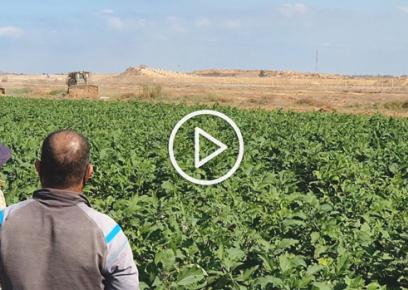
Israel destroys Palestinian farmland in Gaza again, allegedly for security
On 13 Oct. 2020, Israeli bulldozers entered the Gaza Strip and razed 25 dunams of parsley, dill, zucchini, okra, and eggplant crops along the perimeter fence, as well as irrigation systems in these areas. These actions are illegal under international law, which prohibits the destruction of private property in any but exceptional circumstances, which do not apply in this case. These actions also expose the absurdity of Israel’s claim that Gaza is a separate “hostile state entity”, demonstrating that it still controls Gaza.

Settlers attack farmers, damage chicken coops and kill over 300 chickens in the village of Qusrah
On 26 Sep. 2020, settlers stoned a family working its land near the village of Qusrah and vandalized 12 olive trees belonging to another family. They stoned two chicken coops on the outskirts of the village, damaged water container s and pipes – causing the death of over 300 chickens and chicks – and tried unsuccessfully to torch a tractor and a truck. They were accompanied by soldiers who fired tear gas and rubber-coated metal bullets at villagers who tried to help the victims. Israel routinely backs such violence to further its policy goals.

‘Abd a-Rahman al-‘Ar’ir on the scooter he depends on to get around. When the power is out, he can’t charge it or leave home. Photo by Muhammad Sabah, B'Tselem.
Summer 2020: Gaza’s electricity crisis deepens again, with 4 hours of daily supply
Israel controls Gaza’s power supply, whether directly by providing electricity or indirectly by controlling fuel flow to the only local power plant. After years of allowing only enough electricity for eight-hour rotations among residents, on 10 Aug. 2020 Israel also cut off the fuel supply as the latest form of collective punishment against Gazans, reducing the power supply to 4 hours a day for three weeks. In testimonies they gave B’Tselem, residents described the daily repercussions and their deep frustration with living in an unbearable reality.

New Position paper: With or without flights to Abu Dhabi, Israel annexed the West Bank long ago
As part of normalizing ties with the United Arab Emirates, Israel has decided not to officially annex the West Bank as yet. De facto, it annexed the West Bank long ago, treating the area as sovereign Israeli territory while acting unilaterally to establish and perpetuate control. The uproar over official annexation has subsided, but the reality remains unchanged: the international community has welcomed Israel back with open arms – legitimizing its continued policy of dispossession with no price.
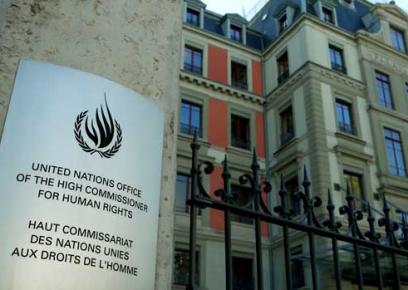
The United Nations Office of the High Commissioner for Human Rights, Geneva. Photo by Denis Balibouse, Reuters, 31 May 2019
Human Rights NGOs in letter to Israel’s Minister of Foreign Affairs: Stop the ministry’s harassment of United Nations OHCHR staff
In an unprecedented move, Israel’s Ministry of Foreign Affairs has decided to stop issuing visas for foreign nationals employed by the United Nations Office of the High Commissioner for Human Rights (OHCHR). In light of Israel’s complete control over entry to the Occupied Territory, OHCHR staff require visas issued by Israel. On Tuesday, 20 October 2020, 17 NGO's in Israel sent a letter to Israel’s Minister of Foreign Affairs, demanding that the measures be reversed and that the issuance of visas be renewed in order to enable the office’s ongoing work.
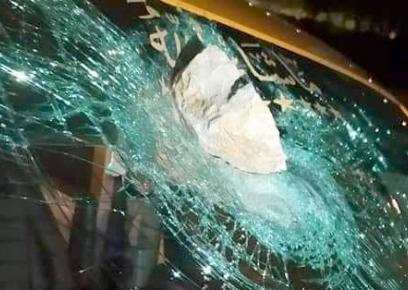
Stone settlers threw lodged in the windshield of Hatem Salah’s taxi. Photo courtesy of the witness.
Settlers stone Palestinian cars for hours on Route 60 near settlement of Eli
On the evening of 3 Sept. 2020, dozens of settlers blocked a lane on Route 60 near the settlement of Eli. They threw stones at passing Palestinian cars, hitting several passengers, and tried to block their way. Testimonies given to B’Tselem indicate that soldiers who came to the area did nothing to stop the settlers or protect the passengers. Israeli policy has enabled routine violence of this kind by settlers and the military against Palestinians in the West Bank for many years.
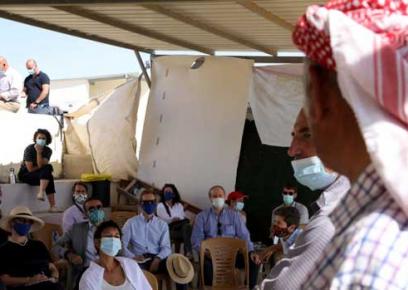
The diplomats tour today. Photo by: B'Tselem\Breaking the Silence
Top diplomats from 17 countries tour Palestinian communities Israel is trying to expel from South Hebron Hills
The representatives of 17 countries, including EU members as well as other countries, are currently visiting Palestinian communities in the South Hebron Hills, whose residents Israel is seeking to expel. Since 2000 the residents have been waging a legal struggle in Israel's High Court of Justice. Last August, before the last hearing in the case, the Akevot Institute for Israeli-Palestinian Conflict Research revealed a document that proved what was already clear: Israel had declared the area a firing zone to facilitate the expulsion of its residents. The judges ignored that information and the residents are currently awaiting their ruling.

Ousamah Hussein holding a piece of the missile that landed near his home. Photo by Khaled al-‘Azayzeh, B’Tselem, 16 August 2020
Israeli policy of bombing crowded areas in Gaza takes fresh toll: head injuries in two children and damage to homes
In August 2020, Israel bombed targets in the Gaza Strip by air and from the ground, injuring five Palestinians – four minors and a woman – and lightly damaging a school and six homes. Palestinian rocket fire injured one Israeli and lightly damaged two homes. In an Israeli airstrike on 14 August near a residential compound in al-Bureij Refugee Camp, two children aged 3 and 11 were injured in the head and four homes damaged. This policy of bombing densely-populated areas, which has caused thousands of casualties, is immoral and illegal.

‘Iz a-Din a-Sha’ar in his cousin Abdallah’s car. Photo by Salma a-Deb’i, B’Tselem, 10 August 2020
Border Police officer shoots into car and injures three passengers, one loses eye
On 5 Aug. 2020, Israeli Border Police officers stopped a car with three Palestinian passengers in the village of al-‘Aqrabaniyah. An officer shot at the windshield, hitting ‘Abd a-Rahman Jbarah in the head. Jbarah lost one eye and may lose sight in the other. The other passengers were injured by glass shards, briefly interrogated and released. Opening fatal fire although the passengers posed no danger is unlawful and unjustifiable, and the investigation reportedly launched is part of the whitewashing mechanism that enables these acts to recur.

The entrance to the al-Fawwar refugee camp. Photo by Mussa Qawasma, Reuters, 15 Nov. 2020
Soldiers again raid Abu Hashhash home, beat two family members and take one to detention on a stretcher
In late August 2020, dozens of Israeli soldiers again raided the home of the extended Abu Hashhash family at night, assaulting several members. They severely beat father of four Iyad Abu Hashhash (45) and carried him away on a stretcher. His relatives later learned he had contracted the coronavirus in an ISA interrogation facility and been quarantined, and then put in administrative detention for four months. Raiding Palestinian homes at night and waking entire families, including young children, is part of the violent occupation routine.
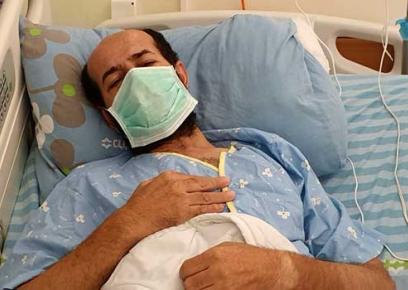
Maher al-Akhras in the Hospital. Photo by Oren Ziv (Local call)
Israel to High Court: Dying Palestinian Still a Security Risk
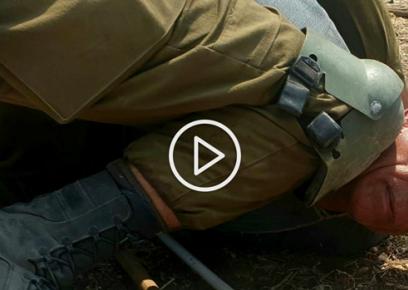
Officer kneeling on Khairi Hanun's neck and during the demonstration. Photo by Muhammad Hamed
Israeli officer attacks Palestinian demonstrator, kneels on his neck and prevents his evacuation at gunfire
On 1 Sep. 2020, during a Palestinian march against expropriation of land from the villages of Shufah and a-Ras to establish the Bustanei Hefetz industrial zone, a military officer pushed a protestor to the ground and kneeled on his neck. When other protestors got the man into a car, the officer smashed the driver’s window and threatened to shoot him. On Monday, 21 September 2020, at around 4:00 A.M., about 15 soldiers raided Khairi Hanun’s home and arrested him. As usual, the military justified this conduct, as part of Israel’s sweeping ban on Palestinians’ right to protest and its automatic backing of security forces’ violence against Palestinians.
Israel’s regime of apartheid and occupation is inextricably bound up in human rights violations. B’Tselem strives to end this regime, as that is the only way forward to a future in which human rights, democracy, liberty and equality are ensured to all people, both Palestinian and Israeli, living between the Jordan River and the Mediterranean Sea.
Since the Hamas attack on 7 October 2023, Israel has acted in a coordinated and deliberate manner to destroy Palestinian society in the Gaza Strip, committing genocide against its residents. In light of Israel’s actions in Gaza, the public statements made by Israeli decision-makers, and the international community’s failure to take effective action, there is a serious risk that the Israeli regime will expand the genocide to other areas under its control—first and foremost, the West Bank.
B’Tselem calls on the Israeli public and the international community to use every tool available under international law to bring an immediate end to Israel’s genocide against the Palestinian people.