Um al-Butum, Wadi Sa’ir, Hebron District: Dozens of settlers attacked the community, injured women and a child and tried to set a house on fire with people inside
Um al-Butum, Wadi Sa’ir, Hebron District: Dozens of settlers attacked the community, injured women and a child and tried to set a house on fire with people inside
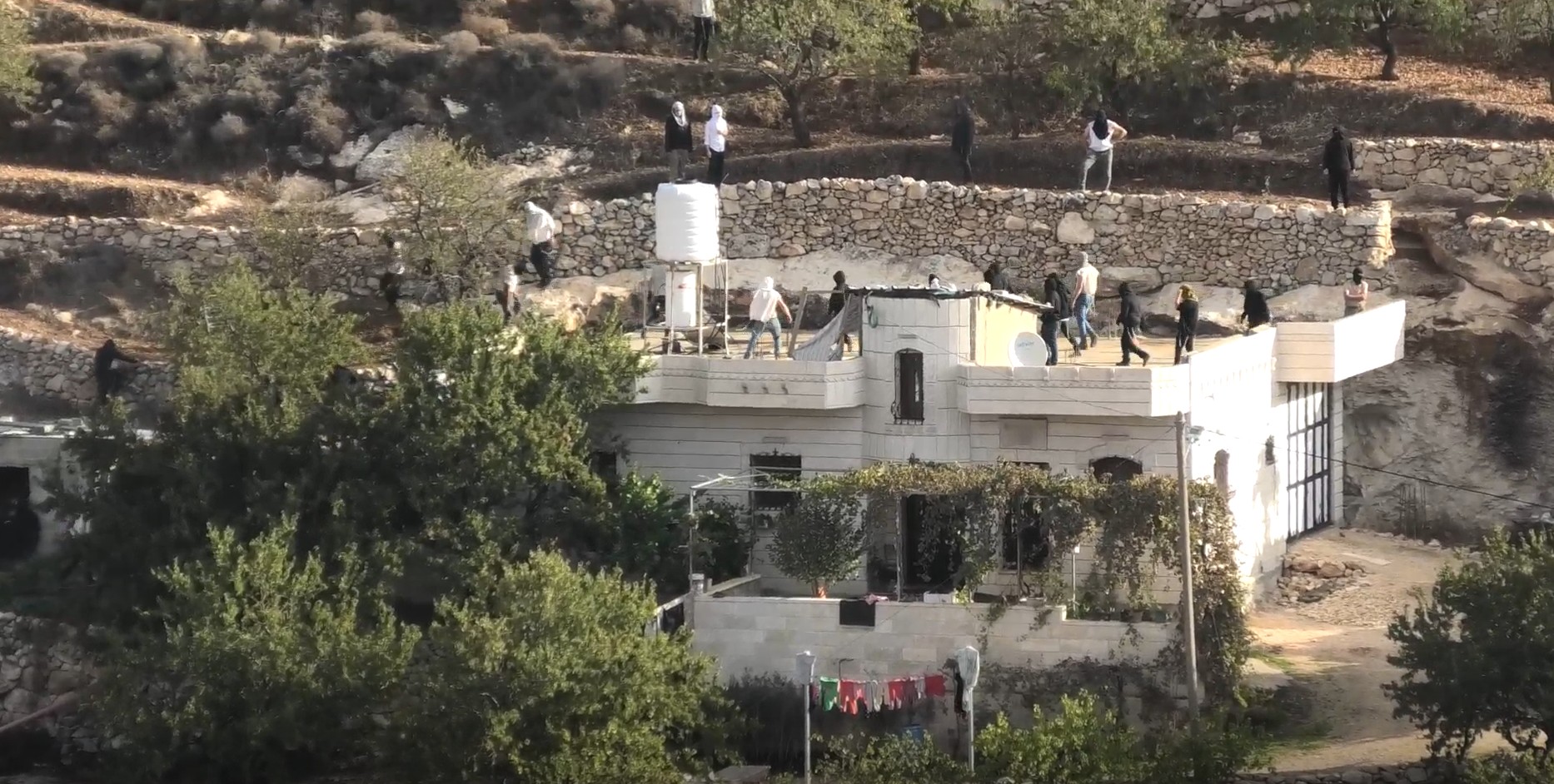
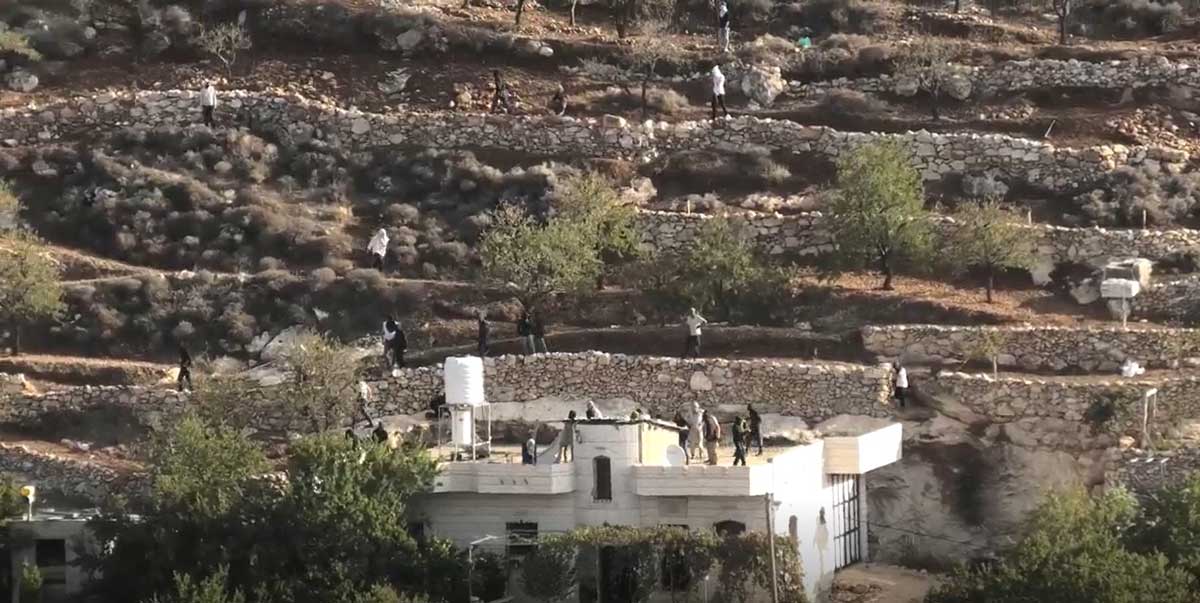
Settlers on the roof of the house. Still from video footage, courtesy of the residents
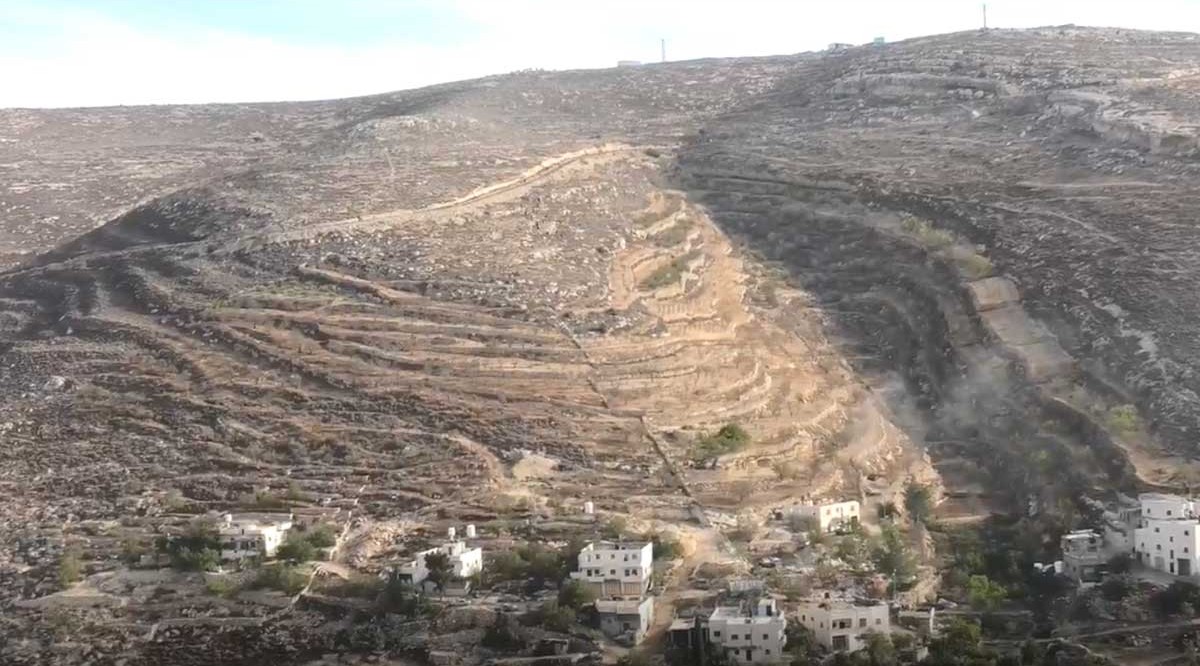
The community of Um al-Butum, which lies in Wadi Sa’ir, is home to an extended family comprised of 23 households and numbering a total of 150 people, including 45 children.
B’Tselem documented numerous settler attacks on the community throughout 2025. Beginning in July of that year, when the outpost Ma’ale Tidhar was established about 500 meters away from the community’s homes, the frequency and intensity of these attacks increased.
On 11 July 2025, after village residents tried to drive away a settler who was grazing sheep near their homes, dozens of settlers descended on the community, attacked houses with stones and fired live rounds at residents.
The community of Umm al-Butum. Still from video footage, courtesy of the residents
The next day, 12 July 2025, dozens of settlers again came to the families’ homes, attacked them with stones, smashed the windows of about 15 houses, set fire to several vehicles and damaged farmland and agricultural equipment belonging to the residents.
On 1 October 2025, at night, settlers cut down about 400 olive trees belonging to local residents.
On 25 October 2025, settlers cut down about 180 more olive trees.
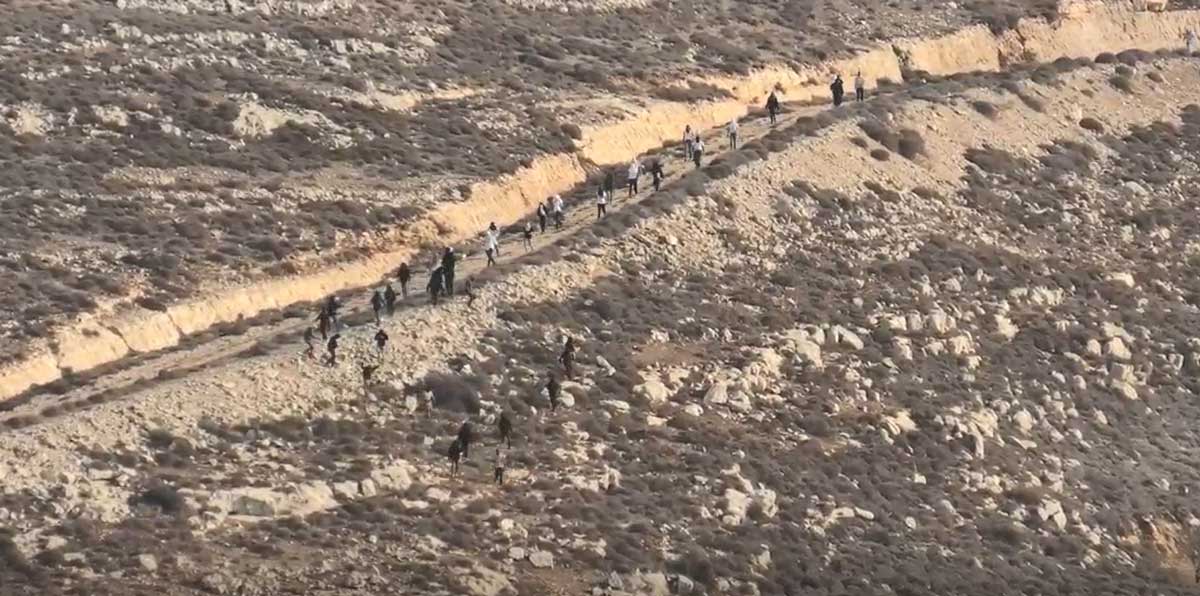
On Monday, 17 November 2025, at around 1:30 P.M., after Civil Administration personnel demolished several structures in the outpost Tzur Misgavi, which was established in 2025 on the ruins of the displaced community of al-Qanub, about 30 settlers descended on the village, attacked its houses with stones for about 10 minutes and then left.
Settlers on their way to Umm al-Butum. Still from video footage, courtesy of the residents
About half an hour later, settlers returned to the village, this time about 40 of them, some armed with clubs and others carrying bottles filled with flammable liquid.
They attacked the houses with stones and tried to break into a house where Jamileh Shalaldeh, 66, was at the time with her daughter-in-law and her four grandchildren, the oldest of whom is four.
The settlers threw stones at the family members through the windows, injuring the 4-year-old in the head.
They set fire to clothes that were hanging outside and to curtains inside the house, poured flammable liquid into the house and ignited it, but the family managed to put out the fire.
The settlers tried to wrench the doors off their hinges and finally managed to break in.
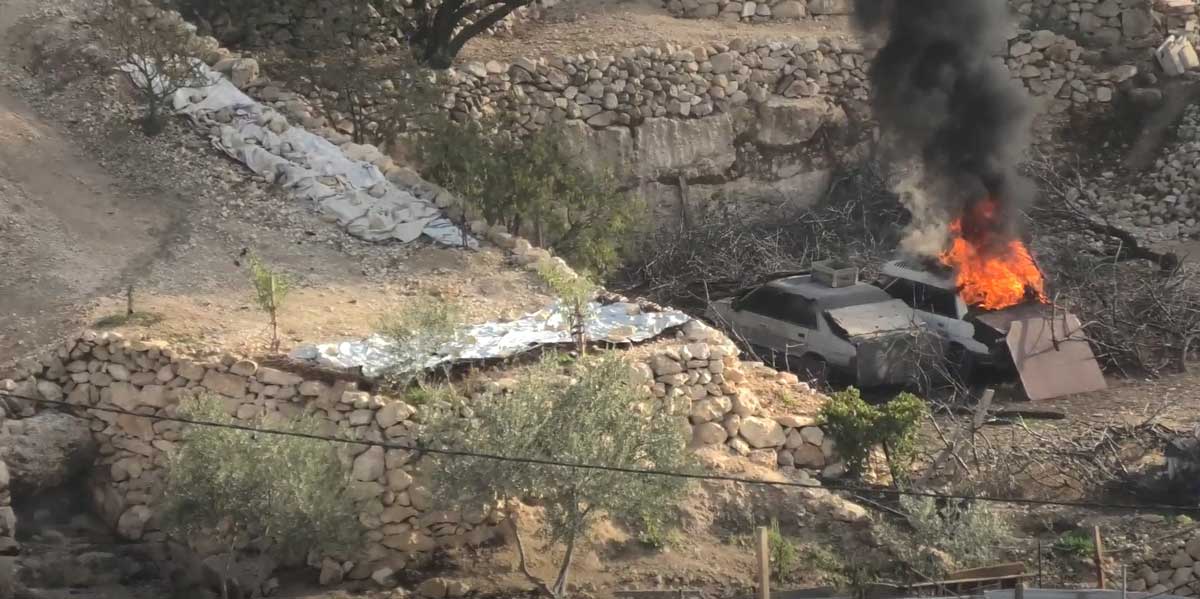
The cars torched by settlers. Still from video footage, courtesy of the residents
When they entered, they attacked Jamileh and her relative with stones, injuring both women in the head.
At this stage, a military force arrived, and the settlers backed away, but continued to block the road leading from the community to the nearby village of al-Maniyah for about another hour, thereby delaying the evacuation of Jamileh and her relatives to the hospital in Beit Jala.
In addition to attacking the family members, the settlers also set four vehicles on fire.
Jamileh Shalaldeh, 66, a mother of 12, related the following in a testimony she gave B’Tselem field researcher ‘Amer ‘Aruri on 30 November 2025:
We are an extended family living in the village of Um al-Butum in Wadi Sa’ir, made up of four nuclear families, my husband and I, and the families of our three sons, which number a total of 14 people, including eight minors.
On 17 November 2025, at 1:30 P.M., I went over to my 43-year-old son N.’s house, after I heard there were settlers around it, and his wife, N., 31, was alone at home with four of my grandchildren, ages 2 to 4. The other two children were at school. When I arrived, I saw that the settlers had already left. They left behind broken flowerpots and stones, and there were stones scattered about. My daughter-in-law N. told me that the settlers had attacked the house with stones for about 10 minutes and then left.
About half an hour after I arrived, settlers came back, maybe the same people. They were holding sticks, and one of them was holding a white plastic container that I suspect contained gasoline. My daughter-in-law and I immediately closed the doors. The settlers started throwing stones at the house again. They removed the protective mesh on some of the windows and smashed the glass door of the living room and the pane of one of the living room windows.
My daughter-in-law, the children and I hid in the hallway between the bedrooms, the only place in the house that has no windows and is considered relatively safe. I saw the settlers taking the laundry off the lines and setting the clothes on fire.
They also smashed the window in the children’s room and poured a flammable substance into it. The children screamed and cried in fear, and I hugged them. They were in total shock. My daughter-in-law cried and shouted, “We’re all going to die,” and called her husband, who was at work. We were all hysterical, and I tried to calm them down and support them emotionally, and I told them, “Don’t be afraid. We’re safe,” even though I knew that was not at all true.
Settlers piling wood on cars before setting them on fire. Still from video footage, courtesy of the residents
My 4-year-old grandson wriggled free of my arms and tried to see what was happening, and then one of the settlers threw a stone at him through the window of the children’s room and hit him in the head. Blood gushed from his head. After that, the settlers smashed the window in my son and daughter-in-law’s bedroom and tried to break the headboard of the bed that was by the window. When they failed, they smashed the window in the second bedroom and set the curtain on fire. I brought a bucket of water and put it out.
The settlers also tried to wrench the kitchen door off. They didn’t succeed, but they bent it, and now it’s hard to close and open. They broke the glass in the window in the kitchen door and threw burning clothes they had taken off the laundry lines inside. I put the fire out again. The stones they used were taken from a stone circle around the house. They also threw stones at the roof of the house, broke solar panels and damaged a satellite dish.
The most dangerous moment was when the settlers managed to wrench off the wooden door of the stairwell and break in. My daughter-in-law and I held mops to defend ourselves. One of the settlers threw a stone at me, and it hit me in the chin and caused bleeding. I felt dizzy and fell to the ground. My daughter-in-law was also hit in the head by a stone. I saw blood spurting from her forehead, on the left side of her head. The children hid behind her and screamed in tears.
Settlers on the roof of the house. Still from video footage, courtesy of the residents
At that moment, the Israeli military arrived, and the settlers fled the stairwell. The military arrived in time to prevent my daughter-in-law, the children and me from being murdered. I saw a fire burning again in the living room and in my son’s bedroom. When the settlers ran away, my other son, S., 31, arrived. The soldiers gave him a fire extinguisher, and he used it to put out the fire in the living room and the bedroom.
The assault lasted for about an hour. Afterwards, my husband ‘A., 68, arrived and called an ambulance, which managed to reach us only about an hour after the incident, because the settlers blocked the road from al-Maniyah to Wadi Sa’ir, where we live, near the Tuqu’ junction, about 3 kilometers from the house. When the ambulance arrived, it drove us to the hospital.
We were discharged from the hospital that same day and drove to the Palestinian police station in the village of Irtas to file a complaint against the settlers. Two days later, the Israeli police demanded that we come to the Beitar Illit station to file a complaint, and my husband went there and filed the complaint.
I had headaches for three days after the assault, and to this day, I have pain in my jaw as a result of the blow to my chin.
Israel’s regime of apartheid and occupation is inextricably bound up in human rights violations. B’Tselem strives to end this regime, as that is the only way forward to a future in which human rights, democracy, liberty and equality are ensured to all people, both Palestinian and Israeli, living between the Jordan River and the Mediterranean Sea.
Since the Hamas attack on 7 October 2023, Israel has acted in a coordinated and deliberate manner to destroy Palestinian society in the Gaza Strip, committing genocide against its residents. In light of Israel’s actions in Gaza, the public statements made by Israeli decision-makers, and the international community’s failure to take effective action, there is a serious risk that the Israeli regime will expand the genocide to other areas under its control—first and foremost, the West Bank.
B’Tselem calls on the Israeli public and the international community to use every tool available under international law to bring an immediate end to Israel’s genocide against the Palestinian people.