Ethnic cleansing of Palestinian communities and lone families in the West Bank (59 communities as of 16 Mar 2026)
Demolitions and confiscations in communities facing expulsion
Thousands of people – residents of dozens of Palestinian communities located throughout Area C, the West Bank – face imminent expulsion by Israeli authorities on a variety of pretexts. The live blog will pool the regular updates we get from B’Tselem field researchers regarding the communities and any attempts by authorities to expel them. Click on the number of a community cluster and then on the tent icon marked on the map for further information about communities facing the risk of expulsion.
The information in the blog reflects the latest state affairs known to us and is updated as we receive new data from the field. For more on the communities facing expulsion, click here.
The information in the blog reflects the latest state affairs known to us and is updated as we receive new data from the field. For more on the communities facing expulsion, click here.
11 Nov 2024
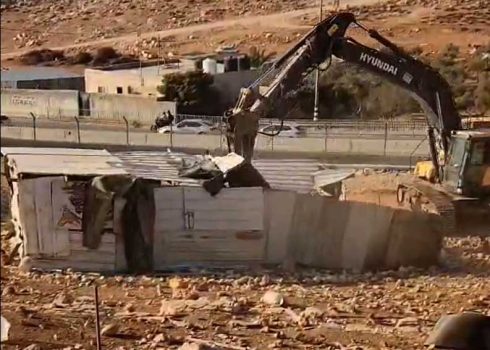
The demolition of one of the shacks. Photo courtesy of local residents
Israel demolished nine structures in the community of Jaba’ al-’Ara’reh, northeast of Jerusalem
On Monday, 11 November 2024, in the early morning hours, Civil Administration personnel, arrived with a military escort at the community of Jaba’ al-’Ara’reh, northeast of Jerusalem, and demolished two structures that were used as a mosque and a diwan (a room used for community gatherings), six shacks used as sheepfolds and a garage.
31 Aug 2016
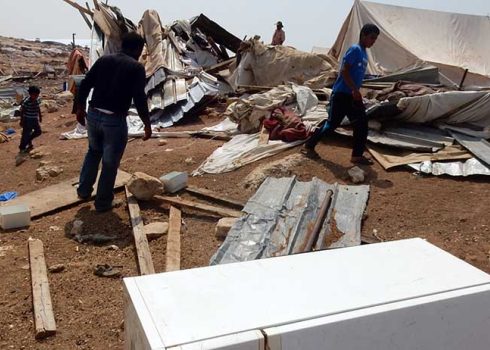
Residents of the community of Ma’azi Jaba’ outside their demolished homes. Photo: Iyad Hadad, B'Tselem, 30 August 2016.
Israeli Authorities Demolish the Homes of Three Families in Ma’azi Jaba’ to the North East of Jerusalem
On 29 August 2016, military and Civil Administration forces came to the community of Ma’azi Jaba’, one of several clusters of shepherding communities located to the northeast of Jerusalem, between the village of Jaba’ and the settlement of Adam (Geva Binyamin). The forces demolished four homes belonging to three families, as well as three structures used for raising and housing livestock, and left 28 people homeless, including 19 minors. Over the first seven months of 2016, the Israeli authorities have demolished a total of 203 homes throughout the West Bank, leaving 823 people homeless, including 423 minors. The scope of destruction witnessed during this period is the worst since B'Tselem began monitoring house demolitions on the grounds of “unauthorized construction” and reflects an intensification of Israel's campaign to displace Palestinians from Area C since the beginning of 2016.
27 Jul 2016
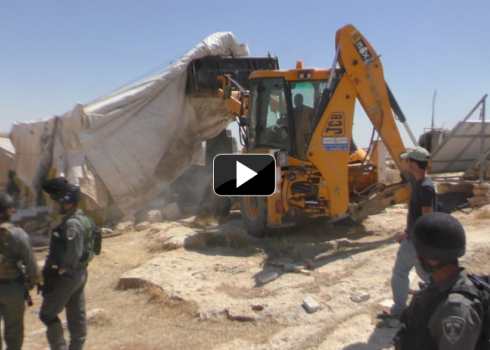
Razed to the ground: Israel steps up demolition of Palestinian homes in Area C
In Jan.-June 2016, Israeli authorities demolished 168 dwellings in Palestinian communities in the West Bank, making 740 people homeless (incl. 384 minors), more than in any one year in the past decade (except 2013). Demolitions are carried out only in Area C, which comprises about 60% of the West Bank, and which Israel views as primarily meant to serve its own needs, and in East Jerusalem. Demolitions play a key role in Israeli policy in the West Bank to displace Palestinians and take over their land. Demolitions and devastating communities do not fulfill “the rule of law”. Rather, they are a longstanding, systematic dispossession to which all Israeli authorities are party.
23 Jun 2016

Spring water reservoir slated for demolition in Khirbet al-Malih. Photo: 'Aref Daraghmeh, B'Tselem, 14 June 2016
Jordan Valley: Israeli authorities seized a tractor carrying water and delivered demolition orders for water reservoirs
On 14 June 2016, despite the 104°F heat in the Jordan Valley, Israeli authorities seized a tractor on which Palestinians from Khirbet Samrah depend to carry water to their flocks and delivered demolition orders for spring water reservoirs that are vital to the al-Malih Palestinian community. This conduct clearly illustrates Israel’s routine abuse of its power against Palestinians in the Jordan Valley, exacerbating the existing water shortage caused by the fact Israel does not allow them to connect to the water supply.
19 Jun 2016

Residents of Wadi Ejheish watch their homes being demolished. Photo by Nasser Nawaj'ah, B'Tselem, 19 June 2016
Civil Administration demolishes two family’s homes in mid-Ramadan
Today, Sunday, 19 June 2016, Civil Administration and military forces came to the Palestinian community of Wadi Ejheish, which is known as “south Susiya” as it lies some five kilometers south of the village of Khirbet Susiya. The forces demolished the homes of two families that number 21 people in total, including four women and 14 minors. The forces also demolished two livestock pens. One of the demolished homes had been donated by a humanitarian aid agency.
6 Jun 2016
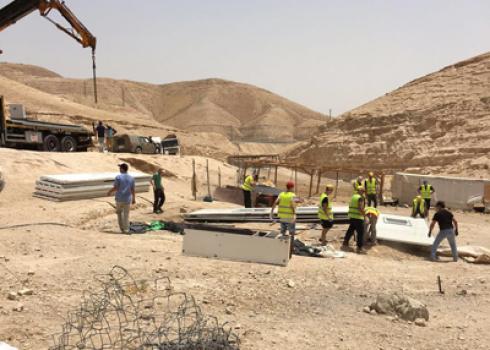
Civil Administration confiscates 7 pre-fabs at community of Wadi al-Qatif, rendering 26 people homeless
Yesterday, 5 June 2016, Civil Administration and Border Police forces arrived at the Wadi al-Qatif (Satah al-Bahar) community, which is located along Route No. 1 between the settlement of Mitzpe Yeriho and a-Nabi Musa. They dismantled and confiscated seven pre-fabs donated several weeks ago by a humanitarian aid agency to replace old huts. Six of the pre-fabs were being used as living quarters by six families, totaling 26 individuals, including 13 minors. The seventh pre-fab was being used as a day care center for 12 of the community’s children. The residents of the community live in an area the Israeli military has defined a closed military zone since the early 1980s.
1 Jun 2016

Abu Kabash family from Khirbet Humsah wait in the shade of their tractor in a field after being forced to vacate their home. Photo by ‘Aref Daraghmeh, B’Tselem, 30 May 2016
375 Palestinians, more than half of them minors, temporarily displaced due to military training in Jordan Valley
On 26 May 2016, Civil Administration (CA) personnel arrived at five Palestinian communities in the northern Jordan Valley and notified 58 families that they must vacate their homes for varying stretches of time from 30 May to 1 June, due to military training scheduled in the area. On all three training days, CA and military personnel came to the communities to ensure that the residents had indeed vacated their homes and gone some distance from the area. In the communities of ‘Ein al-Meyteh, al-Burj and Khirbet al-Malih, 27 families were temporarily displaced for nine hours. In Khirbet a-Ras al-Ahmar, 14 families were made to leave their homes and stay away from the area, some on all three days and some only on one, for nine to 14 hours at a time. The community of Khirbet Humsah was particularly harshly treated: 19 families were temporarily displaced for many hours on all three days; on one, they were made to remain far from home at night, too, and on another they were only allowed to return home at midnight.
18 May 2016

Civil Administration personnel dismantling trailers in Badu al-Baba, covered by border police officers, May 16, 2016. Photo courtesy of the community.
Civil Administration dismantles and confiscates trailers which were home to 49 people, northeast of Jerusalem
On Monday, 16 May 2016, a large force of Civil Administration and Border Police personnel arrived in the Badu al-Baba community, near al-‘Eizariyah, northeast of Jerusalem. The forces dismantled and confiscated ten trailers, which were home to 49 people, including 23 minors. The trailers were recently donated by a humanitarian aid agency to families who had until then lived in tin and wood shacks. The community has about 350 members, roughly half of them minors, and lives in the area designated by Israel as Area E1, where it plans to expand the settlement of Ma’ale Adumim to create a contiguous urban link to Jerusalem. The Civil Administration put this territory under the jurisdiction of the Ma’ale Adumim municipality. The Civil Administration previously demolished structures in the community on 21 January 2016.
7 Apr 2016
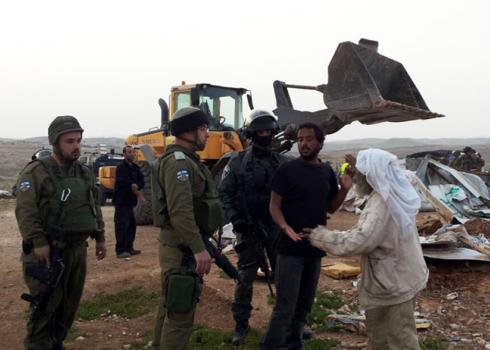
Residents of Um al-Kheir in the South Hebron Hills, against the backdrop of a bulldozer destroying structures in the community. Photo: Nasser Nawaj'ah, B’Tselem, 6 April 2016.
Three days of destruction: Civil Administration demolishes 10 structures in South Hebron Hills and Wadi al-Qalt
More demolitions this morning in the Jordan Valley and Ma’ale Adumim Area. Wave of demolitions, today, Apr. 7, in several West Bank communities including E1 and repeat demolitions in Khirbet Tana in the Jordan Valley. Earlier this week, the authorities demolished 6 dwellings in Um al-Kheir, South Hebron Hills, and 2 in Wadi al-Qalt. The recent action has left 43 people homeless, including 26 minors. It is part of a demolition campaign launched by Israel in early 2016, in which 128 dwellings and 138 other structures in vulnerable communities have already been destroyed, leaving 510 people, including 275 minors homeless.
24 Mar 2016

Civil Administration bulldozer demolishing a residential structure in Khirbet Jenbah in Masafer Yatta, 22 March 2016. Photo: Nasser Nawaj'ah, B'Tselem.
Israeli authorities again demolish structures in two Masafer Yatta communities (Firing Zone 918)
On 22 March 2016, Civil Administration and military forces came to the communities of Khirbet Jenbah and a-Taban in Masafer Yatta, in the area the military has declared Firing Zone 918. In Khirbet Jenbah, the forces demolished a tent that was home to a family of six people, including four minors. The tent was donated to the family by an international humanitarian aid organization. The forces also demolished two livestock pens belonging to the family and confiscated a solar panel donated by an international humanitarian aid organization. The forces then continued to the community of Khirbet a-Taban, where they demolished another livestock pen. These structures were apparently not included in the orders prohibiting the demolition of additional structures in the communities. These orders were issued in February following petitions submitted by residents of the communities after demolitions undertaken by the authorities in the communities of Khirbet Jenbah and Khirbet al-Halawah on 2 Feb. 2016, when 22 dwellings in both communities were demolished. The latest demolitions in the two communities were carried out a day before the hearing held by the High Court of Justice (HCJ) on 23 March 2016 in a principled petition submitted by the residents of Masafer Yatta, after a mediation process between the residents and the state ended without agreements. The residents are opposing the authorities’ attempts to expel them from their land after declaring it a firing zone.
24 Mar 2016

Ruins of an outhouse donated by the EU. Photo: Abdulkarim Sadi, B'Tselem, 23 March 2016.
Israeli authorities demolish homes in Khirbet Tana for third time this year, leaving 85 people homeless, including 30 children
On Wednesday, 23 March 2016, Civil Administration and military forces came to Khirbet Tana to the east of Beit Furik and demolished 17 homes, 21 livestock pens, and five outhouses. The forces also blocked the entrances to five caves, demolished a water reservoir built with the assistance of a Palestinian association, and confiscated four cars belonging to residents on the grounds that they did not have a valid license. This is the third demolition operation in the village since the beginning of 2016. The previous demolitions were undertaken on 9 February 2016 and 2 March 2016. Six of the residential tents that were demolished were donated by an international humanitarian aid organization to families whose homes were demolished by the Civil Administration and the military on 2 March, while two of the outhouses demolished were donated by the European Union. The acts of destruction left 85 people homeless, including 30 minors.
22 Mar 2016

Civil Administration forces remove solar panel in Khirbet Jenbah this morning. Photo: Nasser Nawaj'ah, B'Tselem.
Demolitions taking place right now in Khirbet Jenba
The Israeli Civil Administration is demolishing structures in Khirbet Jenba, in the Masafer Yatta area of the Southern Hebron Hills. More info as we receive it. The residents view this move as a message from the authorities in the run up to tomorrow's high court hearing in their general petition against the attempt to forcibly transfer them from their land through the declaration of the area as "Firing Zone 918"
8 Mar 2016
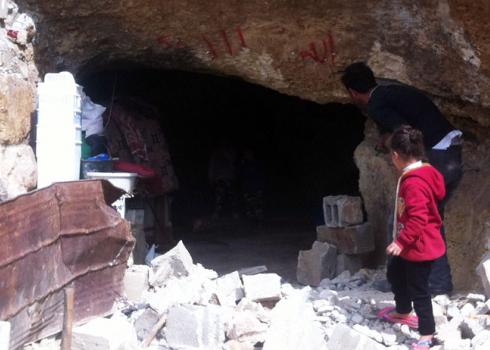
Residents of Khirbet Tana near entrance to residential cave demolished by the authorities. Photo by Abdulkarim Sadi, B’Tselem, 2 Mar. 2016
Demolition spree carries on across West Bank; 435 people, incl. 234 minors, have lost their homes since Jan. 2016
In the first week of March, authorities demolished 17 dwellings, 19 livestock pens, and a school in two Jordan Valley communities, rendering 64 people - incl. 28 minors - homeless. These actions are a direct continuation of the unusually massive demolition campaign authorities launched in Palestinian shepherding communities across the West Bank. Since Jan., authorities have dismantled and demolished 203 structures, including 105 dwellings, in communities threatened with expulsion; 435 people, including 234 minors, lost their homes. This consistently applied government policy constitutes the forced transfer of protected Palestinian residents in an occupied area.
Israel’s regime of apartheid and occupation is inextricably bound up in human rights violations. B’Tselem strives to end this regime, as that is the only way forward to a future in which human rights, democracy, liberty and equality are ensured to all people, both Palestinian and Israeli, living between the Jordan River and the Mediterranean Sea.
Since the Hamas attack on 7 October 2023, Israel has acted in a coordinated and deliberate manner to destroy Palestinian society in the Gaza Strip, committing genocide against its residents. In light of Israel’s actions in Gaza, the public statements made by Israeli decision-makers, and the international community’s failure to take effective action, there is a serious risk that the Israeli regime will expand the genocide to other areas under its control—first and foremost, the West Bank.
B’Tselem calls on the Israeli public and the international community to use every tool available under international law to bring an immediate end to Israel’s genocide against the Palestinian people.