Ethnic cleansing of Palestinian communities and lone families in the West Bank (59 communities as of 16 Mar 2026)
Demolitions and confiscations in communities facing expulsion
Thousands of people – residents of dozens of Palestinian communities located throughout Area C, the West Bank – face imminent expulsion by Israeli authorities on a variety of pretexts. The live blog will pool the regular updates we get from B’Tselem field researchers regarding the communities and any attempts by authorities to expel them. Click on the number of a community cluster and then on the tent icon marked on the map for further information about communities facing the risk of expulsion.
The information in the blog reflects the latest state affairs known to us and is updated as we receive new data from the field. For more on the communities facing expulsion, click here.
The information in the blog reflects the latest state affairs known to us and is updated as we receive new data from the field. For more on the communities facing expulsion, click here.
12 Apr 2018
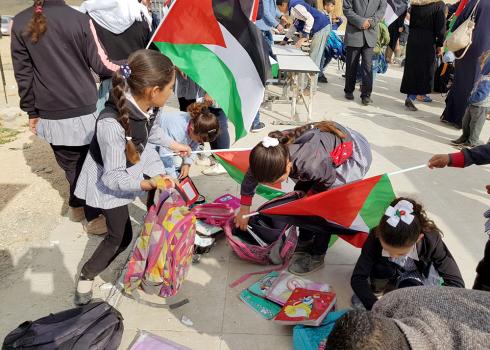
Khirbat Zanutah school girls at the location of the ruined school building. Photo by Nasser Nawaj'ah, B'Tselem, 10 April 2018
Civil Administration demolishes school in Khirbet Zanutah
On Monday, 9 Apr. 2018, at about 9:00 PM, dozens of soldiers and Civil Administration officials came to the village of Khirbet Zanutah, which is situated to the south of the town of a-Dhahiriyah. The forces demolished a school established approximately one month ago with funding from a humanitarian aid organization. The school comprised six rooms, including five classrooms, and served 33 children in the 1st through 6th grades. The forces also confiscated a water container and toilets, leaving behind only the concrete foundations of the school building. Since 2007 the residents of Khirbet Zanutah have been waging a legal battle against the demolition orders issued by the Civil Administration on the grounds of construction without permits – despite the fact that the Civil Administration knows full well that the residents have no opportunity to obtain such permits.
12 Apr 2018
Khirbat Zanutah school girls at the location of the ruined school building. Photo by Nasser Nawaj'ah, B'Tselem, 10 April 2018
Civil Administration demolishes school in Khirbet Zanutah
On Monday, 9 Apr. 2018, at about 9:00 PM, dozens of soldiers and Civil Administration officials came to the village of Khirbet Zanutah, which is situated to the south of the town of a-Dhahiriyah. The forces demolished a school established approximately one month ago with funding from a humanitarian aid organization. The school comprised six rooms, including five classrooms, and served 33 children in the 1st through 6th grades. The forces also confiscated a water container and toilets, leaving behind only the concrete foundations of the school building. Since 2007 the residents of Khirbet Zanutah have been waging a legal battle against the demolition orders issued by the Civil Administration on the grounds of construction without permits – despite the fact that the Civil Administration knows full well that the residents have no opportunity to obtain such permits.
19 Mar 2018
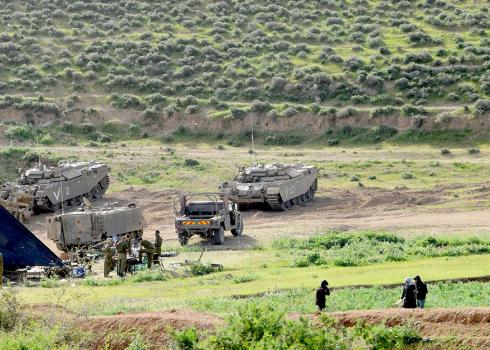
Military training this morning. Photo by 'Aref Daraghmeh, B'Tselem, 19 March 2018
Israeli military trains near Palestinian farmers by Khirbet Um al-Jamal
Since 5 March 2018, more than two weeks ago, large Israeli forces – including infantry, tanks and armored vehicles – have been conducting military training on an almost daily basis near Palestinian communities in several areas in the northern Jordan Valley, mostly near Khirbet al- al-Malih and the village of al-Farisiyah. The troops have been training in the use of live ammunition on pastureland and other farmland indispensable to the livelihood of the local residents. In a number of cases, tanks even drove through the residential area, maneuvering among residents' homes. This morning (19 March), a military force made up of three tanks, a jeep and an armored vehicle drove mere meters away from farmers tilling their land, passing at a distance of some 150 meters from the homes of the community of Khirbet Um al-Jamal. This morning was but one more example of the daily military training routine that Israeli decision-makers impose on the people living in the Palestinian communities of the northern Jordan Valley, with a view to forcing them to leave, ostensibly of their own accord.
13 Mar 2018
Israeli military trains today near Palestinian communities in northern Jordan Valley
Since 5 March 2018, Israeli troops including infantry, tanks and other armored vehicles have been training during the day and night in the area of Khirbet al-Malih and the village of al-Farisiyah in the northern Jordan Valley. The troops train with live fire on pastureland, preventing Palestinian residents from accessing the land.
Today, 13 March, exercises began at 3:00 A.M., including at least 20 tanks and dozens of military vehicles in various areas throughout the northern Jordan Valley, including just one kilometer from homes in the village of al-Farisiyah. In the town of Tubas, residents reported hearing loud shelling. Last night, Civil Administration officials notified 16 families from Khirbet Ibziq by phone who were previously ordered to vacate their homes today, that the military exercise has been delayed. The incessant military training in the Jordan Valley is part of a longstanding policy to drive Palestinian communities to leave, as though of their own free will.
7 Mar 2018
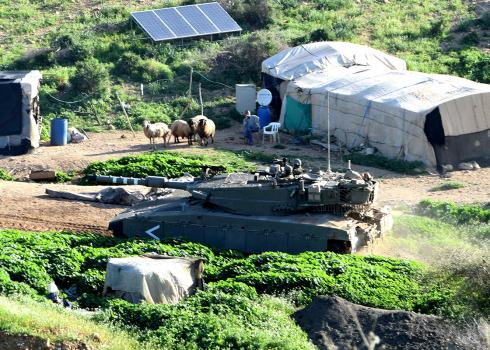
A tank next to the homes of residents in Um al-Jmal in the northern Jordan Valley. Photo by 'Aref Daraghmeh, B'Tselem, 7 March 2018
Military has been training near Palestinian communities in northern Jordan Valley for three days
Over the last three days, 5-7 March, military forces, including scores of vehicles, tanks and other armored cars have been carrying out training exercises both during the day and at night, in several areas located near Khirbet al-Malih and the village of al-Farisiyah in the northern Jordan Valley. The exercises include use of firearms on grazing pastures, while local residents are denied access. Military bulldozers also destroyed part of a chickpea field yesterday. Today, 7 March 2018, at around 7:30 A.M., the forces arrived at nearby Khirbet Um al-Jmal, and armored vehicles and troops trained in between residents’ homes and on farmland. The military also held training exercises near Khirbet Ibziq today, where two families had evacuated their homes following orders they were given by the military on 4 March 2018. Incessant military training in the northern Jordan Valley is part of Israel’s longstanding policy aimed at making living conditions in Palestinian communities unbearable and forcing residents out, ostensibly of their own accord.
5 Mar 2018
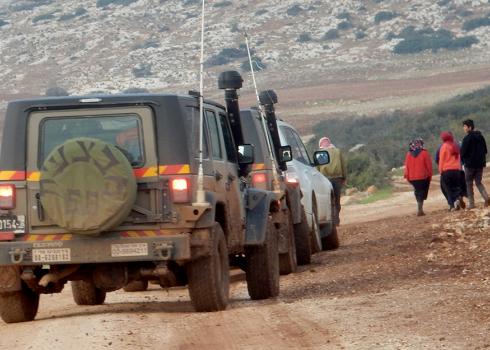
Residents evacuated from Khirbet Ibzik during training in December 2016. Photo: Aref Daraghmeh, B'Tselem
Military orders 16 families in Khirbet Ibziq to evacuate their homes for military training
Yesterday, Sunday, 4 March 2018, at around 11:00 AM, Civil Administration personnel and soldiers arrived in two jeeps at Khirbet Ibziq, in the northern Jordan Valley, north of the city of Tubas. The officials served sixteen families with temporary evacuation orders, which stated the evacuation was needed for the purpose of military training near the families’ homes. All sixteen families were required to evacuate from seven o’clock in the morning until six o’clock in the evening next Tuesday, 13 March 2018. Two families were ordered to evacuate on three more dates, 7, 14 and 21 March 2018. Together, the sixteen families served with orders have 79 members, including 47 children.
These types of evacuation orders are part of a longstanding policy implemented by Israeli decision makers with the object of making the lives of Palestinians in communities in Area C miserable. The actions Israel takes to further this policy include denying access to basic services, destroying water and electricity infrastructure, confiscating farming equipment and holding frequent military training exercises near residents’ homes.
This policy is meant to encourage Palestinians to leave their communities, ostensibly of their accord.
20 Feb 2018
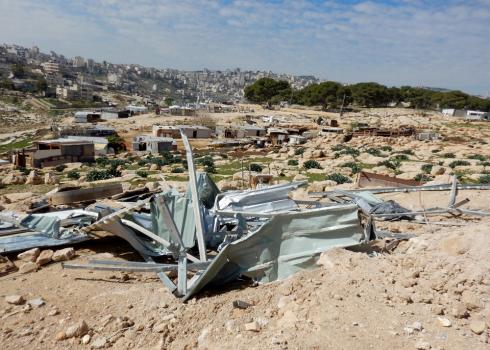
Home demolished by CA in community of Jabal al-Baba. Background: Settlement of Ma’ale Adumim. Photo by ‘Amer ‘Aruri, B’Tselem, 20 Feb. 2018
Israel’s CA demolishes family’s home in Jabal al-Baba for the second time in 4 months
At around 9:00 o’clock this morning, Tuesday 20 February 2018, Israeli Civil Administration personnel came with a bulldozer and a police escort (Border Police and Israel Police) to the community of Jabal al-Baba, which is located near the town of ‘Eizariyah, northeast of Jerusalem. The forces demolished the shack that served as the home of the Abu ‘Aweidah family, thereby leaving the 13-person family – including 10 minors – without a home. In the course of carrying out the demolition, the troops arrested a community resident who lives near the family. This is the second time in less than six months that the Civil Administration has demolished the Abu ‘Aweidahs’ home, having demolished their home on 15 October 2017, along with three other homes. There are several demolition and demarcation orders currently pending against the community, whose residents have been obliged to wage a protracted legal battle to counter the authorities’ attempts to forcibly displace them. Since 2006, Israel has demolished 33 structures in the community, 27 of them had served as homes to 136 people, including 73 minors.
6 Feb 2018
Israel’s Civil Administration demolishes and confiscates pipeline and four unassembled residential tents in the northern Jordan Valley
On Monday morning, 5 Feb. 2018, Civil Administration personnel and a Border Police force came to the area of Khirbet a-Sakut in the northern Jordan Valley, near the settlement of Mehola. They brought a bulldozer, a truck and crane with them. The force dismantled and confiscated a water pipeline about 400 meters long that had served to irrigate the watermelon patch of Tubas resident Bassem Fuqahaa (62). In a testimony Fuqahaa gave that day to B’Tselem field researcher ‘Aref Daraghmeh, he related: “It looks like the confiscation was well-planned. They came to take away the pipeline on the very day I planted the seeds. Why didn’t they give me prior warning? They made me lose all the money I invested and left the patch without irrigation.”At around 4:00 P.M. that day, the troops went to the community of Khirbet Um al-Jamal, to the south, and confiscated four unassembled tents that served as the seasonal home of a local family. The tents had been donated to the family by a humanitarian aid organization after the Civil Administration had demolished the family’s tents on an earlier occasion. The troops also confiscated rolls of barbed-wire and bolts of cloth used for tent maintenance.
* The original update erroneously stated that the tents were currently in use.
4 Feb 2018
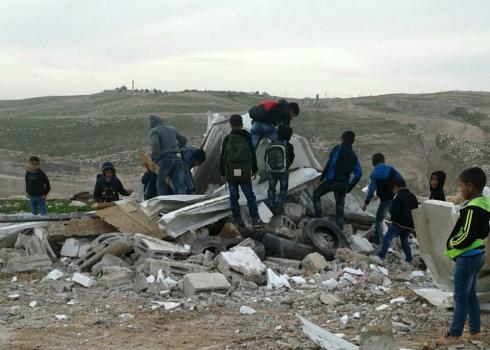
The ruins of one of the classrooms demolished by the Civil Administration. Photo: Ahmad Ibrahim
Civil Administration Demolishes Two Classrooms at the School in the Abu a-Nawar Community
This morning, 4 Feb. 2018, at about 5:00 AM, Civil Administration officials and security forces arrived at the Abu a-Nawar community in some 20 jeeps. The forces demolished two buildings at the community’s school that were used by some 25 children in the 3rd and 4th grades. The officials declared the area a closed military zone and demolished the classrooms, which were funded by the European Union and the Palestinian Authority. Over recent months the residents of Abu a-Nawar have pursued a legal struggle to regulate the buildings in their community, including the classrooms, which were demolished before the legal proceeding in their case was completed. The demolition order for the classrooms was issued in December, and since then the students have been learning at the community’s guesthouse. The demolition of educational buildings is one of the means Israel uses in its attempt to expel Palestinian communities from their homes, so that it can concentrate the residents in enclaves and use the territory for its own needs.
24 Jan 2018
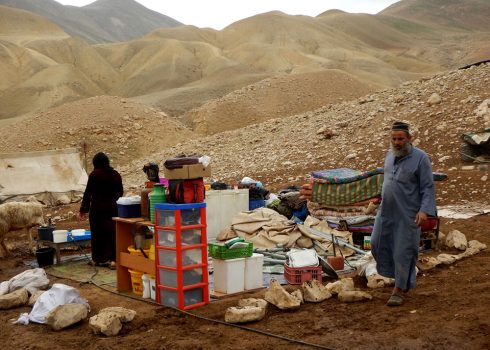
Members of the Bani Maniyah family near the ruins of their home. Photo: 'Aref Daraghmeh, B'Tselem, 24 Jan. 18
CA demolishes residential structures and sheep pens in community of ‘Ein Karzaliyah and home under construction in Jiftlik area
At 10:30 this morning, Israeli Civil Administration personnel arrived with troops and bulldozers at the community of ‘Ein Karzaliyah in the northern Jordan Valley, and demolished a tent used as the home of the last remaining family in the community. Also demolished were three sheep pens belonging to this family, which has six members in total, including three minors. The troops also demolished a residential tent belonging to a family that no longer lives at the site and two more sheep pens, and dug up the dirt road leading to the community to make it unusable. Until April 2017, three families, with a total of 30 members lived in the community, but because of the unceasing harassment by Israeli authorities - including 14 demolitions since 2014 - the two other families left. Earlier today, at around eight A.M., the forces came to the a-Shuna community in the Jiftlik area and demolished a concrete residential structure which was still under construction.
Video footage by 'Aref Daraghmeh, B’Tselem
28 Dec 2017
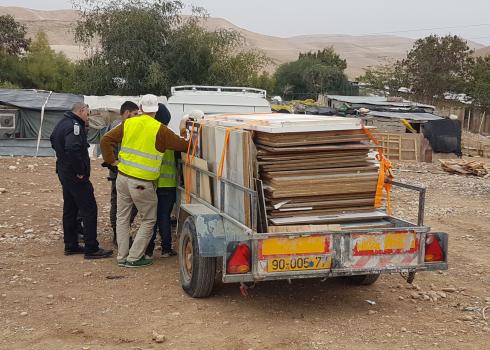
The Civil Administration confiscates wooden panels in the Khan al-Ahmar school this morning. Photo: Amit Gilutz, B'Tselem
Israeli Civil Administration confiscates wooden panels from Khan al-Ahmar
On 28 December 2017, at approximately 8:30 A.M., Civil Administration officials came with Border Police officers to the Khan al-Ahmar School community in the area of Ma’ale Adumim, handed the residents a military warrant and took away 60 wooden panels and two doors. The community of Khan al-Ahmar is located in an area that Israel has earmarked for future expansion of the Ma’ale Adumim settlement. Later that day, at around 1:00 P.M., Civil Administration officials came with Border Police officers to another community in Khan al-Ahmar, a-Tabneh, and confiscated 10 tin panels and four packs of iron bars that are used to erect temporary structures for events. Read all reports on Khan al-Ahmar here.
26 Dec 2017
Israeli military digs deep trenches to prevent access to communities of Masafer Yatta
For over a month the military has been curtailing the movement of the Palestinians living in Masafer Yatta (Greater Yatta) in the South Hebron Hills by putting in place physical obstacles. Local residents occasionally managed to forge side paths to get through, and each time the soldiers restored the obstacle either the same day or the next. This morning, 26 December 2017, at around 10:00 A.M., soldiers arrived in the area with bulldozers. They re-blocked paths the Palestinian residents forged between Masafer Yatta and the community of She’b al-Batem. This time the soldiers also piled up mounds of boulders and dug a ditch – two meters deep, by three meters wide – to keep vehicles from getting though. In addition, the troops also dug another ditch along a road which had not previously been blocked, and which runs between the communities of Khallet a-a-Dabe’ and Khribet al-Fakhit.
13 Dec 2017
The Abu a-Nuwar School. Photo by 'Amer 'Aruri, B'Tselem, 10 August 2017
Civil Administration issued demolition order for school building in Abu a-Nuwar community
This morning, 13 December 2017, residents of the Abu a-Nuwar community found a demolition order that had been placed inside the fourth-grade classroom in one of the school’s buildings. None of the residents saw any security forces in the community, and when the order was placed there is unknown. The order states that if the School owner does not remove it in 72 hours, the authorities will demolish it, at the owners' expense. 72 None of the residents saw any security forces in the community, and when the order was placed there is unknown. The community has about 650 residents, about half of them are children and youths. It lies southwest of al-'Eizariyah, in the area Israeli authorities have designated as E1. It is flanked by settlements on both sides, Kedar and Ma’ale Adumim. The school has two buildings, an old one, which houses the kindergarten and first and second grades – a total of 72 students. The second structure is newer, built in late September 2017, and houses grades three to four, with 25 students. On 7 October 2017, Civil Administration officials, accompanied by security forces, confiscated the doors to these two classrooms. Last summer, military forces arrived at the school, declared it a closed military zone and confiscated solar panels that supplied power to the school and the community’s guesthouse.
Israel’s regime of apartheid and occupation is inextricably bound up in human rights violations. B’Tselem strives to end this regime, as that is the only way forward to a future in which human rights, democracy, liberty and equality are ensured to all people, both Palestinian and Israeli, living between the Jordan River and the Mediterranean Sea.
Since the Hamas attack on 7 October 2023, Israel has acted in a coordinated and deliberate manner to destroy Palestinian society in the Gaza Strip, committing genocide against its residents. In light of Israel’s actions in Gaza, the public statements made by Israeli decision-makers, and the international community’s failure to take effective action, there is a serious risk that the Israeli regime will expand the genocide to other areas under its control—first and foremost, the West Bank.
B’Tselem calls on the Israeli public and the international community to use every tool available under international law to bring an immediate end to Israel’s genocide against the Palestinian people.