A 32-year-old from the a-Shuja’iyah neighborhood in Gaza City, Sarah spoke about the killing of her brother, who has Down syndrome and was attacked by an army dog, and the arrest of two other brothers in their home
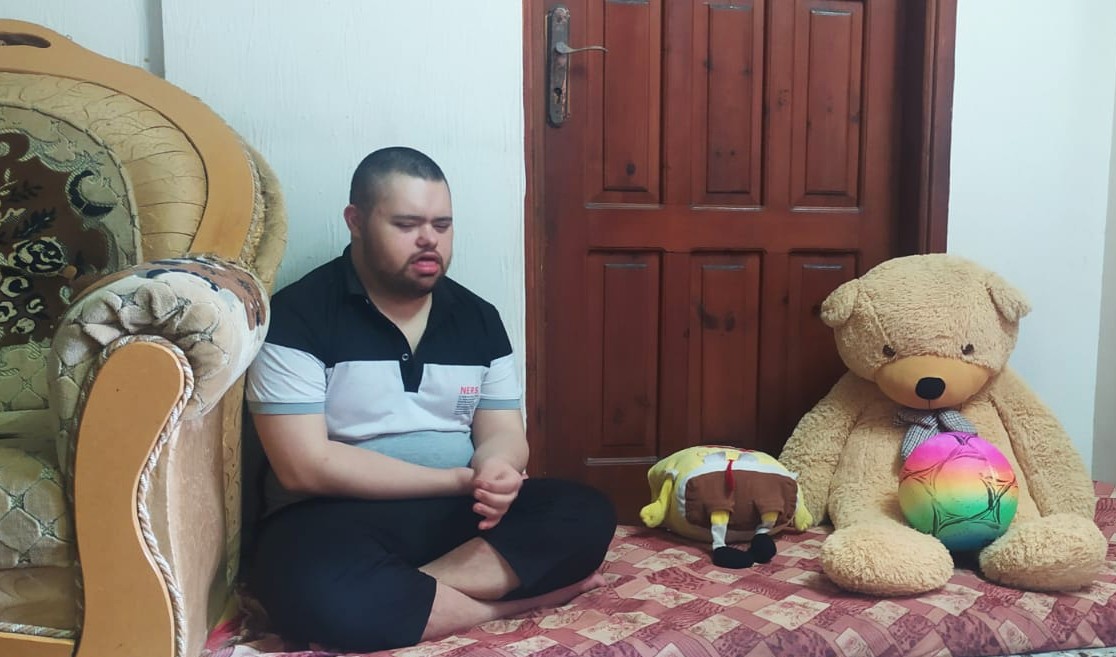
At the beginning of the war, I moved with my mother Nabilah, 71, and my brother Muhammad, 25, who has Down syndrome and autism, to my sister Nur’s house in Deir al-Balah in the central Gaza Strip. From there we move to the house of my brother Jibril, 45, in the a-Samer area in the center of Gaza City, on 25 October 2023. On 2 February 2024, we went back to our home, a five-story building on the main street of a-Shuja’iyah neighborhood, even though it was damaged in a bombing and partially destroyed.

Every time we moved from one place to another, Muhammad suffered especially. We had to walk long distances and it was very difficult for him. Muhammad was barely able to communicate with us. He was always with our mother, who fed him and changed his diapers. We went through some difficult, frightening times, and it’s still going on. Nowhere is safe here. The Israeli shooting and bombing is everywhere and never stops. We’re afraid to go out into the street because we might get shot. We’re not only scared to die, but also that our bodies will stay on the street and rot beyond recognition.
On top of the fear, we don’t have enough food and water. We can’t get hold of anything but tinned food. There’s no fruit and vegetables here, and when a supply of fresh food does somehow reach this area, the prices are sky high.
On 24 June 2024, we were at home with my brother Adam, 39, his wife and their three children, who are between the ages of six months and 13, and my brother Seif a-Din, 38, and his wife and their children, between the ages of five and 14. At 11:00 A.M., a house on our street was bombed and there was shelling. We saw people running on the street with wounded people in their arms. We wanted to get out of the area and tried to leave the house, but the bombing was too heavy. Ten minutes after it started, we saw about 40 military vehicles outside our house and realized we had no way to leave.
We were besieged in our house for ten days. The whole time, we heard live fire and grenades going off outside. Every time, we ran and hid in the bathroom. It was the hardest thing we’ve ever been through. Luckily, we still had water in the containers on the ground. We drank very little, to make it last as long as possible. We rationed the food, too. We couldn’t light a bonfire outside to cook, because we were afraid it would draw the army’s attention, so we had to light a fire and bake pitas in the house. The smoke nearly killed us. We couldn’t breathe.
All that time, we were in touch with Jibril and with another of my brothers, Mikail, who was in southern Gaza City. On 3 July 2024, the tenth day of the attack on our area, around midday, we heard soldiers and realized they were going to come in. I managed to text Jibril telling him that the army was about to enter our house.
We all hid in one room. We were afraid the army would blow up the house or demolish it on top of us. We prepared white flags, hoping the soldiers would understand there were civilians inside. My baby nephew Salah, who was nine months old, was crying. The soldiers heard him and started saying in English, “Baby, baby.”
Before they raided the house, two quadcopters came in. One of them flew into the kitchen and the other was on the roof. We could see them because part of the house was already demolished, including windows, walls and part of the roof. The drones filmed the whole building and then the soldiers sent two dogs in on their own. One of them attacked my brother’s wife and she managed to get away. The other went after each of us, one by one, but didn’t catch anyone. My brother Muhammad was sitting on his couch. It was very hard to get him off that couch. Most of the time he refused to get off, even to eat or sleep.
The dog pounced on Muhammad and bit him in the chest. Muhammad was very frightened and started screaming at the dog: “Get away! Get off me! Get away!” The dog didn’t back off. It grabbed Muhammad’s left arm below the shoulder, as if it wanted to move him. But Muhammad refused to move.
At that point, soldiers came in. Muhammad was already bleeding heavily from his arm. It was a terrible sight and we couldn’t do anything about it. We tried to shout to the soldiers that we were civilians, that they should get the dog away from Muhammad, that Muhammad had a disability, but they paid no attention to us.
At some point, Muhammad was exhausted. He started petting the dog’s head with his other hand and saying: “Let go, sweetie. Let go, sweetie. Enough, enough.” We were shouting, Mom was screaming in pain over Muhammad. It was so hard for her to see him like that, right in front of her eyes. But we couldn’t save him.
More soldiers came up to the second floor where we were. There were already about 40 soldiers there, all with guns. Four of them pointed their guns at Muhammad. Another group of soldiers pointed their guns at us and forced us to get down on our knees. They ordered us to shut up. A third group of soldiers surrounded my brothers Adam and Seif. They threw them on the floor and handcuffed them.
The soldiers counted us and then ordered us to go downstairs. My mother said, “Let me take Muhammad because he’s sick,” but they refused. That was the last time we saw Muhammad. We left him bleeding on the couch.
Muhammad, Seif and Adam stayed upstairs with the army and we went downstairs, the same way the soldiers went up. We were a group of women and children, with a large group of soldiers standing next to us. Mom asked them to keep the dogs away from the little children.
I asked to talk to someone who spoke Arabic, and a soldier came and asked in Arabic, “What is it?” I told him my brother had Down syndrome and autism. I asked him to let me help him and said I had a first aid kit. The soldier asked how old he was and what was wrong with him. He said he’d get him a military doctor and left. I don’t know if a doctor ever came.
At that point, another group of soldiers came in. When I made a slight movement, a soldier hit me on the shoulder with his gun. They held us for two hours on the ground floor. Then the soldiers took my brother Adam downstairs and out into the street, naked and handcuffed. I managed to catch sight of him walking down the street, with them walking behind him. That was the last time we saw Adam.
Then they took us up to the second floor, where my brothers Muhammad and Seif were. We discovered that they’d closed Muhammad in my room and held Seif in another room. We saw Seif. They forced him to kneel on the floor with a black bag over his head. Every time he moved, they beat him.
We sat in the room and the soldiers dragged the sofas and sat on them comfortably. My mother asked about Muhammad and they told her: “Muhammad’s fine.” The soldiers took off their helmets, played songs in Hebrew and talked among themselves. They took my phone, my mother’s and Seif’s.
One soldier told me to unlock the phone and started looking at the pictures. They laughed, ate and drank, sitting in a room with small, hungry children, but they didn’t care. They were smug. We sat there, scared and suffering, for six hours. They broke down walls and went into the kitchen as if it was their own home.
I heard Muhammad say he wanted a drink of water. My mother asked one of the soldiers to let her give Muhammad water, but he refused. I also asked them to let me help Muhammad, but the soldier refused. None of the soldiers went in to give him water.
At 6:00 P.M., two soldiers came out of the room they were holding Muhammad in and made an “it’s over” gesture with their hands. I didn’t understand what happened exactly. The soldiers led us outside. My mother asked them where Muhammad was and asked to see him. One of the soldiers answered with terrifying calm, “Muhammad’s gone. Muhammad’s not here.” Mom told him that Muhammad was here, that we heard his voice just a few moments ago. The soldier said to her: “No, it was someone else.” My mother begged the soldiers to let her see Muhammad, but they refused. On the way down, I tried to peek into the room where Muhammad was, but two soldiers closed the door to the room.
They ordered us: “Raise white flags and go out to the street.” There were a lot of soldiers on the street, with a bulldozer and a tank. We walked about ten meters, and then three tanks and quadcopters that were there fired at us. There was nothing we could do. We saw bodies and suitcases strewn along the street.
We went into the storage room of a bombed building. There was a military bulldozer in front of it. I told my brother’s wife we should get out of there because they might blow up the house with us inside. We went into another house that was also bombed, and hid there in the dark.
Then a plane and a tank discovered us and started shooting at us. We thought our end had come. We prepared to die. We started reciting the Shahadatain. I wrote Jibril’s phone number and address on my arm and on all the little kids’ arms, so they could identify us if they found our bodies. Jibril knew where we were because my sister-in-law had a phone she managed to hide from the soldiers, and she called him and told him we were under siege. She described the place to him and told him they were shooting at us from tanks and quadcopters. Jibril told me to wave a white flag and we tried three times, but they still fired at us. I told Jibril to try and contact the Red Cross. The whole time, we kept reciting the Shahada prayer, because we were sure we were going to die.
We saw a group of people walking with a white flag, so we managed to get out and joined them. There were still three tanks on the street, and the soldiers ordered us to walk on the left side and keep our hands up. We walked through roads full of holes and the smell of death, of rotting corpses. The place was unrecognizable, it was so badly destroyed.
We called Jibril and told him we’d left. He guided us how and where to go until we reached the western part of Gaza, a place called a-Shawa Square. When we got there, I simply collapsed. I couldn’t believe we made it out alive from that ugly place. At that point, we thought Muhammad was still alive. We didn’t know what happened to him since the soldiers forced us to go and leave him behind with them.
We kept walking until we got to Jibril’s house in the center. We stayed with him for two days. Then the army ordered the area evacuated, and we went to the a-Rimal neighborhood. When the army ordered us to evacuate that area, as well, we moved to the a-Saftawi area in the northern part of the city.
On 10 July 2024, we heard the army was withdrawing from a-Shuja’iyah. Two of my cousins risked their lives and managed with great difficulty to reach our house. They found Muhammad’s body in the room where the soldiers held him. The room was full of blood and fluids, and Muhammad’s body was already rotting.
We didn’t expect this level of inhumanity. I don’t know how they killed Muhammad. I don’t know if they did something to him or just left him to bleed to death. The last words I heard him say were asking for a drink of water. I don’t know if they gave him water or left him thirsty.
Our cousins called Jibril and told him Muhammad was killed. They told him there were footprints and bloodstains on the closet, and blood on the walls. Jibril managed to get to our house with great difficulty. He took Muhammad’s body and buried it near the house.
We don’t understand why they did this to Muhammad. They are savages who don’t distinguish between young men, women and children. We’re all targets to them.
I demand justice for my brother. I want our voice to reach the whole world, for the whole world to know Muhammad’s story. I want them to know this army is an army of unscrupulous criminals who have lost their humanity.
That day, before the soldiers arrived, there were moments when Muhammad was happy. He laughing and calling out “baba, baba,” even though our father died in 2002, when Muhammad was only three years old. Dad used to say that Muhammad came to us from heaven and Muhammad loved him very much. But now Muhammad has left us and returned to heaven. May God shower his mercy upon him, and give us strength to endure this tragedy, especially our mother, who never left Muhammad for a moment in 25 years. He was with us day and night and he was very afraid of strangers and noises. We protected him from all harm, and his presence was a constant in our lives.
I can’t understand; what did he do to the soldiers? They treated him horribly, the way they didn’t spare him when he was bleeding and suffering. When we buried him, we saw handcuff marks on his hands.
Muhammad was well-loved by people and everyone treated him with compassion. What else is left to say? I pray for his soul; may it receive the mercy of Allah. And I pray that my brother Adam, and my brother Seif, who was probably also arrested after we left, will be released safely from Israeli prisons.
* Testimony given to B’Tselem field researcher Olfat al-Kurd on 20 July 2024