‘Ali al-Nweiri, 33, is a doctor at Shuhada al-Aqsa Hospital in Deir al-Balah. He lost his wife (also a doctor at the hospital), son, parents, brother, sister-in-law, and nephews in the bombing of his family’s home in Deir al-Balah on 29 October 2023.
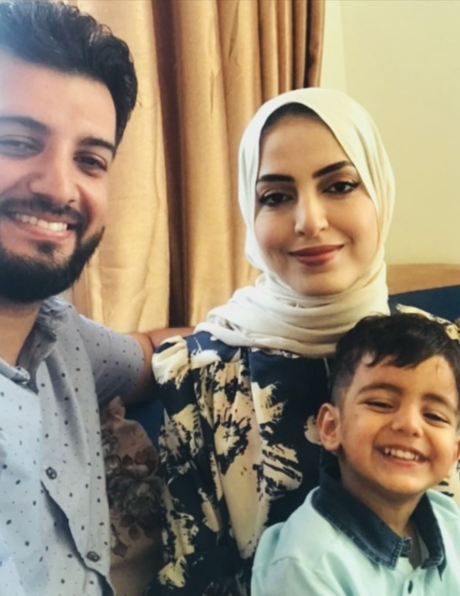
On the morning of 7 October 2023, I was off duty from my job as an orthopedist at Shuhada al-Aqsa Hospital. After hearing explosions and watching the news, I realized something serious was coming. I lived with my wife, Inas al-Haj Yusef, 29, who was five months pregnant at the time, and our three-year-old son, Hassan, in a three-story building with my extended family in Deir al-Balah.
My parents—Hassan al-Nweiri, 59, and Maryam al-Nweiri, 54—and my sister Aya, 23, lived on the first floor. My brother Ahmad, 30, a nurse, his wife Maysoun, 29, a dentist, and their two children, al-Mu’tasem bi-Allah, 5, and Hassan, 4, all lived on the second floor. I have another sister, Alaa, 24, who’s married and lives with her husband’s family.
That day, the hospital went into emergency mode, and I was urgently called in. By the second day of the war, a lot of IDPs and injured people started coming, overwhelming the hospital’s capacity. Most of the injuries involved fractures and limb amputations.
I alternated my shifts at the hospital, working every other day so I could also spend time with my family. Sometimes, because of the workload, I had to stay at the hospital for several days straight. My wife stopped working at the hospital because of the situation there, her pregnancy, and also because we didn’t want Hassan to be left alone.
On 28 October 2023, communication networks were cut off in the Gaza Strip. I was at home, waiting for the hospital bus driver to pick me up. I waited on the street for over an hour, and then we went to the hospital. It was a chaotic day. I treated about 150 people and performed 10 surgeries. I worked until 4:00 A.M. and then slept for two hours in the staff room.
When I woke up, my phone rang. I was relieved that communication had been restored. At 8:00 A.M., I called my wife to ask how everyone was doing. I told her I would be home soon and asked if they needed anything. I bought some groceries and went home. I arrived at 10:00 A.M. and saw that my wife had already made breakfast. We ate together, and I told her about one of the doctors who’d been killed that day. She took the news very hard and started to cry.
After breakfast, I did the midday prayer and went to rest a little around noon. When I woke up, I found myself buried in a pile of debris and rubble. Right before that, while I was asleep, I dreamt that I was walking and a missile fell on me. In the dream, my father, my wife, my son, my sister, and a mass of people were walking ahead of me. The sky wasn’t like the sky we know. Two people dressed in white stopped me and said, “You’re not going with them.” I stopped, and my wife and son kept walking. A few meters ahead of me, they turned and waved goodbye.
Then I woke up and found myself in the rubble. I couldn’t breathe or move. I heard neighbors calling out, “Is anyone here? Is anyone alive?” I started shouting, telling them my back hurt and not to lift me. But neighbors and relatives picked me up and placed me near the building. It was only then that I realize our house had been bombed and completely destroyed. There was smoke rising from it. It was early afternoon, but I thought it was nighttime because of the black smoke that engulfed everything.
I asked about my son, my wife, and my family, but no one answered. I kept asking as they put me in an ambulance that took me to al-Awda Hospital in Nuseirat R.C. A doctor there, a colleague of mine, examined me. I asked him about my family, but he just responded, “What about you? How are you? They’re fine, don’t worry.” As he checked me, I told him my back hurt badly, I could barely feel my legs and I couldn’t move from the navel down.
I was transferred to Shuhada al-Aqsa Hospital. On the way, in the ambulance, I lost consciousness. When I got to the hospital, I asked again about my family, and everyone kept telling me they were fine. They did CT and MRI scans and found a fracture in my first lumbar vertebra [lower back] and there was severe pressure on my spinal cord, which meant I had to have surgery immediately. The doctors told me I wouldn’t be able to stand again due to the severity of the injury and that the hospital didn’t have the necessary equipment for the procedure.
They called a-Shifaa Hospital in Gaza City, but they said they couldn’t admit me because they had too many wounded. They apologized and said they were swamped. They tried the European Hospital east of Khan Younis, and they said they could admit me. I was put in an ambulance, and the whole way I asked the attendant about my family. He just said, “I don’t know,” or “Maybe they were hurt.” I prayed they were safe and sound.
At the European Hospital, they examined me and then did emergency surgery that lasted two or three hours. They set the broken bones and vertebrae and relieved the pressure on my spinal cord.
I woke up only the next day and found my cousin at my bedside. Every time I asked him about my family, he avoided answering. Finally, after I listed each of their names, he admitted they’d all been killed: my mother, father, my brother Ahmad and his family, my wife, and my son. Only my sister, Aya, survived, though she sustained second- and third-degree burns on over half her body. I was in shock and broke down crying.
I didn’t even get the chance to say goodbye to my family. They told me my brother Ahmad’s body was dismembered, my father’s body was found outside the building, and my wife was found wearing her prayer clothes.
I stayed at the European Hospital for a month-and-a-half, doing physiotherapy. My sister, Aya, was also hospitalized there, and my aunt Hiyam, 52, and my other sister Alaa cared for her. My wounds got infected and I had complications. I was told I’d need to get treatment outside the Gaza Strip.
I was given a referral for treatment in Turkey and waited 43 days for a travel permit. The permit came on 10 December 2023, and the very next day, I left with my aunt, Hiyam. We spent one night in the city of al-‘Arish before traveling directly to the airport and then on to Turkey. We flew on a military plane full of wounded people and their caretakers.
We arrived at Bilkent City Hospital in Ankara. My condition was assessed, and I was transferred to another hospital for rehab and physiotherapy. I was treated there for about three months. I left the hospital on crutches and a brace on my left leg. My right leg has improved significantly, and I can walk almost normally on it, but I cannot move my left leg below the knee.
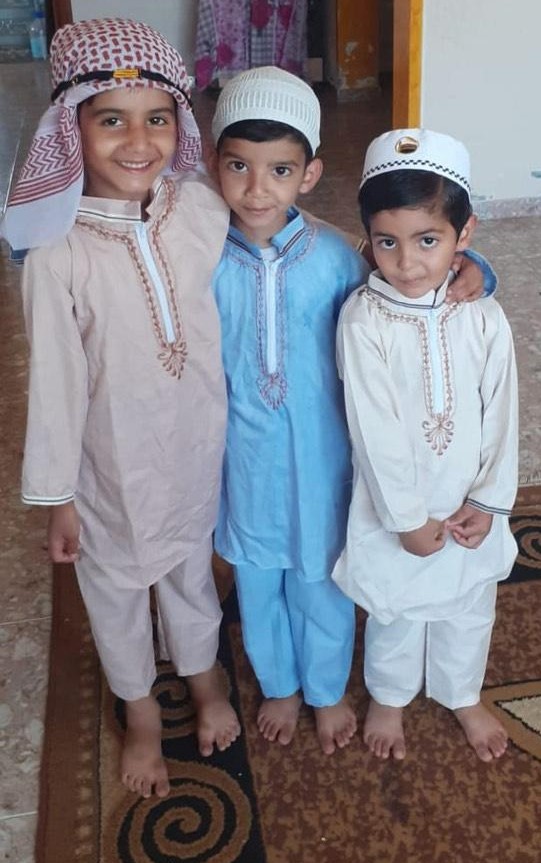
I’m now staying at a hotel with most of the other injured patients and caretakers from Gaza. Two weeks ago, my physiotherapy sessions stopped, and the doctors told me that my left leg would remain as is. Regardless, I still hope for some improvement and to be able to walk on it again, though I don’t have much faith it’ll happen.
I don’t move around much and spend most of my time at the hotel. Now I’m looking for work in my field as an orthopedist here and trying to adapt to my new situation. I really want to go back to working as an orthopedist.
Sometimes, I sink into depression. I’ve lost everything—my parents, my wife and son, my brother, and his family. I’ve also lost my job. My life has been destroyed. I had a happy and beautiful life with my wife. I can’t get used to living without her.
When my wife got pregnant, I hoped for a baby girl. After her death, I was told that doctors tried to save the fetus. It really was a girl, but she survived for only an hour after being delivered.
Israel has taken away every beautiful thing I had in life. It’s robbed me of the people dearest to me. We were just an ordinary family. My father was an elderly man who worked as a teacher. My mother was a homemaker. We were all civilians. None of us were armed or affiliated with resistance groups. Israel murdered us in cold blood. No one from the military called or warned us to evacuate. They didn’t even fire a warning missile. What was our crime? I have lost my entire family except for my two sisters, Aya and Alaa. It all hurts so much. My brother Ahmad was very close to me, and I lost him along with his entire family. None of them survived.
At the beginning of March, my sister Aya also went to Egypt for treatment, accompanied by my sister Alaa and her young son. Aya is doing well and undergoing plastic surgery there.
What else is there to say? I can only pray that God gives me the strength to bear this immense loss and that my sister Aya recovers fully.
* This testimony was given to B’Tselem field researcher Olfat al-Kurd on 21 September 2024
The members of the al-Nweiri family killed:
- ‘Ali’s wife, Inas al-Haj Yusef, 29, an E.R. doctor at Shuhada al-Aqsa Hospital. She was five-months pregnant.
- ‘Ali and Inas’ son, Hassan al-Nweiri, 3
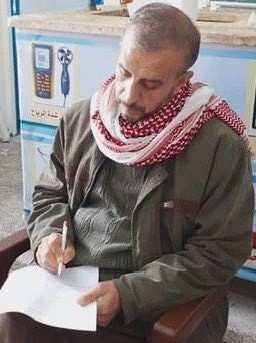
- ‘Ali’s father, Hassan al-Nweiri, 59
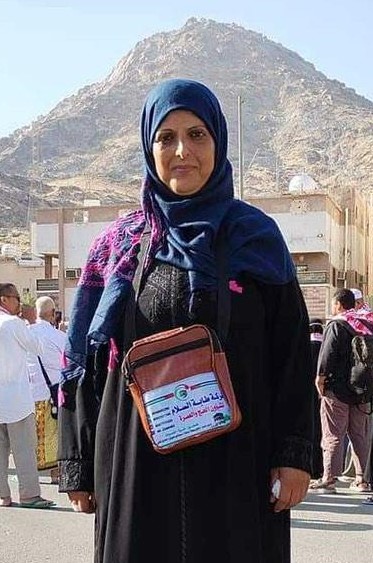
- ‘Ali’s mother, Maryam al-Nweiri, 54
- ‘Ali’s brother, Ahmad Hassan al-Nweiri, 30, a nurse
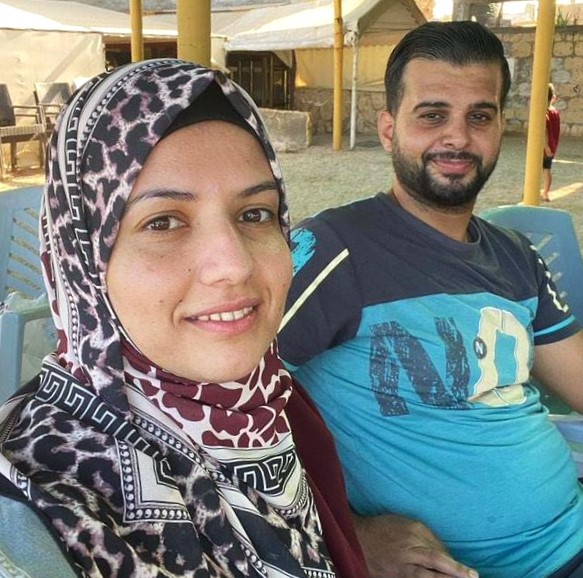
- Ahmad’s wife, Maysoun Muhamad, 29, a dentist
- ‘Ahmad and Maysoun’s son, al-Mu’tasem bi-Allah, 5
- ‘Ahmad and Maysoun’s son, Hassan, 4