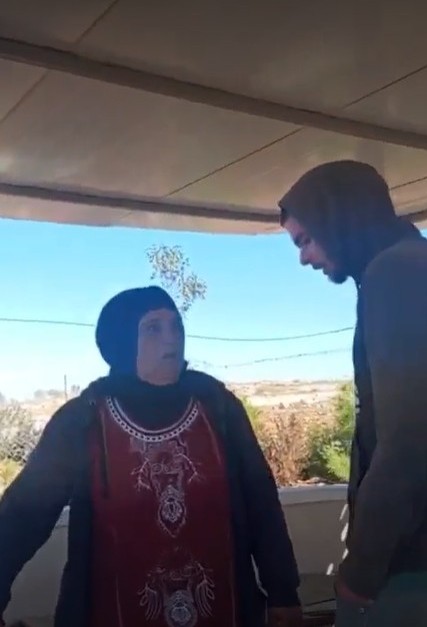
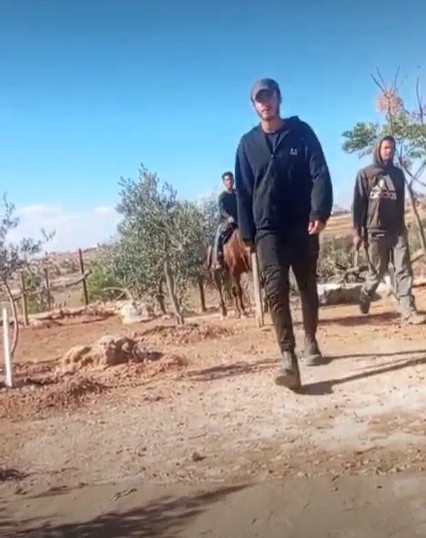
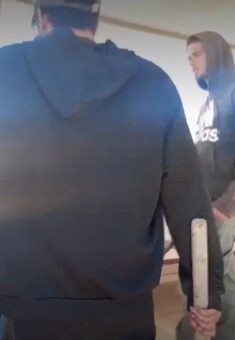
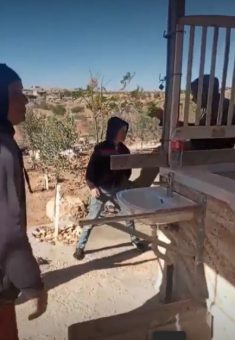
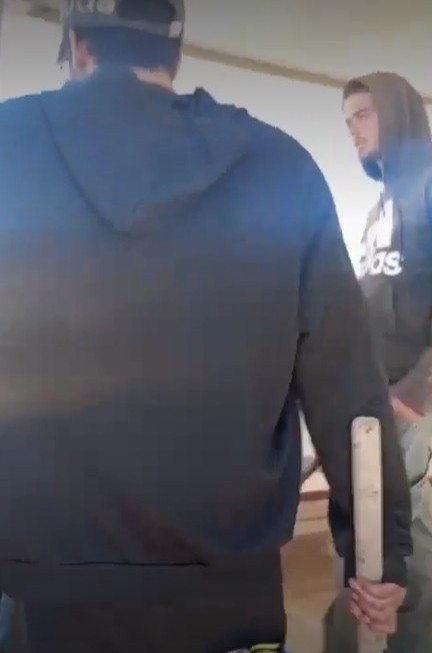
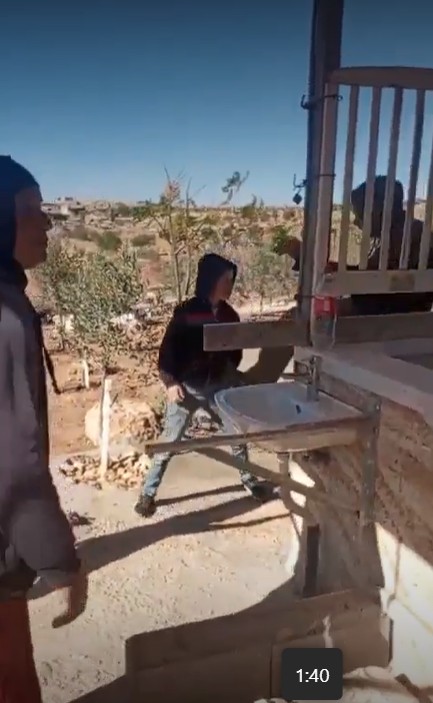
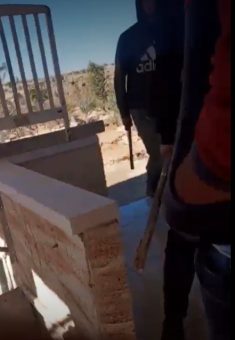
One of the settlers threatening Wadha ‘Obeid. Still from video footage, courtesy of the family
On Wednesday, 26 November 2025, at around 10:00 A.M., Wadha ‘Obeid, a 65-year-old farmer from the Yatta area, went with her son and his family to their farmland in the Khallet al-Humos area, southeast of the town of Yatta in the South Hebron Hills.
The settlers entering the plot. Still from video footage, courtesy of the family
At around 10:30 A.M., the family saw two settlers grazing a herd of cattle near them. Then, one of the settlers came closer to their land, started throwing stones at them and demanded they leave.
The family ignored him and carried on with their farming, but before long, another settler arrived, riding a horse and armed with a club studded with nails.
The settler on horseback cut the fence surrounding the family’s land and began chasing the family members on his horse.
They ran away to a lower spot the horse could not reach, and the settlers left. However, about 15 minutes later, the same settler returned with three others, who were also armed with clubs.
The settlers beat the family members with their clubs, kicked them and stole one family member’s cell phone.
The settlers let up after about 15 minutes and fled the scene, and the family called an ambulance, which evacuated them to El Shaheed Abou El Hassan El Qassem Hospital in Yatta. They were discharged that evening.
B’Tselem field researcher Manal a-Ja’bari collected testimonies from the two women who were assaulted on 30 November 2023.
Wadha ‘Obeid, 65, a mother of seven from Yatta, related:
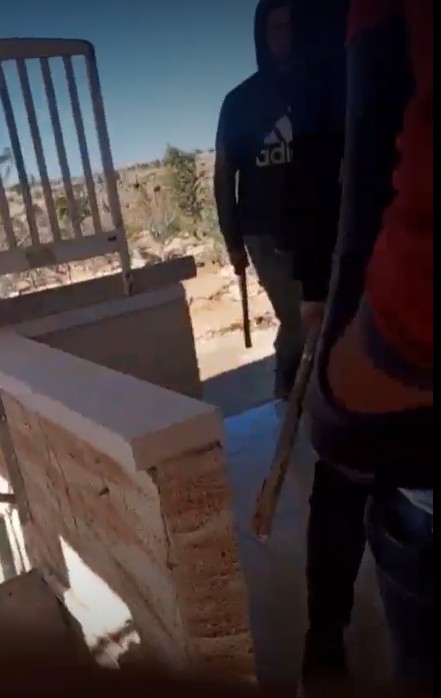
Settlers with clubs in the agricultural structure. Still from video footage, courtesy of the family
I live with my husband, ‘Abdallah, 60, in the Jorat al-Jamal area, and I am a homemaker. My husband has a six-dunam plot of land (1 dunam = 0.1 hectares), with grapevines and fig and olive trees.
Since October 2023, we’ve been suffering from repeated settler attacks and vandalism on our land, trees being damaged, livestock grazing in the vineyard and groves and fences being destroyed. The settlers also destroyed part of our agricultural structure there and stole what was inside it, furniture and kitchenware.
On Wednesday, 26 November 2025, at around 10:00 A.M., I went to the land with my nephew ‘Abdallah ‘Obeid, 33, Warud, my son Muhammad’s wife (he didn’t come with us), their son ‘Abdallah, 13, and my stepson Mahmoud, 10, and we set to work fertilizing the trees. At around 10:30 A.M., we saw two settlers grazing a herd of cattle and sheep in the adjacent area. One of them came up to the fence surrounding our land and started throwing stones at us. We ignored him, and he started calling out to ‘Abdallah ‘Obeid and demanding that he leave. We kept working.
A little while later, another settler arrived, in his twenties, riding a horse and holding a stick with sharp thorns on its head that looked like nails. He got off the horse behind the fence and came closer to us, waving the stick and shouting at us to leave. We told him that the land belongs to us and that we would not leave it.
A settler kicking ‘Abdallah, 13. Still from video footage, courtesy of the family
The settler went over to the fence, cut it with pliers he had in his pocket, got back on the horse and went back to chasing us. We were afraid he would attack us with the horse, so we had to run from place to place to avoid getting hit by the horse’s hooves. We ran, went down to a lower plot and inside an agricultural structure. After about 15 minutes, the settler came back on the horse with three other settlers, young like him, who were also armed with clubs, and they all started shouting at us and threatening to hurt us if we didn’t leave.
One of the settlers attacked Warud, who was trying to film what they were doing on her cell phone, and another settler attacked me. He hit me on the head with a club, then hit me again on the right side of my body. Another settler tried to snatch the phone from Warud’s hands. I felt dizzy and lost my balance. I nearly fell, and then ‘Abdallah ‘Obeid held on to me. Meanwhile, the settlers continued to attack Warud and her son ‘Abdallah. Mahmoud, who is 10, ran away from the area when the assault began.
I saw one of the settlers kick Warud hard in the back, and another settler hit ‘Abdallah, 13, with a club in the stomach and knocked him to the ground. ‘Abdallah ‘Obeid tried to shield us with his body and was beaten all over. After about 15 minutes of violence, one of the settlers stole the phone from my pocket, and they all ran away to the other side of the fence.
I felt dizzy and half-fainted. ‘Abdallah ‘Obeid was writhing in pain, and Warud and her son were also in pain and had bruises. I asked Warud to call her father so he would get us a Palestinian ambulance. The crew arrived after the settlers fled and took us to El Shaheed Abou El Hassan El Qassem Hospital in Yatta. They ran tests and X-rays. We all had injuries and bruises, me, Warud, her son ‘Abdallah and ‘Abdallah ‘Obeid. They gave us painkillers and antibiotics, and we were discharged at around 11:00 P.M.
Later on, we all went to the Israeli police station in the city of Hebron, where we filed an official complaint and gave the investigator the footage that Warud managed to film during the incident.
My head still hurts, and so does the right side of my body.
Warud ‘Obeid, 33, a mother of six, related:
Settlers with clubs in the agricultural structure. Still from video footage, courtesy of the family
On Wednesday, 26 November 2025, at around 10:00 A.M., I reached our field with my mother-in-law Wadha, 65, her nephew ‘Abdallah ‘Obeid, 33, her stepson Mahmoud, 10, and my son, ‘Abdallah, 13. We set about fertilizing the trees, but after about 30 minutes, at around 10:30 A.M., two settlers in their twenties arrived in the area next to our field, leading a herd of cattle and sheep.
One of the settlers started shouting at us from the other side of the fence and ordered us to leave. We ignored him and went on working, and then he picked up a stone and threw it at ‘Abdallah ‘Obeid, who ignored him. We saw the settler making a phone call on his cell phone.
A short time later, another settler arrived, also in his twenties, riding a horse and holding a stick with sharp thorns at its head. He got off the horse, left it behind the fence, came over to us and spoke in Hebrew. I pulled out my phone and started filming what was happening and also called my father and asked him to call the Israeli police.
The settler attacked us, pushed us and tried to snatch the phone from me. He kicked 10-year-old Mahmoud in the stomach, but didn’t manage to take the device. He went back to the fence, took out pliers, cut it and then brought the horse into our land, mounted it and began chasing us, trying to run us over.
We fled from place to place so he would not hurt us, until we went down to a lower point that the horse couldn’t reach. The settler went back to the other side of the fence, and ‘Abdallah ‘Obeid reconnected the fence with metal wire and closed it. We all went into our agricultural structure.
After about 15 minutes, three settlers armed with sticks arrived in the area, including the settler who had attacked us before. They cut the fence again, came over and started shouting and demanding that we leave. We refused to leave, and then one of the settlers hit my mother-in-law on the head with a stick. She screamed in pain, lost her balance and started swaying. I tried to film the assault, but another settler tried to steal the phone from me and kicked me hard in the back when I resisted. Another settler hit my son, ‘Abdallah, twice in the stomach and the right side of his waist.
‘Abdallah ‘Obeid tried to shield us with his body, me, my son ‘Abdallah and my mother-in-law, and Mahmoud, who is 10, managed to run away.
The assault went on for about 20 more minutes. ‘Abdallah ‘Obeid took a bad beating. In the end, one of the settlers stole my mother-in-law’s phone from her pocket, and then they fled. The sheep and cattle herders stayed on nearby land and continued grazing there.
‘Abdallah ‘Obeid was badly bruised and couldn’t stand. My mother-in-law suffered from severe pain and dizziness; I had back pain, and my son, Abdallah’s stomach and the side of his body hurt.
I called my father again, and he called for a Palestinian ambulance. The ambulance arrived at 1:00 P.M. and took us to the government hospital in Yatta, where they did X-rays and CT scans. We all had injuries and bruises. We were given antibiotics and painkillers and discharged at around 11:00 P.M.
My father told me he called the Israeli police several times and reported the assault, but no one came to help us, no police officers and no soldiers.
‘Abdallah ‘Obeid went from the hospital to the Jabarah police station in Hebron and filed a complaint. When he got back home, the Israeli police called him and asked that my mother-in-law, my son ‘Abdallah and I also come in to give a statement.
On Friday, we all went to the Jabarah police station, where an investigator who spoke broken Arabic questioned us. He took our statements, and we gave him a copy of the footage I filmed during the assault.
My mother-in-law’s pelvis and head are bruised, and she’s still suffering from severe pain.
Israel’s regime of apartheid and occupation is inextricably bound up in human rights violations. B’Tselem strives to end this regime, as that is the only way forward to a future in which human rights, democracy, liberty and equality are ensured to all people, both Palestinian and Israeli, living between the Jordan River and the Mediterranean Sea.
Since the Hamas attack on 7 October 2023, Israel has acted in a coordinated and deliberate manner to destroy Palestinian society in the Gaza Strip, committing genocide against its residents. In light of Israel’s actions in Gaza, the public statements made by Israeli decision-makers, and the international community’s failure to take effective action, there is a serious risk that the Israeli regime will expand the genocide to other areas under its control—first and foremost, the West Bank.
B’Tselem calls on the Israeli public and the international community to use every tool available under international law to bring an immediate end to Israel’s genocide against the Palestinian people.