Tell, Nablus District: Israeli settlers attacked a Palestinian family during the olive harvest in Area B and threw stones at a woman. A settlement security guard fired live rounds at family members, humiliated a married couple and assaulted the wife
Tell, Nablus District: Israeli settlers attacked a Palestinian family during the olive harvest in Area B and threw stones at a woman. A settlement security guard fired live rounds at family members, humiliated a married couple and assaulted the wife
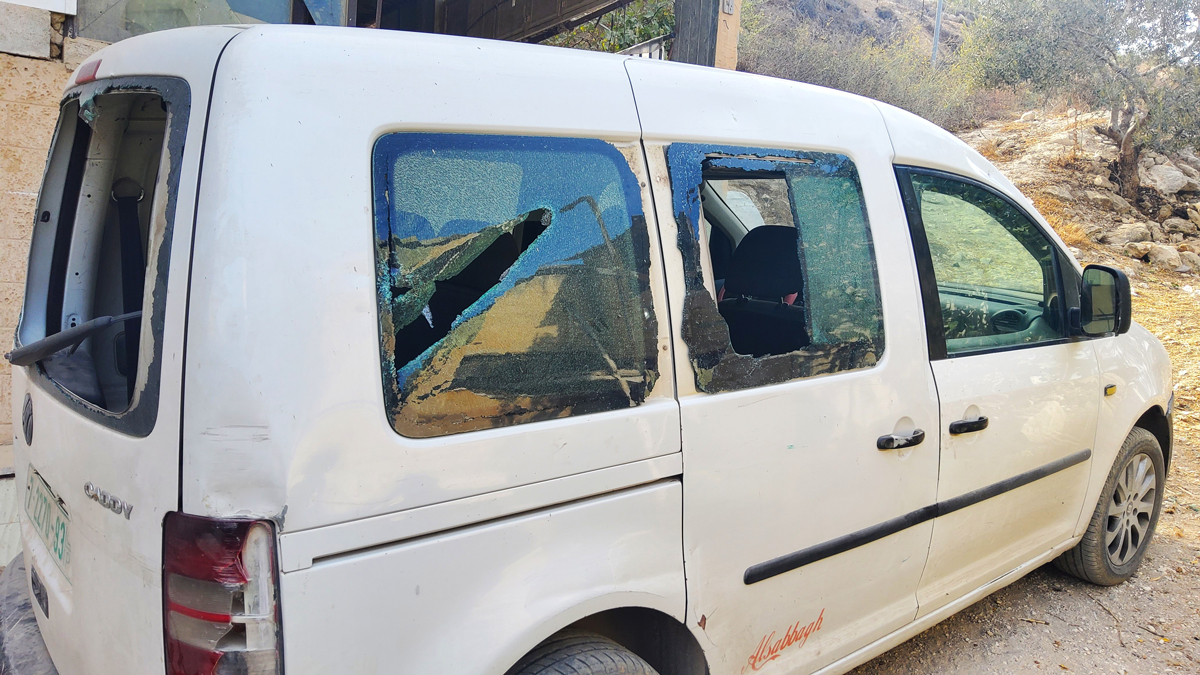
Ahmad Abu Hamadah’s car after the assault. Photo: Salma a-Deb'i, B’Tselem
On Saturday, 1 November 2025, at around 7:30 A.M., seven farmers from an extended family in the town of Tell went to harvest olives in their grove, which lies south of the town in an area defined in the Oslo Accords as Area B.
At around 4:00 P.M., eight settlers arrived and began throwing stones at the farmers.
Three of the farmers managed to flee towards the village, and the other four ran towards a nearby quarry and hid there.
About half an hour later, a family member informed them by phone that the settlers had left the area. The farmers came out of their hiding place, but then a vehicle arrived, and the Yitzhar settlement’s security guard, known to local residents as “Yaakov,” got out and began firing live rounds.
The farmers scattered in different directions. Immediately afterward, Yaakov, who was accompanied by another vehicle with five soldiers, shouted at two of the farmers, Ahmad Abu Hamadah, 51, and his wife Akhlam Ramadan, 41, ordering them to stop and motioning to them with his finger to sit on the ground.
The two obeyed and crouched on the ground, and Yaakov then kicked Akhlam hard in the back, grabbed her head, threw her to the ground and pressed her head against it.
Shortly afterward, F., Akhlam’s sister, arrived.
Yaakov and the soldiers ordered them to get up and marched the three of them for about 200 meters to a spot where about 20 soldiers and about 10 more settlers were standing.
One of the settlers questioned the farmers about what they were doing there.
Meanwhile, the eight settlers who had started the assault found another family member who had been hiding nearby, Rula Ramadan, 36, and began throwing stones at her from a higher plot of land. Rula fell to the ground and, as she lay there stunned, unable to make a sound, she heard the settlers saying she was dead.
The settlers left, and Rula remained lying where she was, for fear they would come back and attack her again. After about ten minutes, Rula mustered the courage to get up and join her relatives where the settlers and soldiers were holding them. After she arrived, the soldiers allowed the family members to give her water and then let them go.
When they returned to their car, they discovered that settlers had vandalized it and smashed its windows. The farmers drove to Rafidya Hospital, where they were treated and discharged later that night.
B’Tselem field researcher Salma a-Deb’i collected testimonies from some of the farmers:
Rula Ramadan, 36, mother of four:
On Saturday, 1 November 2025, at around 7:30 A.M., I went with six other relatives to a plot of land we inherited from my late father. It’s located on the southern side of the town and is called Safhat a-Sirah. The plot covers 7 dunams (1 dunam = 0.1 hectares) and has about 120 fruitful olive trees. This area is defined in the Oslo Accords as Area B, and we usually work there without any problems.
At around 4:00 P.M., my husband started moving the olives that had been picked so we could finish up and go home. We had only one tree left to harvest. I saw my son K. running toward us and shouting, “Settlers! Settlers!” I asked him if he was joking, and he said, “No, Mom, the settlers are here! Run quickly!” At that moment, stones started falling on us. There were about eight settlers there. I ran until I reached a quarry about 200 meters away, together with my two sisters and my brother-in-law Ahmad to take cover until they left.
Half an hour later, I called my sister F.’s husband to find out if we could leave, and he thought the settlers had gone. My sisters and I went back. On the way, I saw a white pickup truck. I thought it belonged to town residents or was a DCO vehicle, but it turned out to be a settler’s car. I saw about eight or ten soldiers approaching on foot. I thought they’d come to rescue us. About 100 meters away from us, I saw another group of settlers and was very frightened.
We ran over rocky terrain and up a hill. It is a hilly agricultural area. I heard about 10 to 15 shots. I couldn’t run anymore, and my sisters were screaming at me to keep going. I told them to go on, that I’d catch up. I saw the settlers getting closer, and I was shaking with fear. I sat down behind a tree. They passed close by, and I held my breath until they disappeared. I stayed there for about half an hour. It became quiet, and then I heard the sound of their vehicle and assumed they had left. I got up and started walking toward the place where I hoped to find the rest of my family. I had barely gone 20 meters when eight settlers suddenly appeared in a plot of land higher up, above me. They were wearing civilian clothes, and their faces were covered. They started throwing stones at me, and I screamed and begged them for mercy. I pleaded with them to stop. The stones hit me all over my body, but they didn’t say a word. They kept throwing stones at me until I fell to the ground. I couldn’t move, and I lost my voice. I heard one of them say, “Dead, dead,” and then they left.
I lay there for ten minutes. My vision was a bit blurred, and my mouth was dry. Eventually, I managed to pull myself together. I got up with difficulty and tried to go back to look for the rest of my family. I moved forward 50 to 60 meters, half crawling, and then I saw a group of soldiers, several vehicles and some more people. I straightened up and waved my arms and called out my husband’s name. Then I heard someone say, “Hey, woman! Hey, woman!” I sat down. I couldn’t stand anymore. I felt like I was about to faint. I closed my eyes, and then I heard someone say, “Get up!” I opened my eyes and saw five or six soldiers around me. I got even more scared. The soldier told me to get up, but I said I couldn’t. The whole left side of my body felt paralyzed.
I lay my head on the rocks and closed my eyes, and then I heard someone say, “Rula, get up!” It was my sister Akhlam’s husband, Ahmad Abu Hamadah. He told me to get up, and I said I couldn’t. He said, “Please, summon your strength and get up.” He gave me some water, and I drank a little. He asked me to get up so we could leave. I stood up.
I barely made it to Ahmad’s car. All its windows were broken, and the seats were covered in glass. My sisters were in the car. I told them I was exhausted and needed an ambulance. They told me that the settlers had hit Akhlam in the back and that my sister F. had been hit in the back by a stone. We drove to the hospital in Nablus, and on the way, came across an ambulance and transferred to it. They wanted to admit me to the hospital, but I discharged myself because my children were worried and I wanted to go home as quickly as possible.
Ahmad Abu Hamadah, 51, father of six
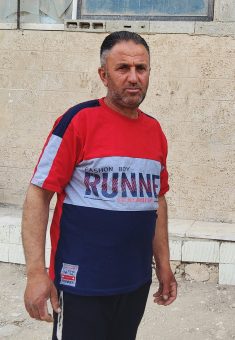
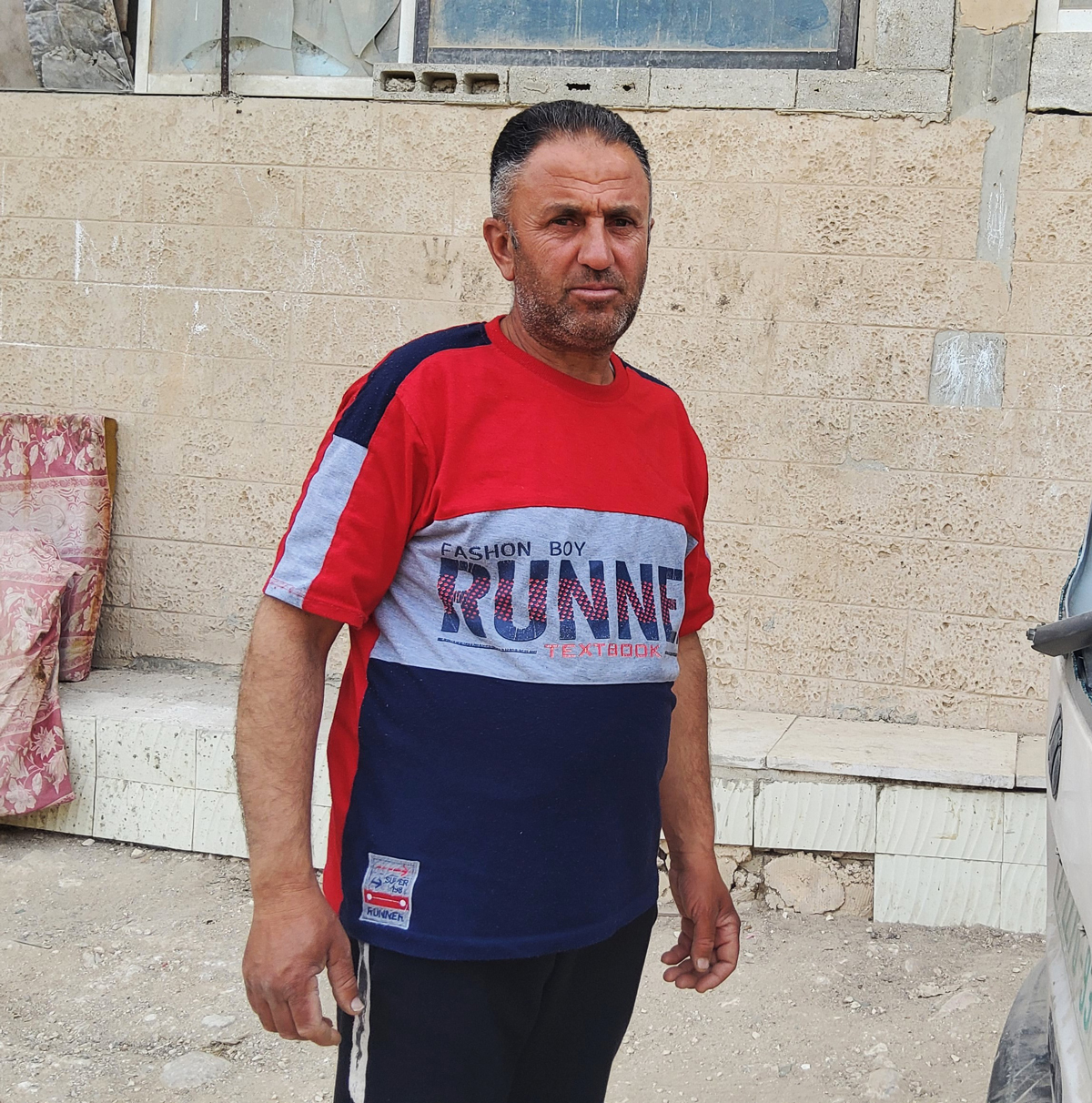
Ahmad Abu Hamadah after the assault. Photo: Salma a-Deb'i, B’Tselem
On Saturday, 1 November 2025, at around 7:30 A.M., we arrived at a plot of land on the southern edge of the town to harvest olives.
At 4:00 P.M., I was on the land with my wife, Akhlam Ramadan, 41, her sisters and their husbands. Since I got engaged to Akhlam in 2001, I have gone with her and her family to this land every year to harvest olives. It was a fun day for the families and the children, and we all went, young and old. This area is defined as Area B, and we’ve never had to coordinate our arrival there and have never been harassed there by settlers, young or old. There are no nearby settlements.
We worked calmly and were almost finished. We had one tree left to harvest. We loaded the olives that had been picked onto my car, which was parked at the edge of the plot, which covers seven dunams. Then Khalil suddenly arrived from a distance, shouting, “Run! There are settlers here!” We didn’t believe him at first. We thought he was joking. But very quickly, stones they threw started falling on us. I saw about eight settlers dressed in black throwing stones at us. I didn’t notice whether they were armed or not. We all ran. It’s hilly terrain, and we had to flee in the opposite direction from where the car was. We found shelter in a quarry in the area and stayed there until we were apprised that the settlers had left the area.
We had barely managed to walk a few meters when I saw a white car approaching. I thought it was an Israeli DCO vehicle and that they’d come to help us, but we were surprised to discover it was the car of the Yitzhar settlement’s security guard, whose name is “Yaakov.” He fired at us. We ran among rocks and thorns. I felt the bullets whizzing past my head. I heard about 10 to 15 shots. F. walked ahead and Rula was behind us. She kept saying, “I can’t walk anymore. I need to rest a bit.”
I saw Yaakov with about five or six soldiers, who looked to me like settlers in uniform. Yaakov started shouting at us. From his gestures, I understood that he wanted us to sit on the ground, so my wife, Akhlam, and I sat down. Yaakov was still shouting in Hebrew and motioning with his hand, and I understood that he wanted us to lie face down on the ground. As I was about to explain this to my wife, he suddenly took a step back and then kicked her in the back with his heavy boot. Akhlam screamed in pain, and he grabbed her head and violently threw her to the ground. At that moment, I also lay down on my stomach with my face to the ground. I thought he or the soldiers were going to kill us. I quietly told my wife to recite the Shahada, but Yaakov shouted at me in Hebrew and ordered me to be quiet. He didn’t let us say a word. He and the soldiers surrounded us. The soldiers didn’t do anything to us and didn’t speak to us, only Yaakov assaulted us.
About five minutes after Yaakov caught us, my wife’s sister, F., arrived crawling on the ground. She lay down next to Akhlam. Yaakov didn’t speak to her, and later, I understood from her that the settlers who had attacked us earlier were still around, and she was afraid they would catch her alone. Yaakov asked me if there was anyone else from our family there, and I told him there was another woman, meaning Rula. He said there wasn’t, and I insisted that there was another woman down below. About half an hour went by with us on the ground, unable to move, not knowing what would happen to us. Then Yaakov ordered us to get up and told us in Hebrew to follow him, with the soldiers walking behind us. I held Akhlam’s hand and she held her sister’s hand. We were very tired and had difficulty walking. Whenever F. or Akhlam stopped, the soldiers shouted at us in Hebrew to keep going.
We walked about 200 meters until we reached two jeeps and about 20 soldiers, this time “real” soldiers, not the ones who were with Yaakov. Nearby, there were also about 10 settlers standing, all dressed in white. One of the soldiers asked, “Who speaks Arabic?” Then a settler dressed in white and armed with a handgun got up and said to me, “I want to ask you a question. Answer only what I ask.” He demanded to know my name, why we were there, and who was with me. I told him this was my wife and her sister and that we were harvesting olives on our land. My phone rang, so he took it from me and asked who was calling me. I told him it was the tractor driver who was supposed to come and take the olives. He asked if he was coming, and I said no, because it was already late and dark. At that moment, I saw my wife’s sister, Rula. The soldiers went over to her, and a settler said to me, “You told me no one else was here.” I replied: “I told Yaakov several times there was another woman with us.”
One of the soldiers called me and asked me to bring a bottle of water. I took a bottle from my car, whose windows the settlers had smashed earlier. I went over to Rula and gave her the water. She was very tired and found it hard to stand up. I begged her to get up. She got up, walking with great difficulty and falling onto thorns. I held her and supported her until we reached my car.
We drove toward Nablus. On the way, we came across an ambulance, and they treated my wife, Rula and F. My wife complained of back pain, and Rula had apparently been badly hit all over her body. We got back at night.
Israel’s regime of apartheid and occupation is inextricably bound up in human rights violations. B’Tselem strives to end this regime, as that is the only way forward to a future in which human rights, democracy, liberty and equality are ensured to all people, both Palestinian and Israeli, living between the Jordan River and the Mediterranean Sea.
Since the Hamas attack on 7 October 2023, Israel has acted in a coordinated and deliberate manner to destroy Palestinian society in the Gaza Strip, committing genocide against its residents. In light of Israel’s actions in Gaza, the public statements made by Israeli decision-makers, and the international community’s failure to take effective action, there is a serious risk that the Israeli regime will expand the genocide to other areas under its control—first and foremost, the West Bank.
B’Tselem calls on the Israeli public and the international community to use every tool available under international law to bring an immediate end to Israel’s genocide against the Palestinian people.