On Sunday, 19 October 2025, at around 8:00 A.M., farmers from the villages of Turmusaya and al-Mughayir, accompanied by solidarity activists, arrived to harvest olives on their land in the Wadi 'Ammar (a-Dalajeh) area.
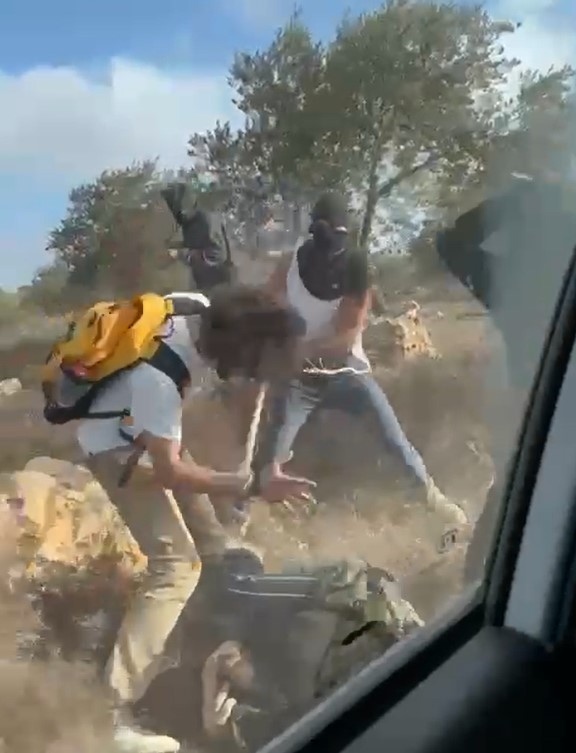
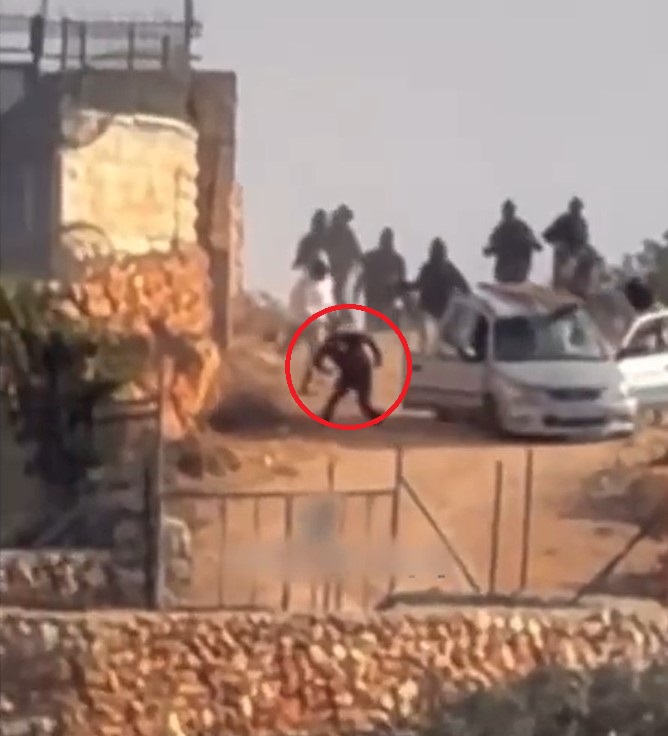
Settlers beating activists. Still from video footage of the incident, courtesy of local residents
About half an hour later, about 10 masked settlers armed with clubs arrived. The settlers began vandalizing a car belonging to A.A., one of the farmers, using clubs and stones.
Several farmers came to his aid and tried to drive away the settlers by throwing stones, and shortly afterwards, soldiers arrived. They fired tear gas at the farmers and drove them away from the area, detaining three of them, including A.A.
The soldiers let the three go after about 40 minutes and drove off towards the Turmusaya plain. A.A. got into his car, which had been vandalized by the settlers, and started driving back towards the other farmers, who were about 200 meters to the south. The moment he started driving, about 50 masked settlers appeared behind him and began throwing stones at the car.
The two other farmers who were near the car fled on foot. A.A. had difficulty escaping in his car, whose tires had been vandalized, and was forced to jump out while it was moving and flee on foot to the nearby village of Khirbet Abu Falah, with dozens of settlers chasing after him.
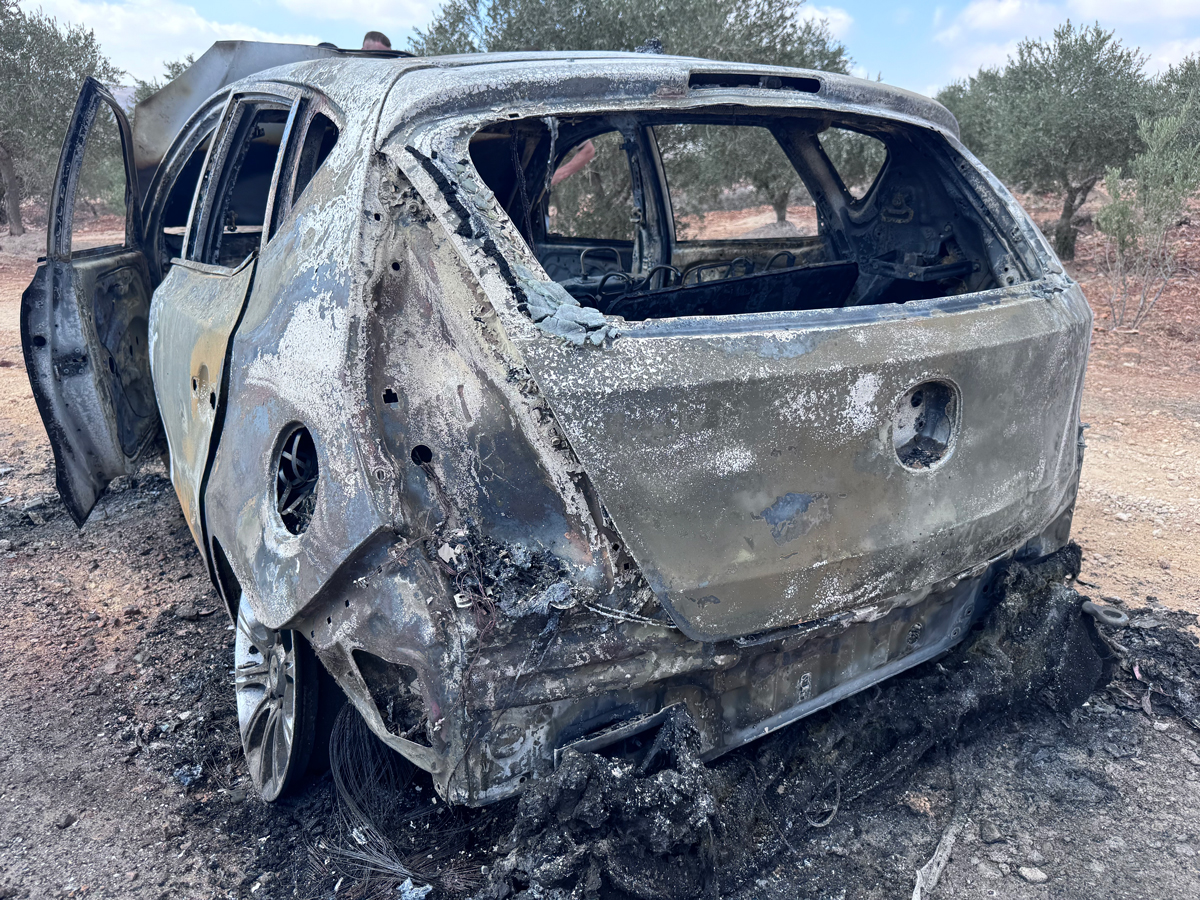
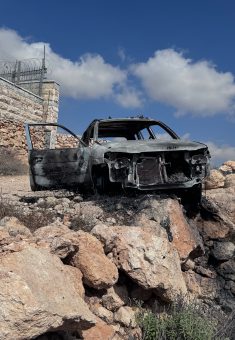
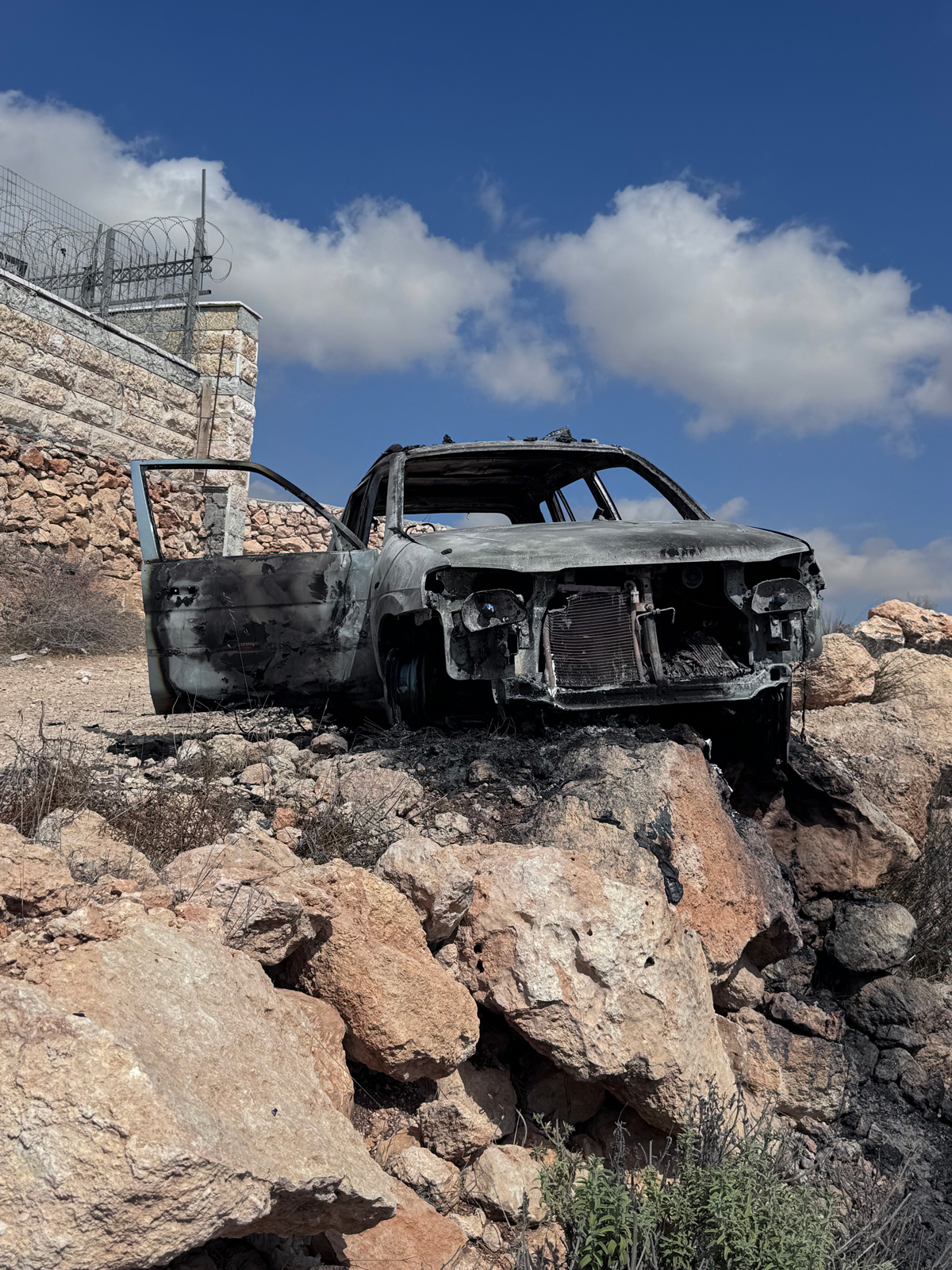
After he abandoned the car, the settlers set it on fire, as well as another car that was parked there.
The settlers then went to where the remaining farmers and the activists accompanying them had fled, about 200 meters from the spot where A.A. abandoned his car, and began beating them with clubs.
Another car that settlers burned in the olive grove. Photo: Salma a-Deb’i, B’Tselem
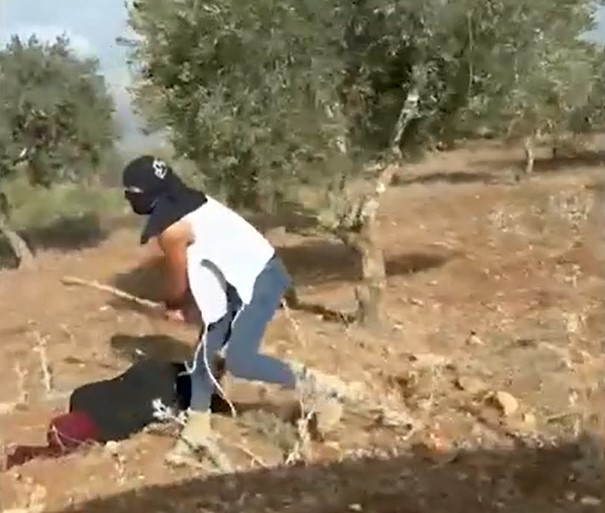
One of the individuals attacked was ‘A.A., 55, A.A.’s sister-in-law, who had fled to this area in a pickup truck. One of them struck her on the head with a club, and she immediately fell to the ground, and then he hit her again and again until she lost consciousness. The settlers also beat activists who were near her.
‘A.A. was taken, semi-conscious, by car to a clinic in Khirbet Abu Falah, and from there she was transferred to al-Istishari Hospital in Ramallah. She regained full consciousness only at the hospital. She was diagnosed with a brain hemorrhage, required 28 stitches and was hospitalized until 22 October 2025. Apart from her, two of the activists were injured after being beaten by the settlers.
The farmers were forced to flee the area, and the settlers burned another car they had left behind.
B’Tselem field researcher Mohammad Romaneh collected the testimonies of several residents
‘A.A.:
On Sunday, 19 October 2025, at around 7:30 A.M., I went out with my brother-in-law A.A., my son and my sister-in-law in A.A.’s car to harvest olives on land in the Wad ‘Ammar area, east of the town of Turmusaya, between the town and the villages of al-Mughayir and Abu Falah. Another one of my sons arrived on his own in a different car.
A settler beats ‘A.A. with a club after knocking her to the ground. Still from video footage of the incident, courtesy of local residents
This land belongs to residents of the town of Turmusaya, and we work it for a share of the crop, because two months ago, in August 2025, settlers and occupation soldiers uprooted five hundred trees on my husband’s family’s land.
We arrived in the Wad ‘Ammar area at around 8:00 A.M. and started getting ready to harvest right away. We spread out the tarps and unloaded the farming equipment we brought with us, and then started harvesting.
While we were working, a car passed by us heading north. After it drove about 200 meters, it turned around and came speeding back. In the car was a woman who shouted to us, “Settlers!” When we heard her, my sister-in-law and I dropped the equipment and started walking south. A.A. didn’t come with us, but went towards his car, which was parked about 70 to 100 meters south of where we were working.
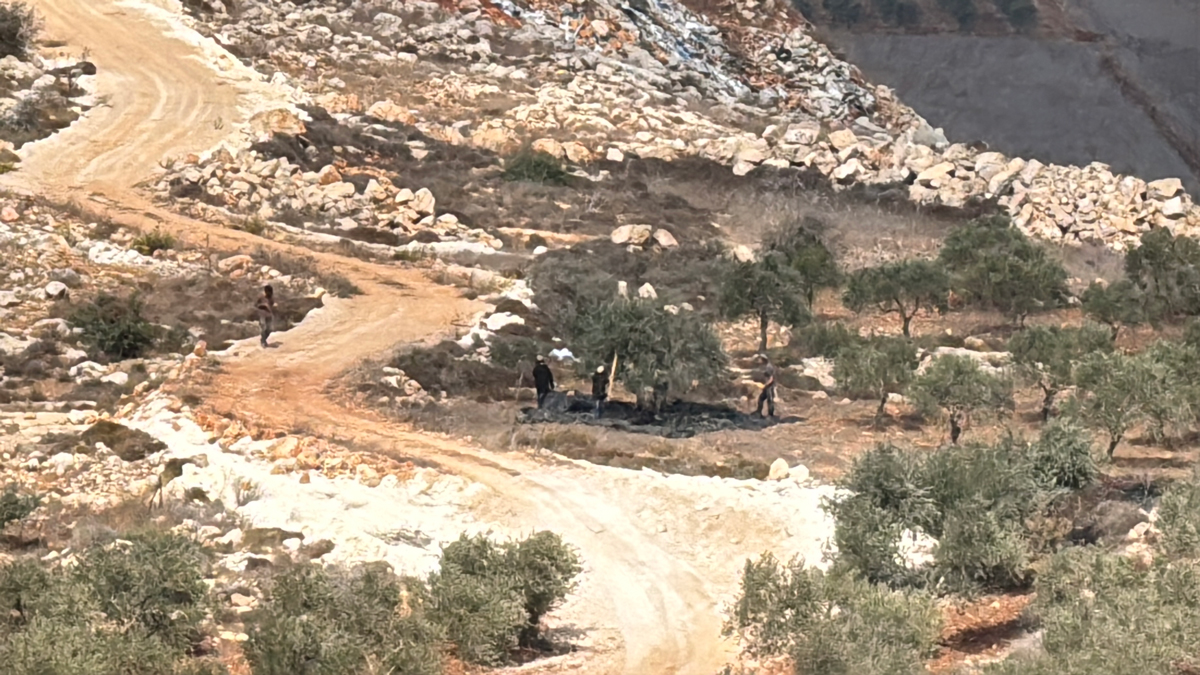
Settlers harvesting olives in Turmusaya groves on the day of the incident. Photo courtesy of local residents
As my sister-in-law and I walked away, I heard A.A. shouting and calling for help and saw two young men running towards him from the north. When I turned around to see what was happening, I saw several settlers vandalizing A.A.’s car with sticks and stones.
My sister-in-law ran away, and I also kept walking away, until I reached a hill some distance from there. From the hill, I saw A.A. and the young men moving the car further south. After they moved it to a spot about 100 meters from where I was, an occupation army force arrived. I saw the soldiers detain A.A. and the guys who were with him. I stayed where I was and watched what was happening from there.
The occupation soldiers fired tear gas canisters at us in order to drive away the farmers who were in the area.
After about 40 minutes, the occupation forces let A.A. and the other guys go and withdrew from the area. A.A. started the car and drove south. After a few minutes, I saw a large group of settlers, at least 40 to 50 of them, masked and armed with sticks or clubs, running towards him and the guys who were with him. As soon as they reached them, they started throwing stones at A.A.’s car, and the guys ran off, leaving him alone.
Meanwhile, a pickup truck with an open bed stopped next to me, and I got on it with my two sons. I got into the cab, and they got into the bed. We started driving away to get away from the settlers, but we had barely managed to go 50 meters when stones started hitting the vehicle from behind. I asked the driver to stop, because I was worried about my sons, who were exposed. As soon as I got out, I saw about 15 settlers with sticks in their hands running towards us and throwing stones at us.
I quickly turned around to get away, but the moment I turned, I felt a strong blow to the back of my head that knocked me to the ground. Then the settlers surrounded me and started beating me on the head and all over my body. For a moment, I thought they wouldn’t stop until they killed me. Everyone who was there ran for their lives.
During the attack, a young man arrived, and then I felt two people lifting me and putting me into a vehicle that took me to the clinic in the village of Abu Falah. From there, I was taken by ambulance to al-Istishari Hospital in the city of Ramallah. They ran tests and scans and found two cuts on the back of my head and another wound on my right hand, all of which required stitches. I also had severe bruises on both legs and on my back, and more bruises in various places on my body and under my right eye.
Later, I was told I had been hospitalized for two days in the intensive care unit. I also heard that the settlers burned several vehicles, including my brother-in-law’s car.
A.A.:
I am married and a father of eight, three of them under the age of 18. One of my sons, ‘Ali, was shot dead by occupation soldiers on 4 December 2020, when he was 16. I live in the middle of the village of al-Mughayir, east of the city of Ramallah. I’ve been working harvesting olives for residents of the town of Turmusaya for 15 years now for a cut of the yield. That’s how I make sure my family has enough olive oil. Usually, I harvest in the eastern lands of Turmusaya, which we’ve always accessed without any need for coordination.
A.A., in the red circle, flees his car as settlers chase after him. Still from video footage of the incident, courtesy of local residents
The Turmusaya municipality announced that Sunday, 19 October 2025, would be the first day of the harvest season in the town’s lands. That day, at around 7:30 A.M., I left al-Mughayir with two of my sisters-in-law and my son, and we drove in my car to the eastern lands of Turmusaya, in an area called a-Dalajeh, which is Area B according to the Oslo Accords.
After a 10-15 minute drive, we arrived and started the harvest preparations right away. I parked my car about 70 meters northwest of where we were working. We began harvesting and worked for about half an hour without any problems.
Then a car with a family passed us, driving to their land north of us, and then it quickly backed up, and I heard a woman in the car shouting to us, “Settlers!” At that moment, there was no other family harvesting in our area.
After about five minutes, maybe even less, I saw about 10 masked settlers with sticks in their hands walking towards the spot where I had left my car. When they got there, they immediately pounced on the car and began smashing the windows and vandalizing the tires. I shouted for help, and two young men, also from al-Mughayir, who were harvesting in the area, came over on foot. We shouted at the settlers, but they would not leave my car, so we threw stones at them. They were forced to leave and walked west, towards the Turmusaya plain.
At that point, I went over with the two guys to where my car was, and meanwhile, I told my two sisters-in-law to get away from there, for fear the settlers would come back and attack again. When we reached the car, we got in, and one of the guys drove. We moved it about 300-350 meters south, and on the way, two more guys joined us.
Then an Israeli military vehicle reached us, as well as a white vehicle carrying soldiers, which I think belongs to the settlement security. When the two vehicles approached, the two guys who had helped me ran off, and the one who was driving accidentally took my car keys with him. I was left there with the two guys who had joined us on the way.
The soldiers detained me and took my ID card. They told me I wasn’t allowed to be in that area. After less than five minutes, an ATV with two settlers arrived and stopped next to the military vehicle. The settlers’ faces were uncovered, and one of them was armed with a rifle.
The soldiers held us for at least 35-40 minutes, and then left us and drove west, towards the Turmusaya plain, but the two settlers who had arrived on the ATV stayed next to us. After the soldiers left, I asked someone who had arrived in an off-road vehicle to tow my car away, because I didn’t have the keys, but then the guy who had accidentally taken them came back and returned them to me. I started my car and drove south, because I was afraid the settlers would attack again.
A.A.’s burned car, where he was forced to abandon it. Photo: Salma a-Deb’i, B’Tselem
The moment I moved, I saw the guys who were standing next to me running away. I looked back and was stunned to see at least 50 masked settlers running towards me from the north.
I kept driving, but because the settlers damaged the tires earlier, the car was moving very slowly. The settlers managed to catch up to me and immediately attacked the car with sticks and stones. Some of them tried to open the driver’s door, and I tried to stop them from inside. When I realized I wouldn’t be able to hold them off, I jumped out of the car and ran away.
The settlers chased me while throwing stones at me, and I didn’t even dare look back. I ran south, and they chased me for at least 400-450 meters. I kept running until I reached the nearby village of Khirbet Abu Falah.
An hour later, I heard that the settlers had attacked my sister-in-law ‘A.A, 55, including blows to the head. I also heard that they burned my car and other vehicles that were there.
‘A.A was taken by car to the emergency clinic in Khirbet Abu Falah, and I arrived there after her. I saw that her face and clothes were covered in blood. She was in shock and not very aware of what had happened. The doctor told us she had to be taken to hospital, and within minutes she was taken by ambulance to al-Istishari Hospital in the city of Ramallah. I went with her, and the doctors there told us her condition was critical and that she had to remain under observation for 12 hours. They ran tests and eventually admitted her to the intensive care unit for two days. Then the doctor told us the danger had passed, that she had made it through the critical stage, and she was transferred to an inpatient ward.
I’ve been going to the Turmusaya groves to harvest olives for 15 years now. This was the first time settlers came there, and also the first time I heard from soldiers that Palestinians aren’t allowed in the a-Dalajeh, Wad ‘Ammar area.
I also want to note that two months ago, settlers and occupation soldiers cut down about 500 olive trees on land belonging to my family, east of the village of al-Mughayir. These 500 are part of the 10,000 olive trees settlers cut down in August 2025.
Israel’s regime of apartheid and occupation is inextricably bound up in human rights violations. B’Tselem strives to end this regime, as that is the only way forward to a future in which human rights, democracy, liberty and equality are ensured to all people, both Palestinian and Israeli, living between the Jordan River and the Mediterranean Sea.
Since the Hamas attack on 7 October 2023, Israel has acted in a coordinated and deliberate manner to destroy Palestinian society in the Gaza Strip, committing genocide against its residents. In light of Israel’s actions in Gaza, the public statements made by Israeli decision-makers, and the international community’s failure to take effective action, there is a serious risk that the Israeli regime will expand the genocide to other areas under its control—first and foremost, the West Bank.
B’Tselem calls on the Israeli public and the international community to use every tool available under international law to bring an immediate end to Israel’s genocide against the Palestinian people.