Beita, Nablus District: Israeli settlers attacked Palestinian olive harvesters, beat a dog to death and torched vehicles; soldiers also attacked the harvesters with tear gas and live fire
Beita, Nablus District: Israeli settlers attacked Palestinian olive harvesters, beat a dog to death and torched vehicles; soldiers also attacked the harvesters with tear gas and live fire
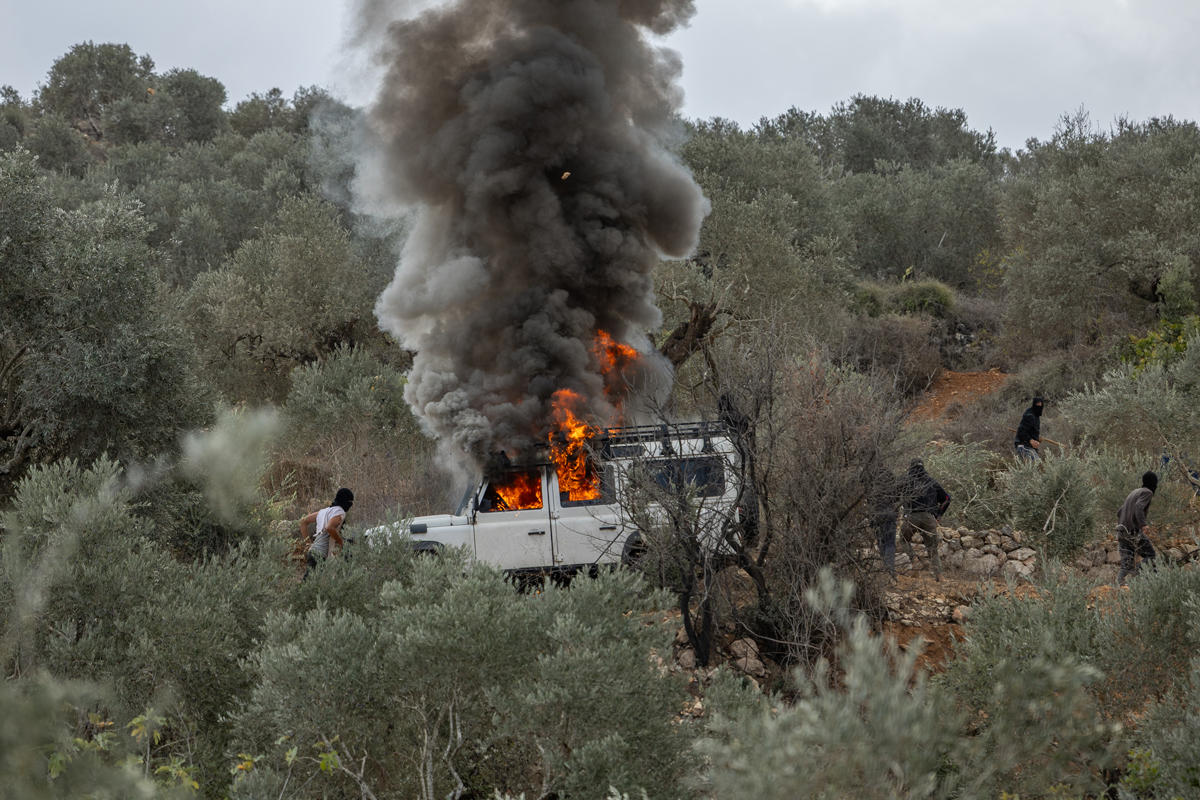
Settlers set fire to a car belonging to one of the harvesters in Beita. Photo: Avishay Mohar, B’Tselem, 10 October 2025
On Friday, 10 October 2025, at around 7:30 A.M., families from the town of Beita went to harvest olives on their land in Area B, in the Jabal Kamas area (Abu al-Hamra), about a kilometer and a half southeast of the town. Settlers established the outpost of Giv’at Mevaser Shalom in this area. At around 8:00 A.M., about 30 settlers came to the land of a family of six who were harvesting their olives and attacked them with clubs and stones. Five family members were injured. Three of them were evacuated to Rafidya Hospital in Nablus and two to a local clinic. When more residents arrived, the settlers retreated.
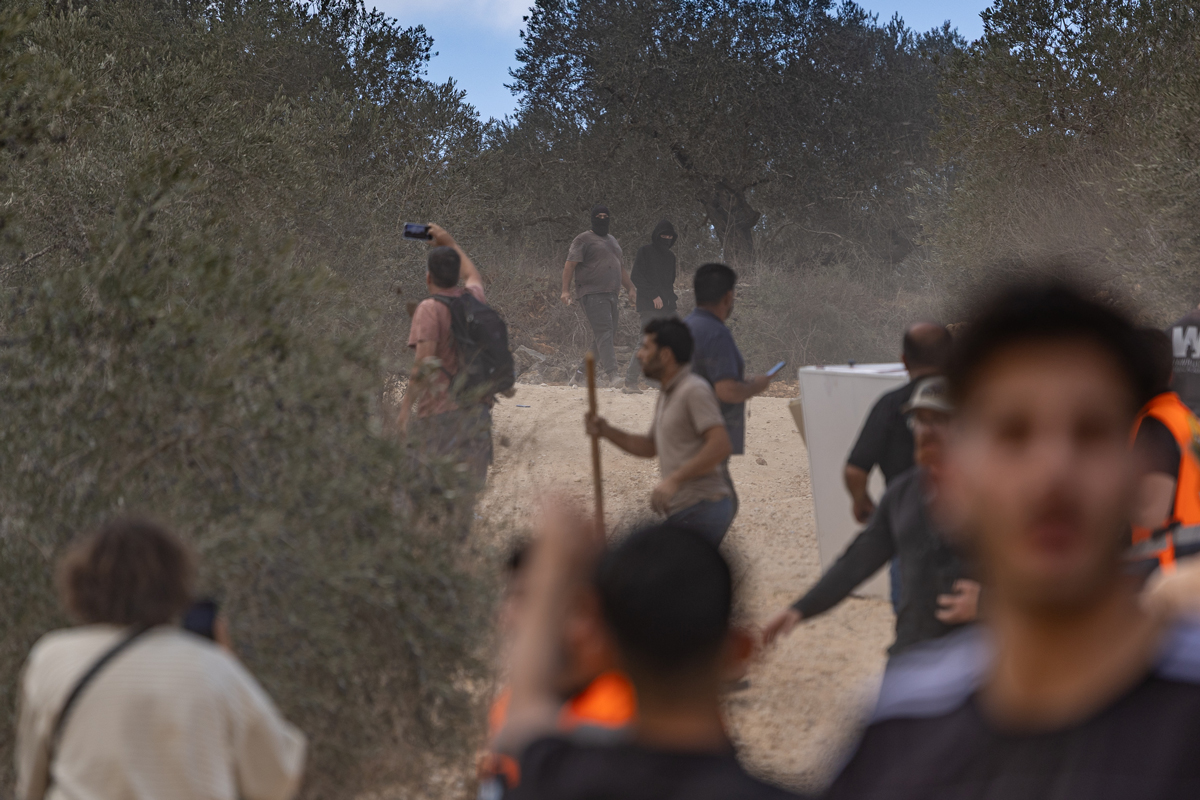
Masked settlers in an olive grove in Beita. Photo: Avishay Mohar, B’Tselem, 10 October 2025
About an hour later, more residents from the town, accompanied by about 30 solidarity activists, arrived to harvest olives in the Jabal Kamas area. As they walked toward the groves, soldiers fired a tear gas canister at them.
When they reached the groves, the farmers and activists saw about ten settlers walking around the area. Shortly afterward, Israeli
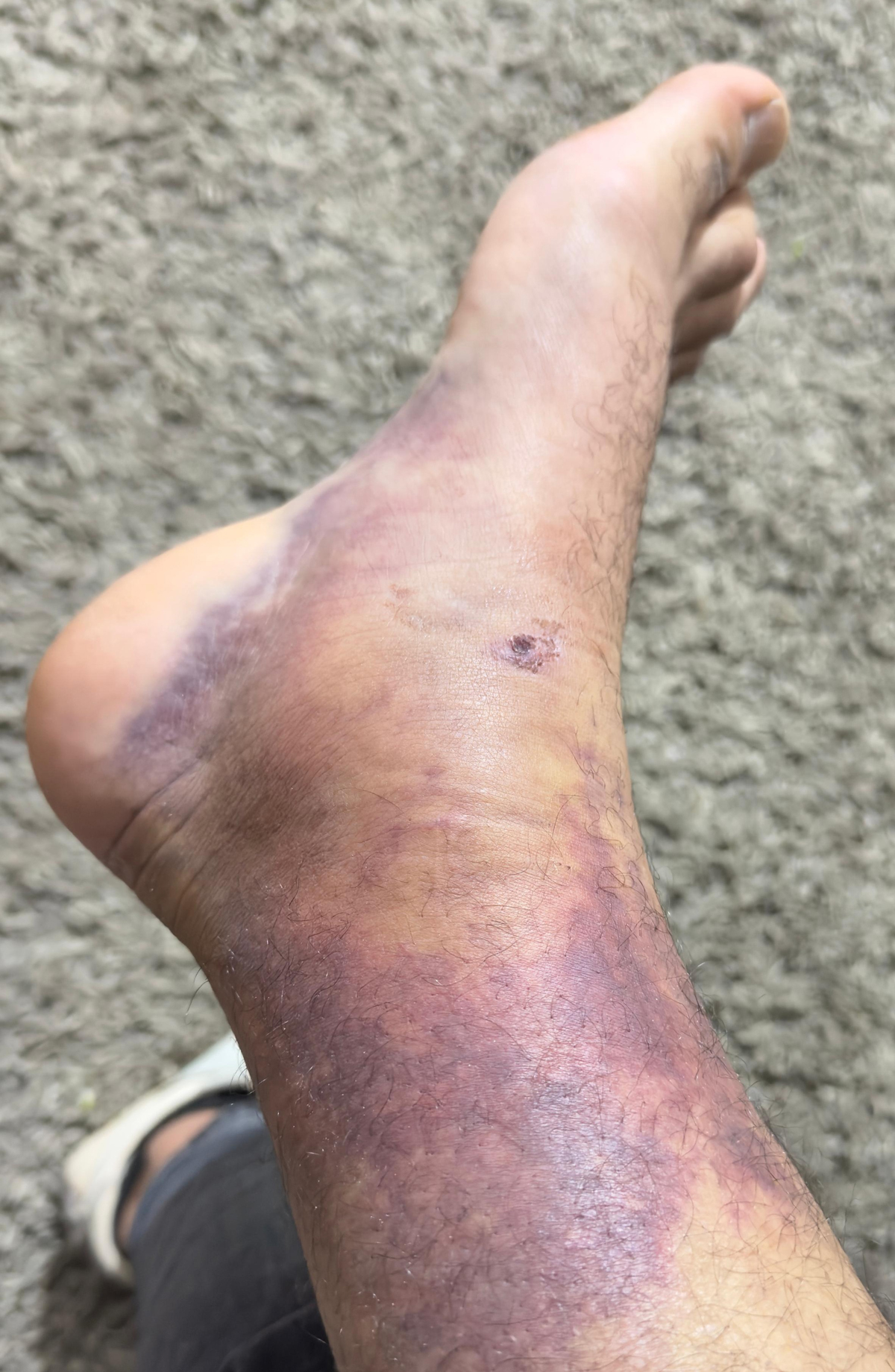
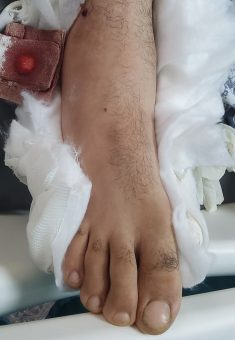
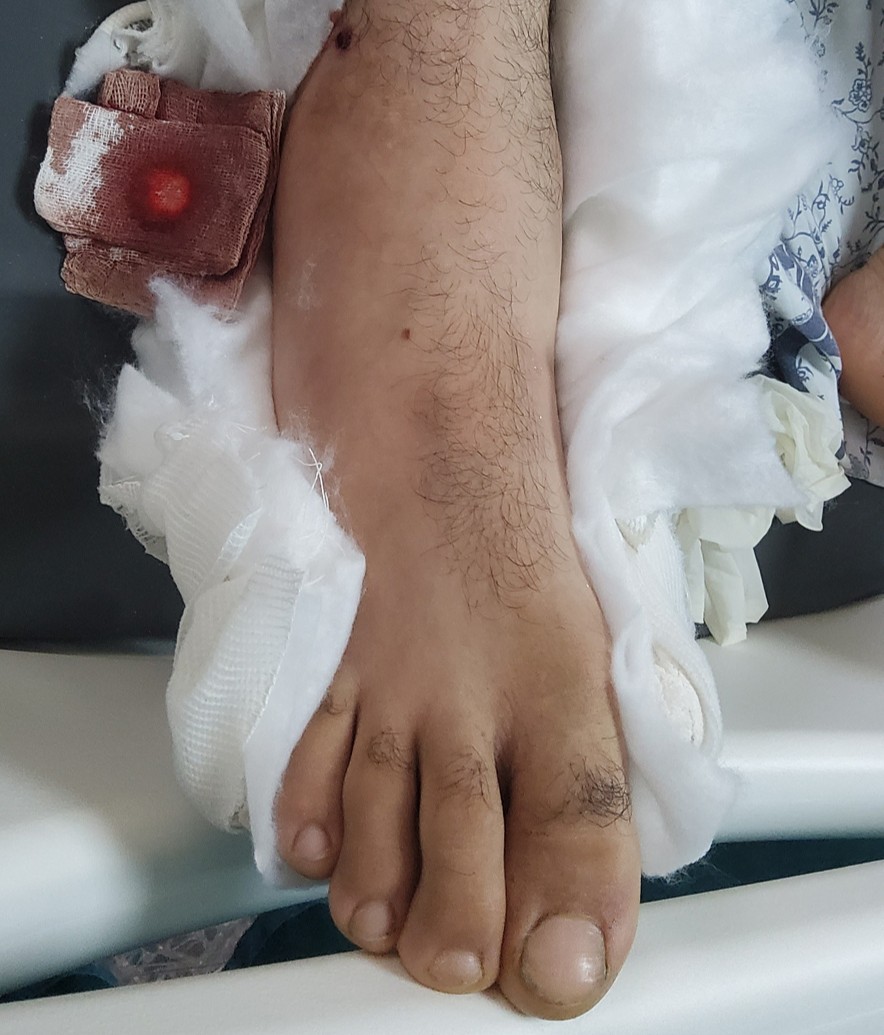
Wahaj Bani Moufleh’s leg after the attack. Photo courtesy of Bani Moufleh
soldiers arrived and began firing tear gas canisters and throwing stun grenades at the harvesters. A photojournalist who was there suffered a fractured leg when a tear gas canister was fired directly at it.
The soldiers continued firing tear gas canisters and stun grenades for about 10 minutes, and only then stopped and let the har
vesters continue picking the olives.
The harvesters finished working in the plots they had reached at around 11:00 A.M. When some of them wanted to move on to other plots, closer to an outpost established in the area a few months earlier, the soldiers denied them access, claiming they had to coordinate the harvest in this area and come on another day.
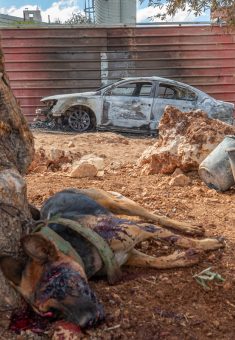
The dog that settlers beat to death. Photo: Wahaj Bani Moufleh, 10 October 2025
During the argument between the farmers and the soldiers, a group of about 30 masked settlers charged at a family who were harvesting olives in their grove, a few dozen meters away. Most of the settlers were armed with cold weapons, including iron bars, clubs, axes and slingshots, and about three of them carried firearms. The settlers began throwing stones at the farmers, beating them and setting fire to their parked vehicles. At the same time, the soldiers began firing tear gas and live ammunition at the farmers, who tried to drive the settlers away by throwing stones.
During the attack, one of the settlers shot a young man from the town in the leg and injured him. The young man was evacuated
by ambulance to Rafidya Hospital. About 80 farmers and journalists were hurt in the joint settler-soldier attack, injured by stones and club blows, suffered tear gas inhalation, and one, the young man mentioned above, was wounded by live fire. Sixteen of the injured were treated at the local clinic in Beita, and 16 others were evacuated to Rafidya Hospital in Nablus. During the attack, the settlers also beat a dog tied to a fence to death, set fire to 12 vehicles and vandalized six others.
B’Tselem field researcher Salma a-Deb’i, collected testimonies from several residents.
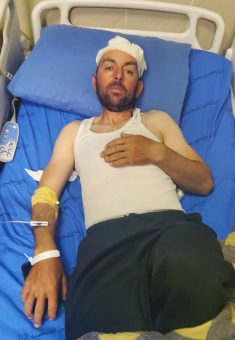
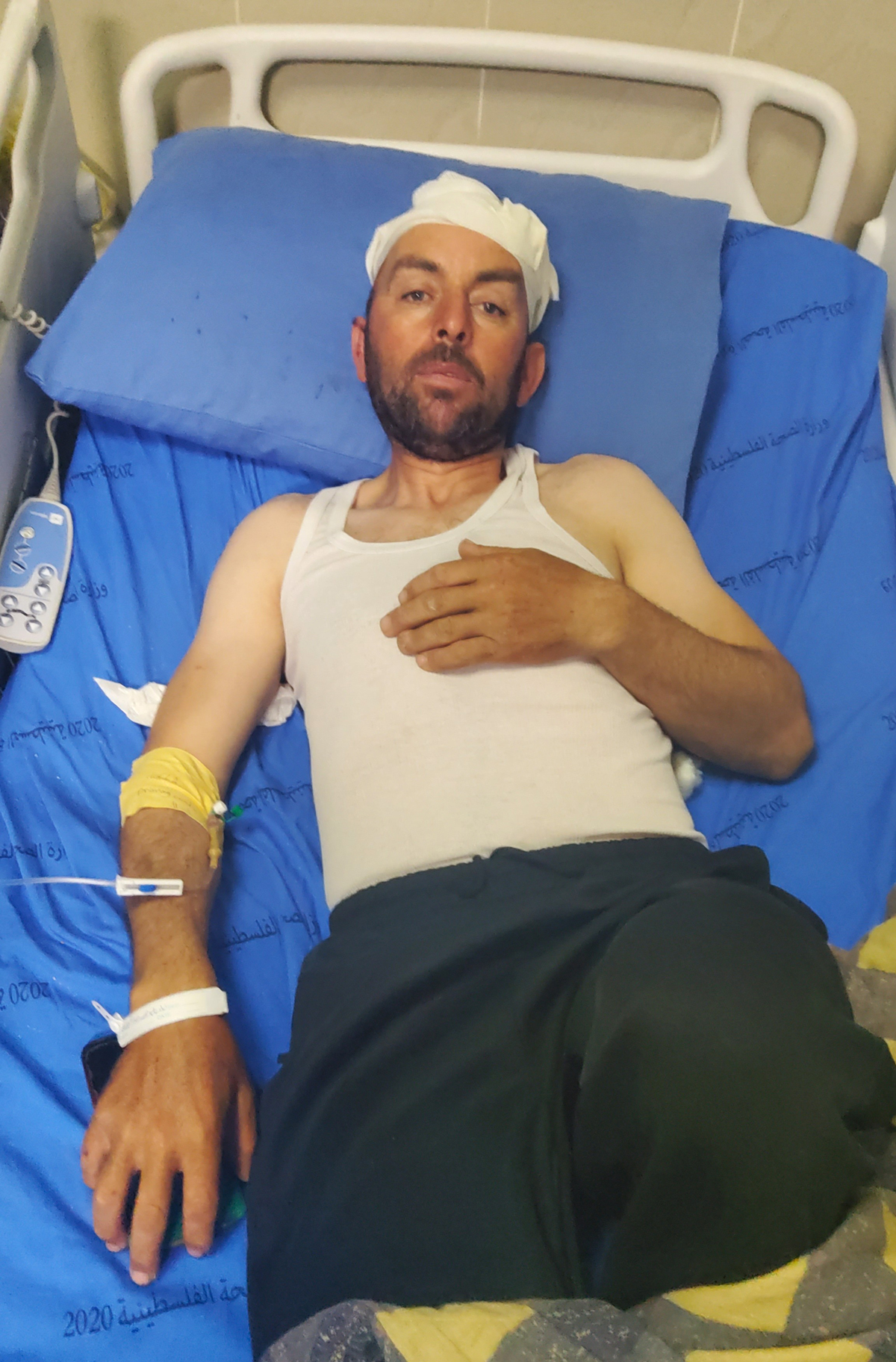
Iyad Dawood, 44, a married father of four, related:
Iyad Dawood at the hospital. Photo: Salma a-Deb’i, B’Tselem
Three days ago, on Friday, 10 October 2025, at around 7:30 in the morning, I arrived with my family at our land in the Kamas area, south of the town of Beita, which is about two dunam (1 dunam = 0.1 hectares) in size. I was with my father, who is 67, my mother, also 67, my two brothers, T., 45, and M., 33, and my sister, 38. A few months ago, settlers set up the outpost tents in the northern part of the area, about 150 meters from our land.
We started harvesting the olives when suddenly, we saw about 30 settlers running toward us. Some of them were masked and holding clubs and axes. They were very close to us when we noticed them, and we had no way to run. One of the settlers hit me on the back of the head with a club. I immediately fell to the ground, and about three or four of them beat me with clubs. My sisters and my mother shouted for help, but the settlers attacked them as well and beat them.
They stopped only when more residents arrived from the nearby groves to help us. When the settlers backed away, we were evacuated to the town, and from there, my father, my brother M. and I were taken to Rafidya Hospital in Nablus. They found that I had a cut on my head and many bruises, on my chest and all over my body.
My father was injured in the head and was bleeding, and my brother M. was badly beaten on the back and legs. My sister and my mother were examined and treated at the village clinic after suffering bruises to their arms and legs. They had X-rays and no fractures were found.
I am still hospitalized at Rafidya Hospital and they want me to stay here four more days for treatment and observation. I am suffering from severe pain in my head and all over my body, and I need help even just to go to the bathroom.
We have never been required to coordinate access to this area, and we went there like we do every year, because it’s in Area B. We were very surprised by the intensity of this attack. All the landowners from the area went out to harvest together, but our large number did not deter the settlers or prevent the attack.
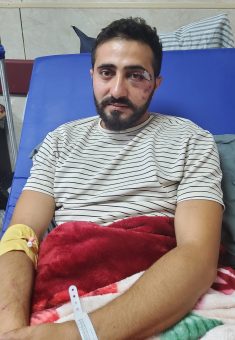
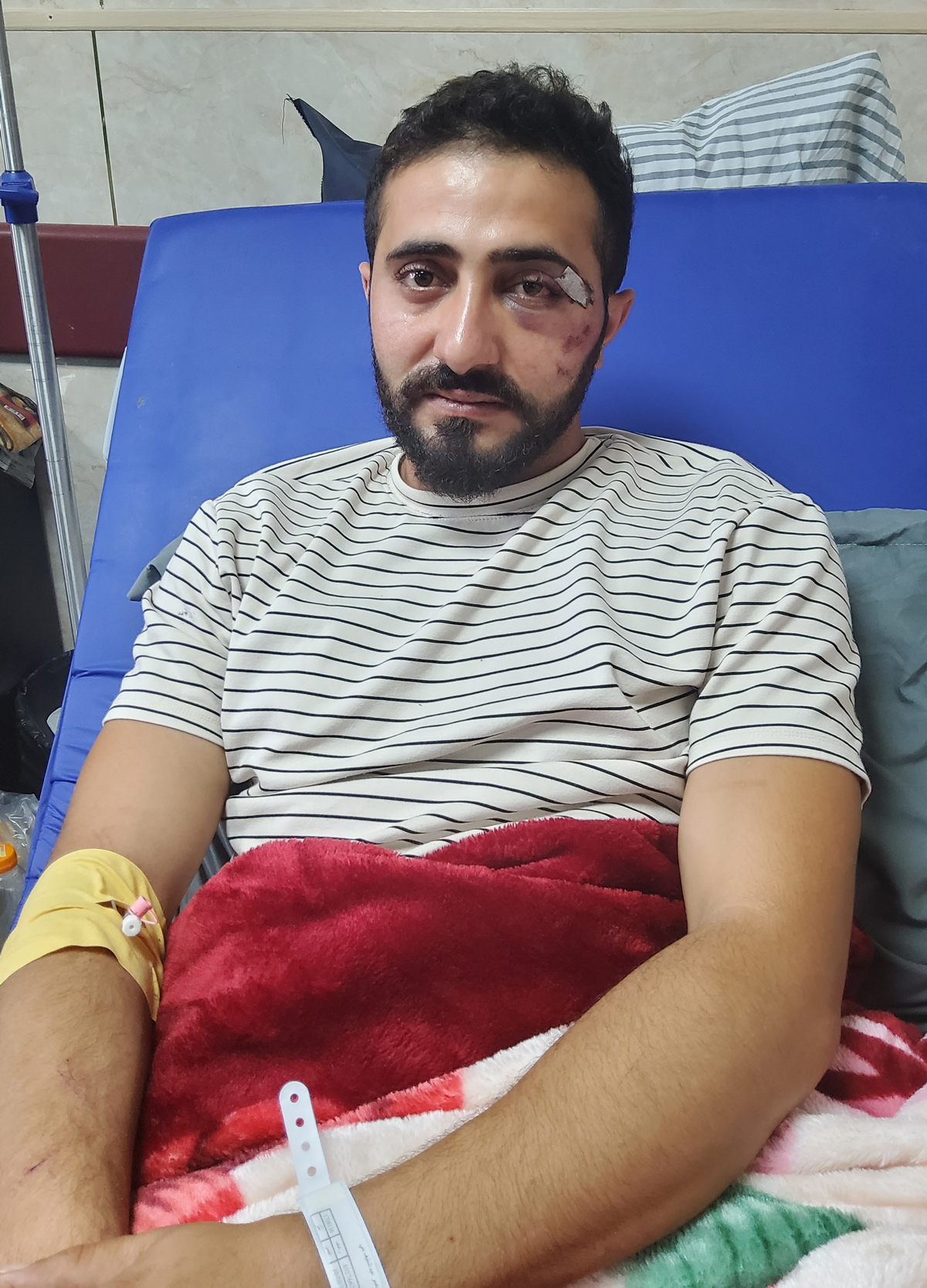
Sharaf a-Din Bani Shamsah, 28, related:
Sharaf a-Din at the hospital. Photo: Salma a-Deb’i, B’Tselem
Yesterday, Friday, 10 October 2025, at around 7:30 A.M., I arrived in the Abu al-Hamra area, on the southern side of town. We have a five-dunam olive grove there. I went there with my father, my two brothers and my two uncles, and we began harvesting olives.
At around 11:00 A.M., we heard women shouting and the sound of glass breaking from the Kamas area opposite us, about 500 meters away. I ran over to help the family harvesting there and, when I arrived, there were about 10 family members there, some of them injured, including an elderly woman who couldn’t stand on her feet, and several people who had bruises. An ambulance they had called arrived, and I helped get the woman into it.
The settlers also set the family’s car, a Land Rover jeep, on fire, and as we were working to put it out, they suddenly came back. There were between 20 and 30 settlers there, masked, dressed in black and armed with rods, wooden clubs and slingshots. They were about 100 meters away from us and surrounded us from all directions. They threw stones at us, manually and with the slingshots.
Suddenly, they were right next to us. I saw about five settlers a few meters away from me. I tried to escape, but found about five more settlers in front of me. One of them hit me very hard in the left side of the face with a club, and I fell to the ground, and then the settlers attacked me with the clubs and beat me all over my body, including my left knee. I screamed in pain, called for help, and tried to get up and run away, but I couldn’t stand because my left knee hurt so much.
Meanwhile, the young men threw stones at the settlers to drive them away from me, and it actually worked. The settlers let go of me and moved a few meters away to chase the young men, and I managed to get away from the area. Several young men came and carried me to an ambulance, which evacuated me to the town clinic. From there, I was taken to Rafidya Hospital. They ran tests and X-rays that showed I have a fracture in my left leg. I also had a wound under my eye, which was stitched. The doctor told me I need fixation with a device because the bones in my knee were crushed and there was a tear in the cruciate ligament, and that I would have to undergo surgery to install this device.
Here I am, still at the hospital.
Testimony of I.A.:
The bullet wound in I.A.’s leg. Photo: Salma a-Deb’i, B’Tselem
Yesterday, Friday, 10 October 2025, at around 11:30 A.M., I arrived with friends in the Kamas area, south of the town, to help residents with the olive harvest. Suddenly, about 30 masked settlers dressed in black, holding clubs and axes, attacked us. I think three of them were holding rifles. They were about 100 meters away from us. They smashed the windows of one of the farmers’ cars, set it on fire and also assaulted his mother. Some young men took her to receive medical treatment.
I advanced with some other young men toward the settlers to drive them away from us, and they did run off. Afterwards, we put out the fire with an extinguisher and dirt. After some time, the settlers came back from the other direction and attacked other residents, about 100 meters away from us. There were many of them, and they attacked the farmers who were harvesting olives. The farmers shouted for help and when I tried to get there, after advancing about 20 to 30 meters, suddenly three or four settlers came out from among the olive trees and one of them raised a gun and fired one shot at me, which hit my right leg from a distance of about 10 meters. The settlers left me and went to where the other settlers were attacking the family. Two young men picked me up and put me in an ambulance that was nearby, which took me to the clinic in Beita, and from there I was taken to Rafidya Hospital. The doctor there explained to me that the bullet penetrated the bone and caused a fracture and that I needed two plaster splints to keep it in place. I am still hospitalized and receiving treatment at Rafidya Hospital.
Photojournalist Wahaj Bani Moufleh stated to B'Tselem regarding his injury:
I was in Jabal Kamas with residents of Beita and international activists. We walked to lands that are dangerous to access, and then settlers began attacking the farmers and trying to steal the olive crop.
I was wearing a journalist’s vest and carrying all my equipment, and I started filming what was happening.
Suddenly, I saw a soldier take a weapon from another soldier, and then I saw him fire a tear gas canister at my leg. The impact of the canister broke my leg. In the same incident, dozens of people suffered from tear gas inhalation.
Israel’s regime of apartheid and occupation is inextricably bound up in human rights violations. B’Tselem strives to end this regime, as that is the only way forward to a future in which human rights, democracy, liberty and equality are ensured to all people, both Palestinian and Israeli, living between the Jordan River and the Mediterranean Sea.
Since the Hamas attack on 7 October 2023, Israel has acted in a coordinated and deliberate manner to destroy Palestinian society in the Gaza Strip, committing genocide against its residents. In light of Israel’s actions in Gaza, the public statements made by Israeli decision-makers, and the international community’s failure to take effective action, there is a serious risk that the Israeli regime will expand the genocide to other areas under its control—first and foremost, the West Bank.
B’Tselem calls on the Israeli public and the international community to use every tool available under international law to bring an immediate end to Israel’s genocide against the Palestinian people.