a 49-year-old mother of six from the a-Rimal neighborhood in Gaza City, spoke about her 14-year-old son losing his leg in an Israeli strike, the expulsion from her home early in the war, the arrest of her husband and sons, and the theft of valuables by Israeli soldiers
Before the war that broke out in October 2023, I lived with my husband, Bahaa a-Din al-Jamali, 59, and our three sons, Mahmoud, 26, Ahmad, 19, and Muhammad, 14, in our home on the fourth floor of a building in the a-Rimal neighborhood. When the war started, there were a lot of bombings in our area, and in December, the army invaded the neighborhood and surrounded the area. We couldn’t leave the house for three days. The soldiers fired smoke grenades, and we couldn’t see what was happening around us. Then, my husband and I looked out the window and suddenly saw soldiers right underneath it. They must have seen us too, and they shelled the building with a tank. The apartment was partially damaged, and it was very frightening. We stayed by the apartment door for two days and couldn’t leave because of the army’s siege on the area. All the neighbors were still in the building as well. Later, soldiers entered the building. They separated the women to one side and the men to the other. They ordered the men to strip almost completely. We women remained dressed.
When we left the building, the soldiers didn’t let us take anything. They tied everybody’s hands, including mine, even though I was carrying my two-year-old granddaughter Leen. She’s the daughter of my daughter, Nada, 25, who was pregnant. They searched us and took all our jewelry and about 40,000 dinars (~ USD 56,420), money my son Mahmoud had saved for his wedding. They also took Nada’s gold jewelry and about 2,000 dinars (~ USD 2,820). At that point, I didn’t know what had happened to my husband, my sons Ahmad and Muhammad, or where they were.
I spoke a little Hebrew and English with the soldiers. I told them we were just civilians and not involved in the fighting. The soldiers ordered us to walk south. We walked until we reached relatives in downtown Gaza City. We stayed with them, and I cried all night because I didn’t know where my husband and sons were. They were released the next day and came to us, and then we walked to al-Wihda Street in Gaza City, to relatives of my husband. The army remained in the a-Rimal neighborhood for 26 days. When they withdrew, we went back to see what had happened to our home. We saw dead bodies on the sides of the roads. We were shocked to see that the army had bombed almost all the buildings. We went into our destroyed home to take some of the things we had left there, like clothes, blankets, and so on. We hoped to find the money or gold the soldiers had taken, but we didn’t find anything. We couldn’t even find the sack of flour my husband and sons tried to take with them when we left.
Suddenly, an Israeli army jeep appeared, and four soldiers got out. They fired at us, and my son Muhammad was wounded by three bullets in his thighs. The bullets went in and out without hitting the bones. People started to flee, and the soldiers left. Because the neighborhood is close to a-Shifaa Hospital, the ambulance arrived quickly, but they didn’t take him to the hospital. They treated him in the ambulance. Muhammad suffered from the injury for two months. He didn’t move and couldn’t walk. In the meantime, we went to the home of Nada and her husband in the a-Rimal neighborhood, which was in reasonable condition. Paramedics would come to the house and change his bandages. In February 2024, my daughter Marah, 21, married Nada’s husband’s brother.
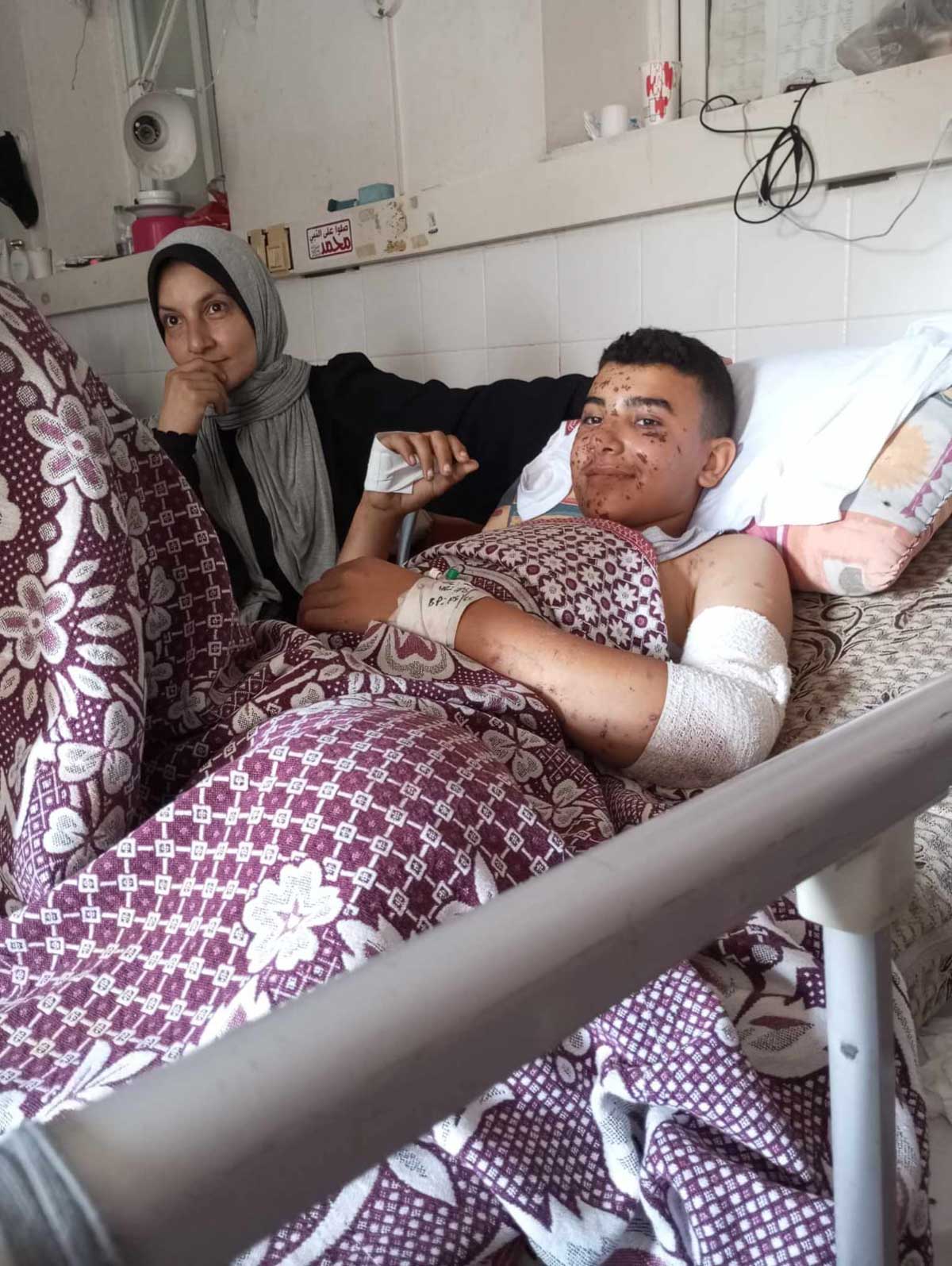
On 28 August 2024, at half past midnight, while we were all sleeping, the house was bombed. I didn’t hear the missile or the explosion, but when I woke up, I heard Ahmad shouting that Muhammad had been killed. I started screaming and crying. I called for help. Three family members were killed in the bombing: my daughters’ parents-in-law, ‘Adel Sahyoun, 64, and Najwa Sahyoun, 59, and their son, Dr. Muhammad Sahyoun, 24. My son Muhammad was injured again and taken to al-Ma’amadani (al-Ahli) Hospital in Gaza City.
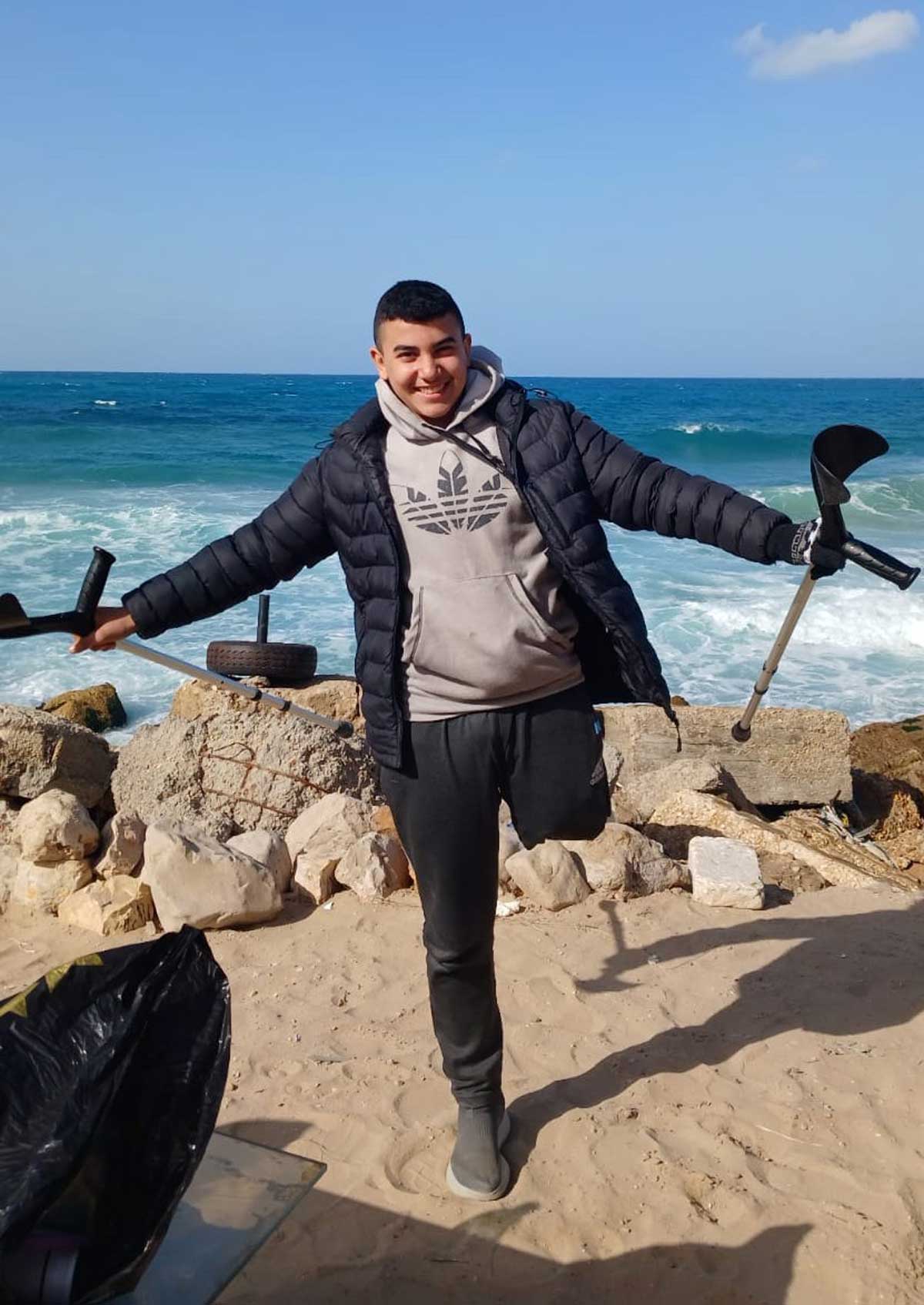
He was taken to the operating room, and they amputated his leg above the knee. He was hospitalized for a week, and I was with him the whole time. When they changed his bandages, he would scream in pain, and I would cry over his condition and over the fact that we no longer had a home where I could hug my son, protect him, and take care of him.
After he was discharged, we moved to my grandfather’s house in the a-Rimal neighborhood. From there, I regularly took Muhammad for medical follow-ups at a Doctors without Borders center, where he was being treated. There were shortages and hunger at the time. There were no vegetables or meat. I tried to provide Muhammad with nutritious food as much as I could. He had anemia, and his hemoglobin was very low. I bought him eggs when I could. A single egg cost about 35 NIS (~ USD 10). Muhammad started walking with crutches, and later, I got a referral for treatment and prosthetic fitting outside the Strip.
On 9 March 2025, we traveled to Egypt with the help of the World Health Organization and arrived at al-Hayat Hospital in Port Sa’id. We’re still here, waiting to be able to travel to the United States through the Heal Palestine organization, so he can get a prosthetic.
Before the war, Muhammad loved to swim. He was a swimmer and won first place in a competition at the club where he trained. He was also a soccer player and was crazy about the game. He is a fan of Real Madrid. Sometimes he tries to play soccer, despite having an amputated leg. He also tries to ride a bicycle. Muhammad is in deep mourning over what happened to him. He is just an innocent child whose life was only just beginning, but he’s already been arrested by the army, injured twice, and lost his leg.
* Testimony given to B’Tselem field researcher Olfat al-Kurd on 19 May 2025.