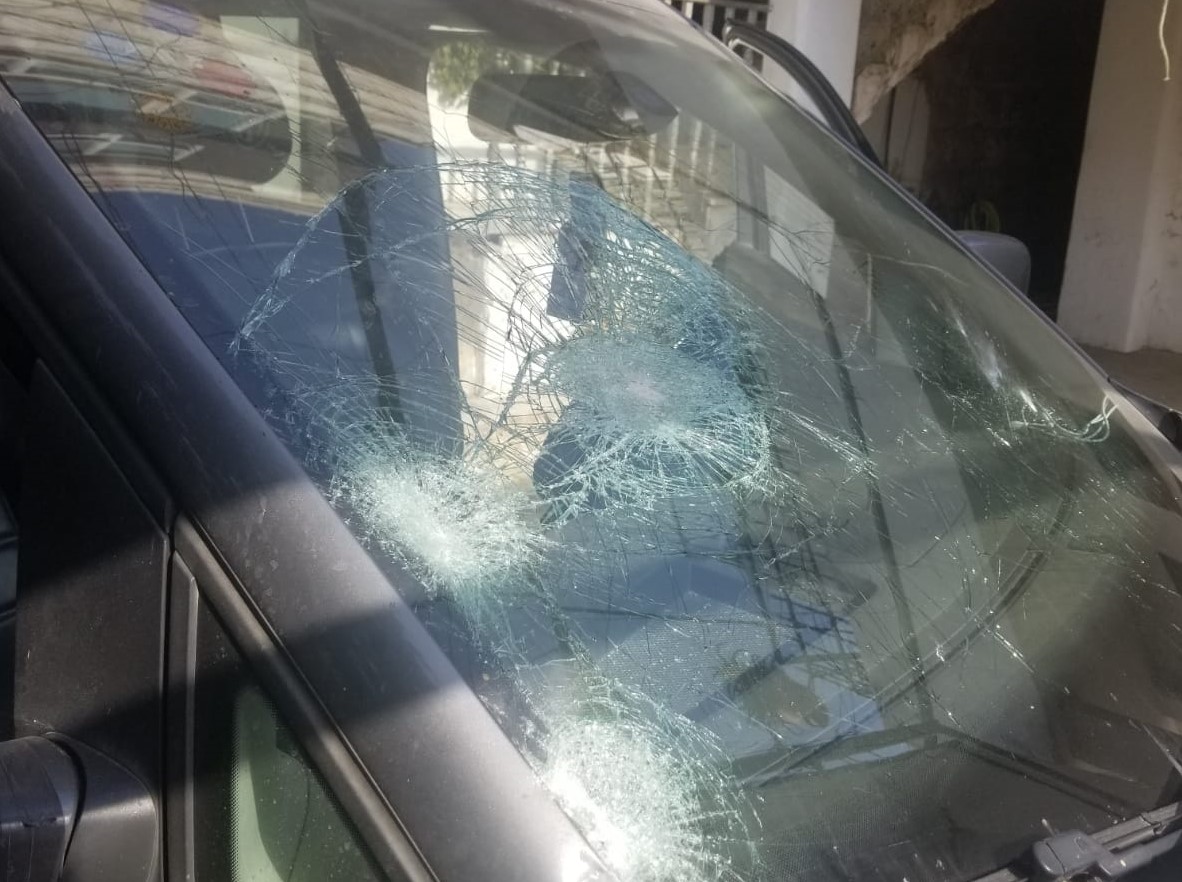
On Thursday evening, 3 September 2020, dozens of settlers blocked a lane on Route 60 near the turnoff to the settlement of Eli. They threw stones at passing Palestinian cars and tried to block their way. Some of the stones hit passengers or the cars.
According to testimonies given by B’Tselem, soldiers were present in the area and came to the spot at least twice, yet did nothing to protect the passengers or stop the settlers from throwing stones. In at least one case, the Israel Police was notified but did not arrive.
This is no exception. It is part of routine, daily conduct by Israeli settlers and security forces in the West Bank that has been going on for many years. Israel’s policy enables these acts of violence towards Palestinians, even when they result in predictable injury to life and limb, as well as damage to property. In this case, too, although the Israeli authorities knew that settlers were throwing stones at Palestinians on a major highway, they chose not to intervene.
The attacks went on for several hours.
In a testimony she gave B’Tselem field researcher Iyad Hadad on 6 September 2020, ‘Abir Snobar (Hamayel) described the attack on the family’s car:
On Thursday night, 3 September 2020, at around 8:30 P.M., we were on the way home from my parents in the village of Yatma. As we neared the turnoff to the settlement of Eli, I saw two cars with Israeli license plates parked in the right lane, which we were driving in. We kept going until we got close to them. At first, I thought it was a car accident.
My husband Saleh and I were sitting in the backseat. I was on the left side and he was on the right. My father-in-law, Musa, who was driving, slowed down. As we got closer, we understood that the road was being intentionally blocked by about 40 settlers spread out on both sides of the road. Some of them were wearing masks and black clothes. They were holding signs, but I don’t know what they were protesting about.
We were scared. My mother-in-law said to her husband, “Get out, go around them. Don’t stop, they’ll kill us!” As soon as my father-in-law started driving around the two cars blocking the traffic, our car was hit by a hail of stones. They hit us on all four sides. We panicked.
I’m nine months pregnant and I was terrified. I tried to duck down and hide as much as I could, but it was hard with my big belly. Within seconds, a stone came through the right window and hit me in the head. It was big, the size of an orange, and landed next to me. I screamed, “My head! My head!” My husband saw I was bleeding badly. He took his shirt off and wrapped it around my head.
They kept on throwing stones at us for about 30 meters, until we got through the stretch of road where the settlers were standing, and then it was over. It looked like every single one of them was holding stones to throw at us. As soon as we got away, my father-in-law phoned friends from the village and asked them to call an ambulance.
I was really shaken, and I think it made my blood pressure drop. I felt cramps in my stomach and was shaking all over. I burst into tears because I was afraid for my baby and started screaming for someone to call an ambulance. My husband tried to calm me down.
A few minutes later, we reached the medical clinic in Turmusaya. We waited for about 20 minutes until the ambulance came and took my husband, my mother-in-law and me to the Mujama Falastin Medical Center, where I was examined, X-rayed and given an ultrasound. There was a gash in my head about five centimeters long and it needed nine stitches.
Ever since, I’ve felt really bad. I’m stressed and anxious all the time. I’m really scared of leaving the village. The attack happened just after I came out of self-isolation at home after visiting America with my husband and in-laws. The visit to my parents in Yatma was our first outing. We wanted to see them after two years of being away and missing them a lot. The settlers’ brutal attack destroyed our peace of mind and deprived us of our most basic right: to move around freely and travel safely.