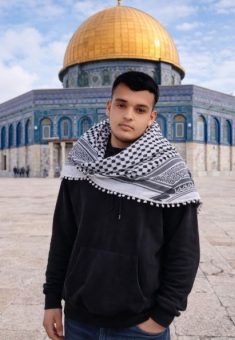
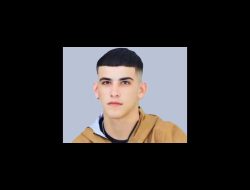
Qays ‘Allan. Still posted on social media, used under Section 27A
On Wednesday, 28 December 2025, at around 7:20 P.M., Qays ‘Allan, 20, from the village of ‘Einabus in Nablus District, drove three of his friends in his car. The four young men drove toward ‘Allan’s home, which is in the western part of the village, and stopped at a grocery store along the way to buy snacks and soft drinks.
When they were about 500 meters away from the house, a bright light suddenly shone on them from the other side of the road, as though someone were signaling to them with a flashlight. ‘Allan slowed down and was about to stop the car, when it suddenly came under fire, with about seven to eight rounds shot at them. ‘Allan was hit in the head. His head dropped onto the steering wheel and the car swerved to the right, hit a masonry fence on the side of the road, bounced to the other side of the road, hit an electric pole and stopped. Throughout this entire time, even after the driver lost control and the car crashed into the fence and the electric pole, the soldiers continued to fire dozens more shots at them.
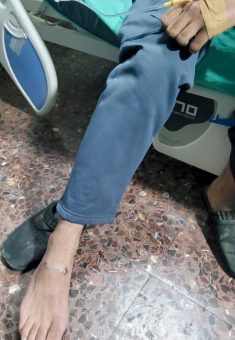
‘Allan was killed, most likely instantly, and his three friends sustained gunshot wounds. Ibrahim ‘Abdallah, 17, was injured in the abdomen and right foot. Yazan Rashdan, 20, sustained a bullet wound to the arm and fragment wounds to his back. M., 20, was lightly wounded by shrapnel.
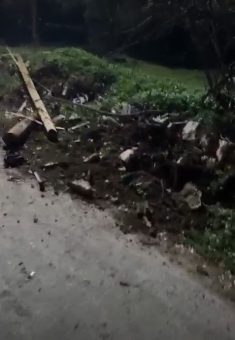
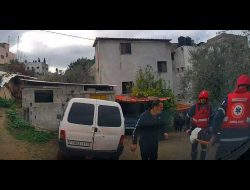
The utility pole the car crashed into before stopping. Still from video posted on social media, used under Section 27A
The soldiers forcibly pulled the three wounded men out of the car, dragged them along the ground for about 20 to 30 meters, beat them and stripped them. One of the soldiers beat Rashdan with his gun, and other soldiers kicked him. ‘Abdallah was also beaten. His head was slammed against a jeep, and then the soldiers kicked him hard in the abdomen, near the site of his gunshot wound, aggravating the injury.
An ambulance arrived within a short while, and two of the wounded persons, ‘Abdallah and Rashdan, were put inside. When the paramedics tried to drive away, the soldiers held them up for several minutes, demanded to see the ID cards of the two wounded, and, when they could not find one of them, took a photo of him for identification purposes and only then allowed the ambulance to drive to Rafidya Hospital in Nablus. The third friend, M., was taken to the same hospital in another ambulance. He was discharged that same day. One of the paramedics stated that when he arrived at the scene, he saw ‘Allan’s car on fire.
After that, the soldiers left the spot, taking ‘Allan’s body with them.
Following the incident, the military issued a statement saying that “a report came in of a terrorist who attempted to run over IDF troops operating in the ‘Einabus area in the Samaria Brigade district. The troops responded with fire and killed the terrorist.” However, as in many other cases, the soldiers recklessly used lethal fire against civilians who were simply driving on the road leading to their village, even though they slowed down in response to the light flashed at them, as any person would be expected to do in such a situation.
This incident is part of a pattern of similar events between December 2025 and March 2026. For example, on 15 March 2026, undercover Border Police officers fired dozens of bullets at the Bani ‘Odeh family’s car without warning, killing both parents and two of their children, ages five and six, and then beat one of the two children who survived the gunfire. On 10 January 2026, in Hebron, Shaker Ja‘bari was fatally shot in front of his daughter and grandchildren, who were with him in the car, after he slowed down when he noticed soldiers walking in front of him. In another incident in Hebron, on 6 December 2025, Israeli soldiers fired at Ahmad a-Rajabi’s car, killing him and a bystander. The soldiers called out to a-Rajabi to stop after he had driven past them in his car, and he backed up to come back to them, but one of the soldiers then fired into the air. A-Rajabi panicked, stepped on the gas pedal again, lightly hit the soldier who was trying to open the car door, and then the soldiers opened heavy fire that killed him and Abu Dawood, a sanitation worker who happened to be there. These cases illustrate a recurring pattern of lethal gunfire at innocent civilians, including children, who posed no threat whatsoever to Israeli forces, without any justification.
B’Tselem field researcher Salma a-Deb’i collected the testimonies of two of the wounded persons and the paramedic who took them to the hospital:
Yazan Rashdan, 20, from the village of ‘Einabus:
On Wednesday, 31 January 2025, at around 7:20 P.M., two friends of mine, Qays ‘Allan and M., and I were helping our friend, Ibrahim ‘Abdallah, with maintenance work in his house, which is near my home in the center of the village of ‘Einabus. When we finished, the four of us left in Qays’s car. The car is unregistered and he uses it only inside the village.
We drove toward Qays’s house, in the western part of the village, to spend the evening there. M. sat next to Qays in the front passenger seat, and Ibrahim and I sat in the back seat. On the way, we stopped by a grocery store to buy snacks and soft drinks, then went back to the car and continued driving toward Qays’s house.
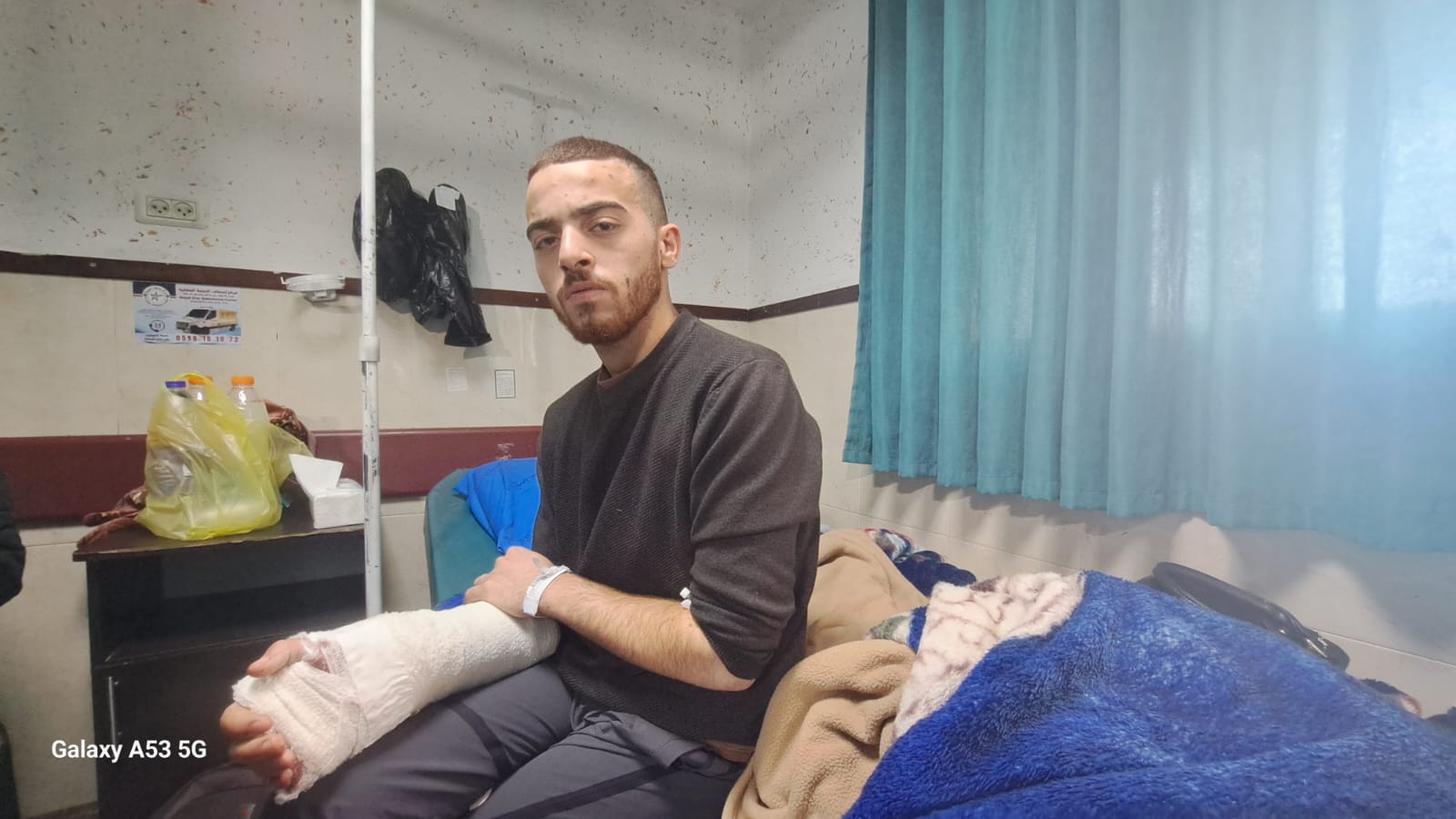
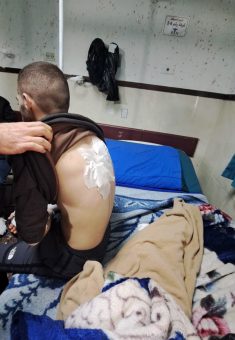
Yazan Rashdan at the hospital. Photo: Salma a-Deb’i, B’Tselem
When we were about 400 to 500 meters away from Qays’s house, we were suddenly surprised by a light about 20 to 30 meters away from us. It looked like someone was standing there signaling to us with a flashlight, but we couldn’t see him clearly. He was standing on the other side of the road, on the left. Qays slowed down and when he was almost at a stop, we were suddenly fired at. I heard seven or eight shots. I didn’t understand what was happening, but I saw Qays drop his head onto the steering wheel, and the car swerved sharply toward the wall on our right.
I heard heavy shooting and couldn’t see anything. I put my head down and crouched on the floor of the car to protect myself. The car stopped after it crashed into the wall on the right side of the road, and as I later found out, also hit a utility pole. Even so, the soldiers continued shooting at us, about 30 bullets. The windows shattered, and the noise was very loud. I kept my head down and shielded it with my hands. The car leaned over onto its right side.
I heard Ibrahim shouting, but I didn’t hear M.’s and Qays’s voices, so I was sure they’d been killed. I couldn’t utter a word, I was so terrified. I didn’t understand what was happening, why all the shooting. We didn’t see any soldiers at all and didn’t know they were in the area. We saw only one person with a flashlight, and we couldn’t make him out either.
Then the left door suddenly opened, and soldiers pulled Ibrahim and me out of the car. It was only then that I saw the soldiers. At first there were about five or six of them, and then more joined them. I didn’t see M. and thought he must be dead.
The soldiers pulled me out forcefully, threw me to the ground and dragged me for about 20 meters. Then I noticed a military jeep arriving from the opposite direction. They put me next to the jeep, a few meters apart from Ibrahim and from M., who I thought was dead.
The soldiers shouted at me and ordered me to put up my hands. I put up my hands. I was wounded in the arm and bleeding. One of the soldiers hit me on the head with his gun, and then he hit me again. I felt dizzy and almost passed out. I couldn’t say a word. I pretended to pass out so they’d stop beating me, but still, they kept kicking me for about three minutes.
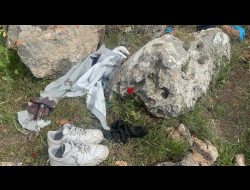
Then they moved away from me. I heard Ibrahim and M. shouting from the beatings they took from the soldiers. I stayed like that for about 10 minutes, and then a soldier came and stripped me, he lifted my shirt and pulled down my pants. I thought they wanted to check where I was wounded, but they did nothing and didn’t give me any medical treatment.
After about 10 to 15 minutes, an ambulance came, and the soldiers put Ibrahim and me in it, but then they wouldn’t let it leave and demanded our ID cards. Ibrahim didn’t have one, so the soldiers refused to let the ambulance leave. In the end, after a few minutes, they let us go, after they took a picture of Ibrahim.
The ambulance took us to Rafidya Hospital in Nablus, and M. arrived there in another ambulance shortly after us. The medical staff checked us, and it turned out that M. had been lightly wounded by several bullet fragments; Ibrahim was seriously wounded in the abdomen and was taken into surgery, and I was wounded in the arm and by fragments in my back.
Later, I found out that Qays had been killed and that the soldiers had his body. I also found out that they torched the car. I don’t know why. I didn’t see it myself, but they probably set it on fire after they moved us away from it.
Ibrahim ‘Abdallah, 17, a twelfth-grade student and a resident of the village, stated in his testimony:
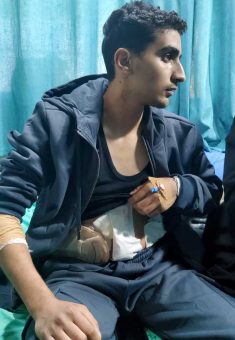
Ibrahim ‘Abdallah at the hospital. Photo: Salma a-Deb’i, B’Tselem
The soldiers opened the car door on the left side and pulled Yazan and me out. I didn’t see M. I thought he and Qays were dead, because they were both sitting in the front. The soldiers grabbed me forcefully and threw me out of the car, then dragged me by the legs, I think it was about 20 meters. They shouted at me, and one of them grabbed me by the neck and slammed my head against the jeep. Then he kicked me in the leg, and I fell. I tried to get up, but the soldiers kicked me again, and one of them hit me in the head with his gun. I felt dizzy and couldn’t see anything. Then he hit me in the chest with his gun and kicked me in the abdomen with his heavy shoe. I felt a sharp pain. I put my hand on my abdomen and felt something sticky and a lump on the side. I lifted my jacket and saw blood and intestines sticking out of the left side of my body. I didn’t even realize I’d been hit in the abdomen until then. Apparently, when the soldier kicked me in the abdomen, my intestines came out. I thought I was going to die from the injury and the blows. Here were my intestines spilling out of my abdomen. I smiled, even though I felt my soul was about to leave my body. I did it because I wanted to be smiling in my last moments. One of the soldiers grabbed me by the neck and tried to strangle me. I mustered all the strength I had at that moment and pushed him, but he stepped on my neck with his heavy boot until I almost choked. If another soldier hadn’t pulled him away, I’d be dead now.
When the soldiers, about five or six of them, backed away from me, I saw Yazan on the ground, in his underwear, with several soldiers around him. Then they stripped me too. I didn’t understand why, maybe to see my injuries. At that moment, I heard the ambulance siren. Paramedics arrived and put Yazan and me into the ambulance. The soldiers asked the paramedic, in Hebrew, for my ID card. I told him it was at home. I understood that they did not want to transfer me until they got my ID card, but in the end, one of the soldiers took a picture of my face, and a few minutes later, they let us leave.
The bullet hole in Ibrahim ‘Abdallah’s foot. Photo: Salma a-Deb’i, B’Tselem
The paramedics took us to Rafidya Hospital in Nablus. I found out that Yazan had been shot in the arm. I was taken into the operating room because it turned out that I had been wounded by a bullet that entered the side of my body and exited through my abdomen. Afterwards, they transferred me to the ICU, and I stayed there for a few days, and then they transferred me to the ward. I found out that same day that Qays had been killed and that the soldiers took his body on the pretext that he had tried to run over a soldier. When I heard that, I went mad. How can that even be? Does anyone think it makes sense that Qays planned to carry out an attack and that the three of us would go with him? It’s insane. We did nothing. They were the ones who fired at us. They didn’t give us a chance to stop at all. They immediately fired at us. Lethal fire. Maybe more than 40 bullets. Everything collapsed before our eyes. Later, I found out that they also burned the car. Why, I don’t know.
The Red Crescent ambulance driver who evacuated Yazan ‘Allan and Ibrahim ‘Abdallah related in his testimony:
On Wednesday, 28 December 2025, at around 7:30 P.M., we got a report from the communications officer at the Red Crescent branch in the town of Beita about a car being shot up in the village of ‘Einabus. We set out immediately, and when we reached the scene, in the western part of the village, we turned on the ambulance’s flashing lights and siren. We stopped about 150 meters away from the soldiers.
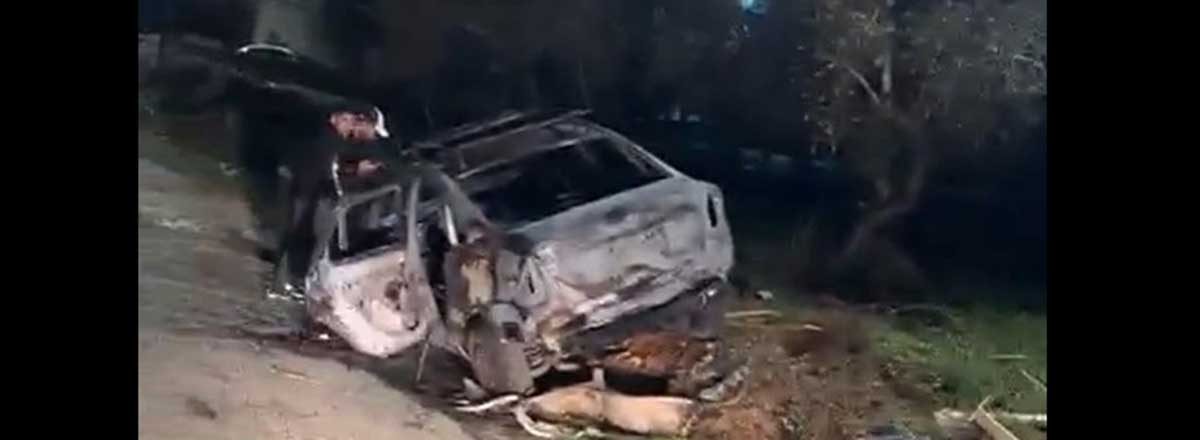
I noticed a military jeep and about four to six soldiers. A young man was lying on the ground, and about 15 meters away from him, there were three other young men. I saw a car on fire.
When we arrived, one of the soldiers signaled us not to come closer and ordered us to back up. I backed up very slowly. At that moment, another soldier, who appeared to be the officer, arrived and signaled me to move forward. I continued cautiously until I reached him. He said to me, “Look here,” and pointed at the young man who was lying on the ground.
The medic who was with me in the ambulance and I quickly got out and went over to the wounded man. It appeared that he had sustained several injuries, including a head injury. I checked his pulse and breath, and there were no vital signs. I told the soldiers that he was dead and asked them to let me go over to the other wounded men.
I went over to the three young men. One of them was wounded in the abdomen, and his intestines were outside; the second had minor injuries, and the third was wounded in the arm. I gave them quick first aid, and the other paramedic and I carried two of them into the ambulance. We wanted to get them out of there as quickly as possible, but the soldiers wouldn’t let me leave because they wanted one of the guys’ ID card, the one who was wounded in the abdomen.
I told them that his condition was critical and that he had to be evacuated urgently to the hospital. One of the soldiers took a picture of him with his cell phone, apparently for identification. A few minutes later, they let us go. At that time, another ambulance arrived. It evacuated the third wounded man to Rafidya Hospital in Nablus, and I evacuated the other two there.
Israel’s regime of apartheid and occupation is inextricably bound up in human rights violations. B’Tselem strives to end this regime, as that is the only way forward to a future in which human rights, democracy, liberty and equality are ensured to all people, both Palestinian and Israeli, living between the Jordan River and the Mediterranean Sea.
Since the Hamas attack on 7 October 2023, Israel has acted in a coordinated and deliberate manner to destroy Palestinian society in the Gaza Strip, committing genocide against its residents. In light of Israel’s actions in Gaza, the public statements made by Israeli decision-makers, and the international community’s failure to take effective action, there is a serious risk that the Israeli regime will expand the genocide to other areas under its control—first and foremost, the West Bank.
B’Tselem calls on the Israeli public and the international community to use every tool available under international law to bring an immediate end to Israel’s genocide against the Palestinian people.