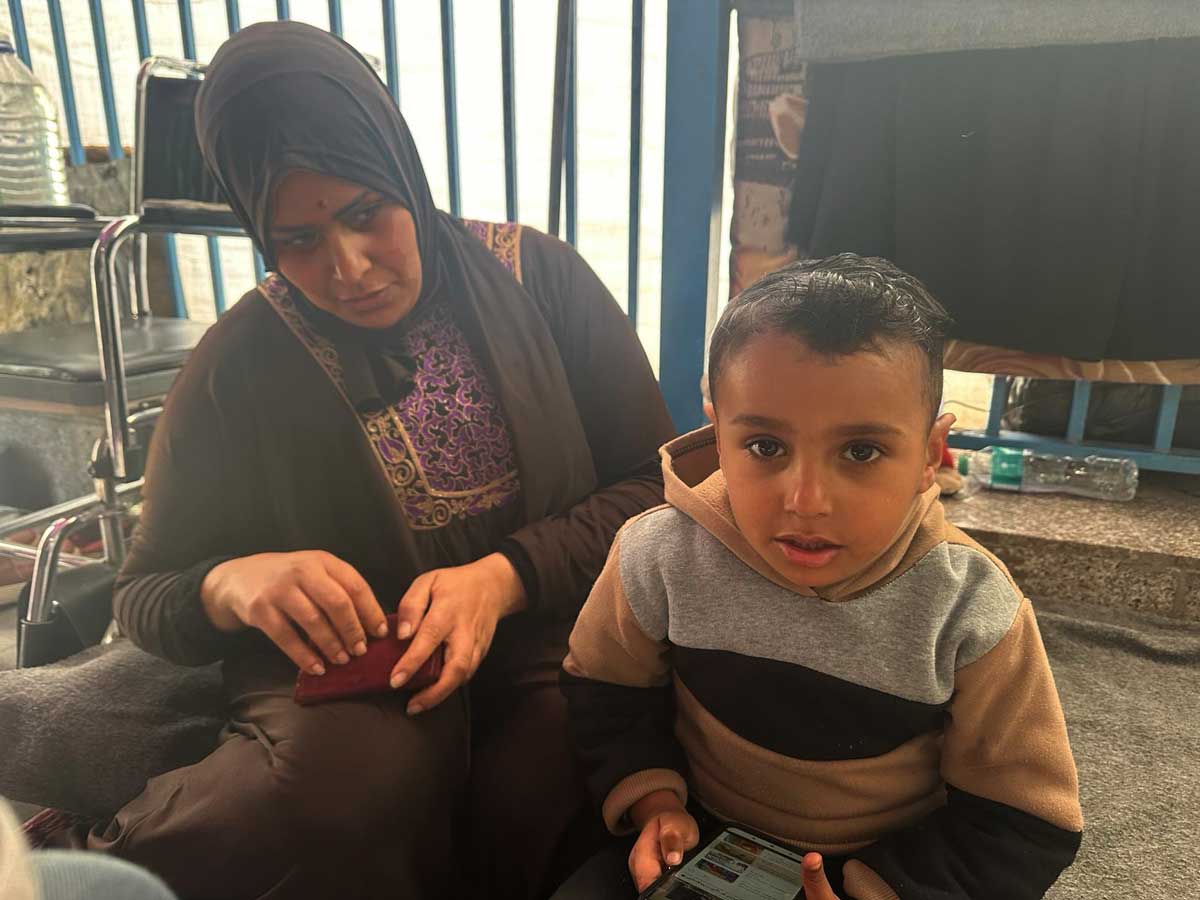
A 33-year-old divorced mother of four, Nasmah recounted her family’s ordeal since leaving home in Gaza and her son, 4, contracting hepatitis at the IDP camp
Until the war, I lived in a-Shuja’iyeh neighborhood in Gaza City with my four children, Khaled, 15, Majed, 11, Malek, 8, and Adam, 4. When the war started, I moved to the Orthodox Cultural Center in Tell al-Hawa with my children as well as my brother Majed, his wife and their three children, Zakaria, 10, Wasim, 8, and Karim, 6, and my sister Rida, 45. We stayed there for two weeks in very difficult conditions, because there was hardly any food or water. It was impossible to go out and get groceries because the bombing was relentless. We heard it all the time.
Then the military ordered us to leave the cultural center, so we moved to a-Shifaa Hospital. There were already thousands of IDPs there, so we settled in the yard. We slept on blankets on the ground. There was a shortage of food and water there, too, and the hygienic conditions were atrocious. There was no water for drinking or bathing. We drank salt water.
Later a-Shifaa Hospital was also hit in a bombing, so we fled to Rafah. We took the few clothes we had and rode in a horse-drawn cart to the al-Kuwait roundabout. From there, we continued on foot to the Israeli military checkpoint in Netzarim. The soldiers ordered us to leave the bags with the clothes there, and we kept walking to Rafah.
When we got to Rafah we came here, to an IDP camp in a school. There were thousands of people here already. For the first two days, we slept on the floor inside the school building, and then we got mattresses. The conditions are difficult here, too. There’s a shortage of food and water for drinking and bathing. There aren’t enough cleaning materials and everything is filthy, the shared toilets, the passageways and the classrooms.
About two weeks ago, Adam, my little one, developed a fever and started vomiting. I took him to the clinic at the school and the doctor said he needed to go to the hospital. We went to Abu Yusef al-Najar Hospital right away, where they gave him an anti-vomiting injection. He didn’t get better, so we went back to the hospital the next day. But they couldn’t help him. His fever stayed high, and he barely ate or drank.
In the end, we reached a private doctor who said Adam had hepatitis. He gave him fluids and more medication, against vomiting, diarrhea and fever.
The terrible sanitary situation is making it hard for Adam to recover. He was at risk every time I had to take him to the dirty toilet at the school.
I’m taking care of him day and night, and am always very careful about hygiene around us. I try to make special food for him from what’s available here, and am still giving him medicine to lower the fever. But Adam is constantly tired and lethargic, and can’t play like other children.
Adam’s illness is another worry, on top of the terrible living conditions here and the financial pressure. I’m a single mother and don’t have much money. My brother Majed opened an ‘Awama (small donut) stand here, but it barely brings in 30 shekels a day and we all have to get by on that.
Our suffering will continue until this war is over.
* Testimony given to B’Tselem field researcher Muhammad Sabah on 11 February 2024