Publications
Filter publications:
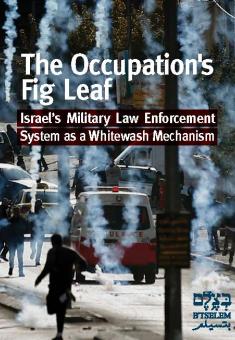
The Occupation's Fig Leaf
Israel’s Military Law Enforcement System as a Whitewash Mechanism
The report explains the reasons behind B’Tselem’s decision to no longer refer complaints to the military law enforcement system. It was made based on information compiled from hundreds of complaints B’Tselem has filed with the military, dozens of military investigations and many meetings with officials. B’Tselem will continue reporting violations but will no longer help a system which serves as a whitewash mechanism and that also, in advance, absolves senior military and government officials of responsibility for the policy they set out.
Backed by the System
Abuse and Torture at the Shikma Interrogation Facility
Joint report with HaMoked, Center for the Defence of the Individual
Sleep deprivation; prolonged binding; verbal and sometimes physical abuse; exposure to heat and cold; poor, meager food; small, foul-smelling cells; solitary confinement; unhygienic conditions. A new report by HaMoked and B’Tselem shows these to be standard in interrogations at Israel Security Agency’s (ISA) facility at Shikma Prison. The report is based on affidavits and testimonials by 116 Palestinians interrogated there from Aug. 2013 to March 2014, including at least 14 who had been interrogated under torture by the Palestinian Authority shortly before. The ISA’s interrogation system is run with the approval of Israeli authorities, including the High Court of Justice.
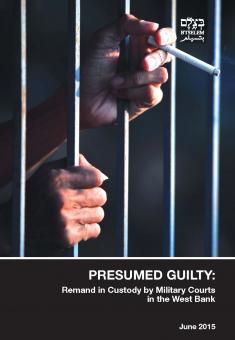
Presumed Guilty
Remand in Custody by Military Courts in the West Bank
A new report B’Tselem published today indicates that remand in custody is the rule rather than the exception for Palestinian defendants. Most cases, therefore, end in plea bargains. To all intents and purposes, the Israeli military court appears to be a court like any other. There are prosecutors and defense attorneys. There are rules of procedure, laws and regulations. There are judges who hand down rulings and verdicts couched in reasoned legal language. Nonetheless, this façade of propriety masks one of the most injurious apparatuses of the occupation. The rules of Israeli law, ostensibly applied to the military court, have been rendered essentially meaningless - merely serving to whitewash the flaws of the military court system.

Black Flag
The legal and moral implications of the policy of attacking residential buildings in the Gaza Strip, summer 2014
The report looks at the policy of bombing residential buildings in Gaza during Operation Protective Edge. This policy was one of the horrifying hallmarks of the fighting in Gaza in the summer of 2014, leading to the death of hundreds of people – more than a quarter of the operation’s Palestinian casualties. The report examines the recurrent stories of many Palestinian families who lost everything in a split second and analyzes Israel’s contention that it followed IHL provisions. While Hamas openly declared its intent to harm Israeli civilians, Israeli officials kept saying, both during and after the war, that the military had obeyed the law and done everything in its power to avoid harming civilians. The report indicates that these claims are entirely baseless.
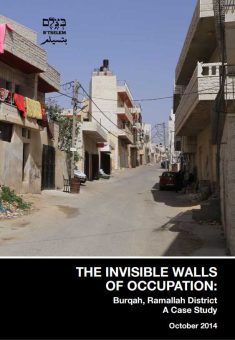
The Invisible Walls of Occupation
Burqah, Ramallah District, A Case Study
This report concerns the village of Burqah, Ramallah District. A rather unremarkable village, Burqah has never taken center stage in the fight against the occupation, and has not been subjected to extreme punitive measures. In fact, we chose to focus on Burqah precisely because it is unexceptional, as a case in point demonstrating what life under the occupation is like for residents of Palestinian villages. Burqah is a small, picturesque village, set amidst fields. Like many other villages, it endures severe travel restrictions which isolate it from its surroundings. It is also subject to massive land-grabs and stifled planning, all of which have turned it into a derelict, crowded and backward village with half its population living at or below the poverty line.
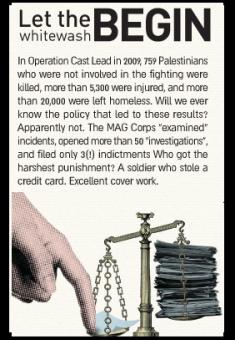
Israeli authorities have proven they cannot investigate suspected violations of international humanitarian law by Israel in the Gaza Strip
During Operation Protective Edge, Israel violated international humanitarian law in some cases, and many other cases are highly suspect. However, B’Tselem does not intend to demand that these suspicions be investigated by Israel’s current investigation mechanisms. This is due to the experience that B’Tselem gained following past military offensives in the Gaza Strip, which shows that there is currently no official body in Israel capable of conducting independent investigations of suspected violations of international humanitarian law.

47 Years of Temporary Occupation
At times, the occupation seems to be a thing of the past, but it is still going strong. A third, and even fourth, generation of Palestinians and Israelis has been born into this reality, and they know no other. Israel has created a reality in which the Palestinians live under a harsh military regime, which serves first and foremost Israeli and settler interests. This reality of dispossession, oppression and violation of human rights in the West Bank has lasted almost fifty years, and indicates far-reaching intentions for the future. While this state of affairs is progressively entrenched, the illusion that it can continue indefinitely grows stronger. The inevitable result is daily violation of the human rights of Palestinians living under occupation. Only ending the occupation will alter this reality.
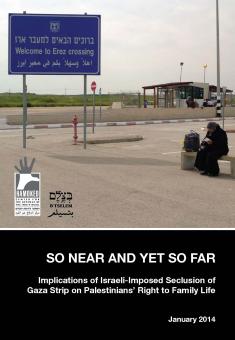
So Near and Yet So Far
Implications of Israeli-Imposed Seclusion of Gaza Strip on Palestinians’ Right to Family Life
Joint report with HaMoked, Center for the Defence of the Individual
The report explores Palestinians’ right to family life in view of Israel’s isolationist policy, which practically prohibits passage between Gaza and the West Bank, thereby severing families and keeping couples from living normally, if one spouse is from Gaza and the other from the West Bank. Tens of thousands face this impossible reality, whereby Israel intrudes on the most intimate aspects of life. Basic features of life–building a family, living with one’s spouse and children and regular contact with the extended family–become a pipedream.

Position Paper: Turkel Commission 2nd Report
Turkel Commission Report on Israel's Mechanisms for Investigating Complaints of Violations of International Humanitarian Law
Six months after the Turkel Commission’s issued its report on Israel’s investigative policy of alleged violations of laws of war, B’Tselem published a position paper on the report. While the commission held that Israel fulfills its obligation to investigate, it noted: “in several of the areas examined, there are grounds for amending examination and investigation mechanisms and in several areas, there are grounds for changing the accepted policy”. The commission’s recommendations are far-reaching. Nonetheless, B’Tselem emphasizes that greater systemic change is needed to bring Israel’s military investigative policy up to par.

Acting the Landlord
Israel's Policy in Area C, the West Bank
60% of the West Bank is designated Area C, under exclusive Israeli control. It is home to 180,000 Palestinians and includes most West Bank land reserves. Israel, citing “state lands” or “firing zones”, largely prohibits Palestinian construction. Israel’s planning policy ignores local needs: refuses to recognize villages or draft plans; blocks development and infrastructure hook-ups; and demolishes homes. Thousands are in danger of expulsion for living in firing zones or “illegal” communities. Israel has appropriated most water sources and restricts Palestinian access to them.

Human Rights Violations during Operation Pillar of Defense, 14-21 November 2012
The report reviews civilian casualties during Operation Pillar of Defense. It provides statistics regarding the number of Palestinians and Israelis killed during the operation (14-21 November 2012). The report challenges the prevalent perception among the Israeli public and media that the operation was “surgical” and caused practically no fatalities among uninvolved Palestinian civilians. The report also demonstrates a significant difference between the first and second half of the operation: 80% of the fatalities of uninvolved Palestinians occurred in the last four days of the operation.

Crowd Control
Israel’s Use of Crowd Control Weapons in the West Bank
The report reveals the full inventory of crowd control weapons used by Israeli security forces in the West Bank. These weapons are meant to be non-lethal, enabling authorities to enforce the law without endangering human life. In fact, however, some of these weapons are dangerous and may be lethal if used improperly. Crowd control weapons have killed and injured demonstrators and people throwing stones.
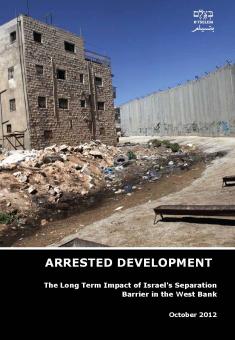
Arrested Development
The Long Term Impact of Israel's Separation Barrier in the West Bank
A decade after construction began on the Separation Barrier, the harm to adjacent Palestinian communities is clear. With some two-thirds of the barrier completed, it has crippled agriculture along its route. By isolating communities from each other and from their land, the barrier has eroded their ability to survive and prevents any sustainable development. This reality violates the state's commitment to the High Court that the barrier would not seriously harm these communities.
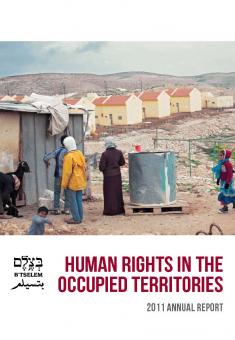
Human Rights in the Occupied Territories
B'Tselem 2011 annual report
The report surveys the broad spectrum of issues regarding the Israeli authorities' human rights record in the West Bank and Gaza Strip over the past year, the 44th year of the Israeli occupation. An interactive version of the report is available online and distributed through social media. The report documents a sharp increase in the number of uninvolved Palestinians killed by the Israeli security forces in the Gaza Strip in 2011. There was also an increase in the number of Israeli civilians killed by Palestinians, compared to 2010.

Under the Guise of Legality
Declarations of state land in the West Bank
The report examined Israel's policy of declaring land in the West Bank "state land". The research reveals that large areas were classified as state land for the use of settlements even though the land was actually privately or collectively owned by Palestinians. This was achieved by re-writing the interpretation to the Ottoman Land Law. This way, between 1979-2000, Israel declared more than 900,000 dunums as state land, an addition of 170% to the total before 1967.
Israel’s regime of apartheid and occupation is inextricably bound up in human rights violations. B’Tselem strives to end this regime, as that is the only way forward to a future in which human rights, democracy, liberty and equality are ensured to all people, both Palestinian and Israeli, living between the Jordan River and the Mediterranean Sea.
Since the Hamas attack on 7 October 2023, Israel has acted in a coordinated and deliberate manner to destroy Palestinian society in the Gaza Strip, committing genocide against its residents. In light of Israel’s actions in Gaza, the public statements made by Israeli decision-makers, and the international community’s failure to take effective action, there is a serious risk that the Israeli regime will expand the genocide to other areas under its control—first and foremost, the West Bank.
B’Tselem calls on the Israeli public and the international community to use every tool available under international law to bring an immediate end to Israel’s genocide against the Palestinian people.