Publications
Filter publications:
Separated Entities
Israel Divides Palestinian Population of West Bank and Gaza Strip
Israel is taking unilateral measures to institutionalize and perpetuate a new factual and legal reality of separation between residents of the Gaza Strip and the West Bank, while severing the interdependent social, economic and cultural ties between the two groups,1 infringing their rights and impeding the possibility that the Palestinian people will realize their right to self determination.
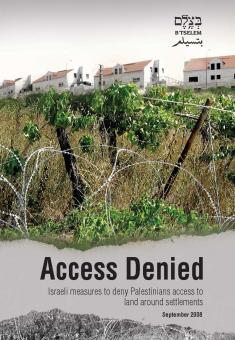
Access Denied
Israeli measures to deny Palestinians access to land around settlements
A report on Israel's blocking of Palestinian access to land around settlements lying east of the Separation Barrier. The report reveals that state authorities and settlers have de-facto annexed rings of land amounting to tens of thousands of dunams to these settlements.
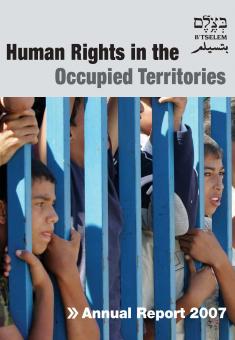
2007 Annual Report
Human Rights in the Occupied Territories
According to the report, the number of Israelis and Palestinians killed in clashes in the West Bank and the Gaza Strip dropped. However, there has been deterioration in many other measures of the human rights situation in the Occupied Territories.

Ground to a Halt
Denial of Palestinians' Freedom of Movement in the West Bank
Since the beginning of the second intifada, in September 2000, Israel has imposed restrictions on the movement of Palestinians in the West Bank that are unprecedented in scope and time. As a result, the fundamental right of West Bank Palestinians to freedom of movement, their exercise of which was limited in any event, has become a privilege that Israel extends to them as it deems fit. Indeed, Palestinian travel in the West Bank is now an exception, which must be justified to the Israeli authorities, and almost every trip entails uncertainty, friction with soldiers, much waiting, and often great expense.
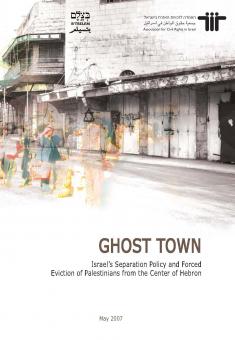
Ghost Town
Israel's Separation Policy and Forced Eviction of Palestinians from the Center of Hebron
Israel's policy of segregation in the center of Hebron led to the closing of at least 1,014 commercial establishments during the Intifada. At least 659 Palestinian families had to leave their homes. These are the finding of a new report issued today by B'Tselem and The Association for civil rights in Israel.
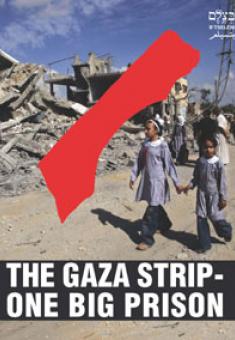
The Gaza Strip: One Big Prison
Despite the so-called “disengagement” in August 2005 and the recent internal violence, the Gaza Strip remains subject to Israeli control. This publication surveys the
various spheres of Israeli control in the Gaza Strip, and the implications
of this control. So long as Israel retains extensive control over Gaza, it cannot disengage from its responsibility.
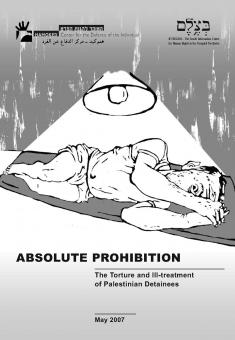
Absolute Prohibition
The Torture and Ill-Treatment of Palestinian Detainees
The ISA routinely maltreats Palestinian detainees during interrogations and in some cases even tortures them. This is one of the findings of the report issued today by B'Tselem and HaMoked: Center for the Defence of the Individual.
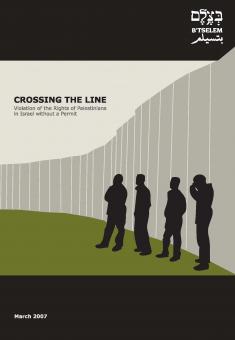
Crossing the Line
Violation of the Rights of Palestinians in Israel without a Permit
The report is a unique study on the infringement of the human rights of the tens of thousands of Palestinian workers staying in Israel without a permit.

Barred from Contact
Violation of the right to visit Palestinians held by Israel
The report details Israel's severe restrictions on family visits with Palestinian prisoners. Israel holds the prisoners inside its territory, in violation of international humanitarian law. Israel's visitation policy violates the right of thousands of families to visit their imprisoned relatives.

Act of Vengeance
Israel's Bombing of the Gaza Power Plant and its Effects
The report shows that most residents of the Gaza Strip continue to be cut off from electricity half of every day, with wide-ranging, adverse affects.

Perpetual Limbo
Israel's Freeze on Unification of Palestinian Families in the Occupied Territories
The report focuses attention on the hundreds of thousands of Palestinians affected by the freeze on family unification that prevents Palestinians in the West Bank and Gaza from living together with their spouses who are foreign residents, in the report Perpetual Limbo.
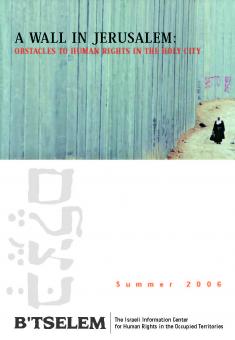
A Wall in Jerusalem
Obstacles to Human Rights in the Holy City
A brochure on Obstacles to Human Rights in the Holy City published as part of a campaign that included tours and briefings.
Under the Guise of Security
Routing the Separation Barrier to Enable the Expansion of Israeli Settlements in the West Bank
The report deals with the route of the separation barrier showing that the route was based on considerations relating to settlement expansion and control of land, and not on security reasons, as the government has continuously claimed.

Means of Expulsion
Violence, Harassment and Lawlessness Toward Palestinians in the Southern Hebron Hills
For the past five years, Israel has been trying to expel some one thousand Palestinians who have maintained the way of life of their ancestors in the southern Hebron hills.

Take No Prisoners
The Fatal Shooting of Palestinians by Israeli Security Forces during “Arrest Operations”
The report raises the strong suspicion that during the past year the military engaged in assassinations in the guise of arrest operations.
Israel’s regime of apartheid and occupation is inextricably bound up in human rights violations. B’Tselem strives to end this regime, as that is the only way forward to a future in which human rights, democracy, liberty and equality are ensured to all people, both Palestinian and Israeli, living between the Jordan River and the Mediterranean Sea.
Since the Hamas attack on 7 October 2023, Israel has acted in a coordinated and deliberate manner to destroy Palestinian society in the Gaza Strip, committing genocide against its residents. In light of Israel’s actions in Gaza, the public statements made by Israeli decision-makers, and the international community’s failure to take effective action, there is a serious risk that the Israeli regime will expand the genocide to other areas under its control—first and foremost, the West Bank.
B’Tselem calls on the Israeli public and the international community to use every tool available under international law to bring an immediate end to Israel’s genocide against the Palestinian people.