Before the war broke out, I lived with my wife, Iman, 30, and our six children, between the ages of 5 and 13, in the a-Zeitun neighborhood in Gaza City, and worked the Tafesh – Frozen Meat and Poultry store. Within a week I stopped working, because there was no regular electricity and there was no poultry or meat.
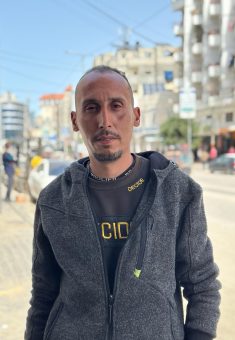
We stayed at home and heard airstrikes all the time. I only went out for urgent groceries. We tried all the time to keep the kids calm, even though the sound of the bombings terrified us, too. We heard on the news and from neighbors that many people were killed or injured.
One of the soldiers cut the internet cables and used them to tie our hands behind our backs.
After two weeks, a lot of residents left our area because they were afraid of the relentless artillery shelling. Some of them moved to the southern Gaza Strip and some to the western part of Gaza City. My family and I also left. We rented a warehouse west of Gaza City and stayed there until the ceasefire was declared, and then we went back home.
Two days after the ceasefire ended, the Israeli military invaded the a-Zeitun neighborhood. The bombings started and didn’t stop. Planes circled above us and fired at anything that moved on the streets. There were a lot of casualties, including people I know whom we couldn’t get out from under the rubble.
The situation was very dangerous. The siege on the area continued. We moved to my uncle's house, which is behind other houses, not on the main street. There were 17 other people in the apartment with us, my relatives and in-laws.
Then, on Thursday, 7 December 2023, around 6:00 A.M., I heard relatives talking to someone in English, and then I saw a tank coming towards our building. I gave my daughter Hiba a white flag so the soldiers would see her and stop coming towards us. The soldiers stopped and ordered us to come out of the house one by one. I was the last to leave.
I held my children and we stood by the house. I saw a lot of soldiers around us and some snipers on the rooftops. It was a very frightening sight, especially for the children. We were surrounded by tanks and armed soldiers, and they were very scared and clung to me. I saw a lot of destruction in the neighborhood, which I hadn’t seen before.
Then an officer ordered us to stand on one side of a wall and the women and children on the other, and to raise our hands in the air. They started calling us one by one. One of the soldiers cut the internet cables and used them to tie our hands behind our backs.
They tied my arms and legs to a fence with my arms stretched up, and held me like that in the "Shabah" position for more than 5 hours. In less than an hour, my whole body started hurting
The soldiers blindfolded the men and boys and led us somewhere else, where they held us for five days with almost no food and water. The whole time we had our hands tied and our eyes covered, and they humiliated, beat and kicked us.
They gave us only a little bread and very little water to drink. One day, a soldier ordered my nephew Mahmoud, 15, to hand out the food to us: a piece of bread for every person and a drop of water from a bottle cap. My hands hurt from being tied and my knees hurt from kneeling so much.
Then they transferred me along with another 60 or 70 detainees to another military point. There, they put us on a bus that took us to a military camp, where they dropped us off in an open yard covered in gravel. It was very cold and windy. They took us into an interrogation room one by one. During the interrogation, the interrogator accused me of belonging to Hamas, and I replied that I had no connection to Hamas and that I sold poultry and meat.
Then they took me to a doctor who examined me. He noted the wounds on my wrists from being tied with the internet cables. When we left the doctor's room, they tied our hands in front of us with zip ties and took us to a large shed. It was evening by then, and they gave us a piece of bread, an apple, cheese and water. I was there three days and the whole day, from morning to evening, we were kept down on our knees and they shouted and swore at us, calling us things like “son of a bitch" and "whores."
After three days, they took me to an interrogation room. The interrogator asked for my name, age and job, and asked why we stayed home and didn't leave. I answered that I had nowhere to go and that other people stayed in the neighborhood, so we stayed too. After the interrogation, they took me to a shed where there were 12 other detainees. They called us one by one to go shower.
We ate, slept and relieved ourselves with our hands tied. Our hands were tied the whole time and we weren’t allowed to talk, move or even turn our heads to look aside
From there, they took us to a bus that drove us to another place, where they dropped us off and put us in a shed. It was cold, and again they made us kneel the whole time. After two days, they took us for another interrogation. I was about the Abu Ras family, which belongs to Hamas. I said, "Not from our family," but the interrogator wasn’t convinced. A soldier who was standing behind me hit me several times on the head and said, "Admit you’re Hamas."
When I said, "I'm not Hamas," he hit me a few more times. Then they tied my arms and legs to a fence with my arms stretched up, and held me like that in the "Shabah" position for more than 5 hours. In less than an hour, my whole body started hurting – my shoulders, arms, legs. After a while, I couldn’t feel them anymore. My whole body went numb.
When they took me down, they took me to a shed. I couldn't walk because my whole body hurt from being in the "Shabah." They kept me in the shed for 15 days, in which we all kneeled the whole time. We ate, slept and relieved ourselves with our hands tied. Our hands were tied the whole time and we weren’t allowed to talk, move or even turn our heads to look aside.
After 15 days, they allowed us to shower and gave us clean underwear. I went into the shower with my hands untied, but with a blindfold that they removed only once I was inside. They took four people to shower at a time. When I was taken in, the water was very cold and the weather was also cold. I only washed the lower part of my body, because I couldn't bear the cold. After the shower, they took us back to the shed and we went back to kneeling with our hands tied, without talking or moving.
I thought about my difficult situation, especially the darkness I was drowning in under the blindfold without seeing anything, about the fierce cold and the strong wind. I was freezing all the time
A few days later, they took me to the interrogation room. The officer asked about names of my relatives, who my brothers were and how many people were in the family. In the end, I signed what he wrote down from my answers.
The whole time, I kept thinking about my wife and children. What happened to them after the army arrested us? Did they kill them? If they’re alive, are they safe and sound or injured? Are they sick? Do they have anything to eat and drink? Did they go south or are they still in the north? I wondered what happened to Gaza, did they destroy it, is anything left of it. Those were the thoughts that occupied me all the time.
I also wondered why they arrested me. Why are they still holding me? What will happen to me here? When will they let me go? I thought about my difficult situation, especially the darkness I was drowning in under the blindfold without seeing anything, about the fierce cold and the strong wind. I was freezing all the time, and hungry and thirsty.
A few days later, they put us back on a bus, with our hands tied and our eyes covered. It was around midday. When the bus stopped, a female soldier came, untied my hands and removed my blindfold, and told me, "Go to Gaza."
My eyes saw light for the first time after 35 days of detention. When I got off the bus, I saw that I was at a crossing, and there were about 100 other detainees around me. We all ran quickly through the crossing (Kerem Shalom). Then we continued walking at a normal pace until we reached the UNRWA people, who gave us food and drink. We ate dates and drank water.
The torture affected our intelligence, because we simply lost the ability to think. All we could focus on was who was beating us, torturing us or seeking revenge upon us
I was detained for 35 days, with no justification and in inhuman conditions. During the detention, I lost about 20 kilos. It was the hardest thing I’ve ever gone through. Every day felt like a year. It was tough on every level – mentally, emotionally, physically. The torture affected our intelligence, because we simply lost the ability to think. All we could focus on was who was beating us, torturing us or seeking revenge upon us. We went through a very, very difficult experience.
I walked from the Kerem Shalom crossing to the al-‘Awdah junction in Rafah. There, I tried to contact my wife and family but couldn't get hold of them. I called my brother Muhammad, who lives in the West Bank. I told him I’d been released and asked him to try to contact relatives of ours. He got hold of them and told me they would come to pick me up. About an hour later, my cousins arrived and took me to Abu Yusef a-Najar Hospital in Rafah.
At the hospital, they ran tests and the doctor said I needed surgery on my left hand to free a nerve there.
Only a few days later, after a lot of attempts, I managed to contact my wife and children by phone. I found out they’d gone back to the warehouse we were in at the start of the war, and that the situation there was very bad. They were suffering in every way – a severe lack of food and water, and incessant bombing. You can’t get the most basic supplies there. My wife is there alone with our small children and my father, who is old and sick, so there’s no one to go and try to get supplies. My wife can barely get hold of anything and they don't have enough money left. They eat once a day.
One of the hardest moments for me and for my wife and children was when I called them for the first time. My wife said, "You’re alive?!" She was surprised I wasn’t dead. She didn't know we were detained. They looked for our bodies in the sand and under the debris, because they thought the Israeli military killed us all. We cried together, after we spoke and I knew they were safe and sound and they knew I was alive. For my wife, it was the best news she ever got – that I was alive and well.
The separation is awful, not being able to be together in this terrible situation. I’m in Rafah and they’re in Gaza, and I can't reach them or help them. I can't bring them to me, either, because there is nowhere for them to be and there’s talk of Israel invading Rafah. I’m trapped here, in a displaced persons’ camp in Rafah with my cousins, and they’re trapped in Gaza, and we can barely communicate.
In the camp with us are 2,400 displaced persons from Gaza City and from the northern part of Gaza. I’m here with no roof over my head, displaced, with not enough food and water, and in the extremely unhygienic conditions. There are long lines for the toilets, for drinking water, for the shower. It’s incredibly noisy all the time. It’s a very hard life.
But I’m holding on to the hope that this suffering will come to an end, that the war will stop, that we’ll go back to our homes and that I’ll reunite with my wife, children and the rest of my family in a-Zeitun.
* Testimony given to B'Tselem field researcher Muhammad Sabah on 26 March 2024
