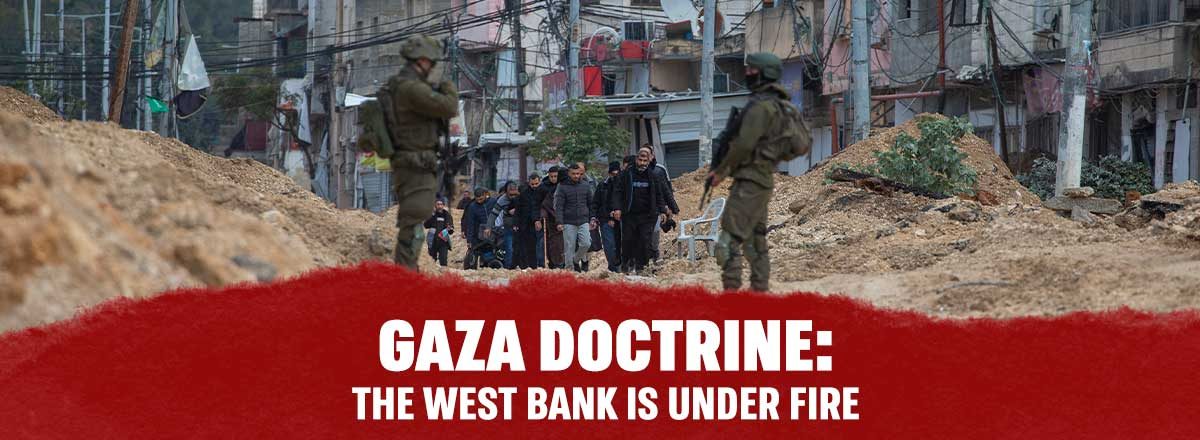
Israel is applying in the northern West Bank tactics and combat doctrines it has developed during its ongoing offensive in Gaza. This includes escalating airstrikes on densely populated areas, enforcing extremely lax rules of engagement that often result in indiscriminate and disproportionate harm to civilians, and displacing residents from areas the military has designated as combat zones. These actions indicate a process of “Gazafication” in the West Bank—already evident in the north and, according to statements by Israeli officials, expected to expand to other areas.
B’Tselem Executive Director Yuli Novak said: "Israel’s complete disregard for international law in the war in Gaza is now being replicated to the West Bank, at this stage mainly in the north. The military activity there, as yet on a smaller scale than in Gaza, is already causing indiscriminate and disproportionate killing and destruction. In 15 months of war in Gaza, the government’s actions made it clear that Israel has no intention of fulfilling its obligations under international law. It is likely to continue blatantly flaunting its duty to protect lives and human rights, and to uphold basic moral and humanitarian standards, unless the Israeli leadership is held truly accountable for its crimes against the Palestinian people.”
In the weeks following the Hamas attack on 7 October 2023, Israeli politicians were quick to proclaim that Israel was waging war not only on the Gaza Strip, but against all Palestinians living under its control.
Since then, senior politicians and public officials have repeated their demand for increased aggression against Palestinians in the West Bank. For example, Israel Katz, now Minister of Defense and then Minister of Foreign Affairs, called for Israel to "deal with the threat [in the West Bank] in exactly the same way as we deal with terror infrastructure in Gaza, including the temporary evacuation of Palestinian residents and any necessary measures."
On 19 January 2025, once the ceasefire in Gaza went into effect, the Israeli government declared it was adding the demand for "increased offensive activity" in the West Bank to its official list of "war objectives". The addition was merely a formal affirmation of Israel’s treatment of the West Bank since 7 October 2023 as another front, where it is applying tactics used in the onslaught on Gaza:
Increased reliance on airstrikes: Since 7 October 2023, Israel has frequently bombed cities and refugee camps in the northern West Bank. From that day to 8 March 2025, B’Tselem documented 69 airstrikes that killed 261 people, including at least 41 minors. Some were carried out by fighter jets for the first time since the Second Intifada. In stark contrast, airstrikes killed 14 people in the West Bank in the 18 preceding years, from 2005 to 7 October 2023.
Loose open-fire policy: Since the war began, Israel has been employing an extremely permissive open-fire policy, leading in many cases to indiscriminate and disproportionate harm to Palestinian civilians, many of them minors. As a result, the last two years have been the deadliest since 2002, at the height of the Second Intifada. B’Tselem documented the killing of at least 488 Palestinians in the West Bank in 2024, at least 90 of them minors. In 2023, 498 Palestinians were killed in the West Bank, 120 of them minors and 4 of them women. In total, from 7 October 2023 to 8 March 2025, Israeli forces killed 180 Palestinian minors in the West Bank, and five others were killed by an unknown Israeli party.
Large-scale invasions and destruction of civilian infrastructure: Israel has conducted a series of military invasions in the northern West Bank since the war began. These intensified after Operation Summer Camps was launched in August 2024 and have escalated since the Gaza ceasefire was declared on 19 January 2025. Large military forces, accompanied by bulldozers, have raided several cities and refugee camps in the area. These invasions are characterized by the deliberate and indiscriminate destruction of civilian infrastructure, including roads, electricity grids, and water and sewage networks. They also involve the detonation and partial or complete demolition of hundreds of homes, disruption of medical aid to residents, and, recently, the use of tanks and armored personnel carriers for the first time since the Second Intifada.
Displacement of civilians: The military, which forcibly transferred civilians in Gaza, is replicating this practice in the West Bank. Since Operation Iron Wall began on 21 January 2025, expanding from Jenin RC to Tulkarm RC, Nur Shams RC and al-Far’ah RC, an estimated 40,000 residents have been displaced. Defense Minister Katz declared they will not be allowed to return home in the coming year.