On the Agenda
Filter updates:
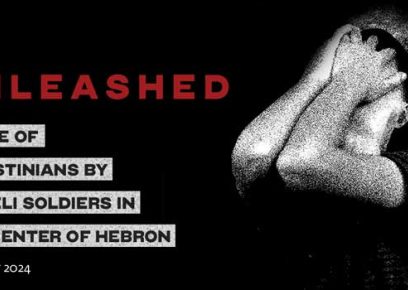
Unleashed: Abuse of Palestinians by Israeli soldiers in the center of Hebron
For over a year, Israel has been waging an unrestrained war against the Palestinian people in the Gaza Strip, the West Bank, and within the State of Israel. The violence that has always characterized the Israeli apartheid regime’s treatment of Palestinians is now appearing in its most direct and exposed form. This report focuses on one facet of this violence: recurring instances of severe abuse of Palestinians by Israeli soldiers in the center of Hebron throughout the summer of 2024...
Personal accountability is a key element in the struggle for justice and freedom for all
The ICC’s issuing of international arrest warrants for Israel’s leaders on the suspicion they committed the crimes of starvation, persecution, and intentionally directing an attack against civilians is one of the lowest points in Israeli history. Unfortunately, all we know about the conduct of Israel in the Gaza Strip over the past year - which was conducted with the knowledge and the direction of the prime minister and the ministerial cabinet – it isn’t surprising that the evidence indicates that Prime Minister Netanyahu and Defense Minister Gallant are responsible for war crimes and crimes against humanity...
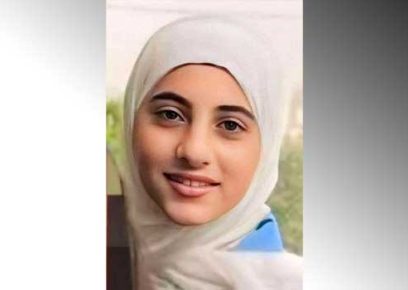
Bana Labum. Photo courtesy of the family
Israel soldiers killed a Palestinian girl, 13, at home in Qaryut after entering the village following a settler attack
On Friday, 6 September 2024, at around 3:00 P.M., dozens of settlers, some of them armed, arrived at the southern edge of the village of Qaryut in Nablus District. Soldiers escorting them in a military jeep stopped near the ‘Ein Silon freshwater spring, about a kilometer away from village homes. Some of the soldiers walked up the road leading to the village and stopped about a 100 meters from the homes. From there, they occasionally fired live rounds at residents who gathered to defend the village. The settlers stopped about 100 meters from the homes and pelted them with stones. Three settlers, one of them holding a Molotov cocktail, went towards one of the homes and tried to set it on fire. Residents pushed them away and started chasing them. During the chase, one of the settlers threw a stone that hit Muhammad Musa (28) in the jaw. Musa was taken to hospital and remained there until 18 September.
Still from video
Israeli soldiers shot and killed an American-Turkish protester endangering no one in the town of Beita
On Friday, 6 September 2024, about 100-150 Palestinians from the town of Beita and around 20 international and Israeli activists gathered for the weekly demonstration against the outpost of Evyatar, built on town land in Jabal Sbeih. Soldiers arrived before noon and deployed near the public park in the area of the Nimer grove, on a hill in the southern part of the town, where prayers are regularly held before the demonstration. At around 12:15 P.M., as locals gathered for the prayers, Ayşenur Ezgi Eygi, 26, an international activist, arrived in the area with other international activists. The prayers proceeded without incident, and then, at around 1:00 P.M., the residents and activists began leaving through the park gate. Most of the residents began making their way back home, with some heading for their cars in the parking lot at the entrance to the park and others walking down the road towards town homes...
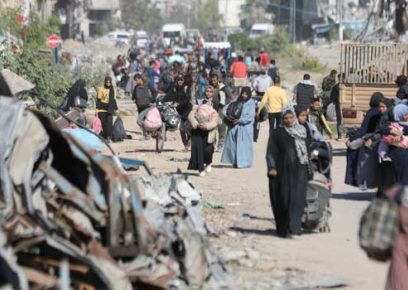
Displaced Palestinians flee from Jabaliya on the orders of the army, Dawud Abu Alkas, Reuters, 22 Oct. 2024
The world must stop the ethnic cleansing of northern Gaza
The magnitude of the crimes Israel is currently committing in the northern Gaza Strip in its campaign to empty it of however many residents are left is impossible to describe, not just because hundreds of thousands of people enduring starvation, disease without access to medical care and incessant bombardments and gunfire defies comprehension, but because Israel has cut them off from the world. Ever since Israel’s current operation in the northern Gaza Strip began on 5 October, the area has been under a near complete siege, relentlessly pummeled by the military...
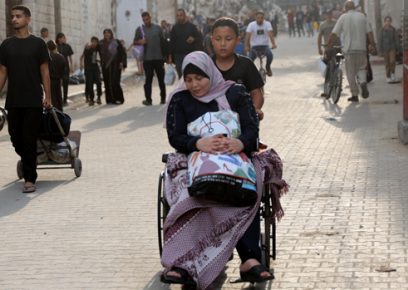
Palestinians fleeing Jabalia camp arrive in Gaza City, October 6, 2024
Israeli NGOs warn international community it will be complicit if Israel forcibly transfers the population of Northern Gaza
Human rights NGOs based in Israel today called on the international community to take action now to prevent Israel from forcibly transferring hundreds of thousands of Palestinians who have remained in the Northern Gaza Strip, including by denying entry of essential humanitarian aid and fuel. The Israeli ceasefire coalition, Gisha, B’Tselem, PHR-I and Yesh Din, said that there are alarming signs that the Israeli military is beginning to quietly implement the Generals’ Plan, also referred to as the Eiland Plan, which calls for complete forcible transfer of the civilians of the northern Gaza Strip through tightening the siege on the area and starving the population.
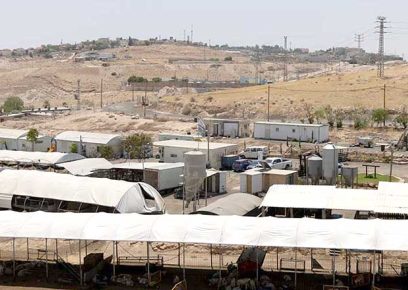
The Lechathila Farm outpost. Photo: Faiz Abu Rmeleh, B’Tselem, 22 July 2024
Settlers driving out Wadi al-Qalt community with state assistance
Over the past decade, settlement outposts and “agricultural farms” have become one of Israel’s primary methods for taking over land in the West Bank and driving Palestinian communities out. Unlike the bureaucratic process involved in establishing an official settlement, ‘pirate’ outposts can be set up quickly, with relatively few resources and laborers. Taking control of farmland via setting up outposts also allows the state to evade direct responsibility for land seizure and shrug off the violent, illegal acts by settlers involved in the process, while effectively supporting them in various ways. By using these settlers as proxies, the state frames the establishment of outposts as an issue of law enforcement rather than policy.
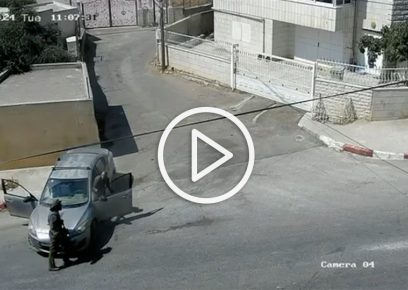
Still from video
Deir Dobwan, Ramallah District: Soldier steals Palestinian’s car after he and two settlers blocked its way with civilian pickup truck
On Tuesday, 10 September 2024, at around 11:00 AM, Samir Safi was driving his car in the eastern part of the village of Deir Dobwan when a civilian pickup truck entered his lane and blocked his way. In the truck were a soldier and two settlers. Safi reversed and tried to turn around, at which point the soldier got out of the truck, ran over to Safi's car, opened the door and ordered him to get out. The settler driving the truck turned it around and stopped, and then got out with the other settler, both of them carrying clubs. Safi got out of his car, and the soldier ordered him to leave. Safi moved away, and the soldier got in the car and drove off. Safi reported the theft to the Palestinian DCO.
Still from video
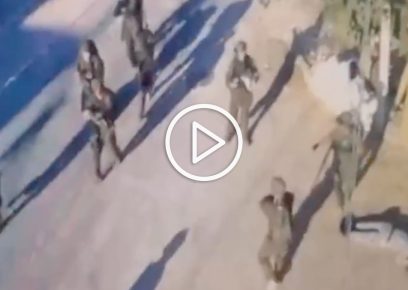
Israeli soldiers on an arrest mission in Tubas shot a PA customs officer, and shot him again as he lay on the ground
On Wednesday, 24 July 2024, at around 6:30 A.M., military jeeps and a white van with Palestinian license plates drove into the town of Tubas. Inside were soldiers, some of them masked and some wearing civilian clothes. The van drove into a dirt parking lot next to a Palestinian Authority customs office and stopped. Two soldiers in civilian clothes got out and greeted customs officers who were standing at the entrance to the building. Three soldiers in uniforms then got out of the van.
Still from video
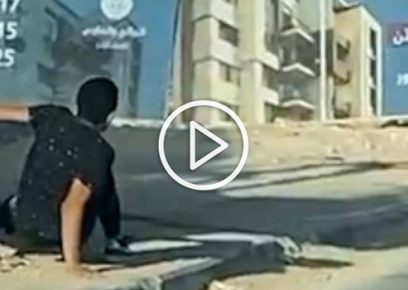
Soldiers who entered al-Birah shot a 12-year-old running home frightened by shots fired at stone-throwers, and then delayed his evacuation by ambulance
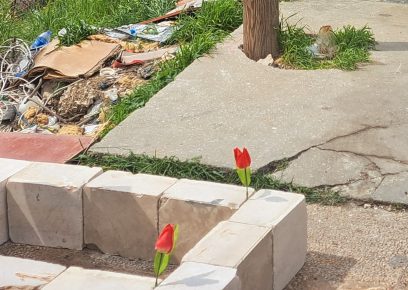
[...] At around 5:10 P.M., about 20 to 30 children and youths gathered in an alley in al-Am'ari Refugee Camp, which is adjacent to al-Birah. Some of them threw stones at the forces by the fire station, and the latter responded by shooting live bullets, tear gas canisters and stun grenades. Shortly before the shooting, 12-year-old Muhammad Hushiyeh set out home from the soccer field in al-Am’ari R.C. At around 5:15, he came out of an alley about 15 meters from the jeeps and turned west on Haifa Street. He heard the shots and started running west, away from the carwash. In video footage captured from the west, he is seen running away from the soldiers, and then several more shots are heard. Muhammad is then seen lying wounded on the sidewalk, about 70-75 meters from the soldiers who shot him, who were likely across the street from him...
The site where Muhmmad was hit. Photo: Iyad Hadad, B’Tselem
Border Police officer exits armored jeep and shoots young man endangering no one in the head from 100 meters away
On the night between 20 and 21 March 2024, Israeli military, Border Police and Israel Police forces entered the neighborhoods of Umm a-Sharayet and Kafr ‘Aqab northeast of Jerusalem and carried out an arrest. At around 5:00 A.M., as the armed forces made their way out of the area on the Ramallah-Jerusalem main road, about 15 young men waited for them by the road, on the outskirts of the Sateh Marhaba neighborhood in al-Birah. Once the forces turned into the Sateh Marhaba neighborhood, the young men also entered the neighborhood through alleyways and threw stones at the armored vehicles from about 10 meters away. The convoy kept driving towards the settlement of Kochav Ya’akov.
B'Tselem at the UNSC: For the Israeli government, the occupation and the settlements matter more than human life
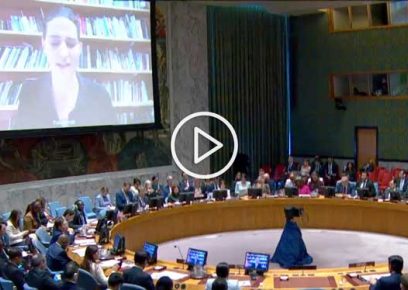
On Sunday, we woke up to the news that six Israeli hostages were executed by Hamas, just before soldiers reached them in a tunnel in Gaza. Another six, added to tens of thousands of people in this land who should not have died over the past year. During this week, hundreds of thousands of Israelis have taken to the streets. They feel angry, desperate and betrayed by their government. They have understood, perhaps for the first time, that the Israeli government does not want to return the hostages in a deal, but to continue the war indefinitely. They see that the occupation and the settlements matter more than human life - and not only of Palestinians, said B'Tselem Executive Director Yuli Novak, who addressed the UN Security Council last night (Wednesday) . B’Tselem - the Israeli Information Center for Human Rights in the Occupied Territories was invited by the Slovenian President of the Security Council to provide an expert review of the state of human rights in Israel/Palestine following the war. Watch Yuli Novak’s address to the UNSC.
Israel’s regime of apartheid and occupation is inextricably bound up in human rights violations. B’Tselem strives to end this regime, as that is the only way forward to a future in which human rights, democracy, liberty and equality are ensured to all people, both Palestinian and Israeli, living between the Jordan River and the Mediterranean Sea.
Since the Hamas attack on 7 October 2023, Israel has acted in a coordinated and deliberate manner to destroy Palestinian society in the Gaza Strip, committing genocide against its residents. In light of Israel’s actions in Gaza, the public statements made by Israeli decision-makers, and the international community’s failure to take effective action, there is a serious risk that the Israeli regime will expand the genocide to other areas under its control—first and foremost, the West Bank.
B’Tselem calls on the Israeli public and the international community to use every tool available under international law to bring an immediate end to Israel’s genocide against the Palestinian people.