On the Agenda
Filter updates:

Maryam Abu Yusef at the family grocery store. Photo: Khaled al-'Azayzeh, B'Tselem, 13 August 2017
Maryam Abu Yusef from a-Nuseirat R.C. describes coping with power and water shortages in Gaza
Maryam Abu Yusef, 67, a mother of five from a-Nuseirat R.C in Gaza, has to plan her life around the limited hours when her home receives electricity and water. Both vital services are provided only once every few days, and not always together. The family does not receive enough water, and what they do get is unfit for drinking. This forces them pay large sums of money to purchase additional water privately.
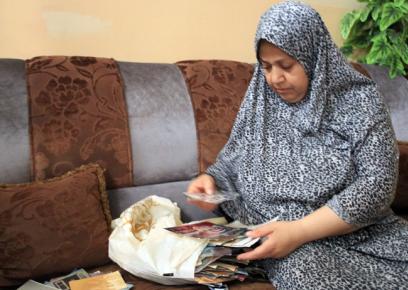
Najah al-Qatnani in her home in Gaza City. Photo: Olfat al-Kurd, B'Tselem, 2 Aug. 2017
Najah al-Katnani, 55, a mother of nine from Gaza City, describes being cut off from her family in the West Bank
Najah al-Katnani was born in al-Jalazun refugee camp in the West Bank. In 1975 she married and moved to Gaza City with her husband. At the time, she and her family could travel freely between the West Bank and the Gaza Strip. After the first intifada, Israel imposed restrictions on such passage. The restrictions were tightened after the second intifada, and Israel now permits passage only in “humanitarian cases.” Gaza residents are prevented from visiting their relatives in the West Bank, East Jerusalem, and Israel.

Palestinians watch the Israeli military arrive at the family home of the person who carried out the attack in the settlement of Har Adar. Photo by Ammar Awad, Reuters,
40,000 Palestinians Collectively Punished after Har Adar Attack
On Tuesday, 26 September, Nimer Mahmoud Jamal, 37, from Beit Surik carried out an attack in the settlement of Har Adar, killing a Border Police officer and two settlement security guards: Sgt. Solomon Gavryia, 20, Yusef Othman, 25 and Or Arish, 25. Border Police officers and the settlement security coordinator – who himself had been moderately hurt during the incident according to the police – shot and killed Jamal. Immediately following the attack, the military implemented punitive measures against the residents of nine villages in the area of Beit Surik, northwest of Jerusalem, totaling about 40,000 people. The military’s actions included raids on villages and homes, damaging property in some cases, scores of arrests, as well as movement restrictions.
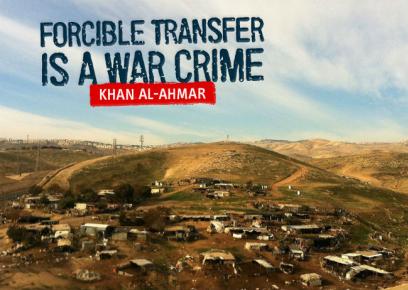
B’Tselem: Israel is asking the High Court’s permission to commit war crime
B'Tselem Executive Director, Hagai El-Ad said, following the State's response submitted earlier today to the High Court of Justice, that the state was asking the court to authorize a war crime: "No sanctimonious language about a ‘planning, proprietary and realistic’ alternate, or ‘time to prepare’ can erase the disgrace or hide the facts: the destruction of Khan al-Ahmar means the forcible transfer of protected persons, and forcible transfer is a war crime. Those responsible for it will bear personal criminal liability – exactly as B’Tselem stated two weeks ago, in a letter addressed to the prime minister, defense minister, justice minister, chief of staff and the head of the Civil Administration."
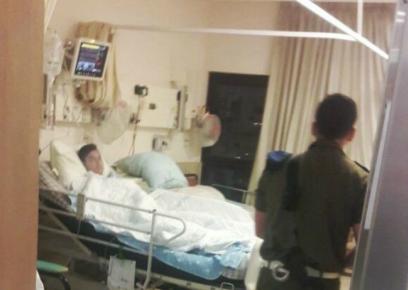
N.R. being guarded by a soldier at hospital. Photo taken by his mother, as she sat outside and was not allowed into the room.
Israeli soldiers shoot and injure Palestinian boy, 13; military prevents parents from sitting by his bed
On 23 July 2017, soldiers shot N.R., 13, after he went through an opening in the Separation Barrier near Jayus. He was hospitalized in Israel for a month and underwent three operations. For the first eight days, soldiers guarding his room prevented his parents from staying with their son and briefly tied him to the bed. His parents were not present when he was interrogated and when his detention was extended. This grave conduct of the security forces is far from unusual, reflecting both declared policy and norms that have developed.
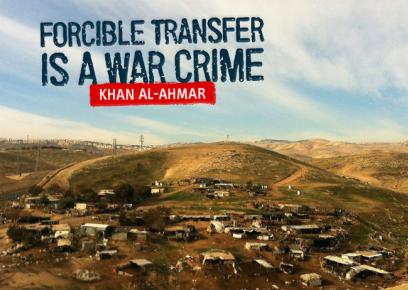
Israel moves to advance forcible transfer of Khan al-Ahmar
Civil Administration signals it is prepared to move forward with the forcible transfer of the entire community, an intention unequivocally stated by Defense Minister Avigdor Lieberman to reporters two weeks ago. Doing so would constitute a war crime under the Fourth Geneva Convention.
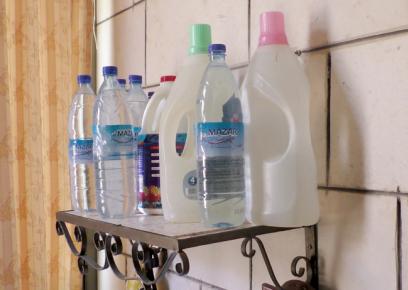
Water stored in bottles in Nablus. Photo: Salma a-Deb'i, B'Tselem, 7 September 2017
180,000 residents of Nablus suffering acute water shortage since June
Residents of Nablus lack sufficient water all year round and especially in summer. The shortage has grown worse in recent years due to low rainfall. Israel prevents the Palestinians from digging new wells and refuses to sell them more water to ease the suffering. As a result of this policy, in summer residents must purchase water privately, at high costs, and use it for essential needs only. Israel abuses its control of all water sources between the Jordan River and the Mediterranean by subjecting Palestinians to a permanent shortage of water.

The road leading to Jabal al-Baba. Photo: 'Amer 'Aruri, B'Tselem, 21 August 2017
Civil Administration damages power and water supply and confiscates trucks in Jabal al-Baba
Yesterday, 10 Sept. 2017, Israeli Civil Administration personnel came with security forces to the community of Jabal al-Baba that lies near ‘Eizariyah, northeast of Jerusalem, and confiscated two trucks with building material donated by an aid organization for fixing the access path to the community. The forces slashed the community’s main water pipe, leaving residents without water, and damaged its power network. This follows the confiscation of the community’s preschool in late August.

Still from video
Israeli military destroys dirt road to Masafer Yatta in South Hebron Hills
On 8 Sept. 2017, at about 3:00 P.M., a military force came with a bulldozer to the dirt road that connects the town of Yatta with the villages of Masafer Yatta, dug it up and blocked it off with rocks. The destruction of the road, which had been renovated just a day earlier with aid funding, forces villagers to now take a long detour. Masafer Yatta, which extends southeast of Yatta in the South Hebron Hills, is home to more than 1,000 people which Israel has been trying to expel for many years, including by declaring the area Firing Zone 918.

The confiscation of vehicles in the fields of Khirbet a-Ras al-Ahmar today. Photo: 'Aref Daraghmeh, B'Tselem, 10 September 2017
Security forces confiscate vehicles and work tools in community of Khirbet a-Ras al-Ahmar
Yesterday, Sunday 10 Sept. 2017, the military confiscated two commercial vehicles and a truck in the agricultural areas to the west of the Khirbet a-Ras al-Ahmar in the northern Jordan Valley from families employed by the landowners in the area as agricultural workers. A few days ago, on 6 September 2017, Civil Administration forces came to the same community and confiscated a tractor and a welding machine and a bus used for transporting agricultural workers to farms in the area. All the confiscations were undertaken on the pretext if presence in a “firing zone,” without issuing confiscation orders.

Still taken from video footage of security forces violently removing Zleikhah al-Muhtaseb from the door. Filmed by Rania al-Muhtaseb, 13 Aug. 2017
Video: Security forces weld door to Hebron home shut on unfounded grounds and use violence
On 13 Aug. 2017, Israeli security forces welded shut a door in the al-Muhtaseb home in central Hebron, using severe violence against a family member who tried to stop them. Their claim that this was needed to prevent “suspects” from passing through is unfounded. Even if it were true, it could not justify such harm. This is another example of Israel’s policy of segregation and restrictions on Palestinian movement in central Hebron, coupled with abuse, violence and daily harassment by security forces and settlers.

B’Tselem to Netanyahu: Demolishing Palestinian communities – a war crime for which you would bear personal liability
Yesterday, 4 September, B’Tselem sent a grave letter to Israel’s prime minister and other top Israeli officials, cautioning that demolition of the Palestinian communities of Susiya and Khan al-Ahmar as planned would constitute a war crime for which they would bear personal liability. B’Tselem made the unusual move after Defense Minister Avigdor Lieberman told the press last week that “work was being done to implement plans to evacuate the Palestinian villages of Sussia in the South Hebron Hills and Khan al-Ahmar near Ma’aleh Adumim within a few months.”
Israel’s regime of apartheid and occupation is inextricably bound up in human rights violations. B’Tselem strives to end this regime, as that is the only way forward to a future in which human rights, democracy, liberty and equality are ensured to all people, both Palestinian and Israeli, living between the Jordan River and the Mediterranean Sea.
Since the Hamas attack on 7 October 2023, Israel has acted in a coordinated and deliberate manner to destroy Palestinian society in the Gaza Strip, committing genocide against its residents. In light of Israel’s actions in Gaza, the public statements made by Israeli decision-makers, and the international community’s failure to take effective action, there is a serious risk that the Israeli regime will expand the genocide to other areas under its control—first and foremost, the West Bank.
B’Tselem calls on the Israeli public and the international community to use every tool available under international law to bring an immediate end to Israel’s genocide against the Palestinian people.