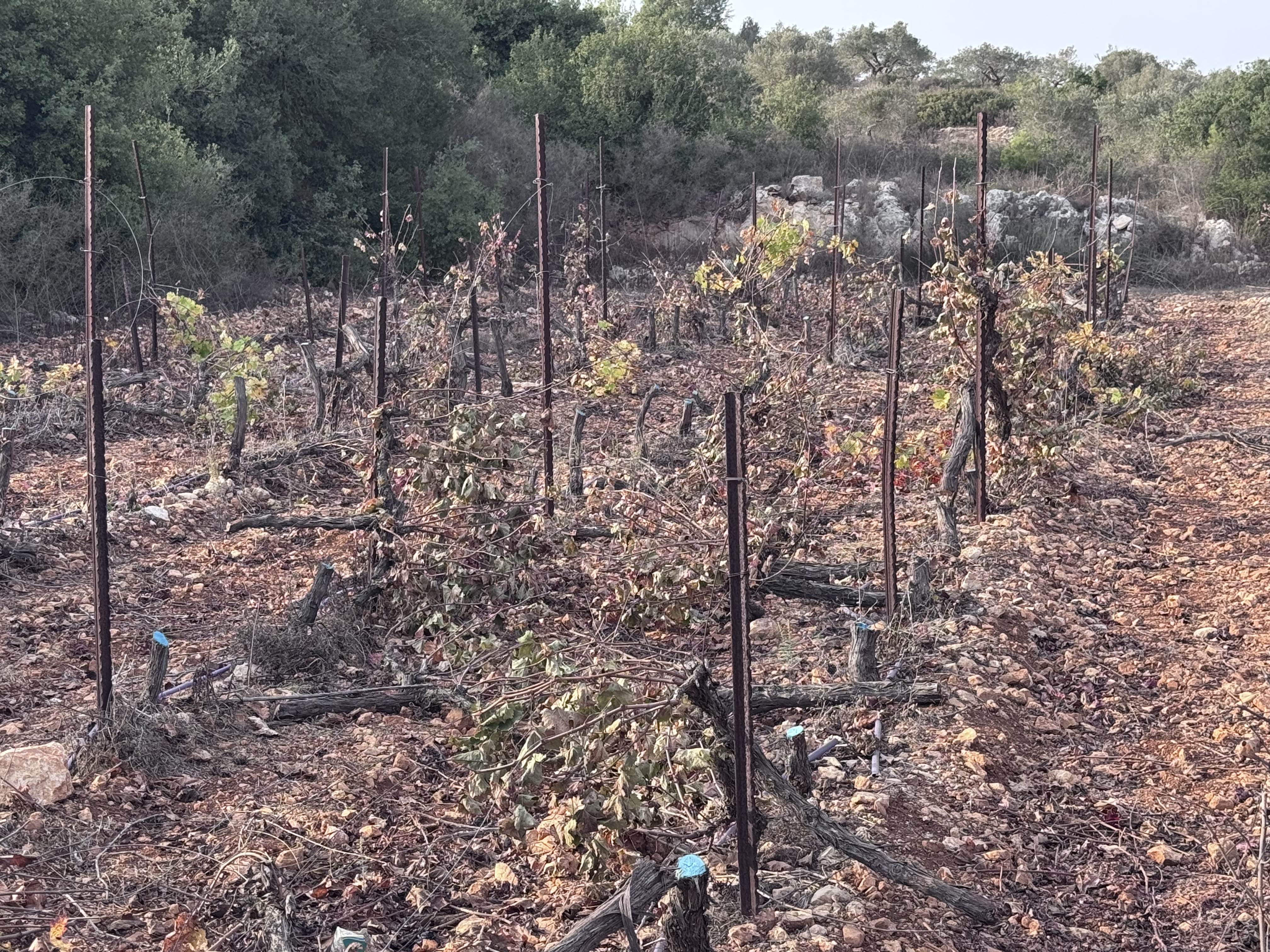
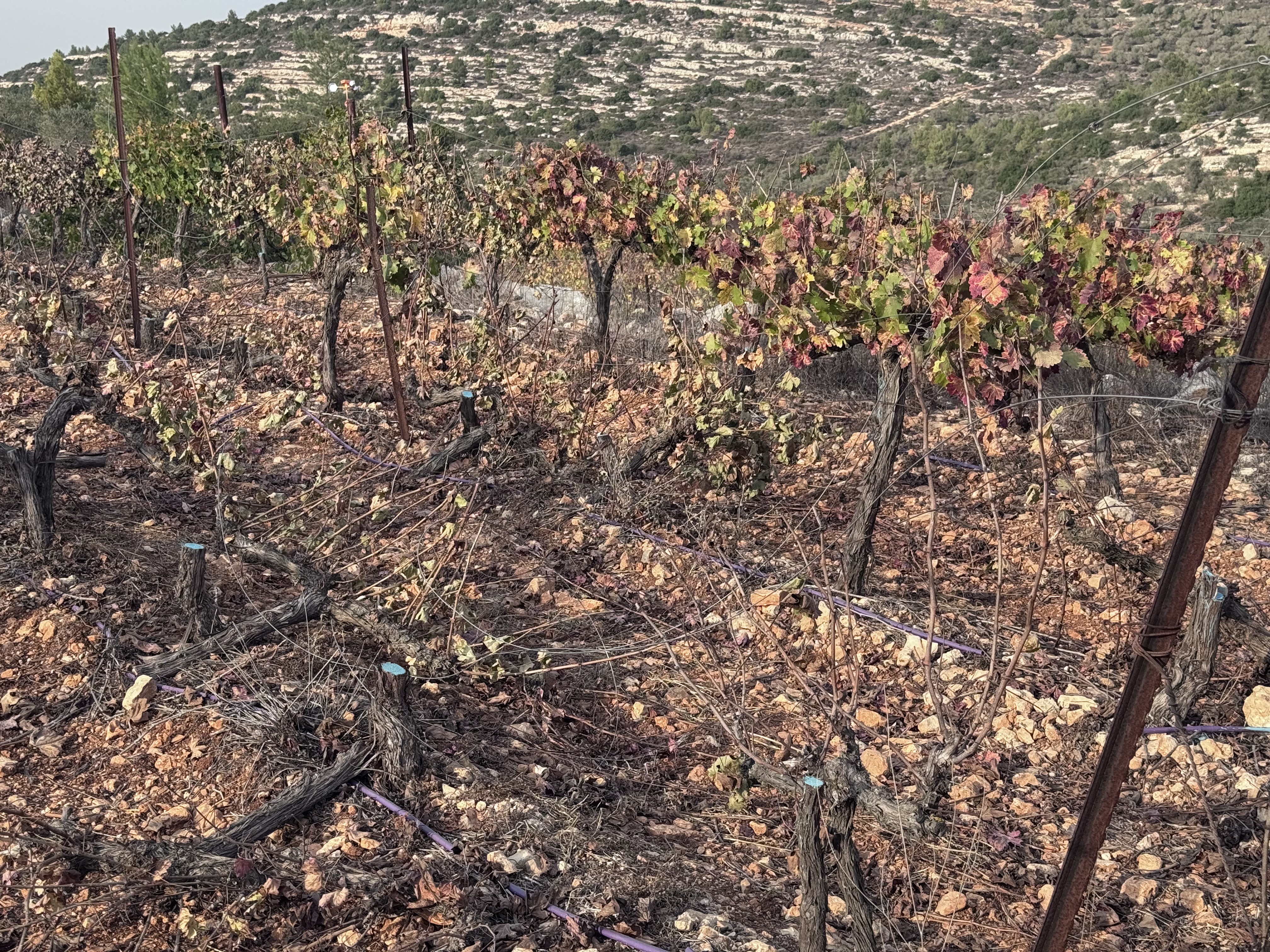
Damaged grapevines in the vineyard owned by the witness and his brothers. Photo courtesy of the family
On Saturday, 1 November 2025, at around 8:00 A.M., members of a family from Bir Zeit discovered settlers had cut down more than 200 grapevines, which were over 23 years old, and damaged the trellis and irrigation system on their land over the course of the night. The land, which covers about 30 dunam (1 dunam = 0.1 hectares) is located between the town of Bir Zeit and the city of Rawabi, about 10 kilometers north of Ramallah, and has a vineyard and an olive grove.
The vineyard, which is a primary source of livelihood for some family members, is enclosed by a metal fence with an iron gate, but the settlers managed to break in and damage the grapevines planted by the family in 1999. The owners applied wax to the trunks of the grapevines that had been cut down, hoping they would grow back, but even if the grapevines do regenerate, it will take at least three years before they bear fruit again.
Settler attacks on local residents have increased since a new outpost was established around August 2025, east of the settlement of Ateret and less than a kilometer west of the vineyard.
R.K., one of the vineyard’s owners, told B’Tselem field researcher Mohammad Romaneh in a testimony he gave on 4 November 2025:
In 1999, we did some development and rehabilitation work on the land and planted grapevines there. The olive trees on our land are old. Later, we started producing wine from the grapes. About eight years ago, we started a winery based entirely on the grapes we grow, which produces between 7,000 and 15,000 bottles of wine a year, depending on the season. Some of the product is exported outside Palestine, and some is sold on the local market. In 2010, construction began on the road leading to the city of Rawabi, which passed through some of our land, and then settlers invaded it and vandalized about 200 olive trees.
Damaged grapevines in the vineyard owned by the witness and his brothers. Photo courtesy of the family
On Saturday, 1 November 2025, at around 8:00 A.M., I got a phone call from one of the workers, who said he had arrived at the vineyard and found the grapevines cut down and damaged. I drove over there and found that nine rows of grapevines had been cut down. Each row had 25 grapevines, and in total, about 225 grapevines were cut down. I noticed that the grapevines had been cut at the base of the trunk, and I estimate that a sharp tool was used. In addition to the trees, the grapevines’ trellis system (metal wires) was also damaged, and so was the drip irrigation system.
It’s clear that the grapevines were damaged the night before, because we go to our land every day and watch over the grapevines, and everything was fine until Friday evening. My concern now is that the attacks will be repeated, especially since this land is a main source of livelihood for some of my brothers. Although the land is surrounded by a metal fence with an iron gate at the entrance, the settlers managed to break in and damage grapevines that are more than 23 years old. I am considering adding more security measures for the vineyard, like installing security cameras.
Israel’s regime of apartheid and occupation is inextricably bound up in human rights violations. B’Tselem strives to end this regime, as that is the only way forward to a future in which human rights, democracy, liberty and equality are ensured to all people, both Palestinian and Israeli, living between the Jordan River and the Mediterranean Sea.
Since the Hamas attack on 7 October 2023, Israel has acted in a coordinated and deliberate manner to destroy Palestinian society in the Gaza Strip, committing genocide against its residents. In light of Israel’s actions in Gaza, the public statements made by Israeli decision-makers, and the international community’s failure to take effective action, there is a serious risk that the Israeli regime will expand the genocide to other areas under its control—first and foremost, the West Bank.
B’Tselem calls on the Israeli public and the international community to use every tool available under international law to bring an immediate end to Israel’s genocide against the Palestinian people.