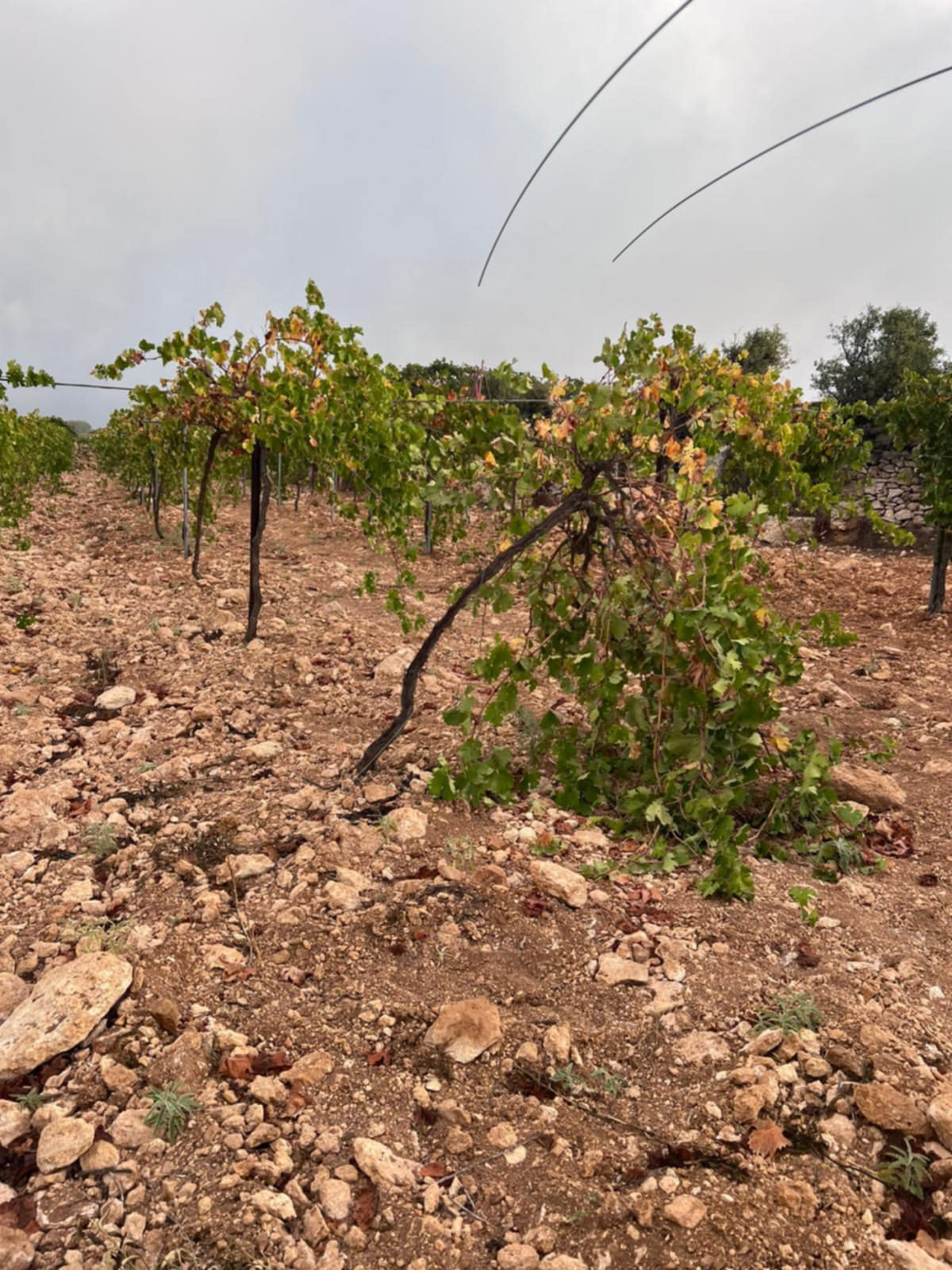
On Sunday, 28 September 2025, at around 4:00 P.M., Muhammad Sh’aban, 46, a resident of Halhul, arrived with his family at their vineyard in the Ras al-Qadi area. As they approached the vineyard, the family spotted four settlers near a water cistern on their plot and saw that the trellis holding up the grapevines near the cistern had been cut. The family backed away, and Muhammad reported the settlers’ presence on his land and the damage to the police. The family then tried to enter their land from another direction to avoid contact with the settlers.
A settler who was grazing sheep in an adjacent plot apparently informed the settlers that the family was approaching from another direction, and they came toward them, some armed with handguns and one with a rifle. The settlers shouted at them, pushed them and ordered them to leave. Later, at least seven more settlers arrived, armed with clubs, surrounded the family members, assaulted them with stones and beat Sh’aban’s sister, Ayat, 45, on her arm and hip with a club.
The family members fled to their car, and then the settlers beat Sh’aban’s brother, ‘Abd a-Latif, 36, who had not yet managed to get into the car, and broke the car window. Sh’aban, who tried to get out to help his brother, was also beaten and injured in his arm and head, and his son Adam, 20, was injured in his hand by glass shards. The family ultimately managed to drive away.
After they had driven about half a kilometer away, they came across a military jeep. The officer went back to the site with Sh’aban, spoke with the settlers, and other soldiers took photos of the family members’ ID cards. Police officers who arrived later spoke with Sh’aban and directed him to file a complaint at the police station.
Muhammad Sh’aban, 46, a father of five from Halhul, gave his testimony to B’Tselem’s field researcher Manal al-Ja’bari on 6 October 2025
I live with my wife, Safaa, 46, and our five children, the oldest is 22, and the youngest is four.
I have a 25-dunam (1 dunam = 0.1 hectares) plot of land with vineyards in the Ras al-Qadi area. About one kilometer south of the plot, an outpost was established on Mount al-Jumjuma (“Ma’ale Halhul”), and about one kilometer north of the plot another outpost was established in the Dhaher al-Bu area (“Gefen Ami Farm”). Ever since the start of the grape harvest season this year, we have been suffering from settler attacks and harassment every time we try to work our land, and this has limited both our ability to pick vine leaves for sale before the harvest and the harvest itself. The settlers also harvest grapes themselves and steal them or feed them to their sheep.
On Sunday, 28 September 2025, at around 4:00 P.M., I arrived at the land to harvest grapes with my two brothers, Hijazi, 43, and ‘Abd a-Latif, 36, my sister Ayat, 45, and my son Adam, 20. When we approached the plot, we saw four settlers sitting on the edge of the water cistern, so we decided to circle around and reach the vineyards from another direction. We also saw that in the area where they were sitting, they’d cut the metal trellis supporting the grapevines. I called the Israeli police and informed them that settlers were on my land, and at their request, I sent them the location on WhatsApp.
When we reached the plot, a settler who was grazing a flock of sheep in the area noticed us, and we saw him talking on the phone and then joining the four settlers by the water cistern. Some of the settlers were armed with handguns, and one of them was carrying an M-16 rifle. The five of them came toward us shouting, pushed us and ordered us to get off the land. We told them that this land was ours and that we would not leave it.
Meanwhile, at least seven more settlers arrived, armed with sticks and wooden clubs. Some of them came in a white car from the direction of one of the outposts. The settlers surrounded us and threw stones at us from all directions. One of them went up to my sister Ayat and hit her with a club on her arm and hip.
We realized we had to escape. My brother, ‘Abd a-Latif, distracted the settlers so we could get into the car. When ‘Abd a-Latif tried to get into the car too, settlers attacked him and hit him with a stick on his arm, and more settlers joined in and beat him as well. Others attacked us with sticks and smashed one of the car windows. I wanted to push the settlers away from ‘Abd a-Latif, but as soon as I opened the car door, a settler hit my left arm with a stick and then struck me on the head.
It took many minutes before we all managed to get into the car and escape from the settlers. ‘Abd a-Latif was bleeding from his left elbow, and Adam was cut by glass when the settlers smashed the car window and was bleeding from his left arm. We drove for about half a kilometer and then came across an army jeep that was on its way to the site. It stopped next to us, and an officer inside asked us what had happened. I told him that settlers had attacked us, and he ordered me to get everyone out of the car and then drive in front of the jeep to lead it to the site. When we reached the land, the settlers were still there, and about 50 meters before we got to them, the officer ordered me to stop, then continued driving toward the settlers and stopped to talk to them.
Meanwhile, another Israeli army jeep arrived, and four soldiers got out of it. One of them took photos of our ID cards. An Israeli police patrol car also showed up, and an officer took my statement and then told me to file a complaint at the police station.
I left with my family, all of us in pain and injured. I had severe pain in my right hand and swelling in my head, and the doctors referred me for X-rays and a CT scan. My sister Ayat was diagnosed with bruises and contusions in her right arm and right hip. ‘Abd a-Latif was diagnosed with wounds, bruises and contusions in various parts of his body. My son Adam was treated for his hand, which had been cut by the glass. After we received the necessary treatment, we were discharged.
The next morning, I went to the police station in the Ma’ale Adumim settlement to file a complaint, but they did not admit me. The following morning, I went to the police station again, and again they did not admit me. I returned the same day at around 2:30 P.M., and after waiting for at least an hour, an officer let me in, and then I filed the complaint.